
All Purpose Cleaner vs Disinfectant Guide
The most popular cleaning advice is often the least discerning: spray every surface with something labeled “disinfectant” and assume the home is safer. That approach confuses removing soil with destroying microorganisms, encourages unnecessary chemical use, and can make a low-waste routine more complicated than it needs to be.
The practical answer to all purpose cleaner vs disinfectant isn't that one product is universally better. They solve different problems. An all-purpose cleaner lifts away food residue, grease, dust, and organic matter. A disinfectant is a specialized product for reducing pathogens under exact label conditions. A well-run household uses both selectively, rather than treating every countertop like a hospital surface.
Table of Contents
- Rethinking How We Clean Our Homes
- The Science and Regulations Behind the Labels
- Comparing Cleaners and Disinfectants Side by Side
- When to Use Each Product in Your Home
- Environmental Impact and Choosing Aligned Brands
- Building a Sustainable and Effective Cleaning Routine
Rethinking How We Clean Our Homes
Cleaning and disinfecting can appear together in the same chore, but they aren't interchangeable. Cleaning relies on soap, detergent, water, and physical scrubbing to remove dirt, grease, organic matter, and many germs. It removes microorganisms from a surface without necessarily killing them. Disinfection uses a chemical agent to destroy or irreversibly inactivate bacteria, fungi, and viruses on inanimate surfaces, although it may not eliminate bacterial spores. The U.S. Environmental Protection Agency's explanation of cleaning, sanitizing, and disinfecting sets out this distinction clearly.
That difference changes how I think about the spray bottles under the sink. A surface covered in dried sauce, skin oils, or dust needs the physical action of a cleaner first. Applying disinfectant over that film doesn't magically turn grime into hygiene. The CDC advises cleaning before disinfecting because soil and organic material can interfere with a disinfectant's activity.
Sterile isn't the everyday goal
Most homes need to be clean, usable, and appropriately hygienic, not sterile. Sterilization is a different and more demanding process, and disinfection itself may not destroy bacterial spores. Treating routine dust, fingerprints, or food crumbs as a pathogen emergency leads to overuse of products that carry stronger chemical claims than the task requires.
That doesn't mean germs never matter. If someone in the home is sick, a surface has been contaminated with bodily fluids, or a household member faces a higher risk of illness, pathogen reduction may deserve a dedicated step. The point is to match the response to the situation.
Practical rule: Remove visible soil first. Add disinfection only when the circumstances justify it and the product label supports the intended use.
An all-purpose cleaner is usually the sensible first choice for kitchen counters, bathroom fixtures, tables, and other nonporous surfaces with ordinary household dirt. It helps reduce what is on the surface through removal, without asking you to maintain a long wet dwell period or apply an antimicrobial pesticide for every daily wipe.
This approach also supports lower-waste living. Using one effective cleaner for routine jobs means fewer specialized bottles, fewer unnecessary applications, and less product sent down the drain. The environmentally responsible choice isn't always the product with the most reassuring front-label language. Often, it's the product you use correctly, in the smallest appropriate role, and refill rather than replace.
The Science and Regulations Behind the Labels
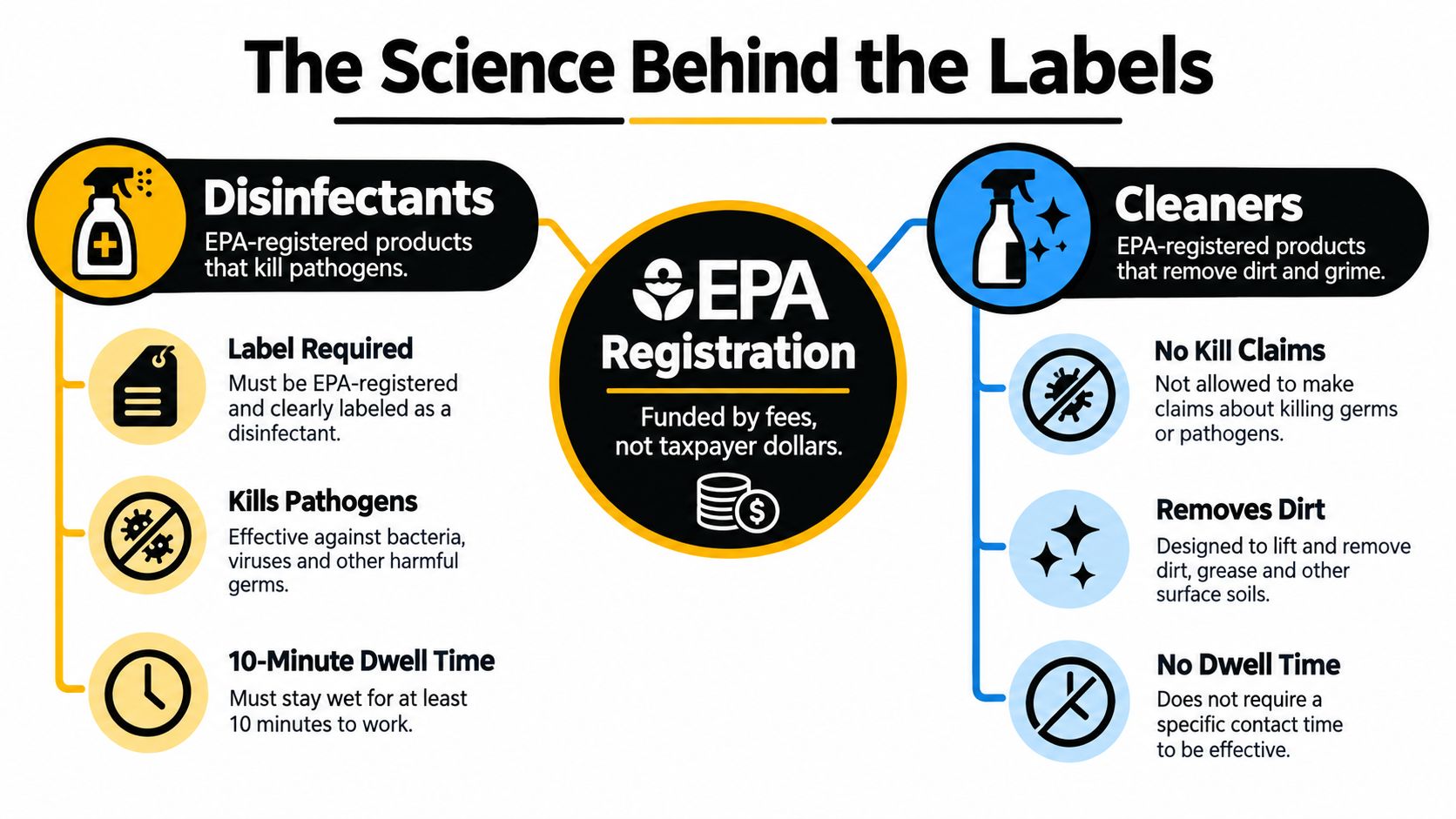
Front-label language can make cleaning products look similar, but the regulatory difference is substantial. Under EPA rules, products making antimicrobial claims are treated as regulated pesticides. A product marketed to disinfect must be EPA-registered and tested against the organisms and use conditions stated on its label. A cleaner that removes grime cannot be assumed to disinfect just because it smells fresh, contains an ingredient associated with antimicrobial activity, or leaves a surface looking bright.
The distinction also appears in performance thresholds. EPA guidance describes sanitizing as reducing microorganisms on hard surfaces to a safer level, commonly requiring at least a 99.9% reduction. For certain food-contact applications, the benchmark is 99.999% within 30 seconds under specified test conditions, as explained in CDC guidance on cleaning and disinfecting the home. These are laboratory criteria under defined conditions, not promises that a household surface becomes sterile.
Disinfection has a broader claim. The product must inactivate the organisms listed on its EPA label when used at the prescribed concentration and contact time. That wording matters because a disinfectant isn't automatically effective against every bacterium, fungus, or virus.
Wet contact time is the overlooked requirement
The most useful number on a disinfectant label is often its wet contact time, also called dwell time. EPA defines contact time as the period the surface must remain visibly wet for the product to work. If the surface dries before that period ends, the user must reapply the product. A label claiming efficacy in 10 minutes requires visible wetness for the full 10 minutes. A 1-minute claim permits a faster workflow, provided all other directions are followed.
The CDC's facility cleaning and disinfection guidance notes that many EPA-registered hospital disinfectants list 10-minute contact times, while studies have shown efficacy for some hospital disinfectants at contact times of at least 1 minute. Those findings can't be generalized across products or pathogens. Pathogen, surface type, concentration, temperature, organic soil, and application coverage all affect performance.
That has a practical consequence. If you spray a product and wipe it away immediately, you may have cleaned the surface, but you haven't necessarily achieved the disinfectant claim. Read the label before buying, particularly if you want a product that fits a quick household routine.
For households concerned about indoor air as well as surface hygiene, Covenant Aire Solutions' indoor air guide offers useful context on reducing volatile organic compounds. Product selection should account for ventilation, fragrance, and the total chemical load in a home, not just the promise printed on a bottle.
A further way to assess trust is to understand what third-party testing means. Independent verification doesn't make every product identical, but it gives shoppers more information than an unqualified marketing phrase.
Comparing Cleaners and Disinfectants Side by Side
The fastest way to choose correctly is to compare the job, not the emotional appeal of the label. An all-purpose cleaner is built around soil removal. A disinfectant is built around validated pathogen inactivation. Neither category replaces the other, and both work poorly when users ignore preparation or directions.
| Feature | All Purpose Cleaner | Disinfectant |
|---|---|---|
| Primary purpose | Removes dirt, grease, food residue, organic matter, and many germs through chemical and physical cleaning | Destroys or irreversibly inactivates listed bacteria, fungi, and viruses on inanimate surfaces |
| Main benchmark | Soil removal, surface appearance, and residue control | Organism-specific efficacy under labeled conditions |
| Regulatory status | A product making no antimicrobial claim generally isn't marketed as an EPA-registered disinfectant | Antimicrobial claims require EPA registration and testing for stated organisms and use conditions |
| Preparation | Use according to the product directions, then wipe or scrub away soil | Clean first when the surface is dirty, then apply enough product to keep it visibly wet for the labeled contact time |
| Best everyday use | Counters, tables, bathroom fixtures, dust, grease, and ordinary spills | Situations where pathogen reduction is specifically needed |
| Environmental trade-off | Can reduce unnecessary chemical applications when used for routine soil | A specialized chemical step that should be reserved for appropriate circumstances |
| Common mistake | Assuming a clean-looking surface has been disinfected | Wiping too soon, using it on heavy soil, or assuming it works against every pathogen |
The table also exposes a common category error. A disinfectant may be a poor cleaner when a surface has heavy grease or food residue. An all-purpose cleaner may leave a surface visibly clean while making no validated kill claim. Appearance alone doesn't settle the question.
Surface compatibility matters
Product strength isn't the only consideration. Delicate finishes, natural stone, painted surfaces, coated metals, and dyed textiles can react badly to the wrong chemistry or excessive moisture. Always check the manufacturer's directions and test an inconspicuous area, especially before using a peroxide-based product or strong disinfectant on a colored material. For a focused example of why chemical choice matters around textiles, consult this guide to protecting delicate rug dyes.
A cleaner's success is visible soil removal without damaging the material or leaving an unwanted film. A disinfectant's success depends on the exact label claim, complete coverage, pre-cleaning requirements, and wet contact time. Those are different measures, so comparing products only by “how powerful” they sound isn't useful.
For readers who want more detail on antimicrobial claims and responsible product selection, Fillaree's resource on antimicrobial cleaning products provides additional context. The responsible choice is the one that fits the surface, the contamination risk, and the instructions.
When to Use Each Product in Your Home
A useful household routine starts with one question: What problem am I solving? If the answer is visible dirt, grease, dust, or food residue, reach for an all-purpose cleaner. If the answer is a specific need to reduce pathogens, check whether disinfection is warranted and whether the product is labeled for that organism and surface.
The CDC says to clean visibly dirty surfaces with soap and water before sanitizing or disinfecting because dirt and other impurities can make germ-killing chemicals less effective. Routine disinfection is usually unnecessary unless someone is sick, has recently visited, or is at higher risk of illness, as described in CDC guidance on cleaning and disinfecting.
Kitchen decisions
After chopping vegetables, wiping a counter with an all-purpose cleaner is generally the right starting point. The cleaner lifts away food residue and grease, while a clean cloth supplies the physical action that removes soil. If raw meat or bodily fluids have contaminated a nonporous surface, follow the product label for any additional sanitizing or disinfecting step rather than assuming an ordinary wipe has achieved pathogen reduction.
Cutting boards deserve care because their grooves can hold organic matter. Scrub away visible residue, rinse as appropriate for the material, and use only a product approved for that surface and situation. Don't let a strong scent substitute for reading the label.
Bathroom and living areas
Bathroom sinks, tubs, toilet exteriors, tables, and shelves usually need cleaning for soap film, dust, fingerprints, and ordinary grime. An all-purpose cleaner can handle those tasks when the product is suitable for the material. A disinfectant may make sense after illness or contamination, especially on frequently touched nonporous surfaces, but it still needs pre-cleaning and the full labeled wet contact time.
Door handles, light switches, remote controls, and phones are often touched frequently, yet frequency alone doesn't mean they need constant disinfection. Clean them according to their material and manufacturer directions. During an illness in the household, increase attention to high-touch surfaces and use an appropriate disinfectant when the label supports that application.
A simple decision sequence
- Look at the surface. If you see grease, dust, food, or organic matter, clean it first.
- Consider the circumstance. Everyday use usually calls for cleaning. Illness, bodily fluids, recent exposure, or a higher-risk household member may justify disinfection.
- Check the label. Confirm the surface, organism claim, application method, and contact time.
- Keep the surface wet. If the disinfectant dries before the required time, reapply according to the label.
- Store products safely. Keep chemicals away from children and pets, and never combine products unless the label explicitly directs it.
A low-impact routine isn't careless. It is selective, label-literate, and built around the actual contamination risk.
Environmental Impact and Choosing Aligned Brands
Eco-conscious cleaning involves more than choosing a bottle labeled “natural.” Ingredients go down drains, fragrances enter indoor air, packaging becomes waste, and repeated applications multiply the impact of a routine. A product can sound gentle while offering no clear evidence about ingredient hazards, performance, packaging, or disposal.
The EPA's Safer Choice program evaluates ingredients for human-health and environmental hazards, along with product performance, pH, packaging, and volatile organic compounds. Qualifying products must perform comparably to conventional products. The standard also restricts ingredients with aquatic-toxicity values below 10 mg/L in direct-release products and requires recognized partners to improve packaging sustainability, according to the EPA Safer Choice standard.
Look past green language
“Green,” “clean,” and “natural” can be useful signals of a company's positioning, but they aren't sufficient purchasing criteria. I look for specific information:
- Ingredient transparency: Can the company explain what the formula contains and why?
- Performance evidence: Does the product remove soil effectively, or does it make antimicrobial claims supported by a recognized standard?
- Packaging details: Is the container reusable, recyclable in the shopper's local system, or part of a documented refill program?
- Operational proof: Does the company explain how refills, returns, cleaning, and reuse work in practice?
- Company values: Does the business support workers, communities, and responsible manufacturing in ways it can describe concretely?
Good products matter, but supporting good companies matters too. A company that invests in effective formulas, honest labeling, refill infrastructure, and community relationships gives shoppers a more meaningful way to align purchases with values.
Refill claims need infrastructure
A reusable-looking bottle isn't automatically low-waste. FTC guidance says an unqualified “refillable” claim can be deceptive unless the marketer supplies a way to refill the package, either through a collection-and-refill system or by selling a product consumers can use to refill the original container. The FTC Green Guides make the practical standard clear: look for an actual mechanism, not just a visual suggestion of reuse.
That mechanism might be an accessible refill station, a concentrated refill product, a subscription, or a documented take-back process. A low-waste household works best when the refill option is convenient enough to become ordinary behavior.
The video below offers another perspective on choosing cleaning products and building lower-waste habits.
Fillaree is one example of a company built around refillable home and body essentials. Its Clean Dream Spray is an all-purpose cleaner for removing dirt and grime from nonporous surfaces such as countertops, porcelain, and bathroom fixtures, and the company offers refill options through home refills, in-person stations, and bulk formats. It's an all-purpose cleaner, not a disinfectant, which makes the distinction especially useful when building a routine. Readers who want to evaluate sustainability claims more carefully can also review Fillaree's guide on how to avoid greenwashing.
Building a Sustainable and Effective Cleaning Routine
A sustainable cleaning routine doesn't mean removing every specialized product from the home. It means assigning each tool a clear job, using it according to its directions, and creating habits that reduce unnecessary consumption. The result is often simpler: one dependable all-purpose cleaner for daily soil, reusable cloths, and a correctly labeled disinfectant for situations that genuinely call for pathogen reduction.
Start with a small station rather than a crowded cabinet. Keep the routine cleaner, cloths, brushes, gloves if needed, and any specialized disinfectant together, but separate products that shouldn't be mixed. Refill the bottle you already use instead of accumulating partially used alternatives.
Five habits that hold up in real homes
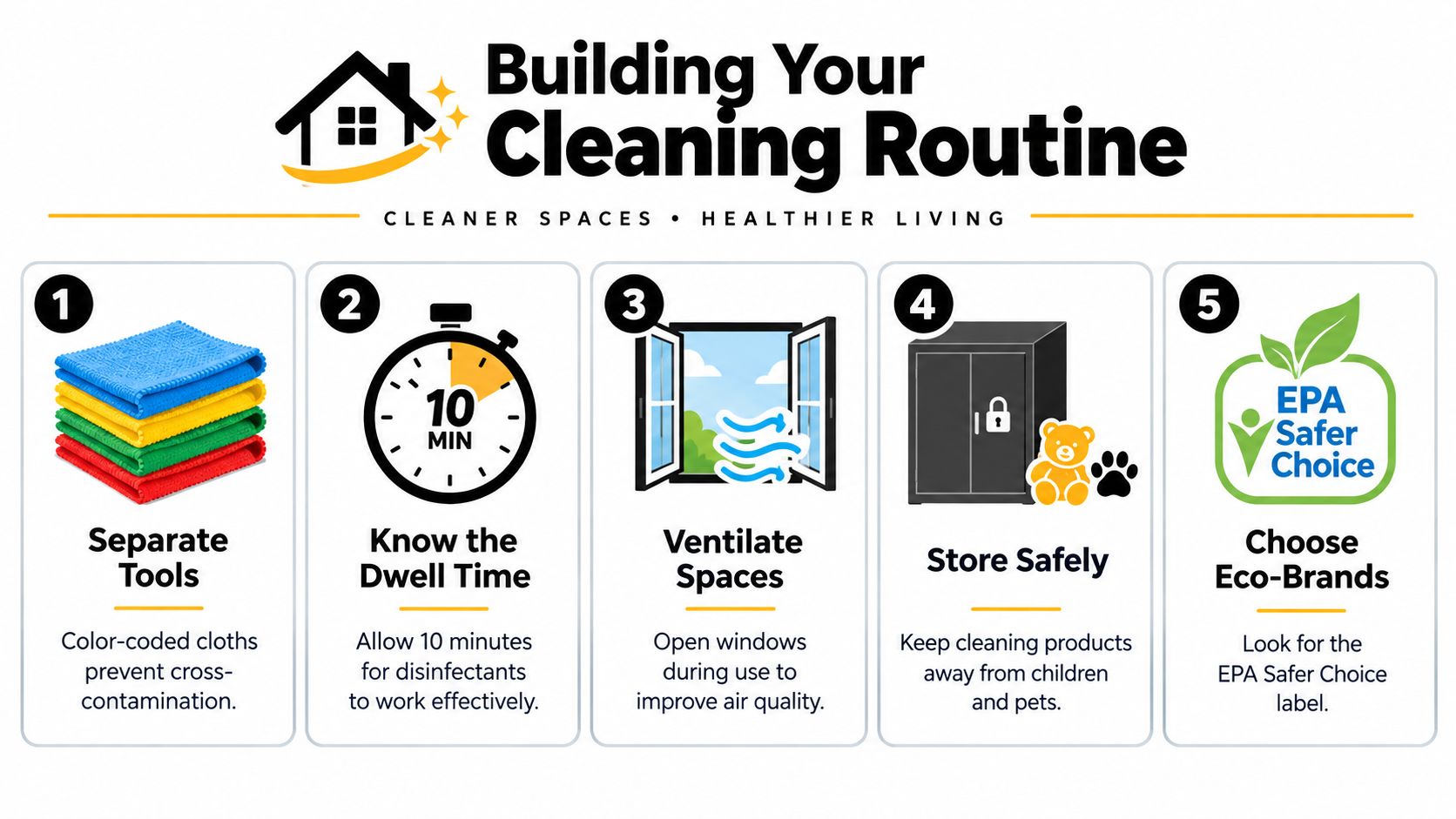
1. Separate tools. Use color-coded cloths for kitchens, bathrooms, and general living spaces. Wash reusable cloths properly and let brushes dry fully between uses. This reduces cross-contamination without requiring a different chemical for every room.
2. Know the dwell time. Read the disinfectant label before you need it. If it specifies 10 minutes, the surface must remain visibly wet for those 10 minutes. A product that dries after 5 minutes hasn't met the stated condition, so reapplication is required according to EPA guidance on selected EPA-registered disinfectants.
3. Ventilate spaces. Open windows or use appropriate ventilation during product use, especially when applying a disinfectant. Avoid turning a small cleaning task into an indoor-air problem.
4. Store safely. Keep every chemical away from children and pets, preserve original labels, and don't transfer products into unlabeled food or drink containers. Never mix cleaning products unless the label specifically instructs you to do so.
5. Choose eco-brands carefully. Look for meaningful standards, ingredient information, durable packaging, and a refill or take-back system that you can actually use. A company's actions should support its environmental language.
Make the routine easy to repeat
Use the all-purpose cleaner for predictable jobs: kitchen residue, bathroom grime, dusty furniture, and everyday spills. Keep the disinfectant for defined circumstances, and write the relevant contact time on a small note near the storage area if the label is easy to overlook. That simple prompt prevents the most common failure, wiping away too soon.
Reusable tools also need maintenance. Rinse cloths promptly, wash them in a way that suits their material, and don't return damp items to a closed container. A refill system only reduces waste if the household uses the refilled product effectively and keeps its tools in working condition.
The deeper lesson is that effective cleaning and low-waste living reinforce each other. Removing soil with the least intensive suitable method saves product and effort. Reserving disinfection for situations where it has a clear purpose respects both the science and the environment. Supporting companies that provide real refills, transparent standards, and useful products turns everyday purchasing into a practical vote for better systems.
Fillaree offers refillable home essentials, including Clean Dream Spray for everyday dirt and grime on nonporous surfaces, with home refill options and in-person refill access. Visit Fillaree to choose a refill approach that fits your household and build a cleaning routine that supports effective care with less single-use packaging.