
Best Body Wash Without Chemicals: A Practical Guide
The most popular advice about finding the best body wash without chemicals is wrong. “Chemical-free” sounds reassuring, but water, plant oils, botanical extracts, and cleansing agents are all chemicals. The useful question isn't whether a formula contains chemicals. It's whether the formula uses skin-compatible cleansing chemistry, a low allergen load, transparent labeling, and packaging that doesn't create unnecessary waste.
For sensitive skin, fragrance and cocamidopropyl betaine, or CAPB, deserve more attention than dramatic “toxic ingredient” lists. For everyday comfort, pH and surfactant selection matter more than whether the front label says natural. For sustainability, a refill system matters more than a recyclable pump bottle that still gets discarded after one use.
| What matters most | What to look for | What to avoid |
|---|---|---|
| Sensitive skin | Fragrance-free, low-pH syndet, simple INCI | Fragrance blends, aggressive surfactants, unnecessary essential oils |
| Dry or compromised skin | Mild surfactants, barrier-supportive formula, low foam | Traditional high-pH soap used daily |
| Ingredient transparency | Full ingredient disclosure and credible certification | “Clean,” “natural,” or “chemical-free” without meaningful detail |
| Lower waste | Refillable bottles, concentrated refills, take-back programs, bars | Refill pouches with no recovery route |
| Family use | Fragrance-free, gentle cleanser with a straightforward formula | Strong scent and complex botanical blends |
Table of Contents
- What “Without Chemicals” Actually Means
- Certifications and Label Claims Worth Trusting
- Comparing Soap, Syndet, and Oil Cleansers
- How to Read an Ingredient Label
- Preservatives That Keep Body Wash Safe
- Best Body Wash Picks by Use Case
- Refill Systems and Low-Waste Buying
- Matching the Right Wash to Your Priorities
What “Without Chemicals” Actually Means
Everything is made of chemicals, including water, coconut oil, aloe, and plant extracts. A plant-derived ingredient can still irritate skin, and a laboratory-made ingredient can be safe and useful. The “chemical-free” label doesn't tell you enough to make a good buying decision.
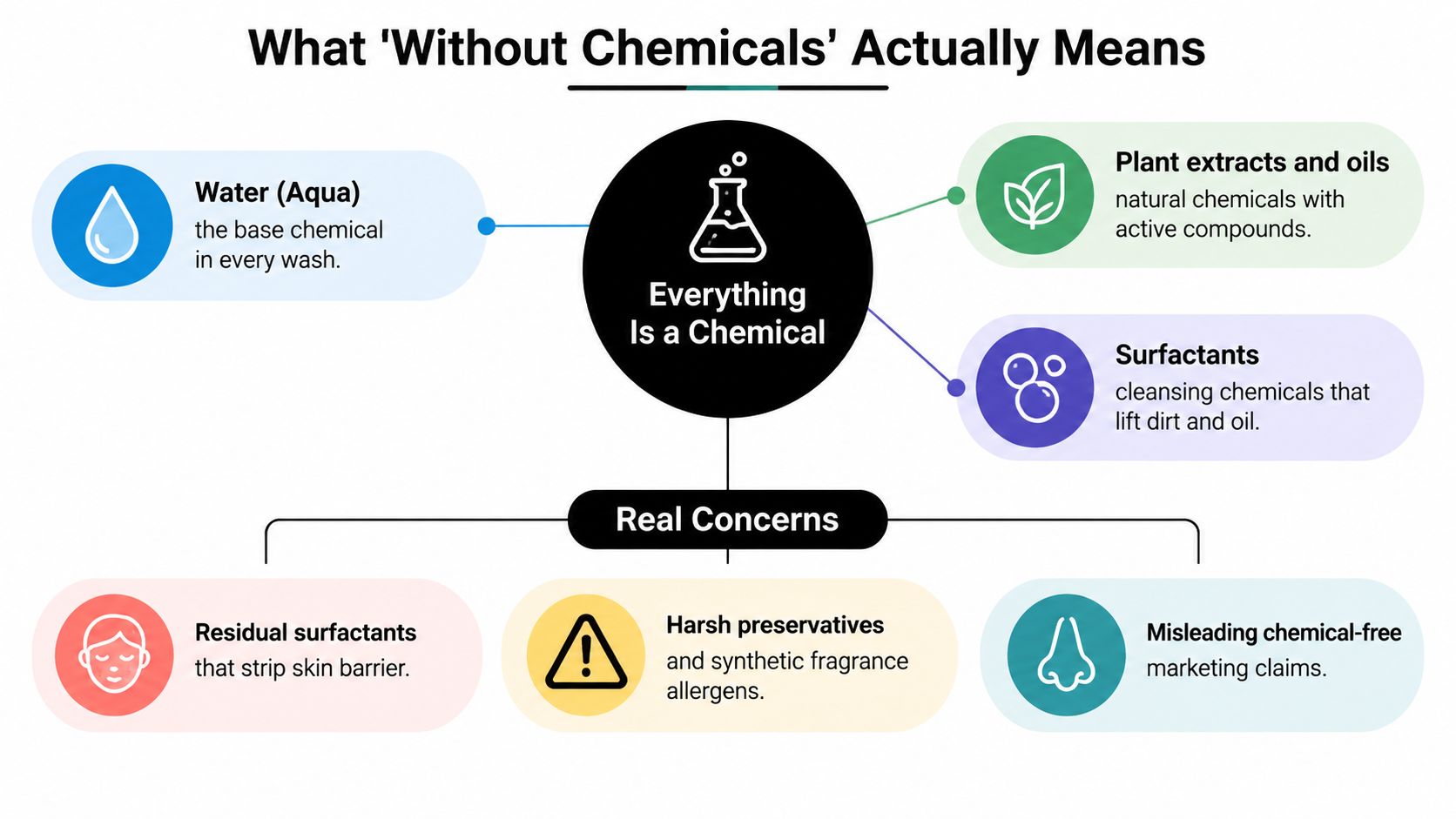
The concerns are more specific. A body wash can leave behind surfactant residue that contributes to tightness, contain fragrance allergens that trigger dermatitis, rely on harsh preservatives, or use a cleansing system that doesn't suit your skin. “Without chemicals” should mean lower irritation potential, fewer unnecessary sensitizers, clear disclosure, and a formula designed around the skin barrier.
Think in terms of allergen load
A low-allergen formula doesn't need to be made entirely from recognizable kitchen ingredients. It needs to limit avoidable triggers and tell you exactly what's inside. “Fragrance” or “parfum” can represent a complex mixture, while essential oils can contribute their own declared fragrance allergens, including compounds such as linalool and limonene.
A cross-sectional study of body washes reported fragrance as the most common allergen in the ACDS core series at 96.7%, followed by CAPB at 60.0%. Those figures come from the study discussed in this analysis of body wash safety and ingredient toxicity. The practical lesson is simple: if your skin reacts easily, start with fragrance-free and examine the surfactant system before worrying about whether an ingredient sounds synthetic.
pH is part of the formula, not a marketing flourish
Traditional soap is alkaline, while syndet cleansers can be mildly acidic to neutral. Comparative cleansing research places typical soap around pH 8.5 to 11.0 and syndet cleansers around pH 5.5 to 7.0, ranges discussed in this comparative review of cleanser pH and skin compatibility.
Practical rule: Choose a fragrance-free, low-pH syndet before chasing a “natural” badge.
A transparent formula with a sensible pH is more useful than a vague promise to remove “chemicals.” If you want to understand how brands distinguish meaningful safety and environmental claims from greenwashing, use this guide to avoid greenwashing in personal care.
Certifications and Label Claims Worth Trusting
Certifications can narrow the field, but they aren't magic shields against irritation. Treat them as screening tools, then read the actual INCI list for fragrance, CAPB, essential oils, and preservatives.
“Clean,” “natural,” “plant-based,” and “free-from” are broad marketing phrases. They can describe a thoughtful formula, but the words themselves don't prove that a brand submitted its product to independent review. A credible seal should identify a defined standard, restricted ingredients, and an auditing or verification process.
Which seals help
EWG Verified is useful as an ingredient and disclosure filter because the product must meet the program's restricted-substance and transparency requirements. It still doesn't mean every sensitive user will tolerate every ingredient.
USDA Organic applies to agricultural ingredients and organic production standards. It can support a responsible sourcing story, but it doesn't automatically establish that the finished body wash is fragrance-free or suitable for reactive skin.
MADE SAFE evaluates ingredients against a prohibited-substance framework and screens for concerns that extend beyond basic product performance. Use it as a broad hazard filter, not a personal allergy guarantee.
COSMOS Organic/Natural and NSF/ANSI 305 provide structured standards for organic or natural personal-care formulations. The value comes from the defined criteria and verification, not from the word “natural” printed alone.
EU Ecolabel focuses more heavily on environmental performance, biodegradability, packaging, and restricted substances. It can be especially helpful when waste and aquatic impact matter alongside skin feel.
| Certification | Fragrance rules | Preservative rules | Audit style |
|---|---|---|---|
| EWG Verified | Restricted ingredient and disclosure framework, not necessarily fragrance-free | Restricted substances and ingredient transparency | Program verification |
| USDA Organic | Organic sourcing rules, not a blanket fragrance ban | Organic production requirements plus applicable safety rules | Accredited organic certification |
| MADE SAFE | Screens ingredients against prohibited substances, not a universal fragrance ban | Restricted substance review | Third-party ingredient assessment |
| COSMOS Organic/Natural | Defined natural and organic standards, fragrance still requires label review | Approved ingredient and processing requirements | Certification and documentation |
| NSF/ANSI 305 | Natural personal-care standard, read the finished INCI | Standard-specific ingredient requirements | Conformity assessment |
| EU Ecolabel | Environmental restrictions, not automatically fragrance-free | Restricted substances and environmental criteria | Independent conformity review |
The strongest buying process is two-stage: select a credible certification, then reject the product if its ingredient list conflicts with your skin needs. This explanation of what third-party testing means is a useful companion when a brand makes testing claims without explaining the standard.
Comparing Soap, Syndet, and Oil Cleansers
The cleanser format determines much of the experience you get in the shower. True soap, syndet, and oil cleansers aren't interchangeable, even when each one is marketed as gentle or natural.
True soap is made through saponification, where fats or oils react with an alkali. It can clean effectively and feel pleasantly simple, but its naturally alkaline chemistry can disturb the skin surface, especially with frequent use or on dry, eczema-prone skin. Syndets use synthetic detergents, which sounds less appealing to shoppers who fear “chemicals,” but the category includes some of the most skin-compatible cleansing systems available.
The evidence is practical. Research on washing practices found that soap and water increased skin pH, while water alone caused no significant change. The measured rise went from 4.9±0.2 to 6.0±0.15 after towel drying and from 4.7±0.4 to 6.4±0.3 after evaporation drying, as reported in this controlled study of soap, water, and skin pH.
The three formats at a glance
| Formulation | Typical pH | Key surfactant | Best for |
|---|---|---|---|
| True soap | 8.5 to 11.0 | Saponified fatty-acid salts | Normal skin that tolerates alkaline cleansing, simple bar routines |
| Syndet bar or liquid | 5.5 to 7.0 | Mild synthetic detergents, such as sodium cocoyl isethionate | Sensitive, dry, or frequently washed skin |
| Oil cleanser | Varies by formula | Oils plus low-foam surfactants or emulsifiers | Dry, compromised, or post-shave skin needing slip |
A good syndet bar may contain sodium cocoyl isethionate and produce a soft, controlled lather without the high-pH soap chemistry. In my view, it's the better default for most adults who shower regularly, particularly when tightness appears after washing.
Where oil cleansers fit
Oil cleansers win when the skin needs lubrication more than foam. A well-designed oil cleanser can lift sunscreen, body oils, and grime while reducing the drag that can aggravate freshly shaved or compromised skin. It still needs a sensible emulsifier or rinse-off system. Pure oil left on the skin may feel nourishing, but it can also leave residue and create a slippery shower surface.
Surfactant choice matters as much as pH. Formulas dominated by anionic surfactants can increase dryness and irritation under skin-pH conditions, while milder systems are more compatible with the stratum corneum. Don't choose a cleanser because it foams dramatically. Choose it because your skin feels comfortable after the rinse and remains comfortable later.
How to Read an Ingredient Label
The front of a bottle sells the story. The INCI list reveals the formula.
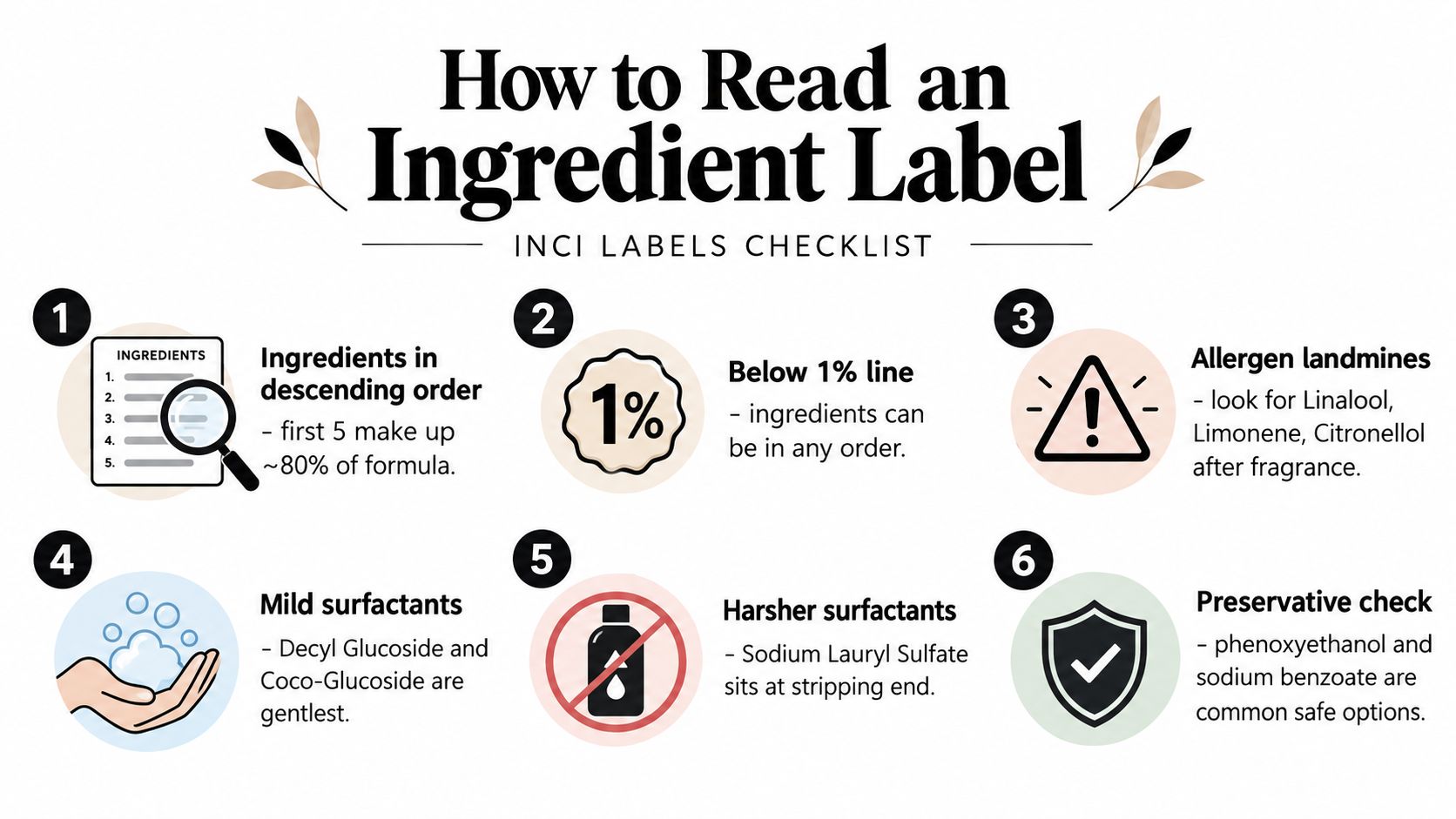
Ingredients generally appear in descending concentration until the formula reaches the 1% line, after which ingredients can appear in a different order. You don't need to memorize every chemical name. You need to identify the cleansing base, fragrance, preservatives, and the ingredients most likely to trouble your skin.
Start with the first part of the list
If water, aloe, glycerin, and mild surfactants appear near the top, you're looking at a water-based wash with a potentially softer feel. If several strong anionic surfactants dominate the opening, expect more cleansing power and a greater chance of tightness, especially if the formula is alkaline.
Sodium lauryl sulfate, or SLS, sits toward the stripping end of common surfactants. Sodium coco-sulfate can sound gentler because of its plant source, but its source doesn't erase its surfactant behavior. Decyl glucoside and coco-glucoside are often chosen for mild cleansing, although even mild surfactants can irritate a particular user.
CAPB deserves its own check. It's a common foam booster and can be a contact allergen, so a “natural” body wash containing CAPB isn't automatically the right choice for reactive skin.
Find fragrance and preservative landmines
“Fragrance” and “parfum” conceal a mixture rather than naming every aromatic component on the front of the bottle. Look for separately declared allergens such as linalool, limonene, and citronellol, particularly after the fragrance entry.
Then scan for preservatives. Methylisothiazolinone, often shortened to MI, and related isothiazolinones are important red flags for people with contact dermatitis. Phenoxyethanol is widely used and isn't the same category of concern as MI, but sensitive shoppers should still evaluate the whole system rather than treating one ingredient as a verdict.
This guide to polysorbate in personal-care formulas helps decode an ingredient that often appears in cleansing and emulsifying systems.
Use this fast scan before you buy:
- Read the cleansing base: Identify the first surfactants and decide whether the formula appears mild or aggressively foaming.
- Circle fragrance: Reject “parfum” if you're trying to remove fragrance from your routine.
- Check CAPB: Avoid it if previous products containing CAPB have caused a reaction.
- Inspect preservatives: Look carefully for MI, methylchloroisothiazolinone, and formaldehyde-releasing preservatives.
- Ignore the front-label halo: “Natural” means little if the INCI contains the exact ingredients you're trying to avoid.
Preservatives That Keep Body Wash Safe
Preservatives aren't optional in a water-based body wash. Water, plant extracts, and a warm bathroom create conditions where bacteria, yeast, and mold can grow. A “preservative-free” claim can sound pure, but an unstable contaminated wash is a far worse outcome than a carefully selected preservative system.
Common systems and their trade-offs
| Preservative | Sensitization risk | Efficacy | Regulatory notes | Typical concentration |
|---|---|---|---|---|
| Phenoxyethanol | Generally well tolerated, though individual sensitivity is possible | Broad-spectrum support in many formulas | Widely used under applicable cosmetic rules | Up to 1% |
| Ethylhexylglycerin | Usually low irritation potential, but not reaction-proof | Often boosts another preservative | Used as part of combined systems | Not specified here |
| Sodium benzoate plus potassium sorbate | Generally considered mild, with performance dependent on formula conditions | Works best in an acidic system and may have gaps against some molds | Commonly used in naturally positioned formulas | Not specified here |
| Benzyl alcohol plus dehydroacetic acid | Can irritate or sensitize some users, with a possible noticeable odor | Useful broad preservation system | Compatible with some Ecocert-oriented formulations | Not specified here |
| Methylisothiazolinone | High concern for contact sensitization | Strong preservative activity | Restricted differently by product type and region | Not specified here |
| Formaldehyde releasers | Sensitization concern for susceptible users | Effective preservation | Examples include DMDM hydantoin and quaternium-15 | Not specified here |
Phenoxyethanol paired with ethylhexylglycerin is a practical system because the booster can improve preservation without relying on a single ingredient. Sodium benzoate and potassium sorbate appeal to shoppers seeking familiar, food-associated ingredients, but they require the formulator to control pH and validate the complete formula.
Why “paraben-free” isn't the whole answer
Parabens remain controversial in consumer marketing, yet they aren't automatically the most allergenic choice in a rinse-off product. Replacing them with MI or another aggressive sensitizer can create a worse experience for a person with contact dermatitis.
A reputable formulator chooses preservatives through challenge testing, pH control, packaging design, and stability work. Shoppers should judge the finished system, not reward a product for displaying a “free-from” claim.
Best Body Wash Picks by Use Case
There isn't one universal winner. A person with eczema-prone skin needs a different formula from someone who wants a strong scent and a luxurious shower ritual. The right choice follows the priority, not the label trend.
| Use case | Product type | Price tier | Certification or acceptance | Refill option | Best for |
|---|---|---|---|---|---|
| Budget-sensitive | Fragrance-free syndet bar or simple drugstore wash | Budget | Look for transparent INCI and sensitive-skin acceptance | Usually bar-based or standard bottle | Low cost and straightforward performance |
| Sensitive or eczema-prone | Fragrance-free, low-pH syndet, ideally CAPB-free | Mid-range | NEA or eczema-focused acceptance can help | Varies by brand | Barrier-conscious cleansing |
| Sustainability-first | Concentrated liquid with a real refill loop | Mid to premium | Check the company's packaging claims | Refill stations, swaps, or take-back | Lower packaging waste |
| Family use | Fragrance-free, gentle, tear-free wash | Budget to mid-range | Dermatological or family-use testing can help | Varies | Shared household routines |
| Luxury and scent | Oil-based or naturally fragranced cleanser | Premium | Certification is secondary to allergy review | Often limited | Scent and sensory experience |
For sensitive skin, Nécessaire The Body Wash Fragrance-Free is a sensible premium-style option because the brand offers an unscented version and positions the formula around skin-supportive ingredients. I'd still inspect the current INCI for CAPB and preservatives before buying, since formulas can change.
For a simpler family routine, cocokind Milky-Soft Face & Body Cleanser is appealing because it is fragrance-free and designed for face and body use. Its milky, low-foam format suits people who dislike the squeaky finish of a highly foaming wash.
For refill infrastructure, Plaine Products Body Wash is a more aligned choice than a conventional bottle with a vague sustainability statement. The company uses aluminum packaging and offers a return and refill model. Bathing Culture also makes sense for shoppers who want reusable packaging and bulk purchasing, but its essential-oil fragrance profile isn't my first choice for reactive skin.
Dr. Bronner's Baby Unscented offers an accessible bar or liquid route, but castile soap is alkaline. Use it because you tolerate true soap and value versatility, not because “organic” makes the chemistry syndet-like. For further selection help, compare these sensitive skin body wash recommendations with the ingredient rules above.
Refill Systems and Low-Waste Buying
A refillable bottle isn't automatically a low-waste system. The company needs to explain what happens to the refill container, who receives it, and whether the packaging is reused, sanitized, or merely sent to a recycling stream.
Three models deserve your attention.
In-store bulk stations
Bulk stations work best when you can bring a durable aluminum or PET bottle, weigh it, refill it, and return repeatedly. The Body Shop has used in-store refill concepts, while other retailers may offer bulk dispensing for selected personal-care products. Ask whether the station accepts your existing container and how the operator prevents cross-contamination.
Mail-back loops
Mail-back programs can recover packaging that local curbside recycling won't accept. Plaine Products is a clear example of an aluminum bottle swap and return approach. The key question isn't whether a pouch is “eco.” It's whether the brand provides a practical return route and processes the material.
Concentrates and home bulk
Concentrates and tablets reduce the amount of water transported to your home, but they require accurate dilution and clean equipment. For a household that already uses a product consistently, home bulk formats such as gallon refills can reduce purchasing frequency and packaging turnover. Dr. Bronner's offers large-format products that can suit this approach, though its castile soap still has the alkaline chemistry discussed earlier.
Don't trust a refill claim until you can answer four questions:
- What comes back: Is the container reusable, recyclable, or discarded?
- Who handles it: Does the brand operate the return loop or outsource the responsibility?
- How do you return it: Is the process prepaid and convenient, or does it depend on special drop-off access?
- What happens after cleaning: Does the company wash and sanitize the package for reuse?
A leaky valve, an unrecyclable pouch, or a return process that requires a long shipment can undermine the environmental benefit. The best refill is the one you'll use repeatedly and return correctly.
Matching the Right Wash to Your Priorities
Choose your priority before choosing your bottle. If your main concern is sensitive skin, start with a low-pH syndet under pH 5.5, no fragrance, no CAPB, and a restrained preservative system. Eucerin Sensitive Skin and Bioderma Atoderm are useful benchmarks for the kind of barrier-oriented positioning to seek, although you should still check the current ingredient list.
If fragrance-free performance matters most, look for a wash that lathers adequately without perfume. Sebamed and Avène XeraCalm are examples of brands and product lines worth investigating in that category. A neutral scent isn't the same as fragrance-free, so confirm the INCI rather than relying on how the product smells in the bottle.
For minimum waste, combine formats instead of chasing a single perfect package. A durable aluminum-loop bottle paired with solid bar products can eliminate several pump bottles from a shower routine. A bar also avoids the water transport built into a ready-to-use liquid, but it may be less convenient for shared household use.
| Priority | Budget pick under $1 per ounce | Mid-range at $1 to $2 per ounce | Premium at $2 or more per ounce |
|---|---|---|---|
| Sensitive skin | Fragrance-free syndet bar | Eucerin Sensitive Skin or Bioderma Atoderm benchmark | Avène XeraCalm or a minimalist fragrance-free cleanser |
| Fragrance-free performance | Unscented bar or simple liquid wash | Sebamed | Nécessaire Fragrance-Free |
| Minimum waste | Bar format or Dr. Bronner's diluted according to directions | BYOMA or a refill-compatible liquid | Drunk Elephant or Codex, only when packaging and formula fit your priorities |
One trade-off rarely gets enough attention: plant-based surfactants may require stronger preservation strategies because the full formula still contains water and organic material. “Natural” doesn't automatically mean gentler, more stable, or better for sensitive skin. Judge the surfactant blend, pH, fragrance, preservative system, and refill pathway together.
Fillaree offers refillable hand and body soaps, including a Charcoal Hand & Body Soap and Soap & Suds Hand & Body Soap, through partner refill stations and home refill boxes. If you want a low-waste routine with a documented return loop for used refill bags, visit Fillaree and choose the formula and refill format that suit your household.