
Castile Soap in Bulk: Costs, Dilution and Refills
About $0.52 per ounce of concentrate is what a gallon priced at $65.99 works out to, based on Botanie Soap's 2025 unscented bulk Castile soap listing. But concentrate isn't necessarily what comes out of your dispenser. Buying Castile soap in bulk makes financial sense only when you account for the dilution your formula supports, the soap you use, and the containers you keep in circulation.
A household bathroom and a busy café also need different purchasing routines. The sensible choice isn't always the biggest jug. It's the size you can dispense cleanly, store properly, and finish without throwing away diluted leftovers.
Table of Contents
- Bulk Castile Soap Prices and Cost per Ounce
- What to Check on a Bulk Castile Soap Label
- How to Dilute Bulk Castile Soap Without Spoiling It
- Dispensers and Where to Buy Bulk Castile Soap
- Refill Systems and Where the Waste Savings Really Come From
- Choosing Companies Whose Values Hold Up
- Pick Your Bulk Size and Start Refilling
Bulk Castile Soap Prices and Cost per Ounce
Compare usable liquid, not just concentrate. The following calculations use that historical gallon listing, not a current price quote. They exclude shipping, tax, water, dispensers, and the time spent refilling.
For this worked example, a gallon contains 128 fluid ounces. Diluting it at one part soap to three parts water produces 512 fluid ounces of diluted liquid, not an equivalent volume of finished foam. An equal-parts dilution produces 256 fluid ounces.
These are purchasing calculations, not permission to dilute every formula the same way. Use the dilution your manufacturer supports for the intended application.
Bulk Castile soap cost per usable ounce
| Product | Size | Price |
|---|---|---|
| Botanie unscented bulk Castile soap, 1 gallon concentrate (2025 listing) | 128 fl oz concentrate | $65.99, about $0.52 per fl oz |
| Same gallon diluted 1:3 for foaming dispensers | 512 fl oz diluted liquid | $65.99, about $0.13 per usable fl oz |
| Same gallon diluted 1:1 for body wash | 256 fl oz diluted liquid | $65.99, about $0.26 per usable fl oz |
| Typical 8 oz concentrate bottle, retail | 8 oz | Unknown, enter the shelf price and divide by its supported usable volume |
A small bottle can cost less at checkout while costing more per wash. Equally, a discounted gallon can become the expensive option if you dislike the formula, overfill dispensers, or discard a diluted batch. Usable volume only saves money when you use it.
For a household, start by recording how quickly you empty a dispenser. For a café, include staff time, replacement pumps, freight, and product left behind in transfer equipment. Monopack ltd.’s pack-size planning for cafés offers useful purchasing context, while our guide to calculating cost per ounce helps standardize the arithmetic.
Buying rule: Divide the delivered price by the ounces you'll actually dispense after an approved dilution, then account for waste and refill supplies.
Don't assume a thinner mixture delivers the same cleaning performance with the same pump stroke. Test the dispenser and the wash experience before treating theoretical dilution savings as money saved.
What to Check on a Bulk Castile Soap Label
Read the oil list before trusting the word Castile. Castile soap began as an olive-oil-centered, plant-derived soap associated with Spain's Castile region, but the name now also covers vegetable-oil blends containing coconut, palm kernel, hemp, or jojoba, as described in the Open University's history of soapmaking.
That history doesn't give modern buyers a standardized recipe. Two products labeled Castile can behave differently in a pump, on skin, or in hard water.
Use this visual checklist when comparing containers.
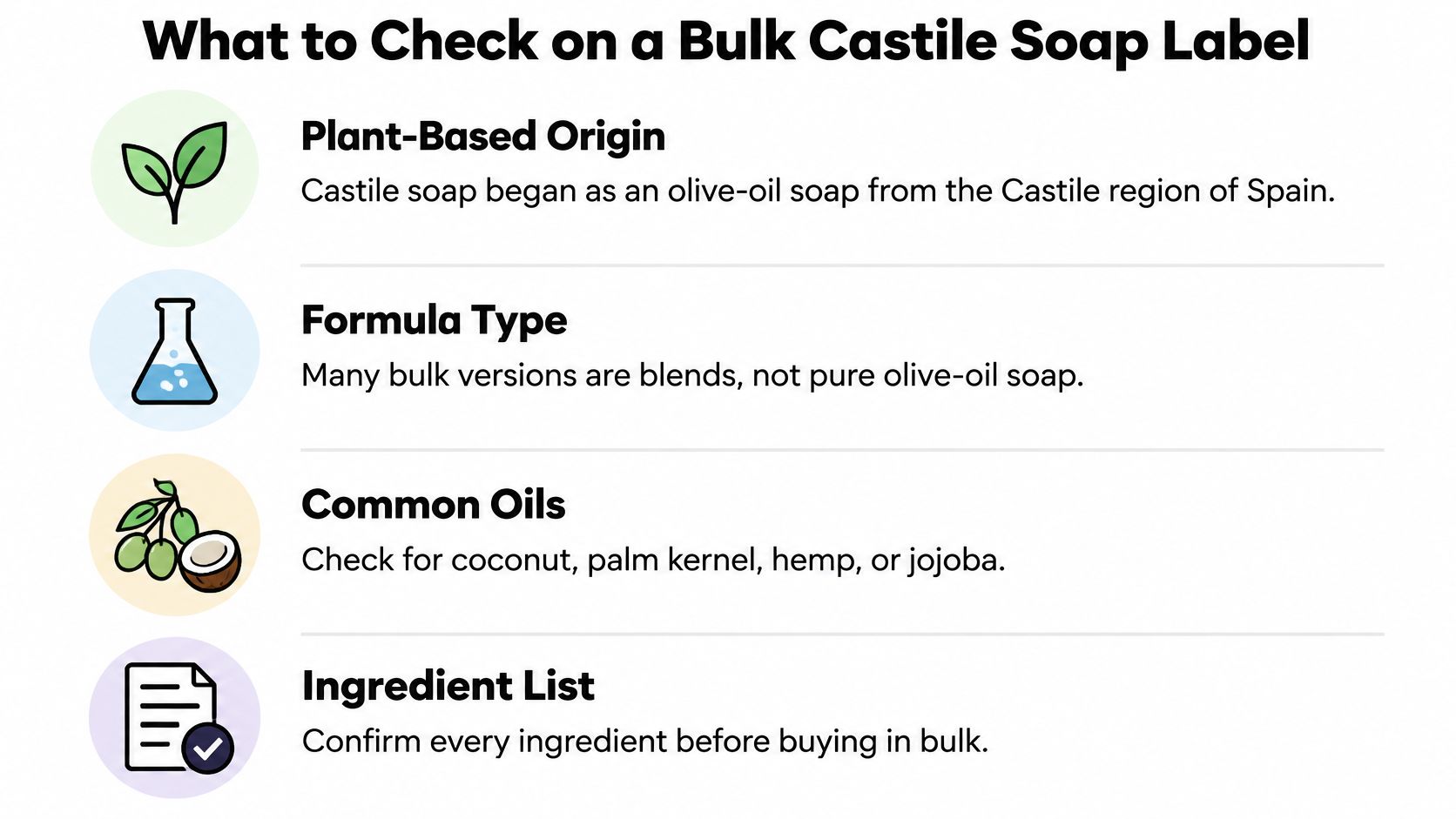
Read the formula and its intended use
- Full ingredient disclosure. Look for the oils, water, fragrance, and any other ingredients, not just a description such as plant-based cleanser. Potassium hydroxide or sodium hydroxide notation describes the alkali used in soapmaking; its appearance alone doesn't establish finished-product quality.
- Oil blend stated. Decide whether you want an olive-oil-focused formula or a blended vegetable-oil soap. Don't pay a premium for an assumed recipe that the ingredient list doesn't support.
- Fragrance identified. Check whether the product is unscented or contains fragrance or essential oils. For a shared café washroom, an unscented option can simplify purchasing around scent preferences.
- Use and storage guidance. Find the intended application, dilution instructions, pH information where available, and a clear period for use after opening. An unopened shelf-life statement doesn't automatically cover a diluted refill.
- Credible certification. Verify what a certification evaluates and whether it applies to the actual product you're buying.
The EPA's Safer Choice standard reviews every ingredient regardless of concentration, includes product-level pH and volatile organic compound requirements, and excludes ingredients with aquatic-toxicity values below 10 mg/L for applicable direct-release products. That's a more useful screening framework than a natural claim alone.
Certification still needs context. A standard for cleaning products isn't interchangeable with approval for every body-care application, and a recognizable badge doesn't replace the label's intended-use directions.
Good products combine transparent ingredients with clear operating instructions. A large container with poorly disclosed contents doesn't become an aligned purchase because it uses less packaging.
How to Dilute Bulk Castile Soap Without Spoiling It
Dilution ratios by use
| Use | Ratio (soap : water) | Batch approach | Storage note |
|---|---|---|---|
| Foaming hand soap | 1 part soap : 3 parts water | One refill bottle at a time | Use within the stated after-opening period; discard if it separates or clogs |
| Liquid body wash | 1 part soap : 1 part water | Small batch | Keep sealed between uses; discard if it separates |
| Dish or floor cleaning, concentrate | No water | Fill only what you use | Keep sealed until opened; follow the label's after-opening guidance |
Treat these as starting applications, not universal recipes. The foaming ratio is our recommendation for Soap and Suds in most foaming dispensers. The body-wash example requires a formula whose manufacturer supports equal-parts dilution.
The concentrate row describes storage and dispensing before use. It doesn't mean you should spread neat soap over a floor. Apply the cleaning product according to its surface-use directions.
Prepare the bottle before the mixture
- Start with a clean, dry container. Empty it completely, wash the bottle and pump, and rinse away residue. Use a manufacturer-compatible sanitation method, such as an appropriate hot-water process or alcohol rinse, then let the components dry. A casual splash of hot water isn't validated sanitation, and heat can damage some pumps.
- Choose fresh, clean water. Use potable water and clean measuring equipment. Hard water can affect soap's appearance and lather; purified water may improve consistency, but it doesn't make a diluted mixture sterile.
- Measure by volume. Use a marked measuring jug rather than estimating inside an opaque bottle. Add the water, pour in the measured soap, and combine gently instead of shaking up a head of foam.
- Make a small working batch. Fill what you expect to use promptly rather than diluting the entire bulk container. Don't top up old mixture with fresh soap.
- Date and protect the refill. Label the preparation date and the manufacturer's applicable use deadline. Keep the bottle away from heat and direct sunlight, with its closure fitted between uses.
The practical sequence is simple enough to keep beside a refill station.
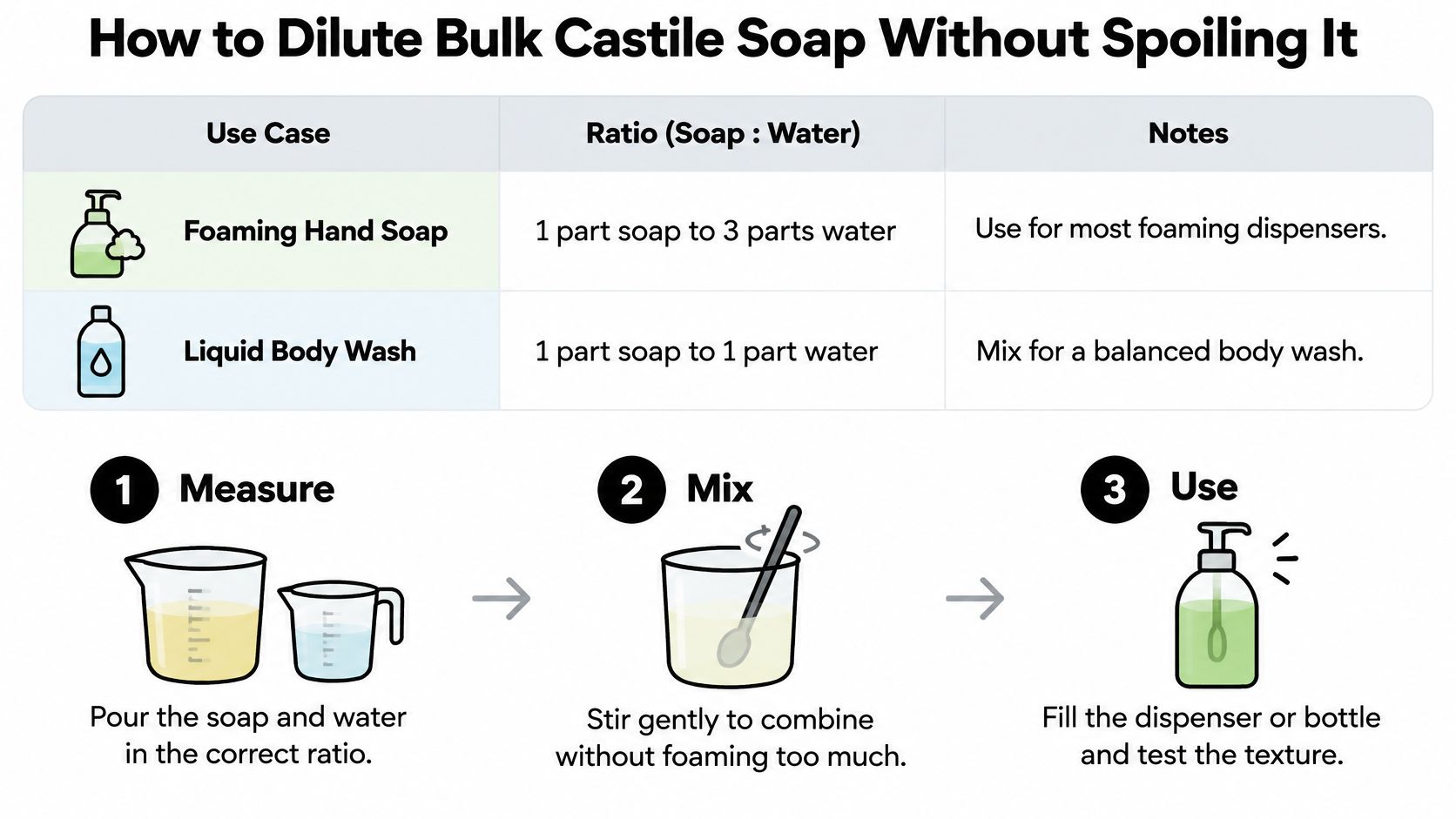
Know when not to keep a batch
Adding water isn't merely a way to stretch a purchase. The FDA's guidance on microbiological safety and cosmetics warns that water can dilute preservatives and allow microorganisms to grow, and that contaminated cosmetics can become harmful.
That doesn't mean every soap contains an added preservative. It means you shouldn't assume the original formula's protection survives your changes.
A preparation date helps you manage a batch. It doesn't prove that the batch is microbiologically safe.
Discard a mixture that develops an unexpected odor, visible growth, separation, or persistent clogging. Don't try to rescue it by adding more water, fragrance, or acid. Clean the dispensing equipment before starting again, and remember that a normal appearance doesn't establish safety.
Business buyers need evidence beyond a clean-looking sample. Ask for lot-level microbial results and validation relevant to the intended dilution and refill system. Contract Laboratory's soap-testing guidance describes ISO 11930 challenge testing over 28 days, which evaluates microbial survival after deliberate inoculation. Agree on water quality, equipment sanitation, storage conditions, and the maximum period after opening rather than inventing a universal diluted-soap shelf life.
Dispensers and Where to Buy Bulk Castile Soap
Match the pump to the working liquid. A foaming dispenser needs a foam-ready mechanism and an appropriately thin mixture. A flip-top or squeeze bottle is often more practical for diluted body wash, while a labeled squeeze bottle with a locking cap can control transfers of concentrate.
Choose an opaque container or store the bottle away from light. Check that the closure seals properly and that you can dismantle the pump for cleaning.
Choose a buying channel you can manage
Buy direct from a brand offering bulk containers, such as Botanie's unscented gallon format, or use a refill shop with a documented returned-container process. Compare the minimum order, delivered price, container handling, and available storage instructions.
For a café, transfer equipment matters as much as the jug. Our gallon-jug pump guide is a useful starting point for planning controlled dispensing.
- Prepare the dispenser. Clean and sanitize it before its first fill and after clearing a clog.
- Assign responsibility. Give a named staff member ownership of refilling and dating.
- Rotate stock. Use older stock first and keep a sealed backup sized to your turnover.
- Request quality documentation. Obtain lot-level microbial results before committing to a large container intended for dilution.
A cheap jug isn't convenient if its outlet leaks or its pump can't be cleaned.
Refill Systems and Where the Waste Savings Really Come From
Bulk works best when you finish the soap, reuse the container repeatedly, and complete the return loop. A larger package alone doesn't establish lower environmental impact. Shipping, washing, product loss, and disposal all belong in the comparison.
A durable working bottle is the visible part of that system.
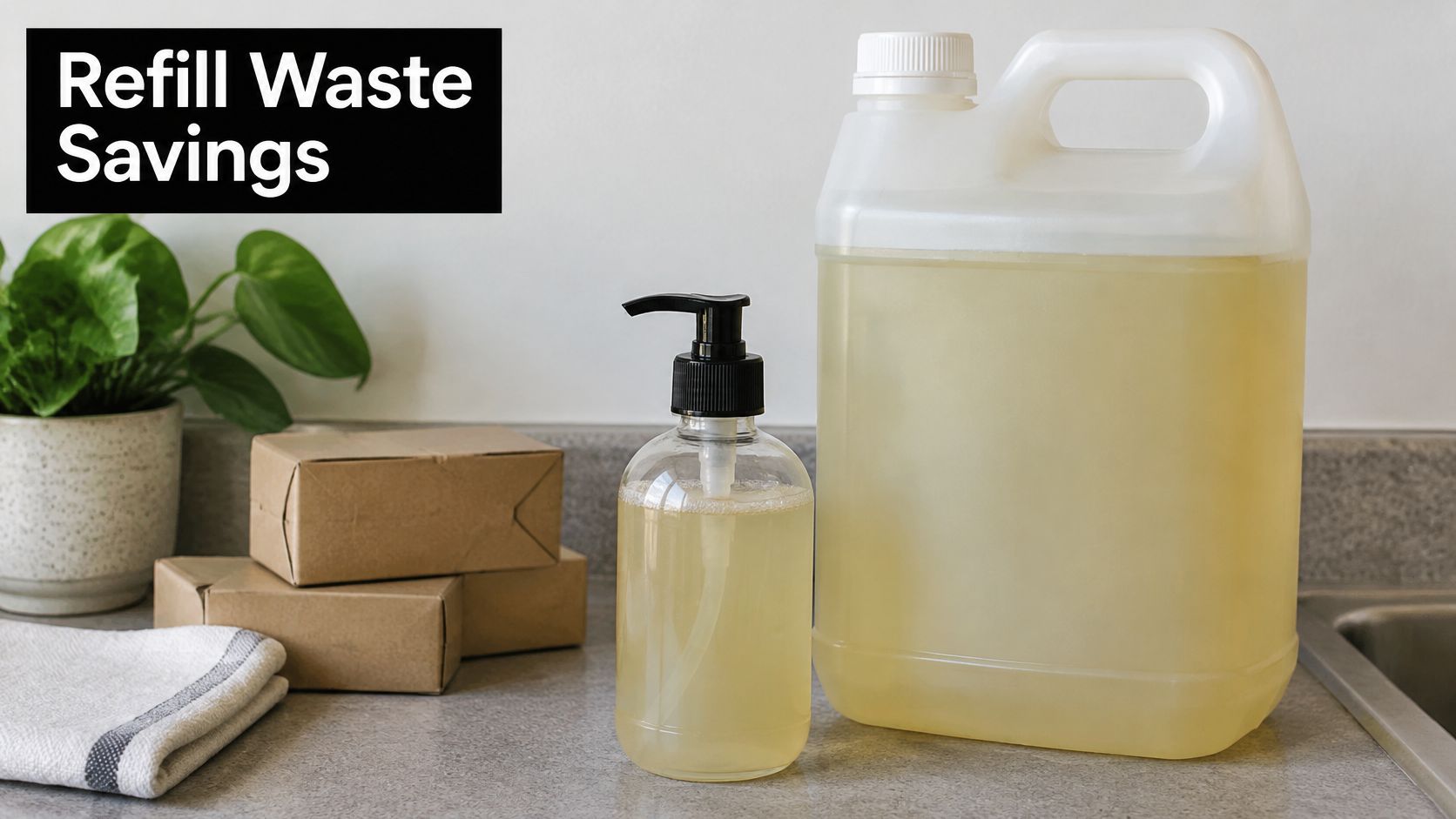
A packaging comparison discussed in this life-cycle review estimated 284 g CO2e per conventional liquid-detergent bottle versus 62.6 g CO2e for refill packaging. That's evidence of potential packaging savings, not a footprint calculation for every Castile soap refill. The review also describes assessments in which liquid soap has a larger life-cycle impact than solid soap, so product format deserves attention alongside package size.
Follow the container beyond checkout
Ask questions that reveal what happens after a refill arrives:
- Repeated use. Is the working bottle durable, and can its pump be replaced without discarding the bottle?
- Actual recovery. Does the supplier clean and refill returned packaging, or merely accept it for disposal?
- Transfer loss. Can you drain the package cleanly without spills, trapped residue, or excessive rinsing?
- Transport. How far does the liquid travel, and what does the return journey require?
- End of life. Can you separate the components and use disposal options available locally?
At Fillaree, our home refill boxes top up standard bottles, and we take back used refill bags to wash, sanitize, and reuse. That process depends on customers returning the bags rather than treating them as single-use packaging.
The refill process is easier to assess when you can see the handling involved.
Build a loop that fits your space
For a household, a workable setup is a protected concentrate container, a reusable working bottle, and a designated place for packaging awaiting return. Dilute only when the formula supports it. Don't add a mixing step to a product sold ready to use.
For a café, include container returns in the purchasing routine rather than leaving empty packaging beside the sink indefinitely. Keep return instructions where staff sort deliveries.
Waste check: Count the containers you actually reuse and return, not the containers you intended to reuse.
A refill system can be environmentally worthwhile without being impact-free. The strongest case is a system you can maintain reliably, without spoiled soap, unnecessary shipments, or a cupboard full of abandoned pumps.
Choosing Companies Whose Values Hold Up
A green label doesn't tell you how a company treats its workers, buys ingredients, or handles complaints. Supporting good companies who care requires evidence about the business, not just attractive packaging.
B Lab's assessment framework considers governance, workers, community, and environment separately. Community topics include diversity, economic impact, supply-chain management, and charitable giving; worker topics include financial security, health and safety, and career development. Those categories turn aligned values into questions you can investigate.
Read beyond the badge
A named example shows what a category breakdown can reveal. B Lab lists Standard Communities with an overall B Impact score of 97.2, including 17.0 for governance, 33.0 for workers, and 25.8 for community.
That example illustrates how to read an assessment, not which soap to buy. A company-level score doesn't prove that every product or package is environmentally superior, and it doesn't substitute for ingredient disclosure or refill performance.
Use these checks when deciding where your purchasing money goes:
- Find an independent assessment. Establish who evaluated the company, what they assessed, and whether the assessment still represents the business.
- Read the category results. Look for evidence connected to your priorities, such as worker well-being or responsible sourcing. A badge alone won't explain where a company performs well.
- Check operational disclosure. Read sourcing information, staff policies, and refill procedures. Specific commitments are more useful than broad claims about caring for people and the planet.
Apply the same standard to us
We're a women-owned manufacturer in Durham, North Carolina. We publish sustainability and third-party certification information, and our soaps are third-party certified to kill harmful bacteria and are safe for waterways. Those credentials should be read within their stated scope, not extended to an untested homemade dilution.
Our guide to sustainable personal-care brands can help frame comparisons, but the same scrutiny should apply to Fillaree as to any supplier.
There are real trade-offs here. A locally accessible refill may simplify returns, while a distant supplier may disclose more about sourcing. Decide which requirements are essential, then compare the remaining options without assuming that a single label settles every question.
Values-based buying is strongest when good intentions become repeatable practices. Clear ingredients, credible credentials, fair treatment, and an operational refill loop should reinforce one another.
Pick Your Bulk Size and Start Refilling
Start with the smallest purchase that lets you test the whole routine. A household using foaming hand soap daily may eventually make good use of a gallon, but only after confirming that the formula suits the users and the dispenser works reliably.
For a café or office, choose a bulk size you can manage through small working batches. Keep the backup labeled and protected, and make refilling part of a named person's duties rather than an informal task anyone might handle.
Test before you scale
Our Soap & Suds 8 oz refillable bottle costs $9.00 USD. We recommend one part soap to three parts water in a foaming dispenser, giving you a practical way to test the wash and refill routine before committing to a larger purchase.
Evaluate the full experience: how the pump dispenses, whether people use an appropriate amount, how easily the bottle cleans, and whether you'll follow through on returning packaging. Don't choose a gallon solely because the concentrate price looks attractive.
Use the usable-volume calculation when comparing sizes, but keep your actual consumption in view. A household that takes a long time to empty a working bottle needs a different stock level from a café with frequent handwashing.
Pick an approved dilution, prepare a clean dispenser, and record the applicable after-opening deadline. Before reordering, review the supplier's ingredient disclosure, business practices, and container-return process. Buy more only when the smaller setup works without waste.
Fillaree offers refillable home and body essentials, home refill boxes, and a return system for used refill bags. Visit Fillaree to choose a manageable starting size and build a refill routine that fits your household or workplace.