
Dish Soap Spray Bottle: Choosing, Using, and Refilling
You've just finished cooking, the sauté pan is slick with oil, and the sink is already filling with dishes. Pouring a thick ribbon of soap onto a sponge often creates one concentrated, sudsy patch while grease remains everywhere else. A dish soap spray bottle changes that sequence by putting a thin layer of cleaner directly on the pan, plate, or sponge before scrubbing begins.
That convenience only lasts if the bottle keeps producing a usable mist. The challenge is reliability: choosing a trigger that tolerates wet hands, mixing soap thin enough to spray, clearing residue before it hardens, and setting up refills you'll maintain. A sustainable bottle that clogs after a few uses usually becomes another discarded container.
Table of Contents
- Why a Dish Soap Spray Bottle Changes the Way You Wash
- Picking a Spray Bottle That Survives the Kitchen Sink
- Mixing the Right Dish Soap Dilution for Spray Use
- Building a Simple Refill Habit With Bulk Dish Soap
- Troubleshooting Clogs, Weak Spray, and Film
- Does a Refillable Spray Bottle Actually Cut Waste
- Your Next Steps Toward a Closed-Loop Kitchen
Why a Dish Soap Spray Bottle Changes the Way You Wash
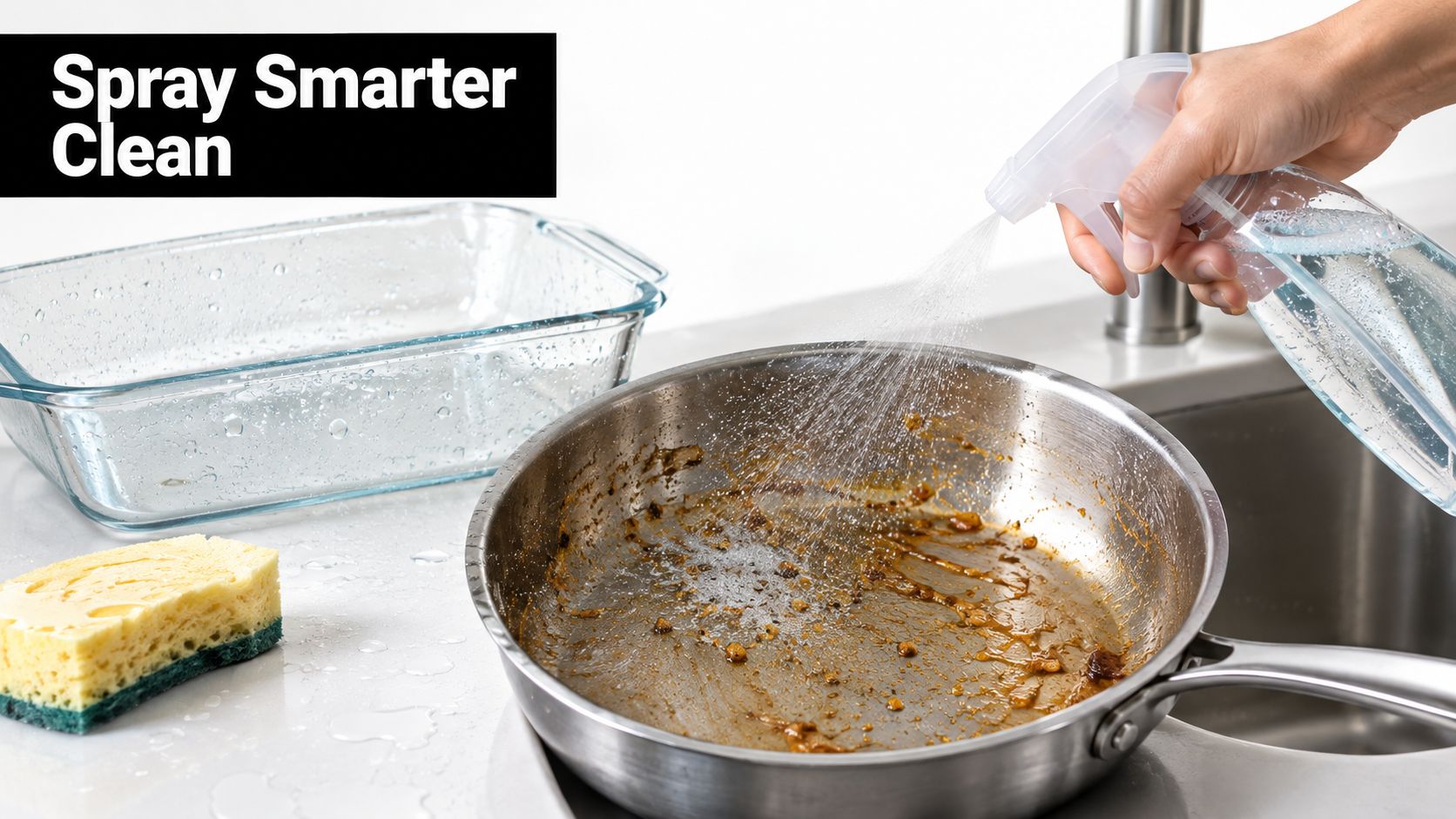
Spray the greasy pan while it's still warm, let the cleaner spread across the surface, then wipe away loose food and oil before adding water. The bottle changes the order of work. Instead of flooding the sink and asking a sponge to distribute concentrated soap, you treat the grease where it sits.
That approach also helps with small jobs. A mist on a lightly soiled plate or the inside of a lunch container can provide more even coverage than soap poured onto one corner of a sponge. You'll still need enough water and friction for baked-on food, but fresh grease often responds better to early treatment than to prolonged scrubbing after it dries.
Coverage comes before sustainability
A poured formula tends to pool. A properly diluted spray distributes cleaner across a wider area, which can reduce the amount of soap sitting in the sponge and lower the chance of a sticky residue on dishes. The benefit isn't automatic, though. A poorly chosen sprayer can leave large droplets, foam excessively, or stop working when the formula is too viscous.
The format is relatively new in dish care. Procter & Gamble launched Dawn Powerwash in 2020, describing it as its first completely new form of dish detergent since Dawn liquid soap appeared in the 1970s. Dawn first arrived as bottled liquid dish detergent in 1972 to 1973, placing the major format shift roughly 47 to 48 years later, as reported by ABC7 Chicago's coverage of Dawn's spray format.
Practical rule: Use the spray to pre-treat and distribute soap, not as permission to skip wiping food scraps or rinsing thoroughly.
A sensor tap can complement this workflow by reducing the need to touch a faucet with greasy hands. For a broader look at hands-free kitchen fixtures, the automatic sensor tap guide is a useful resource. The bottle and tap solve different problems, but together they keep the washing sequence cleaner and more deliberate.
Picking a Spray Bottle That Survives the Kitchen Sink
A kitchen sprayer needs to tolerate moisture, soap residue, drops, and repeated trigger pulls. The prettiest bottle isn't necessarily the most dependable. Clear plastic makes film easy to spot, while a sturdier opaque bottle can hide buildup until the nozzle starts misbehaving.
Standard trigger sprayers are the safest starting point for dish soap. They offer controlled output and usually tolerate a moderate amount of dilution. Continuous-mist nozzles feel efficient for broad surfaces, but they can be awkward with slippery hands and may be less forgiving when residue accumulates. Small pump heads are compact, though they require more repeated hand movement and aren't my first choice beside a busy sink.
| Format | Capacity | Best For | Watch Out For |
|---|---|---|---|
| Standard trigger | 16 to 24 oz | Pan pre-treatment and daily dishes | Repeated refilling in smaller bottles |
| Continuous mist | 16 to 24 oz | Wide, light surface coverage | Slippery handling and residue sensitivity |
| Small pump head | Compact bottle | Controlled spot application | More pumping and slower coverage |
Capacity changes the feel of the tool. A 16-ounce bottle is light but needs frequent refilling. A 24-ounce bottle usually balances reach and handling. A 32-ounce bottle holds more, but the extra weight can strain the trigger mechanism and make a wet bottle uncomfortable to use.
Materials and hardware
PET offers clarity and a light feel. HDPE is a practical choice when you want a tougher, less transparent container. Glass resists some forms of odor retention and looks good on the counter, but a sink is a hard place for breakable packaging. Adjustable poly nozzles are inexpensive and replaceable; metal tips can resist corrosion from alkaline formulas but may dent if dropped.
Test the bottle before buying:
- Trigger pull: It shouldn't feel gritty, excessively stiff, or loose.
- Nozzle adjustment: Turn the setting and confirm it changes from a stream to a mist.
- Gasket seal: Check that the closure sits evenly and doesn't wobble.
- Cleanability: Prefer a head that can be removed and rinsed.
A bottle intended for bulk refills should also have a standard neck and a replacement-trigger option. Fillaree's eco-friendly spray bottle information is relevant here because compatibility with a refill system matters more than decorative finish. A durable bottle with accessible parts is easier to keep in service.
Mixing the Right Dish Soap Dilution for Spray Use
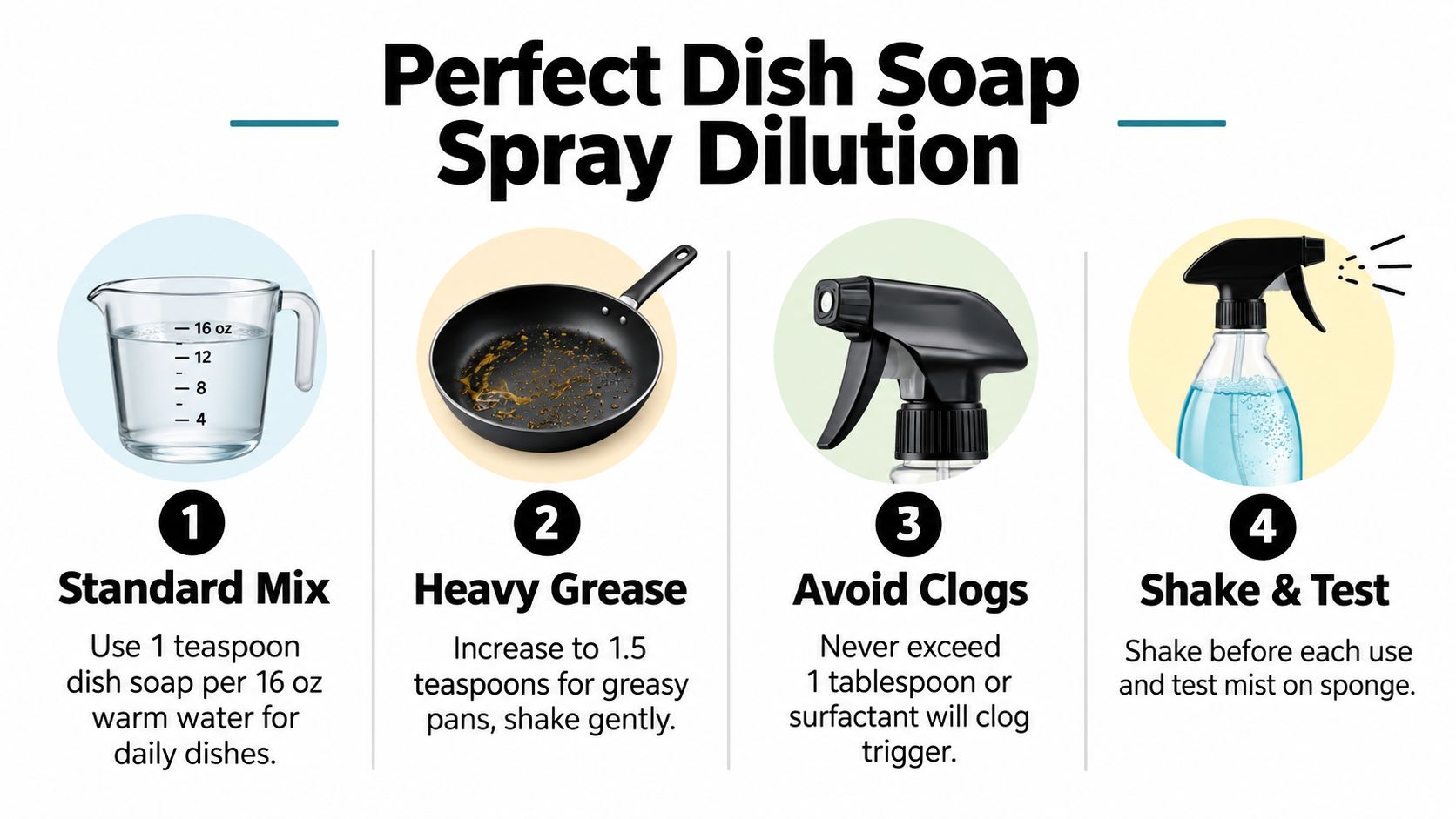
Most spray failures begin in the measuring stage. Too much soap makes the liquid thick, leaves a film, and forces the trigger to push a heavy mixture through a small opening. Too little soap produces a weak treatment that encourages you to spray more often.
A practical starting point comes from dilution guidance for a 500 mL bottle. A 0.25% solution uses 1.25 mL of dish soap, 0.5% uses 2.5 mL, and 1.0% uses 5 mL. The same guide recommends adding water first, then soap, topping up the bottle, and mixing gently rather than shaking hard. The measurements and method are detailed in this dish soap dilution guide.
For a 16-ounce bottle, another recipe uses 13 ounces of water, 4 tablespoons of dish soap, and 2 tablespoons of isopropyl alcohol, with the stated purpose of improving grease cutting and sprayability. That is a much stronger blend than a light daily mist, so I'd treat it as a heavy-duty formula and test it cautiously on the intended surfaces.
A safer mixing routine
Start with the low end, especially if you're using a concentrated product. Add water first to cushion the soap as it enters the bottle, then add the soap slowly. Gently roll or invert the container instead of whipping air into it. Foaming isn't the same as cleaning power, and excessive foam makes coverage harder to judge.
A useful kitchen shortcut is to measure with spoons, but keep the recipe written on a label so the next refill doesn't become guesswork. Test the mist on a sponge or an inconspicuous area before spraying a full pan.
Water quality matters. Mineral-heavy water can contribute to a chalky film on glass, and a formula that works in one kitchen may leave residue in another. If you're troubleshooting cloudy dishes, review these kitchen housekeeping hints, then test filtered water or a different concentrate rather than immediately increasing the soap.
For another refill-oriented dispenser example, see Fillaree's guide to refilling a foam soap dispenser. The principle is the same: the container and formula must be treated as a matched system.
Building a Simple Refill Habit With Bulk Dish Soap
Refilling works when it has a trigger, a repeatable measurement, and a place in the kitchen routine. Without those three pieces, people either wait until the bottle is empty or improvise a stronger mixture that eventually clogs the sprayer.
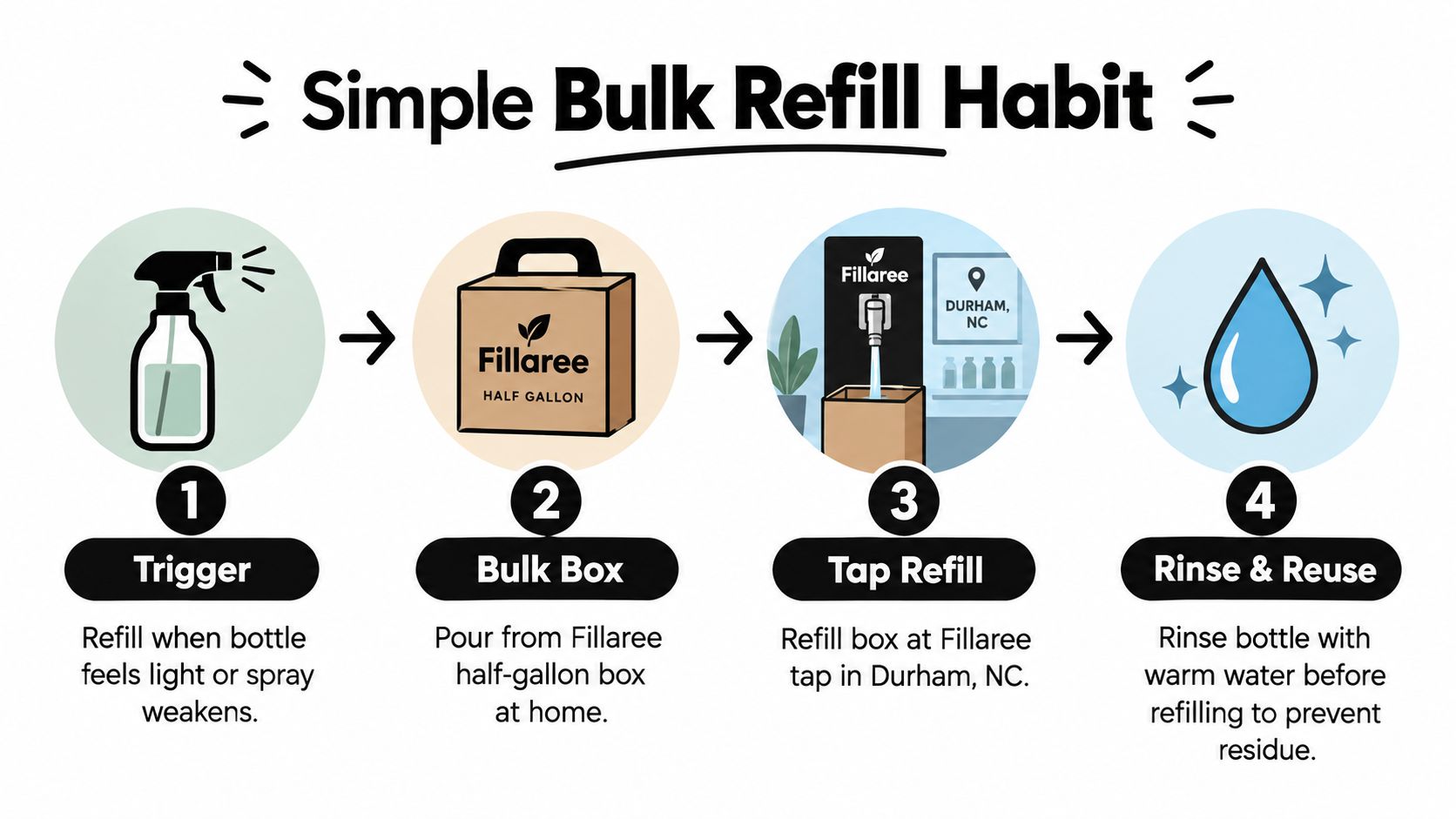
A half-gallon bulk box can function as the reserve supply, while the smaller spray bottle stays beside the sink. Fillaree offers home refills in 0.5-gallon boxes, and its system is designed to top up standard 8-ounce bottles up to eight times, according to the publisher information supplied for this article. Those figures describe the brand's refill format, not a universal result for every bottle or formula.
Four steps that remove guesswork
- Choose a trigger. Refill when the bottle feels light or the spray begins to weaken. A calendar reminder can help, but the physical cue is better because it responds to actual use.
- Write the mix down. Keep the chosen dilution beside the bottle. Use the low-concentration baseline from the earlier section unless your product instructions call for another ratio.
- Pour with control. Set the bottle in the sink, use a small funnel, and add the measured water before the soap. Pouring slowly prevents a foamy overflow and makes it easier to see the final level.
- Label the batch. Mark the dilution date and formula on removable tape. If the spray starts leaving film, you'll know which mixture to adjust rather than changing several variables at once.
Keep bulk soap in a cool, dark cabinet, away from direct heat and strong sunlight. Store the working bottle upright on a small tray so drips don't spread across the counter. When the container is empty, follow the supplier's return instructions rather than assuming every package belongs in household recycling.
Make the return loop visible
Refill logistics decide whether the system survives beyond the first enthusiastic purchase. Put the empty bulk container near the door or with your shopping bags, and choose a regular refill stop. Fillaree has a Durham, North Carolina storefront and partner refill locations, while home delivery can suit households that don't live near a station.
A pump attachment can make a large container easier to manage. The gallon jug pump guide is useful when the refill container is too heavy or awkward to pour safely. Supporting companies that design packaging for reuse, take back appropriate materials, and publish clear handling guidance aligns the product with the habit instead of leaving the customer to solve the waste problem alone.
Troubleshooting Clogs, Weak Spray, and Film
A failed sprayer usually points to a mechanical obstruction or a poor mixture, not a mysterious chemical reaction. Start with the nozzle and trigger head before throwing away the bottle.
If the nozzle clogs, remove the trigger head and soak it in warm water with a few drops of dish soap for about 10 to 20 minutes. Use a fine pin or needle to clear the opening, then flush it again. The spray bottle cleaning protocol warns against forcing the pin, because enlarging the orifice can permanently change the spray pattern. Mineral buildup may need vinegar rather than soap-water soaking.
Match each symptom to one change
- Weak spray: Check the dip tube for a kink, tighten the trigger head, and test filtered water if your tap leaves visible mineral deposits.
- Film on dishes: Lower the soap concentration, rinse the bottle thoroughly, and avoid adding fragrance oils or other ingredients to the concentrate.
- Leak at the trigger: Inspect the threads, spring, and O-ring. Replacing the trigger head is often more sensible than replacing the whole bottle.
- Foam instead of mist: Let the mixture settle, then mix more gently at the next refill. Excess air can make the output look stronger than it is.
Keep the nozzle on a small paper towel between uses if drips collect around the tip. Rinse the bottle regularly before residue layers build up, and replace a worn trigger rather than accepting a deteriorating spray pattern. A short soak and careful manual clearing resolve many clogs, while heavier residue can require a longer soak.
Protect the orifice: A pin should clear the opening, not enlarge it. Gentle pressure preserves the spray pattern that makes the bottle useful.
Does a Refillable Spray Bottle Actually Cut Waste
A refillable bottle isn't automatically a low-waste choice. The result depends on whether the bottle remains in service, whether the refill packaging has a realistic return or reuse route, and whether the household follows the dilution instructions consistently.
The broader packaging market helps explain why spray formats are widely available. One market estimate valued global spray bottle packaging at $6.2 billion in 2025 and projected $9.1 billion by 2034, a 46.8% rise over the period at a 4.8% CAGR, while another estimate placed the market at about $7.5 billion in 2025 and projected $10.8 billion by 2033 at a 6.5% CAGR. These figures come from separate estimates in the spray bottle packaging market report, so they should be read as indicators of sustained commercial demand, not as a precise single market total.
Consumer interest doesn't remove the practical friction. A 2025 UK survey reported that 64% of shoppers viewed reusable, refillable, and returnable packaging as more effective at reducing waste than recycling, and 69% wanted legally binding reuse and refill targets, according to Packaging Europe's report on reuse and refill preferences.
| Method | Bottles/Year | Transport Impact | Net Waste Score |
|---|---|---|---|
| Single-use dish soap | New bottle for each purchase | Ships finished product repeatedly | Highest packaging burden |
| New-plastic store refill | Less frequent replacement of the sprayer | Still relies on new refill packaging | Moderate, depending on package |
| Return-and-refill loop | Reuses the working bottle and returnable supply packaging | Strongest when collected locally or shipped efficiently | Lowest when the loop is completed |
A decorative glass bottle shipped with unnecessary protective packaging can undermine its environmental promise. A refill station that requires an impractical journey may also discourage repeat use. The refillable cleaning products market research identifies dilution friction, starter-kit cost, and unreliable performance after refilling as restraints on adoption, as discussed by The Business Research Company.
The sensible test is simple. Does the bottle last, can you obtain refills without excessive travel or packaging, and will the empty container be reused or returned? If not, the green label may describe an intention rather than a functioning system.
Your Next Steps Toward a Closed-Loop Kitchen
The useful habit loop has four parts: choose a repairable bottle, dilute carefully, refill from a source you can realistically access, and keep the nozzle clean. None of those steps needs perfect equipment. Together, they prevent the common failure that turns a promising spray system into another short-lived kitchen accessory.
Set a 30-day refill reminder today, then adjust it to your actual consumption. Keep the bulk supply where you can see it, but not beside heat or direct sunlight. Label the spray bottle with the dilution date and recipe, so another household member won't have to guess what's inside.
Refill models are gaining support because they fit ordinary routines when companies remove unnecessary friction. A 2026 study across five countries included 2,749 respondents and found that flexible pouches were the most purchased personal-care refill format, with 66% buying them in the previous 12 months; 81% were more likely to purchase recyclable refills, according to Amcor's refill packaging study. Those findings concern personal care rather than dish soap, but they reinforce a practical point: packaging needs to be convenient and credible for people to keep using it.
A separate 2026 sustainability analysis summarized refillable packaging as capable of reducing plastic waste by about 80% versus single-use containers, while concentrated cleaning products could cut shipping emissions by up to 90% by removing water from transport. The analysis is presented by Elchemy's overview of sustainable cleaning trends, and the exact outcome still depends on the materials, transport, and return behavior in a particular system.
Start this week with one bottle, one written dilution, and one reliable refill route. If you're near Durham, plan a storefront refill stop or identify a partner station; if you're farther away, arrange a home bulk delivery and keep the return packaging with your shopping bags. A reusable bottle becomes meaningful when you use it repeatedly, support companies that care about their workers and waterways, and make the low-waste choice easy enough to repeat.
Fillaree offers refillable dish soap systems, bulk home delivery, and local refill options that help keep a dish soap spray bottle in service instead of sending another container to waste. Visit Fillaree to choose a refill route, order a home supply, or find a practical way to build this routine into your kitchen this week.