
Eco Friendly Stickers: A Practical Guide for Brands
A recycled-paper sticker isn't automatically an eco friendly sticker. That popular advice skips the part that often determines what happens after the customer peels it off: the adhesive. A paper face stock can look responsible while its glue disrupts recycling, contaminates compost, or leaves a release liner that no nearby facility can process.
The practical question isn't just, “Is this sticker made from paper?” It's, “Can the entire sticker system, including face stock, adhesive, ink, coating, and liner, move through the disposal route attached to the package?” Brands that answer that question before printing avoid vague green claims and make choices that work outside a product specification sheet.
Table of Contents
- Why Most Eco Friendly Stickers Fail at End of Life
- Understanding the Three Sustainable Sticker Pathways
- Compostable Versus Recyclable Stickers in Practice
- How to Match Stickers to Your Packaging and Disposal Reality
- Real Brands Making Smart Sustainable Sticker Choices
- Design and Printing Considerations for Eco Friendly Labels
Why Most Eco Friendly Stickers Fail at End of Life
A sticker made from recycled paper can still create a waste problem. The paper face may be compatible with a recycling stream, but the adhesive can gum up machinery, reduce fiber quality, and create defects during recycled paper production. Glue deposits have been linked to holes in recycled paper and web breaks, which means a small label can affect the efficiency and quality of a much larger process. UPM's explanation of sticker contamination describes why the backing material alone doesn't tell the whole story.
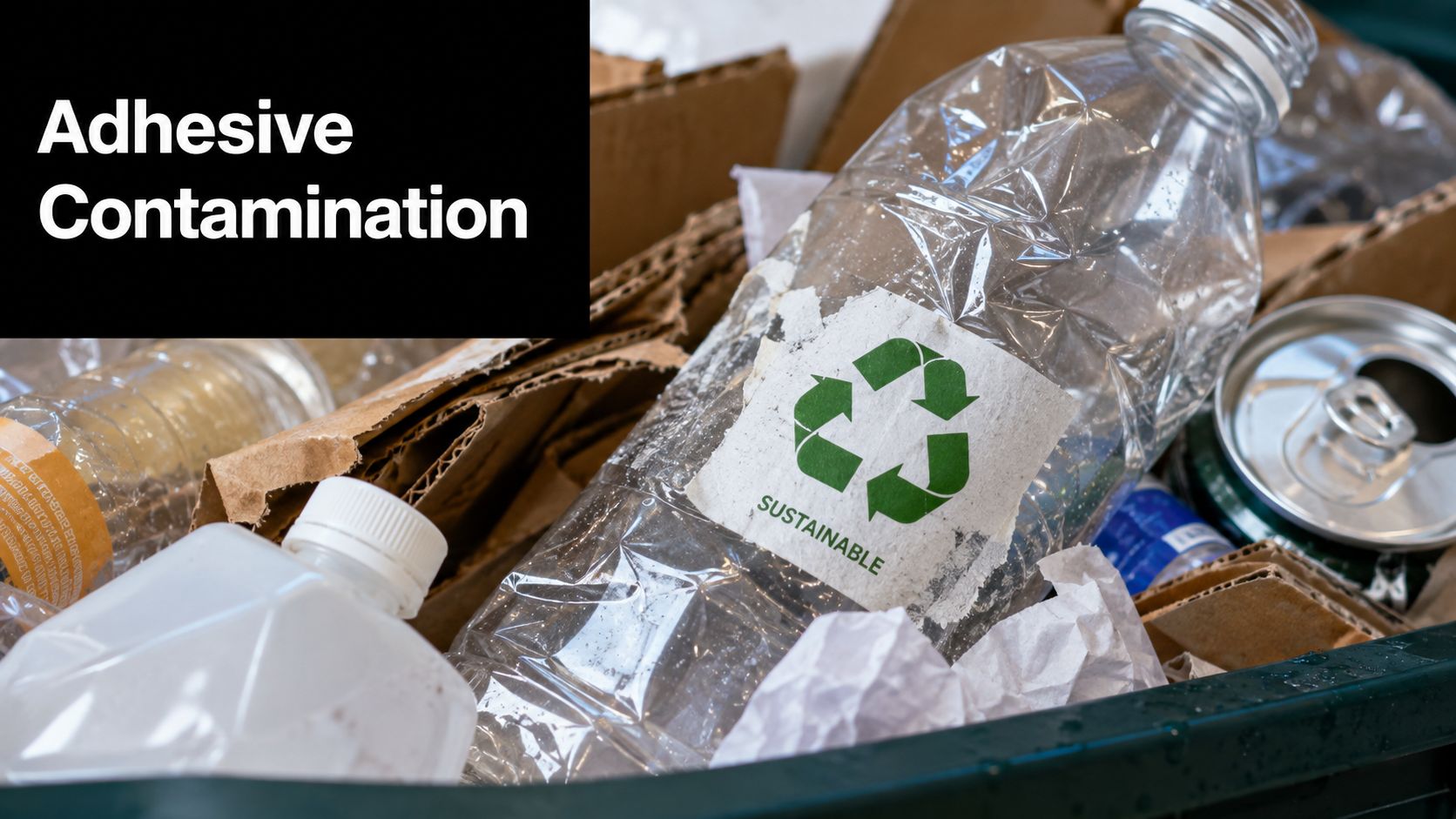
That mismatch appears in composting, too. A compostable paper or film face doesn't make the whole product compostable if the adhesive remains intact or introduces materials that the composting system doesn't accept. Industrial compostability is also different from backyard compostability and landfill breakdown, so a claim without disposal instructions can leave customers guessing. Brands should be especially careful before directing customers to practical guidance on starting composting at home, because an industrially certified sticker may not belong in a home compost pile.
The hidden contamination route
Recycling facilities handle paper, cardboard, plastics, and mixed packaging through processes designed for specific material streams. Adhesive residues can interfere with equipment and fiber recovery, while coatings and laminates may make separation harder. On plastic packaging, the wrong glue can remain with the container or contaminate the flakes produced during recycling.
That's why “paper sticker” is an incomplete specification. A responsible supplier should be able to identify:
- Face stock: What the visible sticker material is made from.
- Adhesive chemistry: Whether the glue is compatible with the intended recycling or composting process.
- Ink and coatings: Whether printed layers introduce incompatible materials.
- Release liner: Whether the peel-off backing has a recovery route.
Practical rule: Choose the disposal pathway first, then select the sticker components that support it.
The wider sustainable labels market shows that these choices now operate at industrial scale. One 2026 summary projects the global sustainable labeling market to reach $15.4 billion by 2027, with a 7.9% CAGR, while another estimates $52.8 billion in 2025 growing to $115.4 billion by 2035, at an 8.7% CAGR. These projections come from labeling industry market summaries, but market growth doesn't make every product claim trustworthy. The meaningful test remains end-of-life compatibility.
Understanding the Three Sustainable Sticker Pathways
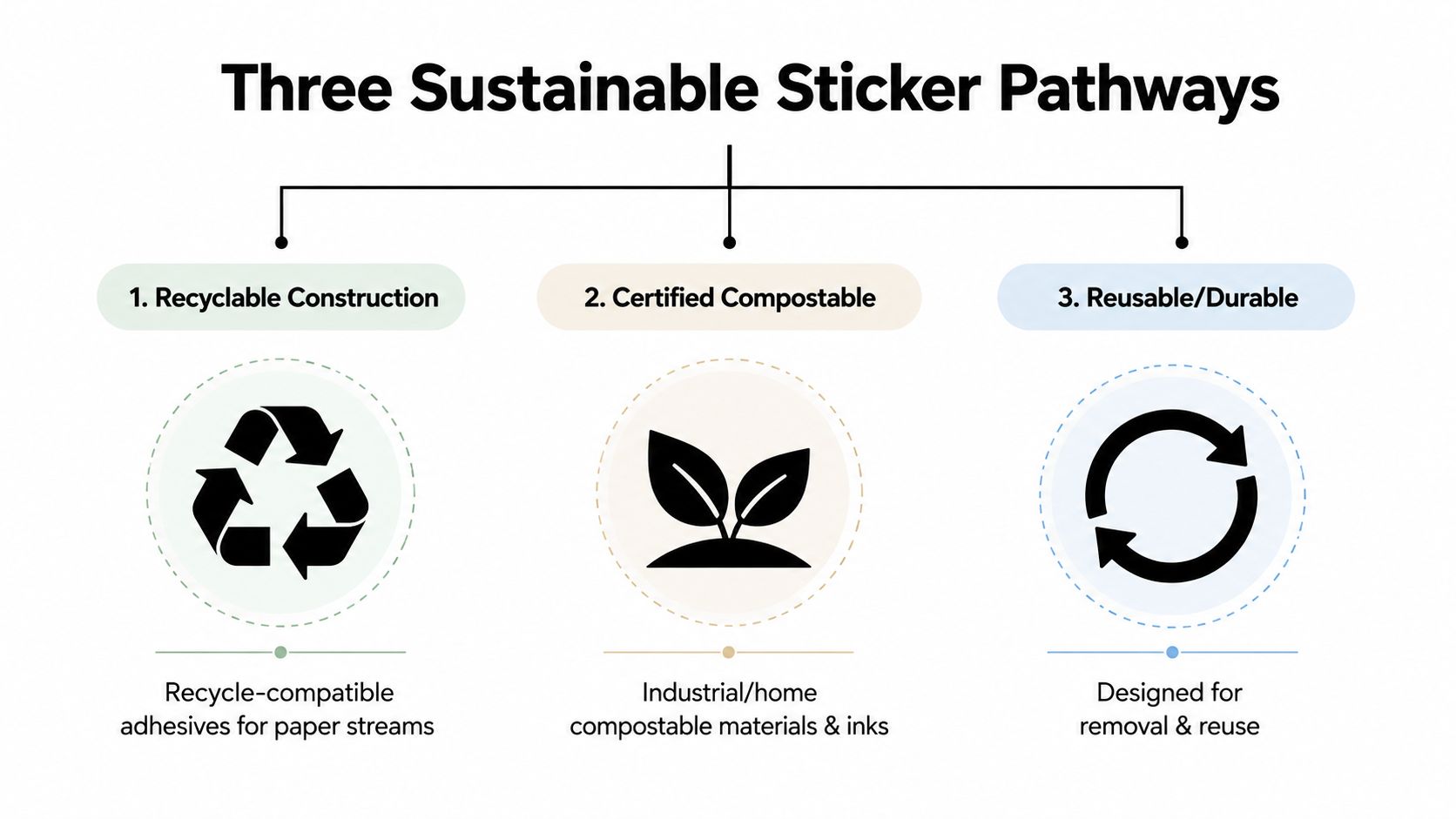
There isn't one universally sustainable sticker. In practice, three pathways are credible: recyclable construction, certified compostable construction, and wash-off or reusable designs for specific applications. Each works under different conditions, and each fails when the disposal environment doesn't match the specification.
Recyclable construction
For paper or corrugated packaging, the most straightforward route is a paper face stock paired with a recycle-compatible adhesive. Recycled paper is often a sensible starting point because paper-based labels still account for about 90% of the sustainable labels market, according to a 2024 industry report summarized by World Metrics. Recycled inputs can also reduce impact. The same 2026 industry summary reports that recycled label materials reduce carbon emissions by 20% versus virgin materials.
That doesn't mean every recycled-paper sticker belongs in every paper stream. Ask the printer whether the adhesive, ink, coating, and liner have been evaluated for the relevant recycling system. If the package is cardboard, specify compatibility with paper recycling rather than accepting “eco” as a substitute for technical documentation.
Certified compostable construction
Compostable stickers make sense when they're attached to packaging that is itself certified compostable and customers have access to the right composting route. The system needs a compostable face stock, a certified compostable adhesive, and inks that won't undermine the claim.
In North America, buyers commonly look for third-party verification connected to ASTM D6400 or ASTM D6868 and BPI. European systems commonly use EN 13432 or ISO 17088. One cited benchmark requires at least 90% conversion to water vapor and carbon dioxide within a maximum of 90 days at roughly 50 to 60°C, as described in StickerGenius's certification guidance. That benchmark applies to the specified industrial conditions, not to a backyard pile or a landfill.
Wash-off and reusable designs
Some applications need a different solution. Wash-off adhesives can help separate labels from PET bottles during recycling. One industry source reports that wash-off adhesives can increase the yield of clean PET flakes by 20%, while linerless labels can reduce label waste by up to 40%, according to the market summary cited above.
Reusable or repositionable stickers can also reduce disposal pressure when the application permits removal and reuse. This route is less about biodegrading quickly and more about extending useful life. For a refill container, temporary promotion, or returnable package, a removable adhesive may be more appropriate than a permanent compostable label.
A useful supplier specification is simple: recycling-compatible adhesive for paper and corrugated packaging, certified compostable components for certified compostable packaging, and wash-off adhesive for compatible PET recycling applications. Circular economy guidance for businesses can help teams think beyond the sticker itself and consider how packaging returns, refills, and recovery work.
Compostable Versus Recyclable Stickers in Practice
Compostable and recyclable stickers solve different problems. A recyclable sticker keeps material in a recovery stream, while a compostable sticker is designed to break down under a defined composting process. Neither option is automatically better without knowing what the package is made from, how customers dispose of it, and what local facilities accept.
| Factor | Compostable Stickers | Recyclable Stickers |
|---|---|---|
| Best fit | Certified compostable packaging with access to industrial composting | Paper, cardboard, or corrugated packaging entering a paper recycling stream |
| Adhesive requirement | Certified compostable adhesive matched to the face stock and ink | Adhesive evaluated as compatible with the intended recycling process |
| Certification focus | BPI, ASTM D6400/D6868, EN 13432, or ISO 17088, depending on market | Supplier evidence for material and adhesive compatibility with the relevant recycling stream |
| Disposal reality | Requires the correct composting environment and clear instructions | Requires collection and processing through an accepted recycling system |
| Durability | Often less suitable for wet, outdoor, or long-life applications | Paper versions can also have limits, while more durable constructions may suit demanding use |
| Main risk | Customers may assume backyard compostability or landfill breakdown | Adhesive, coating, or liner may contaminate recycling despite a paper face |
Industrial compostability is a standards-based claim, not a synonym for “will disappear anywhere.” The cited benchmark requires at least 90% conversion within a maximum of 90 days at approximately 50 to 60°C, under industrial conditions described by StickerGenius. A brand using that route should print or communicate the disposal environment clearly.
Match performance to the job
A dry product label used indoors may work well on recycled paper. A bottle handled around sinks, a shipping package exposed to rain, or an outdoor sign needs stronger resistance. Paper, kraft, and compostable films generally have lower durability than vinyl or BOPP in wet, outdoor, or long-life conditions, so replacing a long-lasting label with a fragile alternative can create premature waste and relabeling.
The sustainable choice is the material that performs for the required life and then enters the correct recovery route.
For a certified compostable food package with commercial compost access, compostable stickers may be the sensible choice. For a corrugated shipping box, recyclable paper construction may be more practical. For a returnable bottle, removal, wash-off performance, or reuse may matter more than compostability.
How to Match Stickers to Your Packaging and Disposal Reality
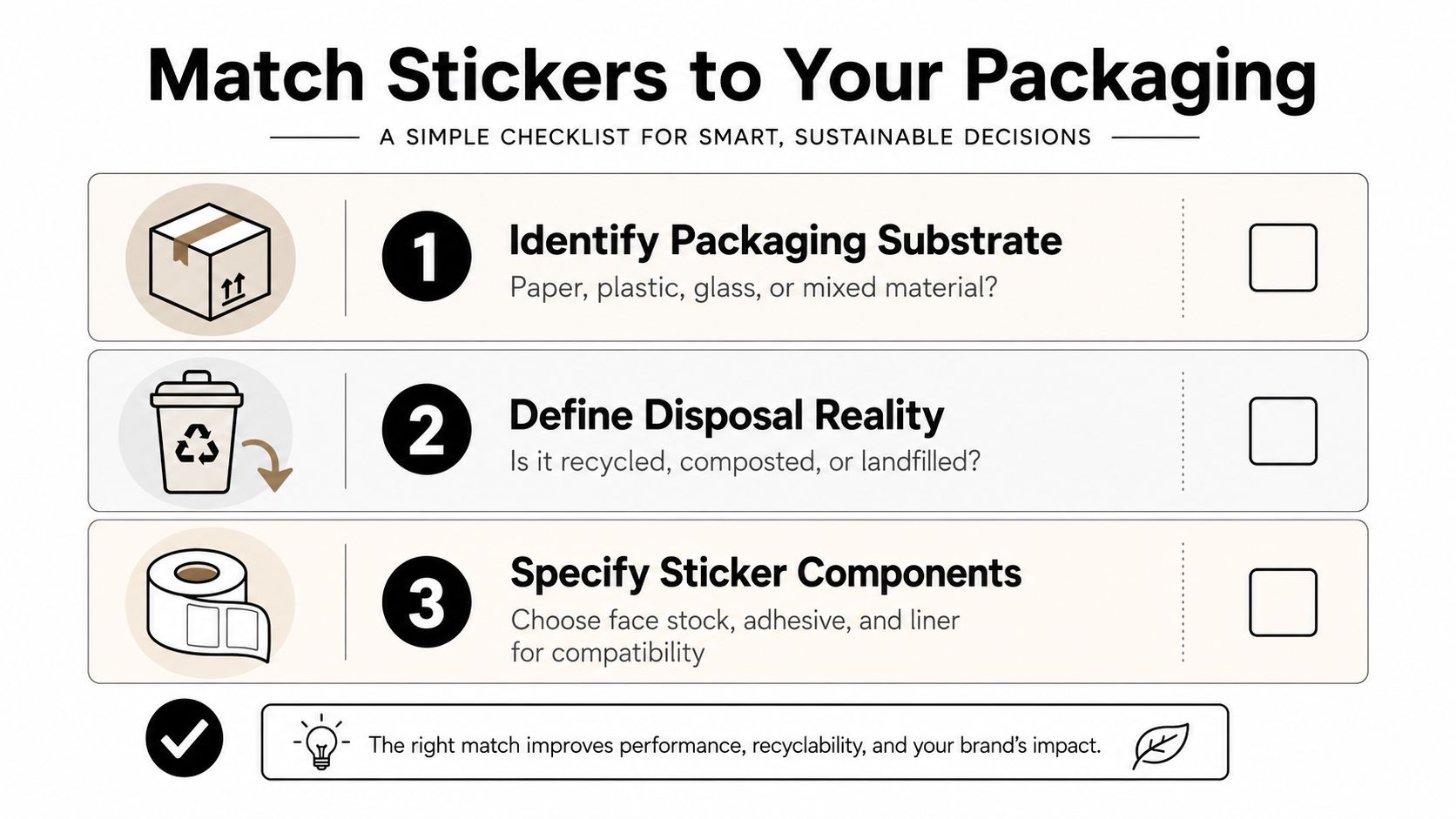
Start with the package, not the sticker catalog. A supplier can offer recycled paper, compostable film, or bio-based adhesive, but the right selection depends on the substrate and the disposal route that customers can use.
Identify the packaging substrate
Write down whether the sticker will go on paper, corrugated cardboard, PET, glass, or a mixed-material package. The same adhesive can behave differently across surfaces, and a label designed for paper recycling isn't automatically appropriate for plastic recycling.
For paper and corrugated packaging, ask for a recycling-compatible adhesive and a liner with a realistic recovery option. For PET bottles, ask specifically whether the adhesive is designed to wash off during the relevant recycling process. For glass, focus on removal, residue, durability, and whether the bottle is intended for reuse or recycling.
If your products use containers that must survive repeated handling, a guide to durable glassware stickers offers useful application context. Durability isn't a sustainability failure when it prevents labels from peeling, smearing, or requiring replacement during the intended use.
Define the disposal reality
Separate the intended route from the route you wish existed. If customers place the package in paper recycling, specify components that support that stream. If the package is certified compostable and commercial composting is available, choose a fully certified compostable sticker system. If neither route is reliably available, avoid presenting the sticker as compostable or recyclable without qualification.
Consumers need clear directions, too. 54% of consumers check labels for recycling instructions before disposal, according to the industry source summarized by UPM. A short instruction such as “remove before recycling” or “commercial composting only” can prevent a technically sound material from entering the wrong bin.
Verify every component
Request documentation for the face stock, adhesive, ink, coating, and liner. Look for BPI verification in North America, and EN 13432 or relevant TÜV certification in European systems. Don't accept “biodegradable” as a complete answer. Ask where it breaks down, under what conditions, and whether the adhesive is covered by the certification.
For shipping materials, a resource on the eco-friendly shipping box can help you evaluate the box and the label as one packaging system. That mindset prevents a recycled carton from carrying a sticker that undermines its recovery route.
Real Brands Making Smart Sustainable Sticker Choices
Good sustainable choices often look less glamorous than a broad “biodegradable” claim. The strongest examples specify the entire system and accept trade-offs openly.
EcoEnclose's “Zero Waste” stickers use 100% post-consumer waste paper and a release liner made from 100% recycled paper that is curbside recyclable with paper products, according to the company's custom sticker specifications. That approach prioritizes compatibility with paper recycling rather than treating recycled face stock as the whole sustainability story. It's a useful model for brands sealing corrugated mailers, paper boxes, or other fiber packaging.
A certified compostable adhesive route
StickerGizmo takes a different path with biodegradable recycled paper labels. Its product uses recycled paper with a compostable, biodegradable permanent adhesive that isn't fossil-fuel derived, and the company states that the label carries EU Ecolabel certification alongside adhesive certification to EN 13432, as described in its bio recycled paper label materials.
That specification suits a brand with a genuine composting pathway and the budget and supply-chain discipline to maintain certification. The permanent adhesive may support product performance, but the compostability claim still depends on the complete labeled system and the disposal conditions communicated to customers.
A transparent compromise
Plan It Green Printing offers another instructive example. Its recycled paper labels use an aggressive water-based acrylic emulsion adhesive, but the company explicitly states that the adhesive itself isn't certified compostable. It also says the paper can go in the paper recycling bin and that the toner inks are certified compostable to standards including TÜV EN 13432 and ASTM 6400, according to its recycled paper label details.
That distinction matters. The label may be appropriate for paper recycling, but the ink certification doesn't turn the adhesive into a compostable adhesive. Clear limits are more useful than a sweeping claim that invites customers to put the product in the wrong waste stream.
Supporting companies that care about these details helps create demand for better liners, adhesives, documentation, and recovery systems. Small brands can ask suppliers for samples, test labels through shipping and handling, and choose a documented compromise instead of rewarding vague marketing.
Design and Printing Considerations for Eco Friendly Labels
Sustainability decisions continue into artwork and production. Water-based and soy-based inks can support a lower-impact print specification, but the ink choice must still be considered alongside the face stock, adhesive, coating, and disposal route. Simple artwork can also reduce unnecessary layers, heavy coverage, and finishes that complicate recovery.
Release liners deserve special attention. Europe generates over 1 million tons of release liner waste annually, according to the industry source summarized by UPM. Linerless labels can reduce label waste by up to 40%, while organized recovery programs such as CELAB give participating converters a route for collecting and recycling liner material. These figures and examples come from the same industry coverage, and they show why the backing sheet shouldn't disappear from your procurement conversation.
Ask your printer practical questions before approving artwork:
- Ink system: Are the inks water-based, soy-based, or otherwise documented for the intended recovery route?
- Finish: Do you need a laminate, or will an uncoated stock perform adequately?
- Liner: Can the supplier provide recycled content, linerless construction, or a recovery option?
- Application: Will the sticker face moisture, friction, refrigeration, or outdoor exposure?
- Claim language: Can the disposal instruction be printed clearly without overstating compostability?
Brands exploring flexible production models can also review this guide to eco friendly print on demand for broader printing considerations. The same discipline applies to stickers: test the finished item, document the components, and communicate the disposal route plainly.
Your final artwork should make responsible disposal easier, not merely decorate the package. Choose the smallest practical label, avoid unnecessary coatings, and ask for a physical sample before committing to a run. Fillaree offers refillable home and body essentials through refill stations, home refills, and recyclable stickers, giving low-waste brands a practical example of how packaging details can support a broader reuse system. Visit Fillaree to explore refillable soaps, shampoos, conditioners, dish soap, and cleaners designed for lower-waste routines.