
Gentle All Purpose Cleaner: What It Is and How to Choose
You've probably done this today. Dinner's over, there's a stripe of olive oil near the stove, a sticky ring from the jam jar on the counter, and somebody has already touched the fridge handle with questionable hands. You want one spray bottle that cleans it up fast, doesn't leave your skin feeling stripped, and doesn't make the kitchen smell like a chemistry lab.
That's where a gentle all purpose cleaner earns its keep.
Most guides stop at “choose plant-based ingredients” and call it a day. That's not enough. A cleaner can sound wholesome and still be irritating, streaky, too weak for greasy messes, or packaged in a way that creates more waste than it saves. What matters is how the formula works, where it sits on the pH scale, what the label promises, and whether the refill system makes sense in real life.
Table of Contents
- What a Gentle All Purpose Cleaner Actually Is
- What's Inside the Bottle and Why It Matters
- The Role of pH in Everyday Cleaning
- Cleaning Power Without Harsh Chemistry
- Reading Labels and Certifications With Confidence
- Refill Systems and Real-World Waste Reduction
- Choosing the Right Gentle Cleaner for Your Home
- Smart Usage and Storage Habits That Last
What a Gentle All Purpose Cleaner Actually Is
A gentle all purpose cleaner is the bottle for the messes that happen on repeat. You spray it on the counter after lunch, wipe a smudge off the fridge, clean the sink rim, and move on with your day. It is made for routine soil on hard, sealed surfaces, not for every cleaning problem in the house.
That distinction matters more than the marketing usually admits.
A lot of products get called gentle because they sound plant-based or smell mild. A better definition is functional. A gentle cleaner should remove everyday grime without being unnecessarily rough on skin, indoor air, or the surfaces you use constantly. It should also stay in its lane. Daily cleaning is one job. Removing baked-on grease, mineral scale, or disinfecting after illness is a different job.
Here is the simplest way to picture it. A gentle all purpose cleaner works like a good everyday sponge, not a strip-sanding tool. You want enough bite to lift fingerprints, food splatter, and the film that builds up from normal life, but not so much force that each wipe feels like overkill.
What it should handle well
A solid formula should be comfortable doing jobs like these:
- Greasy fingerprints on cabinets and appliance doors
- Food spots and light splatter on countertops and stovetops
- Toothpaste drips and light bathroom residue around the sink
- Frequent wipe-downs on sealed surfaces used every day
This category gets heavy use in real homes. One NIH/NCBI review citing the EPHECT 2012 report found that all-purpose cleaners are used in kitchens by 84% of users and in bathrooms by 76% across European countries (NIH/NCBI review). If a product shows up that often, the details matter. pH matters. The surfactants matter. The difference between a ready-to-use spray and a concentrated refill matters too.
That last point gets missed all the time. A cleaner is not gentler just because the front label says natural or the bottle looks minimalist.
What a gentle cleaner is not
A gentle all purpose cleaner is usually not the right pick for oven carbon, thick soap scum, mold staining, or a disinfection step after raw meat or stomach bugs. That does not mean the product failed. It means the tool and the task did not match.
People get frustrated here because the phrase all purpose sounds broader than it really is. In practice, it means broad enough for day-to-day household messes, not broad enough to replace every specialty cleaner.
If you like seeing how cleaning pros translate lower-toxicity product choices into actual household routines, this guide to pro natural cleaning in Palm Beach County gives a useful outside view.
Why the definition should be tighter
“Gentle” should not be vague or purely emotional. It should point to a formula built for repeated indoor use, frequent contact with common surfaces, and enough cleaning strength to handle ordinary mess without resorting to harsher chemistry. That is why this topic goes beyond ingredient buzzwords. The useful questions are more concrete. Is the pH in a surface-friendly range for routine cleaning? Are the surfactants mild but effective? Does the product meet meaningful safety screens, such as EPA Safer Choice ingredient standards? If it comes in a refill format, does the concentration reduce packaging and shipping waste?
Those are the questions that separate a nice-sounding spray from a well-built cleaner.
What's Inside the Bottle and Why It Matters
Turn a cleaner bottle around and the ingredient panel can look either reassuring or completely cryptic. The easiest way to read it is by function. Most formulas are built in layers. One set of ingredients loosens grime, another helps them work better, another keeps the product stable in the bottle.
The jobs ingredients do
| Ingredient Type | What It Does | Watch For |
|---|---|---|
| Surfactants | Lift dirt and oily film so you can wipe it away | Vague naming, harsher sulfate-heavy choices in stronger formulas |
| Builders | Help in hard water and support cleaning | Ingredients that may not suit every surface if the formula leans too aggressive |
| Solvents | Dissolve greasy or sticky residue | Stronger solvent smell or residue if overused |
| Preservatives | Keep mold and bacteria from growing in the bottle | Sensitivity in some users |
| Fragrance or essential oils | Add scent or mask base-ingredient odor | Hidden sensitivity triggers |
The heavy lifters in a gentle cleaner are usually the surfactants. These are the molecules that grab onto grease with one end and water with the other, so the mess can be lifted off the surface instead of smeared around. Mild nonionic surfactants, including glucoside types, are common choices when a brand wants broad surface compatibility.
Builders matter too. Ingredients such as sodium citrate can help when your tap water is mineral-heavy, because hard water can tie up surfactants and make a cleaner feel weaker than it really is.
Where sensitivity often hides
A “gentle” label doesn't guarantee a universally easy formula. A few common pressure points deserve a closer look:
- Fragrance blends can be the biggest mystery on the label because the single word doesn't tell you much.
- Preservatives are necessary in water-based cleaners, but some people react to them more than they react to the cleaning agents.
- Essential oils sound natural, but “natural” and “non-irritating” are not the same thing.
Some of the mildest-feeling cleaners on a counter get that way from careful surfactant balance, not from trendy scent ingredients or a long list of botanicals.
Concentrates shift this picture. A ready-to-use spray is mostly water by design, while a concentrate packs more of the functional ingredients into a smaller volume. That can reduce shipping weight and packaging churn, but it also means dilution matters. Use too much concentrate and you can create streaking, residue, or unnecessary skin contact.
If you want a closer look at one mild surfactant family often used in lower-impact formulas, Fillaree's piece on caprylyl/capryl glucoside is a helpful ingredient-level explainer.
Good products and good companies
There are solid options in this category from companies that try to align formula choices with packaging choices. That matters. A bottle that sounds gentle but relies on vague ingredient language or disposable-heavy packaging only solves part of the problem. Supporting good companies who care usually means looking at the full picture: formula disclosure, refillability, and whether the product is honest about what it can and can't do.
The Role of pH in Everyday Cleaning
You spray the kitchen counter after making lunch, then wipe a bathroom sink an hour later. Same bottle, different messes. Whether that cleaner feels gentle or harsh often comes down to one quiet detail in the formula: pH.
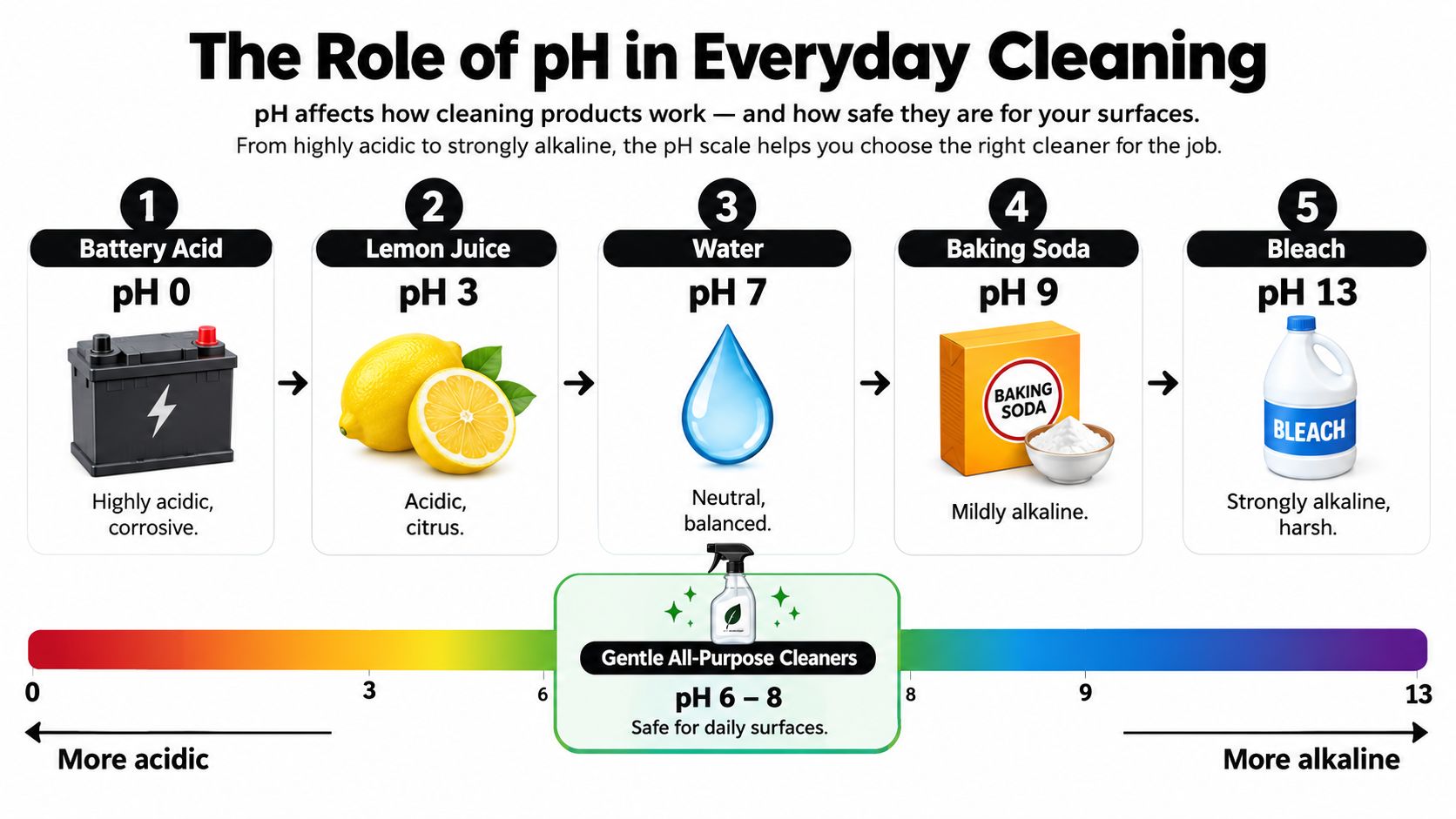
pH measures how acidic or alkaline a product is. On one end are acidic materials like lemon juice. In the middle is plain water. On the alkaline side, baking soda is mild and bleach is much stronger. For everyday cleaning, pH acts a lot like volume on a speaker. Turn it too high or too low, and the product may do more than the job calls for.
Where gentle cleaners usually land
A gentle all purpose cleaner usually sits close to neutral, often around pH 6 to 8. Broader general-purpose cleaners can extend further into mild alkalinity, roughly pH 7.5 to 10.5, because more alkaline formulas often cut oily soil faster (pH and cleaning overview).
That near-neutral range is popular for a practical reason. It works across the places people clean every day without pushing too hard on hands or common household surfaces. If your home has sealed wood, painted cabinets, laminate, stone-look finishes, stainless, and plastic all within a few steps of each other, moderation matters.
Why pH is only part of the story
pH matters, but it is not the whole formula.
A product can be near neutral and still clean well if the surfactants are chosen carefully and used at the right level. Those ingredients lift grease and food residue off a surface so your cloth can carry them away. Mild alkalinity can help with oily or protein-heavy messes, which is why many daily cleaners sit just a little above neutral instead of matching water exactly.
That is also why "plant-based" does not tell you enough. Two cleaners can both use plant-derived ingredients and behave very differently if one is pushed higher in pH or uses a harsher overall system. EPA Safer Choice screening looks at ingredient safety thresholds ingredient by ingredient, which gets much closer to what readers want to know than a soft marketing claim on the front label.
The tradeoff people miss
Higher pH often brings more bite. It can also bring more dryness on hands and more risk for finishes that do better with a gentler touch.
Lower pH has its own lane. It can help with mineral residue or soap film, but it may struggle with greasy stovetop splatter. That is why one bottle cannot be perfect at every job. A gentle all purpose cleaner is usually built for daily soils across mixed surfaces, not for the heaviest grease or thick limescale.
For most homes, near-neutral to mildly alkaline is the useful middle ground. It is the cleaning equivalent of a good everyday shoe. Comfortable enough to wear often, sturdy enough for regular use, and not overbuilt for chores that call for a more specialized tool.
Cleaning Power Without Harsh Chemistry
A lot of people hear “gentle” and think “not strong enough.” That mixes up two different jobs: cleaning and disinfecting.
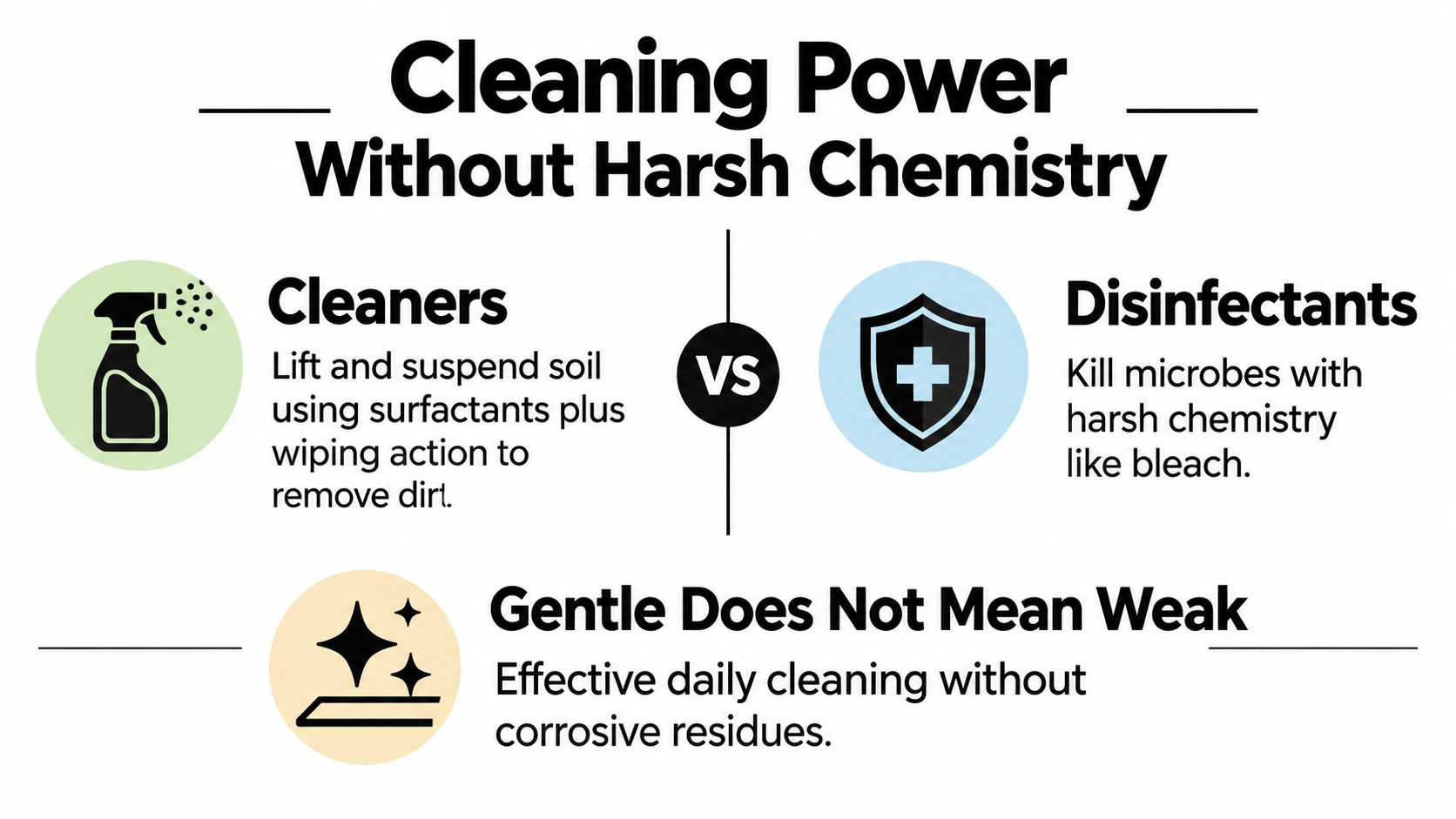
A cleaner removes soil. It loosens grease, food residue, dried splatter, and some microbes through chemistry plus wiping. A disinfectant is a different kind of product. It's meant to kill germs under specific label conditions.
Public-health guidance is pretty clear on that split. Regular cleaners remove soil, while disinfectants or disinfectant cleaners are needed to kill germs. The American Cleaning Institute notes that disinfectants are required to destroy 99.999% of pathogens within roughly 5 to 10 minutes, and sanitizers within about 30 seconds under label conditions (cleaning and health FAQ).
Most daily messes are soils first
Crumbs, grease haze, soap residue, coffee drips, toothpaste, tracked-in dirt. These are cleaning problems before they're disinfection problems.
That means a gentle cleaner can be exactly right for the majority of your routine wiping. It doesn't need bleach, quats, or heavy antimicrobial chemistry to do that job well. It needs enough surfactant action, the right solvent balance, and a cloth that picks the mess up.
Here's a useful visual example from retail labeling. Some all-purpose products are marketed to kill 99.9% of viruses and bacteria, while EPA-regulated disinfectant claims usually name specific organisms and exact contact times such as 10 or 30 seconds (product example showing disinfectant-style claims). That's a reminder to read the front label carefully. “Cleans and freshens” is not the same as “disinfects.”
How to get better results with a mild formula
Gentler chemistry often asks you to clean a bit smarter.
- Let it sit briefly so the formula can loosen the mess
- Use microfiber so the soil gets lifted instead of smeared
- Match the tool to the job because a textured cloth beats paper towel on sticky residue
- Reserve stronger products for burnt-on grease, mineral crust, or true disinfection needs
If you're cleaning items outside the usual kitchen-and-bathroom routine, product choice matters even more. For example, gardeners often need a different level of sanitation and residue control on tools and pots, which is why this guide on how to sterilize gardening tools is a useful companion read.
Reading Labels and Certifications With Confidence
Cleaner labels mix useful information with a lot of soft-focus language. “Natural,” “plant-powered,” and “non-toxic” may sound comforting, but they don't tell you much by themselves. What helps more is a certification with a real review standard behind it.
The label that does the most work
EPA Safer Choice is one of the clearest signals on a cleaner bottle. EPA says every ingredient in a labeled product must meet strict safety criteria, including review for carcinogenicity, reproductive and developmental toxicity, aquatic toxicity, and environmental persistence (EPA Safer Choice).
EPA's standard also includes hard ingredient thresholds. Ingredients with acute aquatic toxicity values at or below 10 ppm are not acceptable, and acceptable ingredients must avoid persistence, bioaccumulation, and aquatic toxicity above the program's limits (EPA Safer Choice Standard).
That's the difference between marketing language and a meaningful screen. A bottle can call itself fresh, green, or natural with almost no useful explanation. It can't carry Safer Choice without meeting a defined review framework.
What common certifications actually cover
| Certification | Focus Area | Trust Level |
|---|---|---|
| EPA Safer Choice | Human health and environmental ingredient screening | High for formula safety review |
| USDA Certified Biobased | Renewable carbon content | Useful, but not a safety signal by itself |
| Green Seal | Environmental and performance criteria | Helpful when paired with ingredient transparency |
| ECOCERT | Ingredient and process standards, often with a natural-products lens | Helpful, depends on product category |
| Brand-created claims like “natural” | Marketing language | Low unless backed by specifics |
A fast label check
When you're standing in the aisle, check for these in under half a minute:
- Certification first. Safer Choice tells you more than “clean ingredients.”
- Ingredient disclosure next. A fuller ingredient list is a good sign.
- Fragrance wording. Fragrance-free or clearly disclosed fragrance is easier to evaluate than mystery scent language.
- Surface fit. Make sure the product is meant for the surfaces you clean every day.
If you want a good reality check on how sustainability language gets stretched on packaging, Fillaree's guide on how to avoid greenwashing is worth a read.
Refill Systems and Real-World Waste Reduction
Refillable cleaners sound simple. Buy one bottle, refill it, use less plastic. The basic idea is solid. The answer, though, depends on concentration, shipping weight, whether you reuse the bottle, and what happens to the refill packaging afterward.
What refill systems do well
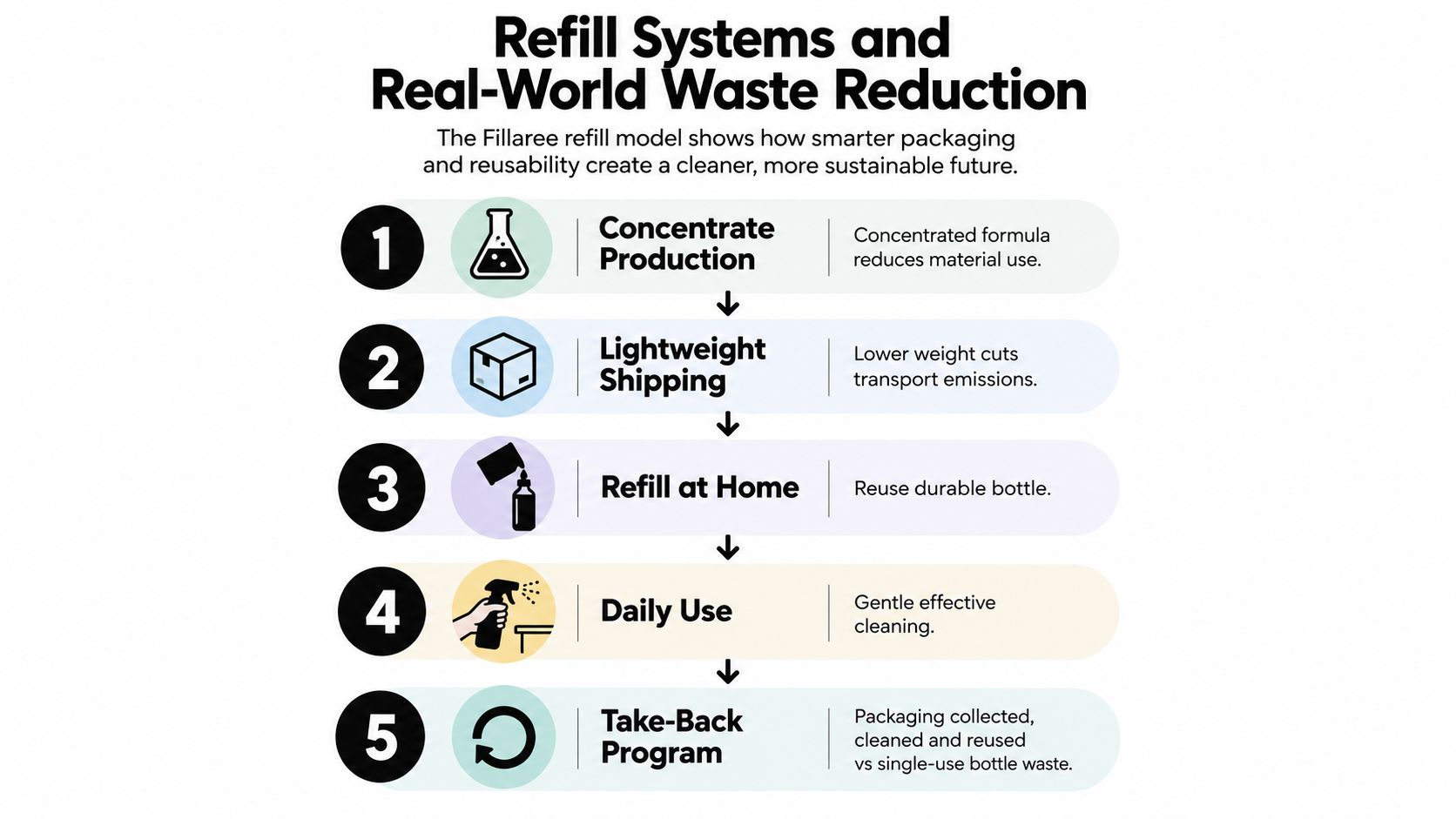
A durable spray bottle can interrupt the cycle of repeatedly buying and discarding ready-to-use bottles. Concentrates, refill pouches, and waterless formats also reduce the amount of water shipped from one place to another. That matters because with cleaners, a lot of what gets shipped is often just diluted product.
The cleaning industry's Circular Packaging goal frames the issue in a useful way: reduce virgin material per dose by increasing post-consumer recycled content, increasing concentration, or using less packaging, and make 100% of cleaning-product packaging recyclable or reusable (Circular Packaging goal).
Where the honest tradeoffs are
Refills don't automatically win in every situation.
- Bottle reuse has to happen. If the reusable bottle gets tossed early, the system loses much of its value.
- Shipping distance matters. Lightweight concentrates help, but shipping still has a footprint.
- User behavior matters. Tablets and concentrates ask people to measure, dilute, and store things properly.
- Convenience counts. If a refill system is too fussy, some households drift back to single-use bottles.
Refill is a behavior loop, not a magic bottle. The product only works as a waste-reduction system if people keep the bottle in service.
A practical example helps here. Fillaree offers home refills for all-purpose cleaner in larger-format boxes and also runs a take-back loop for used refill bags, which are washed, sanitized, and reused. That kind of model tries to address more than just the first bottle. It also looks at the packaging after use. If you're curious how refill stations fit into a lower-waste routine, this explainer on a refill station zero waste approach lays out the logic well.
Values matter here too
Aligned values show up in a practical way. If you're supporting good products and supporting good companies who care, the question isn't only “Is this bottle recyclable?” It's also “Did the company design the system so reuse is likely, easy, and worth sticking with?”
Choosing the Right Gentle Cleaner for Your Home
By the time you've compared labels, the easiest buying method is a short filter. Not every bottle needs to be perfect. It does need to make sense for your surfaces, your skin, and your habits.
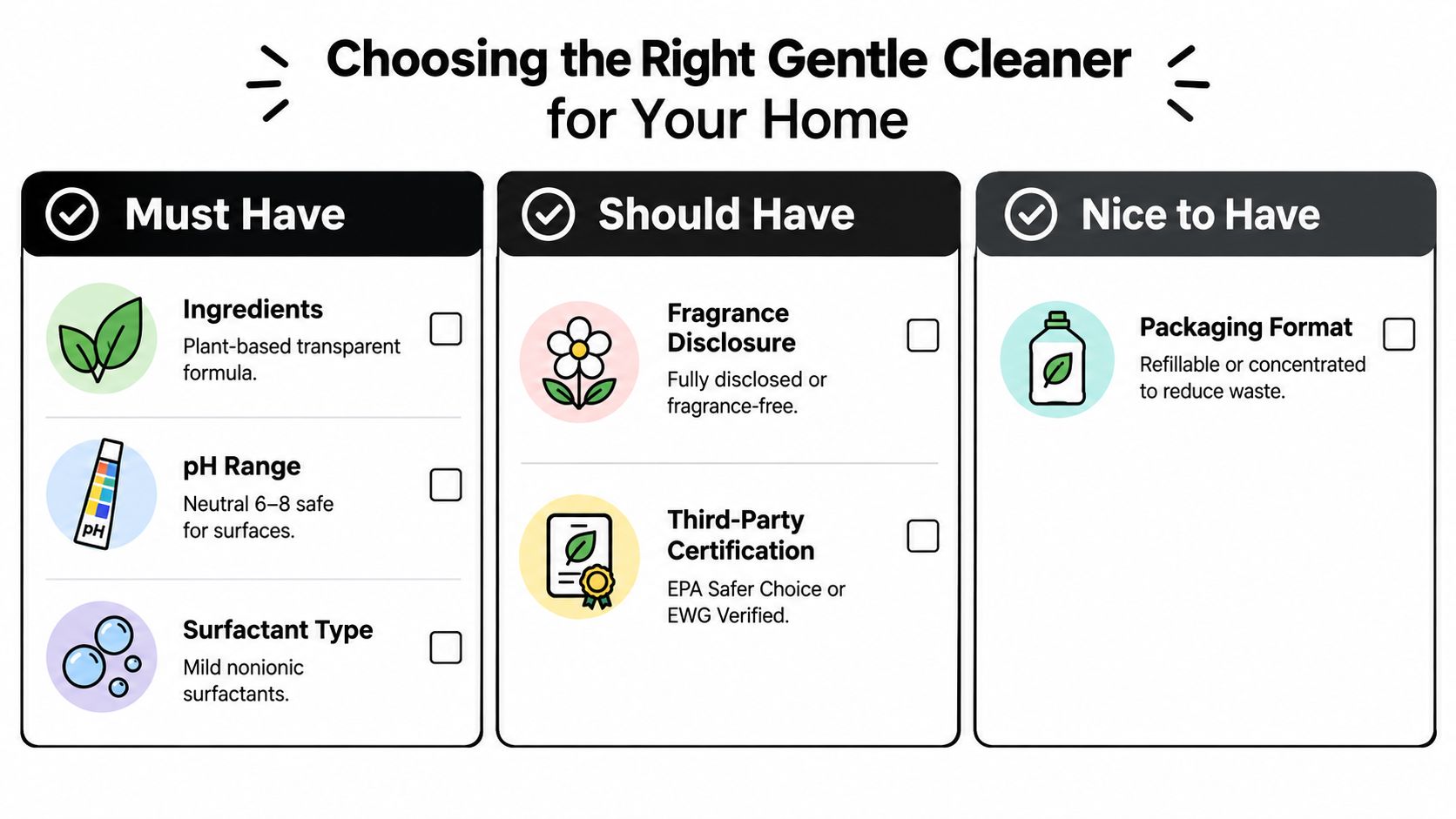
Must-have checks
- A near-neutral formula for routine mixed-surface use
- Clear ingredient disclosure so you're not guessing what's in the bottle
- Mild surfactants rather than a formula that leans on harshness for effect
- An honest use case that says cleaner when it means cleaner, not pretend disinfectant
Should-have features
These aren't mandatory for every home, but they make choosing easier.
A fragrance-free option is useful if you have sensitive skin, scent-triggered headaches, or you clean around food often. A trusted certification helps too, especially if you don't want to decode every ingredient yourself.
For households with sealed stone, finished wood, stainless, pet areas, or kids helping with wipe-downs, surface compatibility matters more than a loud “power clean” claim.
Nice-to-have, but worth paying attention to
Refillable or concentrated formats are worth a look if you'll keep the bottle in rotation. Good product design should fit the way you already clean, not ask you to become a different person.
Some shoppers also care about whether a company's values line up with its packaging and formula choices. That's reasonable. There are plenty of good products on the market, and it makes sense to support good companies who care about transparency, waste reduction, and safer routine use.
Buy the bottle that passes this one-line test: clear ingredients, near-neutral pH, a credible certification if possible, and a refill format you'll actually use more than once.
Smart Usage and Storage Habits That Last
Even a very good cleaner gets judged by how it's used. The two big mistakes are using too much and expecting instant results on a mess that needs a little dwell time.
Use it in a way that helps the formula work
If you're using a concentrate, dilute it as directed and label the bottle clearly. More concentrate doesn't always mean more cleaning. It can mean more streaking, wasted product, and extra residue on the surface you just wiped.
For dried splatter or greasy fingerprints, spray first and give it a short pause before wiping. Pairing a gentle cleaner with microfiber usually improves performance because the cloth physically grabs loosened soil.
- For counters and appliance fronts use a spray-and-wipe approach
- For sticky buildup let the product sit briefly before wiping
- For finished surfaces test first and avoid over-wetting
- For heavier messes use a second pass instead of overloading the first one
Store it like a product you want to keep working
Keep bottles capped, labels readable, and refills sealed. Store them in a cool, dry place away from direct heat. If you keep backups, use older concentrate first so nothing lingers half-open for too long.
Don't mix cleaners with other products, especially bleach or acidic mixtures. Even with a mild formula, basic ventilation is smart in small bathrooms or laundry rooms.
Build a rhythm that keeps stronger products unnecessary
The easiest way to make a gentle all purpose cleaner feel effective is to use it before grime turns into a project. A quick weekly pass on counters, sink edges, handles, and bathroom touchpoints usually prevents the kind of buildup that forces you into stronger chemistry later.
That's the quiet advantage of a good daily cleaner. It keeps routine messes routine.
Fillaree offers refillable, low-waste home and body care, including an all-purpose cleaner made for regular surface cleaning and a circular refill system designed to keep bottles in use longer. If you want a practical way to match gentle cleaning with lower-waste habits, visit Fillaree.