

Gentle Shampoo for Everyday Use That Actually Works
You wash your hair in the morning, step into the day feeling fresh, and then notice the trade-off by afternoon. Your scalp feels tight, your ends feel rough, or your hair has turned into a halo of frizz. Skipping tomorrow's wash doesn't feel realistic, especially if you exercise, work outdoors, have an oily scalp, or prefer the clean feeling.
The problem isn't daily washing by itself. The more useful question is whether your shampoo's pH and cleansing system suit repeated use. A gentle shampoo for everyday use should remove sweat, sebum, and product residue without leaving the scalp uncomfortable or the hair stripped.
This guide keeps the science practical. You'll learn how scalp-friendly pH works, why mild surfactants can still clean effectively, how to choose a formula for your hair and scalp, and how small washing habits can reduce dryness. We'll also connect regular washing with refillable packaging, because a product you use often should fit your values as well as your routine.
Table of Contents
- Introduction to Gentle Daily Washing Without Worry
- What Makes a Shampoo Truly Gentle for Daily Use
- How Mild Surfactants and Moisturizing Ingredients Work Together
- How to Match a Gentle Formula to Your Hair and Scalp Type
- Everyday Washing Routine That Keeps Hair Healthy
- Why Refillable Formats Make Sense for Regular Washers
- Choosing Your Gentle Everyday Shampoo With Confidence
Introduction to Gentle Daily Washing Without Worry
Maya washes her hair most mornings. Her fine hair looks oily after exercise, and her scalp feels better when she removes sweat before work. Yet she's been switching shampoos every few weeks because one leaves her roots clean but her ends brittle, while another feels soft but doesn't remove enough buildup.
That experience is common in principle, even though everyone's hair behaves differently. Washing frequency depends on oiliness, activity, texture, scalp condition, and personal comfort. Guidance cited in hair-care market analysis commonly places normal to oily hair at a wash every 2–3 days, while dry or damaged hair may be washed every 3–5 days (Market.us' sulfate-free shampoo market analysis). Those ranges are useful reference points, not rules you have to force onto your own head.
A person with an oily scalp may comfortably use a mild shampoo every day. Someone with dry, inflamed, or highly sensitive skin may need fewer washes and a more protective routine. The label “gentle” can't decide that on its own.
Practical rule: Judge a shampoo by how your scalp and hair feel after repeated washes, not by how luxurious the lather feels during one shower.
The market's direction supports this shift in thinking. Independent estimates place the sulfate-free shampoo category at roughly USD 4.2 billion to USD 5.7 billion in 2024–2025, with projections of about USD 8.2 billion to USD 10.6 billion by 2030–2034, depending on the provider and forecast period (Straits Research). Those figures don't prove that every sulfate-free product is suitable for every scalp, but they do show how mildness and ingredient awareness have become mainstream concerns.
A good everyday choice starts with three filters: pH compatibility, a mild surfactant system, and a formula matched to your scalp. From there, technique matters. So does packaging. If you wash regularly, refillable shampoo can reduce the stream of single-use bottles leaving your bathroom.
What Makes a Shampoo Truly Gentle for Daily Use
A gentle shampoo does more than avoid a short list of ingredients. It cleans the scalp while respecting the conditions that help hair and skin remain comfortable.
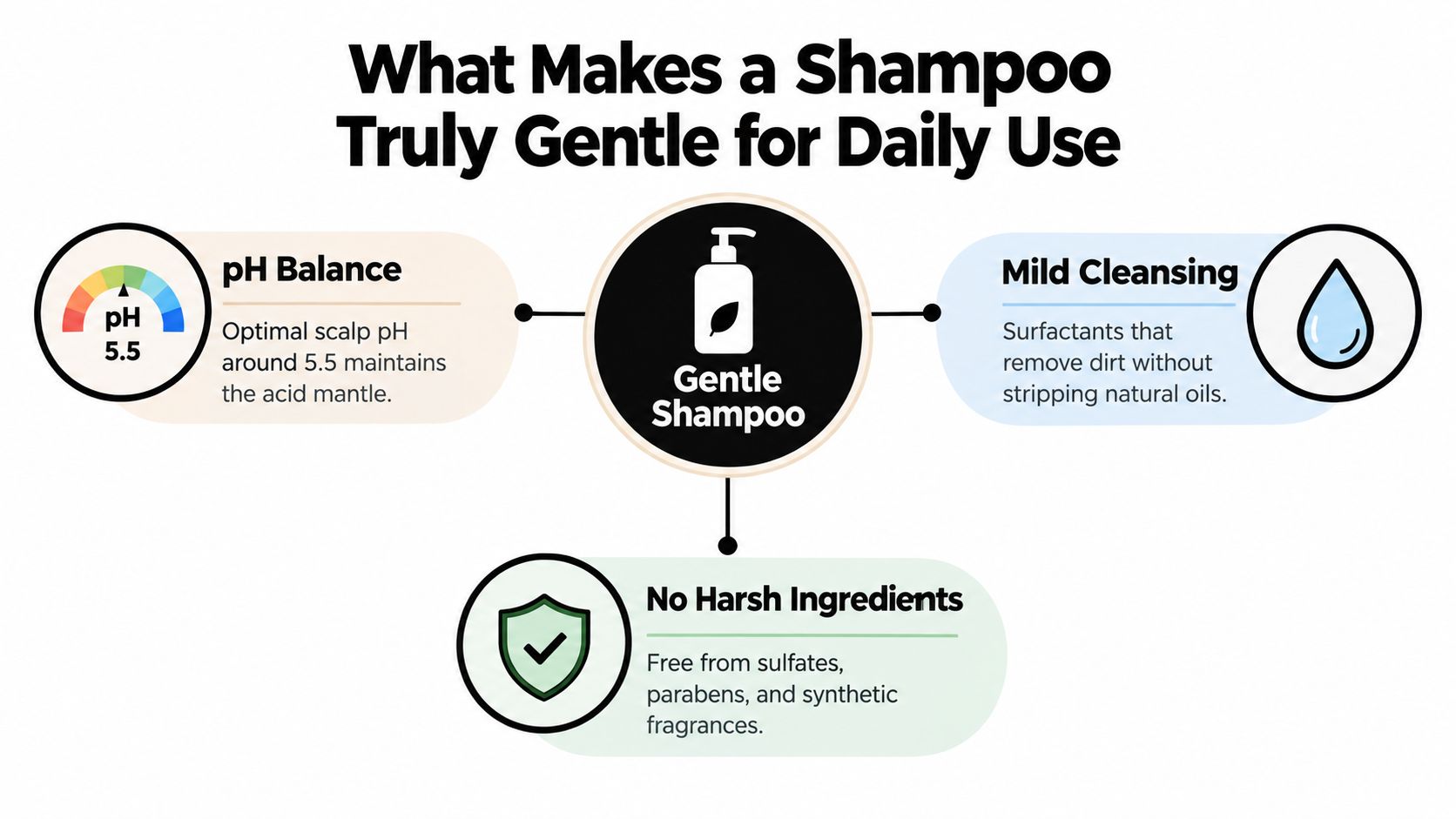
The scalp's pH is reported at about 5.5, while the hair shaft is reported at around 3.67. Dermatology literature identifies low-pH shampoo as pH 5.5 or lower, and explains that formulas above the scalp's acidic range can increase cuticle swelling and roughness (dermatology literature on shampoo pH).
Think of the scalp's acid mantle as a thin protective raincoat. It doesn't stop every drop from touching your skin, but it helps the surface manage moisture and outside irritants. A shampoo that sits close to scalp acidity is less likely to push that surface toward the tight, squeaky feeling many people associate with over-cleansing.
For routine washing, a defensible pH target is about 4.5–5.5, particularly for sensitive, dry, color-treated, or chemically processed hair.
pH isn't the only consideration. The cleansing agents, or surfactants, determine how strongly a shampoo lifts oil and soil. A high-detergency system can produce dramatic foam and a very clean sensation, but it may also remove more of the scalp's natural oils than you need for repeated washing.
A mild cleanser can still be effective. The aim isn't to leave sebum and sweat behind. It's to remove what needs removing without repeatedly disturbing the scalp's moisture balance.
The three useful label checks
Start with the pH if the manufacturer provides it. A clearly stated pH near the scalp's acidic range gives you more information than vague wording such as “pure,” “clean,” or “natural.”
Next, look at the cleanser blend. Amphoteric surfactants are often used in gentle formulas because they can cleanse with a softer feel than a shampoo built around aggressive detergency. You're looking for a balanced system, not the absence of one ingredient family.
Finally, consider potential irritants. Sensitive-scalp shoppers often prefer fragrance-free, dye-free formulas with fewer botanical extras and essential oils. A dermatologist-positioned example from CeraVe lists its gentle shampoo as free from fragrance, parabens, sulfates, dyes, formaldehyde releasers, botanical extracts, essential oils, and harsh cleansing agents, while also describing it as pH balanced and dermatologist tested (CeraVe Gentle Hydrating Shampoo).
How Mild Surfactants and Moisturizing Ingredients Work Together
Two shampoos can both promise gentleness and feel completely different. The reason often lies in how the formula balances cleansing power with moisture support.
A stronger detergent system grabs oil efficiently. That can help after heavy styling products, swimming, or a sweaty workout, but it may leave fine hair squeaky and dry hair rough. A mild system takes a more measured approach. It lifts sebum and soil while aiming to leave more of the hair's natural comfort behind.
Expert formulation reviews highlight amphoteric surfactants, including cocamidopropyl betaine, as useful for moderate cleansing and moisture retention. Pairing an amphoteric surfactant with a smaller amount of an anionic surfactant can improve foam without relying entirely on a harsh-feeling cleanser (shampoo pH and ingredient guidance).
| Cleansing approach | What it does well | What to watch for |
|---|---|---|
| High-detergency cleanser | Removes heavy oil and buildup quickly | May leave frequent washers with tightness or dry lengths |
| Mild amphoteric system | Cleans everyday soil with a softer feel | May need careful technique when buildup is heavy |
| Blended surfactant system | Balances foam, cleansing, and comfort | The full ingredient list matters more than one “hero” ingredient |
A gentle shampoo for everyday use shouldn't be confused with a shampoo that barely cleans. If your roots still feel coated after rinsing, the issue may be product amount, water quality, styling buildup, or a formula that's too mild for your particular routine.
Moisture support gives the cleanser room to work
Moisturizing ingredients help the hair cope with repeated cleansing. Humectants such as glycerin and panthenol attract and retain moisture, while conditioning materials can help the hair shaft feel smoother after washing. Lipid-supporting ingredients, including ceramides and fatty acids, are used to help protect the hair's surface.
These ingredients don't cancel out an overly aggressive cleanser. They work as part of the overall design. A shampoo with mild surfactants, moisture-supporting ingredients, and compatible pH is more likely to feel balanced over time than one that depends on powerful cleansing alone.
For another ingredient perspective, Fillaree's discussion of caprylyl capryl glucoside in shampoo offers a useful example of how a plant-derived cleansing ingredient can fit into a broader formula conversation. The important habit is to assess the complete product rather than treating “plant-based” as an automatic synonym for gentle.
A short demonstration can also make the process easier to understand:
How to Match a Gentle Formula to Your Hair and Scalp Type
The right shampoo depends on what your scalp does and what your lengths need. Fine, oily hair may need frequent root cleansing, while thick, dry curls may need less disruption and more attention to conditioning. Color-treated hair often benefits from a lower-stripping approach because repeated harsh cleansing can make the hair feel rough and affect how long color looks fresh.
Use observable signs instead of relying on the front label. If your scalp feels oily soon after washing, focus on cleansing balance. If it feels tight, itchy, or uncomfortable, reduce potential irritants and examine your wash frequency. If your ends tangle or frizz, your shampoo may be spreading too far down the hair.
| Hair and Scalp Profile | Best Gentle Formula Traits | Daily Use Guidance |
|---|---|---|
| Fine hair with an oily scalp | Light conditioning, mild but effective surfactants, no heavy residue | Daily use may suit you if roots become oily quickly; watch for limpness or buildup |
| Thick or coarse hair | Moisture-supporting ingredients, creamy conditioning, mild cleansing | Wash as often as comfort allows, keeping cleanser focused at the scalp |
| Dry or damaged hair | Low-irritant formula, moisture support, pH close to scalp acidity | Consider less frequent washing if daily use creates tightness or rough ends |
| Color-treated or chemically processed hair | Mild surfactants, pH-conscious design, conditioning support | Keep shampoo mainly at the roots and protect the lengths with conditioner |
| Sensitive scalp | Fragrance-free, dye-free, low-irritant ingredients | Start with less frequent washing if irritation appears, and stop products that sting |
| Curly or textured hair | Gentle cleansing, slip, and enough moisture for detangling | Use scalp-focused washing and avoid rough handling of the lengths |
How to read your own feedback
A shampoo is probably a workable match when your scalp feels clean but not tight, your roots don't become coated, and your lengths remain manageable after conditioning. One wash can be misleading, especially if you're changing several products at once.
Give yourself a simple observation period. Notice whether discomfort appears immediately, whether frizz worsens after repeated use, and whether the scalp becomes oilier because you're compensating for dryness with extra product or frequent touching.
Sensitive-skin shoppers may find it useful to compare fragrance-free options, such as this guide to fragrance-free shampoo for sensitive skin. If burning, persistent itching, rash, or unusual shedding appears, discontinue the product and seek professional medical advice rather than trying to scrub the problem away.
Everyday Washing Routine That Keeps Hair Healthy
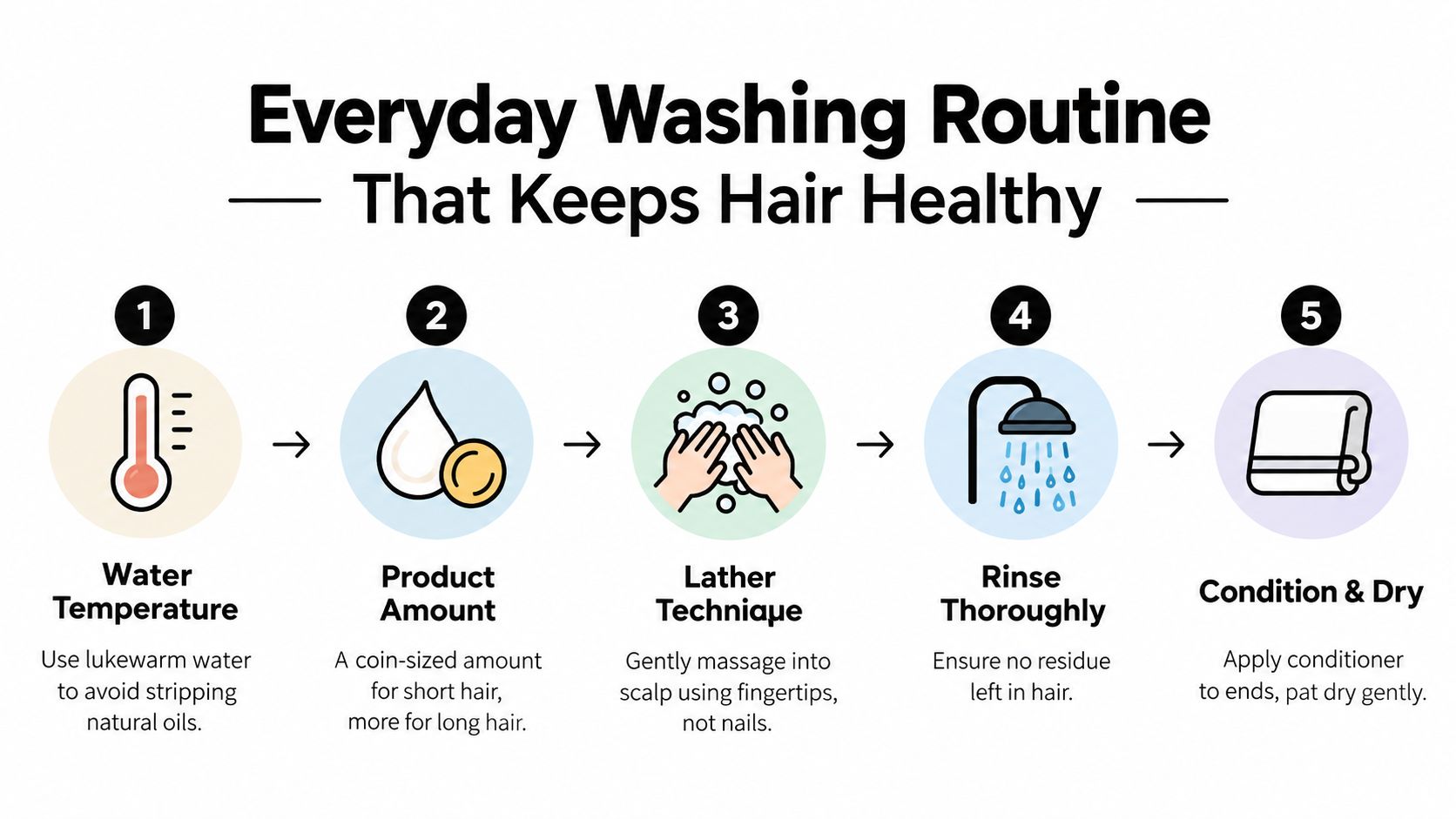
A mild formula works best with a mild technique. You don't need a complicated bathroom ritual, but you do need to keep the cleanser where it belongs, rinse thoroughly, and handle wet hair with care.
A calmer wash from start to finish
- Wet with lukewarm water. Very hot water can leave the scalp and lengths feeling drier. Lukewarm water gives you a comfortable starting point without turning the shower into a stripping treatment.
- Use a modest amount. A coin-sized amount can suit short hair, while longer or denser hair may need more. Start small and add only if the scalp isn't fully covered.
- Massage the scalp with fingertips. Spread shampoo across the roots and use the pads of your fingers, not your nails. Let the lather move through the lengths as you rinse instead of scrubbing the ends directly.
- Rinse until the water runs clear. Residue at the scalp can feel like oil or itchiness later. Spend enough time rinsing around the hairline, crown, and behind the ears.
- Condition the ends. Apply conditioner from the mid-lengths downward, adjusting for your texture. Fine hair may need a lighter application, while dry or curly hair may benefit from more slip.
Pat hair with a towel rather than twisting it tightly. If you use a brush, wait until the hair is less fragile or choose a tool designed for detangling wet hair. For a small upgrade to the practical side of your routine, you can find organic bath accessories from Comfort Pure, including items that support gentler handling and a lower-waste bathroom.
Tomorrow morning's checklist: Lukewarm water, shampoo at the scalp, fingertips instead of nails, a complete rinse, conditioner on the lengths, and gentle drying.
If your scalp feels tight, reduce product and consider washing less often. If roots feel greasy, improve the massage and rinse before assuming you need a stronger cleanser. If frizz appears, keep shampoo off the ends and improve conditioning and drying technique first.
Why Refillable Formats Make Sense for Regular Washers
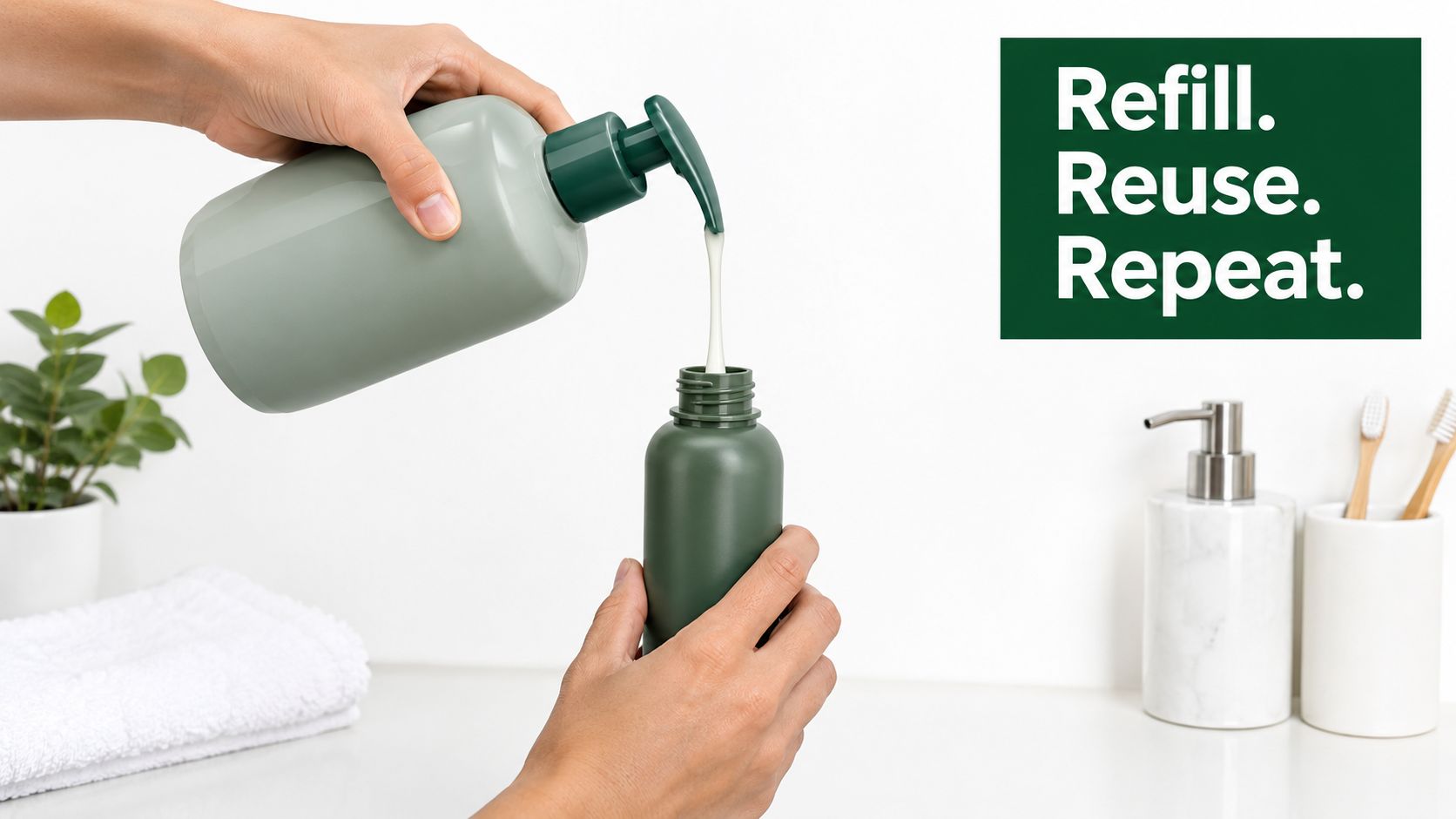
Everyday shampoo creates a packaging question as well as a hair-care question. The more often you replace a bottle, the more useful a refill system becomes, because the same container can stay in service while the product arrives in a lower-waste format.
Independent sustainability coverage reports that refill models can reduce plastic waste by 20%–60% over a product's lifetime, while some systems report reductions of up to 80% in plastic waste and nearly 50% in CO₂ emissions across production and distribution (refill-system sustainability coverage). The exact result depends on the packaging, transport, reuse behavior, and recovery process, so refill claims deserve careful attention rather than blanket assumptions.
A major beauty company's refillable shampoo system claims that one refill uses 82% less plastic than two 250 ml shampoo bottles, with the same format reusable repeatedly (Kérastase refillable packaging information). The practical lesson is straightforward. A reusable dispenser matters most when you keep using it and refill it instead of treating it as a decorative second bottle.
A refill habit that fits real homes
Fillaree is a women-owned, Durham-based maker of refillable, low-waste home and body essentials. Its system includes refill stations, home 0.5-gallon boxes, subscriptions, and a take-back process for used refill bags. The company says those bags are washed, sanitized, and reused at no cost to the customer, which gives regular washers a way to connect product use with material recovery.
Local access can make the habit easier. Customers can use 70+ partner stations across the United States or visit Fillaree's Durham storefront, while home refills can top up standard 8 oz bottles up to eight times, according to the publisher information provided for this article. Those are practical options for households that want a consistent gentle shampoo for everyday use without adding a new disposable bottle to every purchase.
The values matter too. Supporting good companies who care means asking whether a product is effective, whether its packaging has a realistic second life, and whether the business makes its reuse system convenient enough for ordinary people. Refill subscriptions and local bulk stations work best when they remove friction, not when they demand perfection.
For a closer look at the bathroom hardware that makes repeated refilling easier, see Fillaree's guide to a refillable shampoo dispenser.
Choosing Your Gentle Everyday Shampoo With Confidence
Choosing well doesn't require memorizing every ingredient name. Use three filters.
First, check pH compatibility. A formula around the scalp's acidic range, commonly discussed as about 4.5–5.5 for routine use, is a sensible starting point for frequent washing, especially when your scalp or hair is sensitive. If the brand doesn't disclose pH, look for clear formulation information and pay close attention to how your scalp responds.
Second, look at the cleansing system. Mild amphoteric surfactants, balanced blends, and moisture-supporting ingredients can clean without making “squeaky” hair the goal. Sulfate-free positioning can be useful, but it isn't a complete guarantee of gentleness, so read the broader formula and watch your results.
Third, match the product to your scalp. Oily roots, dry ends, fine strands, curls, color-treated hair, and fragrance sensitivity all call for different compromises. A good product should leave you clean and comfortable, not merely foamy.
Practical examples can help you compare alternatives without buying blindly. If you're exploring similar hair-care categories, this roundup of 5 dupes for The Inkey List hair can provide additional ideas, but use the same pH, surfactant, and sensitivity checks for every option.
A refillable bottle can then turn a product you already trust into a steadier low-waste habit. Choose companies that care about formula performance, packaging recovery, and the people involved in making the product. That combination makes everyday hair care feel less like a compromise and more like a practice you can keep.
Fillaree offers gentle, sulfate-free, paraben-free, and synthetic-fragrance-free shampoo alongside refill options designed for regular use. Visit Fillaree to explore the shampoo, find refill options, and build a lower-waste hair-care routine that suits your home and your values.