
Hand Soap Refill Antibacterial: A Practical Low-Waste Guide
The popular advice is simple: if you want cleaner hands, buy antibacterial soap. That shortcut misses the harder question. The refill format can affect contamination control, dilution, storage, and dispenser hygiene, while the antibacterial label itself doesn't guarantee better everyday handwashing.
A low-waste choice can work well, but only when the formula, refill container, pump, and handling routine all support one another. Plain soap and careful technique remain enough for most household sinks, while higher-control settings may justify a properly regulated antimicrobial product. The useful decision isn't “antibacterial or sustainable.” It's whether the entire system performs safely.
Table of Contents
- Why Antibacterial and Refill Format Both Deserve a Second Look
- What Antibacterial Hand Soap Actually Is
- The FDA Rule That Reshaped Antibacterial Soap
- Does Antibacterial Soap Really Wash Better
- Refill Options Worth Knowing About
- Frequent Use, Waterways, and Labels That Matter
- Good Companies Doing Refill Right
- A Simple Refill Routine That Actually Works
Why Antibacterial and Refill Format Both Deserve a Second Look
Antibacterial soap doesn't automatically beat plain soap. The FDA's 2016 consumer antiseptic wash action removed 19 active ingredients, including triclosan and triclocarban, after manufacturers failed to show that they were safer or more effective than plain soap and water in everyday settings. That decision should change how we read the label at the sink.
Most households need three things: enough soap, running water, and thorough rubbing. Soap surfactants loosen oils and soil, friction lifts microorganisms, and rinsing carries them away. A product labeled antibacterial may add an active ingredient intended to reduce specific bacteria, but that extra claim doesn't erase poor technique, a dirty pump, or a contaminated refill bottle.
Refill adds another decision axis that ready-to-use bottles often hide. A product may come from:
- A sealed concentrate pouch, mixed with water at home.
- A bulk drum, dispensed at a zero-waste shop.
- A large liquid container, poured into a smaller pump bottle.
- A returnable package, cleaned and reused by the brand.
Each route creates different handling conditions. The critical questions are whether the refill has been diluted correctly, whether the container was cleaned before use, whether the product remains stable after opening, and whether the dispenser is ever topped off without being emptied.
Where antibacterial products can make sense
Clinical care, food preparation, and busy shared workspaces deserve a more careful assessment than a private bathroom. Those settings involve more users, more frequent contact, and greater consequences when hand hygiene fails. Even there, product selection should follow workplace requirements and label directions rather than the broad assumption that every antimicrobial formula offers the same protection.
At home, plain soap is usually a sensible default. A fragrance-free formula may also be preferable for people who wash often or have easily irritated skin. Sustainability and hygiene can coexist, but the refill system has to be treated as part of the product, not as an afterthought.
What Antibacterial Hand Soap Actually Is
Antibacterial hand soap is a surfactant-based wash that includes an active ingredient intended to reduce or inactivate particular bacteria during handwashing. Plain soap primarily depends on surfactants, water, rubbing, and rinsing. Antibacterial formulations add a claimed antimicrobial action, but both types still depend on the physical removal process.
Common actives in modern consumer formulations include benzalkonium chloride, benzethonium chloride, and chloroxylenol. Quaternary ammonium compounds such as benzalkonium chloride and benzethonium chloride disrupt bacterial cell membranes. Chloroxylenol works through interactions with proteins and cellular systems. The intended result isn't leave-on disinfection. These are wash-off products, so contact time, dilution, rinsing, and the condition of the skin all matter.
A normal wash should involve enough product to create coverage and lather, followed by vigorous rubbing across palms, backs of hands, between fingers, thumbs, and around nails. The plain-language explanation of what makes soap antibacterial is useful for separating the active ingredient from the broader cleaning action.
The refill variables
Refill products introduce water content and storage variables that don't apply in the same way to a sealed bottle. A concentrate may be stable in its original package but require precise dilution after opening. Adding water can change the preservative environment, viscosity, pump behavior, and shelf life. A dispenser that sits beside a warm sink also faces repeated exposure to wet hands, splashes, and residue around the nozzle.
That doesn't make refill unsafe. It means the refill instructions are part of the formulation's performance. Use the stated dilution, keep the concentrate closed, use clean equipment, and don't combine leftover batches unless the manufacturer specifically allows it.
Practical rule: The word antibacterial tells you less than the active ingredient, dilution instructions, lot information, and refill handling process.
A refill brand should disclose the full ingredient panel and explain whether the product is ready to use or requires mixing. If a supplier provides only a broad marketing phrase and no usable instructions, choose a more transparent option.
The FDA Rule That Reshaped Antibacterial Soap
The modern category took shape after a long regulatory debate. Triclosan was first proposed for FDA review in 1978, proposed again in 1994 and 2013, and then removed from consumer hand-soap products in the FDA's final action on September 2, 2016. The decision removed 19 active ingredients, including triclosan and triclocarban, because manufacturers hadn't demonstrated that those ingredients were safer or more effective than plain soap and water for ordinary consumer use. The regulatory history of triclosan and antibacterial soap shows why the label deserves scrutiny.
The rule didn't mean that every antimicrobial product disappeared. It narrowed the consumer wash category and separated everyday hand soap from other products, including hand sanitizers and antiseptic products used in healthcare. Products that remain in the category still need to meet applicable requirements, and the active ingredient must be clear on the label.
Triclosan is also a useful warning for refill buyers. When an old imported product or overseas refill stock makes a strong legacy claim, check the active ingredient and the distribution market rather than assuming the formula follows current U.S. consumer requirements.
What to verify before buying
Look for the following information on a refill product:
- Named active ingredient: “Antibacterial” by itself isn't enough.
- Use directions: Confirm whether the product is ready to use or concentrated.
- Dilution instructions: Follow the stated ratio rather than estimating by sight.
- Ingredient disclosure: The full panel should remain available after dilution.
- Market authorization: A consumer product sold in the United States should align with current FDA requirements.
The FDA action and antibacterial soap context matter because refill packaging can make a product look informal, even when the underlying formula is regulated. Conversely, attractive packaging can't rescue an undisclosed or improperly handled product.
Does Antibacterial Soap Really Wash Better
The practical evidence doesn't support a blanket claim that antibacterial soap cleans hands better. A 2011 meta-analysis found an efficacy difference of about 0.5 log CFU between antimicrobial and nonantimicrobial soap, and a 2025 review reported similar reductions for plain soap, 2.34 with a 95% confidence interval of 1.9 to 2.79, and antimicrobial soap, 2.15 with a 95% confidence interval of 1.4 to 2.89. The review found no apparent advantage for antimicrobial soap. These findings are summarized in the published comparison of antimicrobial and nonantimicrobial soap.
A log reduction is a laboratory way to describe how much the bacterial count falls. It isn't a promise that a person's hands will be free of microorganisms after washing. Real sinks introduce rushed washing, incomplete coverage, dirty towels, skin creases, product dilution errors, and recontamination from a pump or faucet.
| Soap Type | Log Reduction | Best Setting |
|---|---|---|
| Plain soap | 2.34, 95% CI 1.9 to 2.79 | Everyday household handwashing |
| Antimicrobial soap | 2.15, 95% CI 1.4 to 2.89 | Situations with a documented reason to use an antimicrobial formula |
The same source reports that higher post-wash bacterial counts remained in 31.3% of paired samples at baseline and 26.7% after one year, even with antimicrobial soap. That result makes the operational lesson clear: an active ingredient isn't a substitute for complete handwashing or clean dispensing equipment.
What works at the sink
Use either plain or antibacterial soap with a deliberate routine:
- Wet hands with clean running water.
- Apply enough product to cover the hands.
- Rub palms, backs, fingers, thumbs, and nail areas thoroughly.
- Rinse away the loosened soil and microorganisms.
- Dry with a single-use towel or an air dryer.
For most homes, the wash method matters more than the antibacterial label. In clinical, food-handling, or shared-tool environments, follow the applicable workplace protocol and product directions. For a household choosing a refill, prioritize reliable dispensing, complete ingredient disclosure, and a formula that people will use correctly.
Refill Options Worth Knowing About
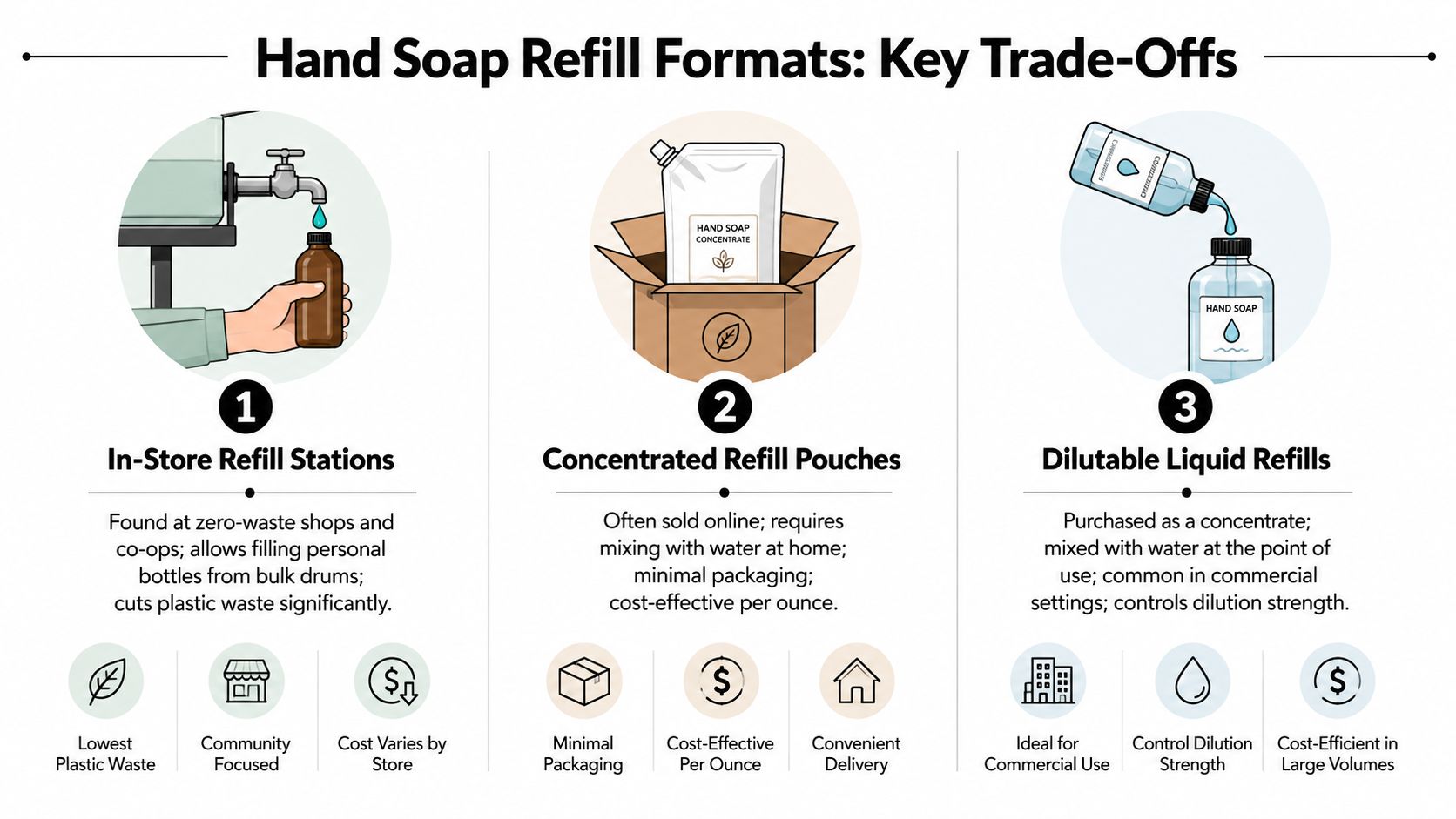
Refill formats solve different problems. A refill station can eliminate repeated containers but depends on disciplined cleaning. A concentrate can reduce the amount of water shipped but puts dilution responsibility in the user's hands. A take-back program can preserve a durable package, but only if customers return it and the company has a real cleaning and reuse pathway.
In-store refill stations
Zero-waste shops and co-ops often dispense liquid from bulk drums into a customer's clean bottle. This can work beautifully when staff control the nozzle, prevent bottle contact, and maintain a visible sanitation schedule. It becomes a poor choice when customers bring visibly dirty containers, taps develop residue, or staff add new product to a dispenser without first assessing the old batch.
Ask whether the station records cleaning, how it handles damaged bottles, and whether the soap is ready to use. A station that can't answer those questions is relying on the appearance of bulk sustainability rather than a controlled process.
Concentrated home refills
Concentrates and pouches reduce the need to ship water and let a household refill on its own schedule. One industry example says a 1.3 L concentrate bottle can yield approximately 8.5 bottles of 750 mL antibacterial hand soap, according to Ecolab's dilution product sheet. The environmental benefit depends on correct mixing and what happens to the pouch or bottle afterward.
Use a dedicated funnel, measure the water, and mark the bottle with the product name and refill date. Don't improvise a dilution because the liquid looks too thick or too thin. Viscosity can affect the pump, but appearance isn't a reliable test of antimicrobial performance.
Returnable packaging
Take-back models keep a durable bottle or pouch in circulation rather than asking the customer to dispose of it after one use. They require shipping coordination, a clear return label, and a company that washes, sanitizes, inspects, and reuses the package.
The right comparison isn't just “which refill uses the least plastic?” Consider contamination risk, handling effort, storage space, dilution accuracy, and the return path. A smaller household may prefer sealed pouches. A café may prefer a controlled bulk system. A refill shop may need documented cleaning procedures and staff training.
Frequent Use, Waterways, and Labels That Matter
Frequent handwashing can irritate skin whether the soap is plain or antibacterial. If a person washes repeatedly during a workday, a fragrance-free formula with skin-conditioning ingredients such as glycerin, aloe, or squalane may feel more sustainable in practice because people are less likely to avoid washing when their hands sting or crack.
Environmental claims also need chemistry behind them. Triclosan and triclocarban became central to the regulatory debate, while quaternary ammonium compounds raise different questions about breakdown and wastewater handling. Benzalkonium chloride may break down more readily than some legacy actives, but treatment chemistry still matters. A refill brand should explain its environmental rationale instead of using “natural” or “plant-based” as a substitute for ingredient disclosure.
Plastic packaging is a major reason refill systems attract attention. National Geographic's reporting on personal-care packaging says plastic packaging on U.S. products has increased by more than 120 times since 1960, and nearly 70% of that waste ends up in landfills. Those figures don't prove that every refill system is responsible, but they do explain why package reuse and concentrated products matter.
Read the label in layers
- Start with the active: If the product says antibacterial, identify the named active ingredient.
- Check the full formula: Look for preservatives, fragrance, dyes, and ingredients that may aggravate sensitive skin.
- Review the refill directions: Concentrate, ready-to-use liquid, and tablet systems require different handling.
- Look for meaningful certifications: USDA BioPreferred, EPA Safer Choice, Ecocert, NSF, and third-party safety documentation can add useful context when they apply.
- Ask about station hygiene: A trustworthy refill business should explain how it cleans nozzles, drums, funnels, and returned containers.
Skip a product that uses “antibacterial” without naming the active. Also be cautious with “triclosan-free” marketing if the company doesn't disclose what replaced it. The absence of one controversial ingredient isn't proof that the entire system is gentle, effective, or environmentally sound.
Good Companies Doing Refill Right
Good refill companies make their logistics visible. They explain what arrives, how customers use it, what happens to the empty package, and which claims belong to the formula rather than the packaging.
Fillaree offers refillable hand and body soap through home refill packaging and partner refill stations. Its system includes 0.5-gallon boxes for topping up standard 8 oz bottles up to eight times, plus a return process for used refill bags that the company says it washes, sanitizes, and reuses. Fillaree also describes its formulas as third-party certified to kill harmful bacteria while remaining safe for waterways. That combination gives a buyer specific questions to verify: the exact product claim, the refill instructions, and the return process for the package.
Other businesses illustrate different models. Dial's concentrated refill packaging example uses 100% paper-based cardboard cartons, while its refill packets are reported as recyclable through TerraCycle. That is a concrete packaging pathway, although customers still need to follow the relevant collection instructions.
Wonderfil's company profile describes a women-owned refill-technology business using an intermediate bulk pouch system and a circular distribution model. It also emphasizes suppliers manufacturing in California and ingredients with certified organic and fair-trade credentials. Supporting companies that care means checking whether their values appear in operations, not only in brand language.
| Brand or Example | Refill Format | Key Certifications or Claims | Antibacterial? | Packaging Return |
|---|---|---|---|---|
| Fillaree | Home refill boxes, returnable bags, partner stations | Third-party bacterial-kill certification described by the company | Product-specific claim, verify the label | Used refill bags returned for washing, sanitizing, and reuse |
| Dial | Concentrated refill cartons and packets | Packaging claims reported by trade coverage | Product-specific, verify the formula | Packets associated with TerraCycle recycling |
| Wonderfil | Intermediate bulk pouch distribution | Certified organic and fair-trade sourcing priorities described by the company | Not assumed from refill format | Circular distribution model described by the company |
| Plaine Products | Refillable bottles and home refills | Verify current certification and formula claims | Don't infer from refill packaging | Check the current bottle return process |
Before supporting any new company, ask four questions: Are all ingredients disclosed? Is the antimicrobial claim specific? Does the package have a real return or recycling route? Are refill stations cleaned and documented? Good products earn trust through answers that customers can inspect.
A Simple Refill Routine That Actually Works
A safe refill routine starts before the bottle is empty. Wash the vessel thoroughly, rinse it, and sanitize it using a method compatible with the bottle and the product instructions. Let it dry fully. Don't pour fresh soap into a container holding a thin layer of old soap, because topping off can carry residue and microorganisms into the new batch.
The CDC guidance on soap dispenser refilling and contamination warns that topping off liquid soap dispensers has been associated with outbreaks of pathogenic bacteria. The same research describes sealed-refill dispensers as less contaminated than open bulk-refill systems. A refill can reduce waste, but a sealed system and disciplined sanitation matter more than the word antibacterial on the label.
Use the same workflow every time
- Clean and dry the bottle. Use a dedicated brush or funnel, and never refill a vessel that smells sour, looks cloudy, or contains separated liquid.
- Prepare the refill point. Wipe the pouch spout, bulk nozzle, or funnel. Keep the refill container from touching the pump opening.
- Measure and label. Follow the manufacturer's dilution directions. Mark the product name, batch information if available, and refill date.
- Maintain the pump. Wipe the nozzle regularly, remove dried residue, and replace a pump that spits, clogs, or allows liquid to run back into the bottle.
For a household, store concentrate in a cool, dark place and keep a plain soap available for anyone whose skin reacts to fragrance or antimicrobial ingredients. In an office or café, assign one person responsibility for checking the dispenser, documenting cleaning, and rejecting a refill station with visible biofilm.
Keep this short checklist near the sink:
- Empty first: Never top off a partially filled dispenser.
- Clean between batches: Wash, rinse, sanitize, and dry the bottle.
- Measure dilution: Don't estimate concentrate by eye.
- Label the date: Record each refill and batch when available.
- Inspect daily: Watch for odor, cloudiness, separation, leaks, or pump residue.
- Protect the nozzle: Keep the spout away from hands, funnels, and bottle openings.
- Escalate problems: Discard questionable product and report an unhygienic station.
For a visual demonstration of a refillable dispenser setup, use the following resource:
Fillaree offers refillable hand and body soap through home refill boxes, returnable packaging, and partner refill stations, with product claims and handling instructions available for review. Visit Fillaree to compare its refill options and choose a lower-waste routine that keeps formulation, dispenser hygiene, and packaging recovery in the same system.