
Heavy Duty All Purpose Cleaner: What It Actually Does
You're halfway through a Sunday kitchen reset. The stovetop still has a sticky film around the burners, muddy paw prints run along the baseboards, and the bathroom tile needs more than a quick mist and wipe. One bottle labeled heavy duty all purpose cleaner promises to handle everything, but “heavy duty” can mean very different things from one formula to the next.
The useful question isn't whether a cleaner sounds powerful. It's what the formula contains, which surfaces it suits, whether it disinfects, and how much waste it creates after the bottle is empty. Once you understand those four points, choosing a cleaner becomes much less mysterious.
Table of Contents
- What Heavy Duty Really Means in a Cleaning Bottle
- The Ingredient Classes Behind Heavy Duty Cleaning
- Where Heavy Duty Cleaners Work and Where They Should Not
- Cleaning Versus Disinfecting and How to Read the Label
- Safety, Fragrance, and the Wastewater Question
- Refillable, Concentrated, and Low Waste Options Worth Knowing
- How to Choose and Use a Heavy Duty All Purpose Cleaner
What Heavy Duty Really Means in a Cleaning Bottle
By late morning, the kitchen usually reveals why one general-purpose spray may not be enough. A neutral everyday cleaner can lift crumbs, fingerprints, and a light cooking film from a counter. Dried grease on a range hood, soap residue on bathroom tile, and tracked-in soil along grout lines need more chemical assistance and more contact time.
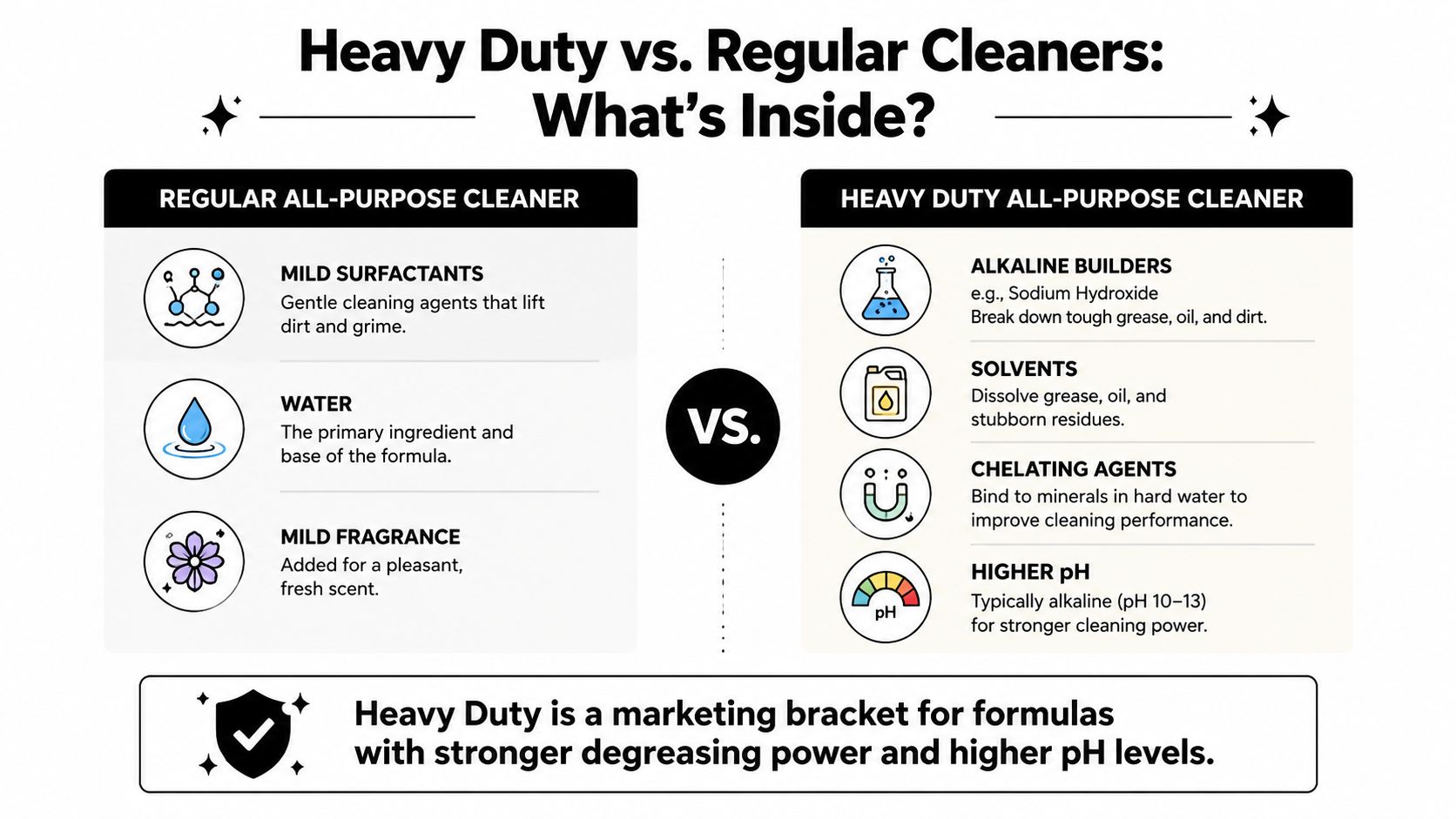
“Heavy duty” is mostly a marketing bracket, not a tightly defined product category. In practice, manufacturers often use the term for formulas that combine stronger surfactant systems with alkaline builders, solvents, or other helpers. Those ingredients can make dried grease, soap scum, and embedded soil easier to loosen than they would be with a mild daily spray.
Three useful signals
A label deserves closer attention when it gives practical evidence of stronger cleaning rather than relying only on bold wording.
- Alkalinity or solvent support: A higher-pH system or added solvent can attack greasy soils that mild surfactants leave behind.
- Dwell-time guidance: A formula that tells you to let it sit before wiping is designed to soften or emulsify soil rather than depend only on immediate friction.
- A dilution range: Concentrates that work at different ratios can serve both routine wiping and more demanding restoration work.
An everyday all-purpose spray often emphasizes mild surfactants, water, and a neutral or near-neutral feel. A heavy-duty formula may be more slippery, more alkaline, or more noticeable in odor because it has been built to break down tougher deposits.
Practical rule: Treat heavy duty as a tool for difficult soil, not as the default spray for every surface in the home.
The terms industrial, professional, and heavy duty aren't regulated performance guarantees. Two bottles can sit beside each other in the same aisle and behave very differently. Check the directions, surface list, dilution instructions, and safety information before assuming that a stronger label means universal compatibility.
The global all-purpose cleaner market was valued at about $5.8 billion in 2025 and is projected to reach $8.3 billion by 2034, with a projected compound annual growth rate of 4.6%, according to market coverage of the all-purpose cleaner category. That same snapshot identifies liquid formats as the largest share at 52.3%, while residential use accounts for 58.4% of revenue, which helps explain why household formulas increasingly need to balance serious cleaning with frequent, careful use.
The Ingredient Classes Behind Heavy Duty Cleaning
A heavy-duty cleaner is a small team in a bottle. Each ingredient class handles a different part of the job, because grease, mineral film, food residue, and tracked-in dirt do not yield to identical chemistry. The formula succeeds when those roles support one another.
Surfactants create the first lift
Surfactants lower water's surface tension, so the liquid spreads across a surface rather than forming beads. They surround oily and particulate soil, loosen it, and hold some of it in the liquid until wiping or rinsing removes it.
Heavy-duty products commonly blend anionic and nonionic surfactants. Nonionic systems can perform well after dilution because they support wetting and emulsification across different soils. A formulation reference describes liquid all-purpose cleaners as containing about 1–10% surfactants, up to 10% builders, and 0–10% solvents, with water making up roughly 75–85% of the formula. These ranges appear in this heavy-duty all-purpose cleaner formulation guide.
The dilution instructions matter as much as the ingredient names. A concentrate designed for several jobs may call for different water ratios, and glass cleaning has its own practical considerations, as shown in these dilution ratios for glass cleaner. More product is not automatically better. Excess cleaner can leave a film that attracts new soil.
Builders change the cleaning environment
Alkaline builders, including carbonates and hydroxide-based materials, reduce interference from hard-water minerals. Higher alkalinity can also help break down fatty soil, which allows a strong degreaser to reduce scrubbing.
Builders and surfactants perform different tasks. Surfactants lift and suspend soil. Builders adjust the water and soil conditions so that lifting process works more effectively.
Solvents dissolve what water struggles with
Solvents and hydrotropes help dissolve oily residues that surfactants may leave behind. Alcohols and glycol ether-type solvents can improve grease cutting, but they may also increase volatility and odor, making ventilation and label directions important.
Chelants and sequestrants handle minerals. Citrates or GLDA bind hard-water minerals, helping the cleaner behave consistently with ordinary tap water. Readers comparing plant-derived options can use this explanation of caprylyl capryl glucoside to see how one surfactant class fits into a complete formula.
| Ingredient Class | What It Does | Typical Examples |
|---|---|---|
| Surfactants | Wet the surface, loosen soil, and suspend grease or particles | Anionic and nonionic surfactants |
| Builders | Reduce hard-water interference and support alkaline cleaning | Carbonates, citrates, hydroxide-based builders |
| Solvents and hydrotropes | Dissolve oily residue and help keep the formula stable | Alcohols, glycol ethers, hydrotropes |
| Chelants and sequestrants | Bind minerals so the cleaner performs in ordinary tap water | Citrates, GLDA |
| Optional boosters | Add job-specific support | Enzymes, mild abrasives, quaternary ammonium compounds |
Some products add enzymes for organic residue, mild abrasives for stuck-on deposits, or quaternary ammonium compounds for antimicrobial purposes. Those additions change the product's purpose, so a booster should not be treated as interchangeable with a cleaning ingredient.
Ingredient lists provide clues, not a complete performance profile. A nonionic-surfactant-based cleaner outperformed leading branded cleaners at both 1:8 and 1:16 dilutions in an ASTM D4488-A6 particulate-and-oily-soil test on vinyl tiles, as described in the industrial formulation testing reference. The practical lesson is qualitative: surfactant synergy and soil-release chemistry can matter as much as adding more active ingredients. That is also why a shorter ingredient list is not automatically safer, greener, or weaker. Read the directions, surface limits, safety information, and refill or dilution instructions together.
Where Heavy Duty Cleaners Work and Where They Should Not
A heavy-duty cleaner earns its place when the soil is stubborn and the surface is washable. Think of a greasy stovetop after cooking, the outside of an oven door, a range hood filter, ceramic tile around a shower, or grout lines darkened by tracked-in dirt. Properly diluted formulas can also suit porcelain, vinyl, laminate, and sealed concrete, provided the label specifically allows those surfaces.
The same product may be inappropriate on a finish that depends on a protective coating. Strong alkalinity and solvents can strip, haze, soften, or etch vulnerable materials.
Match the chemistry to the finish
| Surface | Heavy Duty Safe? | Why |
|---|---|---|
| Stovetop and range hood | Usually, when labeled and diluted correctly | These surfaces commonly collect grease and cooking soil |
| Ceramic tile and grout | Often, with a spot test | Durable tile can tolerate stronger cleaning, while grout and sealers vary |
| Bathroom tile and porcelain | Often, if the label permits | Soap scum and body oils respond well to stronger surfactant systems |
| Vinyl and laminate floors | Sometimes, at the recommended dilution | Full-strength or frequent use may leave residue or affect protective layers |
| Sealed concrete | Often, with care | The sealer determines compatibility |
| Unsealed wood | Usually no | Water, alkalinity, and solvents can stain or swell the material |
| Marble or travertine | Avoid unless specifically approved | Acidic or strongly alkaline products can damage natural stone |
| Waxed finishes | Usually no | Strong chemistry may strip the wax |
| Aluminum | Use caution | Alkaline cleaners can discolor or dull the metal |
| Clear-coated electronics | No direct spraying | Solvents and liquid intrusion can damage coatings and components |
Surface test: Apply a small amount in an inconspicuous spot, let it react for the label's stated time, wipe, and inspect after drying.
Dilution controls the trade-off between cleaning power and residue. A concentrated bottle that rescues a greasy stovetop can be over-medicating a vinyl floor if you use it at full strength every week. On floors, a measured diluted solution and a clean microfiber mop are usually more sensible than repeated heavy applications.
For delicate finishes, choose the milder alternative first. Heavy-duty chemistry belongs on the grimy few square feet that need it, while an everyday cleaner should handle the surrounding surfaces.
Cleaning Versus Disinfecting and How to Read the Label
Cleaning and disinfecting answer different questions. Cleaning removes soil, while disinfection uses a registered product and stated conditions to reduce or kill specified microorganisms. A degreaser can leave a kitchen counter visibly spotless without making a germ-killing claim.
The reverse problem matters too. A disinfectant applied over a greasy film may not reach the microorganisms beneath that soil. Clean the surface first when the product directions require it, then apply the disinfectant for the full contact time, keeping the surface visibly wet for the period listed on the label.
Read the claims, not just the front panel
On an EPA-registered disinfectant, look for the EPA registration number, the organism list, and the required contact time. A broad phrase such as “kills 99.9%” doesn't tell you which organisms were tested, how long the product must remain wet, or whether the claim applies to your surface.
| Action | What It Does | Mechanism | Everyday Example |
|---|---|---|---|
| Cleaning | Removes visible soil and residue | Surfactants, builders, solvents, and wiping or rinsing | Degreasing a counter |
| Disinfecting | Addresses listed microorganisms under label conditions | Registered antimicrobial chemistry and required wet contact time | Treating a bathroom fixture after cleaning |
| Sanitizing | Reduces microorganisms to a stated level under defined conditions | Product-specific antimicrobial action | Treating a food-contact surface when the label permits it |
A heavy-duty cleaner isn't automatically a disinfectant. EPA guidance recognizes that a general all-purpose cleaner or a lead-specific cleaner may be suitable for general cleaning and post-intervention cleaning, but that doesn't turn every strong cleaner into a germicide. For more context on the distinction, see this discussion of antimicrobial cleaning products.
Where certification fits
EPA Safer Choice is a pollution-prevention program that helps buyers identify products made with safer ingredients while still meeting performance expectations. The EPA screens ingredients for human-health and environmental risks, rather than examining only one active ingredient, and its eligible products include all-purpose cleaners. The EPA Safer Choice program overview explains the role of the label and its ingredient-screening approach.
The EPA also maintains a public all-purpose cleaner product finder, so shoppers can verify a specific product instead of trusting an unsupported green claim. Certification guidance describes screening areas that can include carcinogenicity, reproductive and developmental toxicity, aquatic toxicity, persistence, VOCs, packaging, audits, and performance requirements, as summarized by this explanation of green-cleaning certifications.
Choose the job first. Use a cleaner for grease, soap scum, and food residue. Add a disinfectant only where transmission concerns justify it, such as cutting boards, bathroom fixtures, or pet zones, and follow the label exactly.
Safety, Fragrance, and the Wastewater Question
“Stronger” doesn't automatically mean “more hazardous,” but it does mean you should pay closer attention to exposure and disposal. A spray can become an inhalation concern when you mist continuously, skin can become irritated through repeated contact, and fragrance can bother people with sensitivities, including households managing asthma or eczema.
Ventilation matters most in small rooms. Check the product's Safety Data Sheet for hazard classifications, personal-protection advice, first-aid instructions, and ingredient disclosures where available. Solvents often described with “butyl” terminology, some quaternary ammonium compounds, and chlorine bleach deserve extra caution in poorly ventilated areas. Never mix cleaners unless the label explicitly permits it.
Think beyond the sink
After use, surfactants, solvents, fragrance materials, dyes, and particles from synthetic scrubbers can enter wastewater. Municipal treatment systems and septic systems don't operate in exactly the same way, so local disposal instructions matter, especially for concentrated products.
That doesn't mean a heavy-duty cleaner is automatically a poor choice. It means the formula, dose, frequency, and disposal route belong in the same decision. A product that cleans with less residue and works at a measured dilution may be a better everyday choice than a harsh formula that requires repeated rinsing.
Fragrance-free and dye-free options exist for practical reasons. They reduce unnecessary sensory load and can make it easier to identify whether the cleaning chemistry itself is causing irritation. A low-odor product also helps in kitchens, bathrooms, and shared spaces where ventilation isn't ideal.
Before buying: Ask whether you need degreasing strength, antimicrobial action, fragrance, or simply routine soil removal. Don't pay for claims your household won't use.
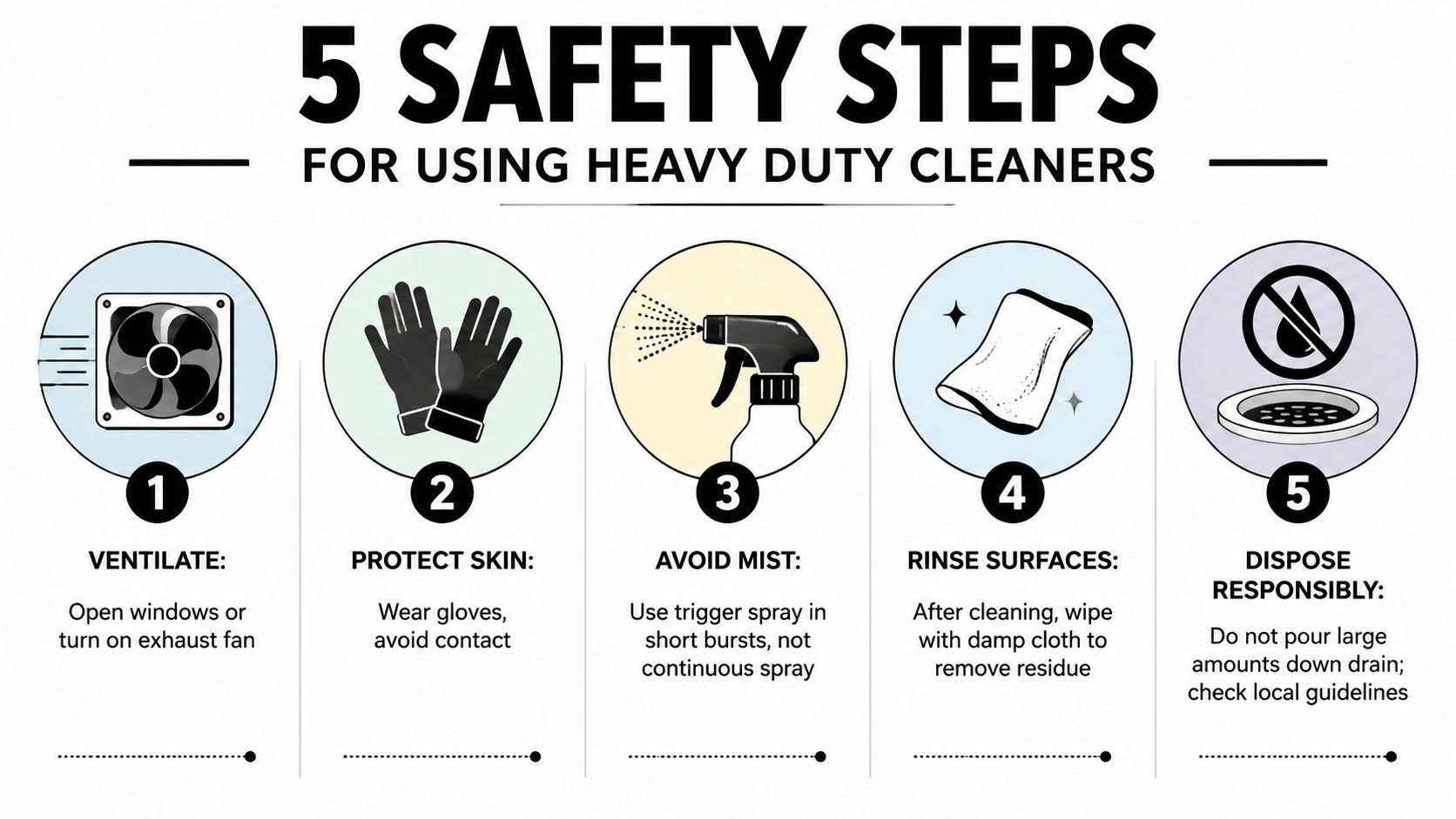
Use short trigger bursts rather than creating a cloud of mist, wear gloves for repeated kitchen cleanup, wipe residue with a damp cloth when the directions call for it, and keep concentrated products away from children and heat. The label's instructions outrank assumptions about what “natural” or “powerful” means.
Refillable, Concentrated, and Low Waste Options Worth Knowing
Packaging changes the footprint of a cleaner, but no single refill format wins for every household. Concentrates reduce the amount of finished product transported, while refill systems can keep a durable bottle in circulation. Shipping still requires packaging and energy, so plastic avoidance should be evaluated alongside formula safety, delivery frequency, and whether you'll reuse the container.
Four formats on the shelf
| Format | Cost Per Use | Packaging Waste | Convenience | Best For |
|---|---|---|---|---|
| Ultra-concentrate | Can be efficient when measured correctly | Low for the amount of cleaner transported | Requires accurate dilution | Households comfortable measuring |
| In-store bulk refill | Depends on local pricing and travel | Reuses the customer's container | Convenient near a refill station | Local shoppers with nearby access |
| Mail-back aluminum or HDPE container | Depends on return logistics | Keeps containers in a reuse loop | Requires sending empties back | People who value a managed return system |
| Premixed pouch refill | Simple, with no mixing at home | Uses less rigid packaging than a new bottle | Easy to pour or swap | Households prioritizing convenience |
The practical difference between a concentrate and a premixed refill is guesswork. With a concentrate, the user must follow the label ratio and have a suitable bottle. With a managed refill system, the user can return an empty container and swap in the next supply without calculating each batch.
Fillaree offers a refill-oriented model built around home and local replenishment. The brand makes low-waste home and body products, offers refill access through partner stations, and provides home refills in 0.5-gallon boxes that top up standard 8 oz bottles up to eight times, according to the publisher information supplied for this article. Its system also takes back used refill bags, washes and sanitizes them, and reuses them at no cost to the customer.
Supporting good companies who care means looking for more than a recycled-looking label. Check whether a company explains its packaging, return process, ingredient choices, and product performance. The EPA lists ECOS as offering 120 Safer Choice-certified products, and ECOS states that it was named a U.S. EPA Safer Choice Partner of the Year for 2024, details available on ECOS's Safer Choice product page.
For outdoor materials, cleaning technique matters as much as the product. If synthetic grass is part of your routine, this guide to how to rinse synthetic grass offers useful surface-care context. For an overview of what to look for in a lower-waste formula, see this guide to an eco-friendly all-purpose cleaner.
Low waste isn't automatically greener if the cleaner itself creates avoidable hazards or leaves heavy residue. Pair a refillable format with transparent ingredients, appropriate dilution, and a surface-specific use plan.
How to Choose and Use a Heavy Duty All Purpose Cleaner
A good purchase starts with the job, not the scent or the largest label on the bottle. Before bringing home a heavy-duty cleaner, run through five checks.
- Confirm the soil. Grease, soap scum, baked-on food, and mildew may justify stronger chemistry. Dust, fingerprints, and fresh spills usually don't.
- Match the surface. Check the product's approved materials. Don't use an alkaline cleaner on vulnerable stone, bleach on fabrics, or a solvent-heavy product on clear-coated electronics.
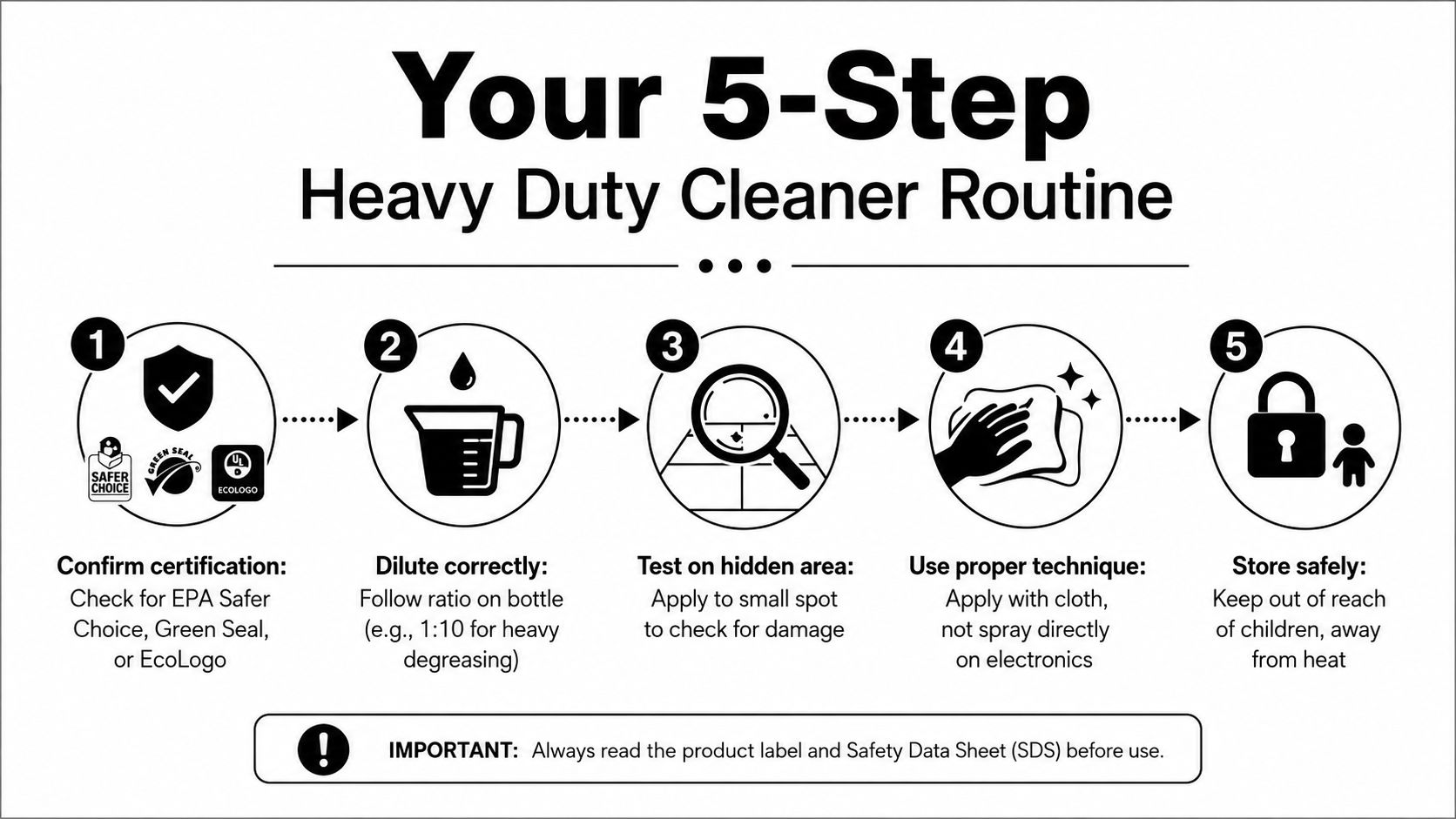
- Verify the claim. Look for a credible third-party mark such as EPA Safer Choice, Green Seal, or EcoLogo, then verify the product in the certifier's directory when one is available.
- Compare the format. Concentrated refills can reduce packaging and shipping weight, but only if you'll measure them accurately and keep a compatible bottle available.
- Question fragrance and antibacterial language. Choose fragrance-free when sensitive people or pets share the space. Choose an antibacterial or disinfecting product only when that function serves the actual task.
A routine that prevents overuse
Start by removing loose crumbs, hair, grit, and other debris. Apply the cleaner according to the label's dilution ratio, give stubborn grime the stated dwell time, and agitate with a microfiber cloth or suitable brush.
A 30 to 60 second dwell time is included in the practical routine requested for this guide, but always follow the product label if it specifies a different period. Wipe away the soil, then rinse food-contact zones with clean water when the directions require it.
Microfiber is a sensible tool because it captures loosened soil instead of spreading a wet film. Use separate cloths for kitchens, bathrooms, and pet areas, and launder them according to the fabric and product instructions.
For additional perspective on achieving a spotless shine with eco cleaners, compare the cleaning result with the residue left behind. A shiny surface isn't necessarily a clean surface if fragrance, oils, or detergent film remains.
A reasonable shortlist can include Fillaree, Branch Basics, and ECOS, but treat brand names as starting points rather than guarantees. Confirm the exact product's surface directions, certification status, fragrance profile, refill method, and antimicrobial claims before buying.
The best heavy-duty cleaner is the one you can use deliberately, dilute correctly, store safely, and replenish without creating a stream of disposable bottles.
Fillaree offers refillable home-care products, including Clean Dream Spray for dirt and grime on nonporous surfaces such as countertops, porcelain, and bathroom fixtures, with home refills and local refill options designed for repeated use. Visit Fillaree to explore a lower-waste cleaning routine that supports careful formulation, reusable packaging, and companies that care about the communities they serve.