
Is Castile Soap Good for Skin? a Practical Guide
Yes, castile soap can be good for skin when it's diluted and used thoughtfully, especially on the body and hands. But because true castile soap is alkaline, usually around pH 9 to 10, and skin sits much lower at about pH 4.5 to 5.5, it's often a poor daily facial cleanser for dry, sensitive, or eczema-prone skin.
That gap is where most of the confusion lives. People often ask, “If it's plant-based and simple, shouldn't it automatically be gentler?” Sometimes yes. Sometimes no. A cleanser can be natural, low-waste, biodegradable, and made by a company that cares, and still be the wrong match for your face if your skin barrier is already struggling.
I've found that castile soap tends to make the most sense when you stop treating it like a moral choice and start treating it like a tool. A good tool works beautifully in the right setting, then feels awful in the wrong one. Castile soap is like that. It can be a practical, aligned-values option for body washing, hand washing, and refill routines, but it asks for more respect around dilution, frequency, and skin type than many labels admit.
Table of Contents
- What Castile Soap Actually Is and Why People Ask
- A Short History of Castile Soap
- How Castile Soap Interacts with Your Skin
- Castile Soap vs Conventional Soaps and Cleansers
- Matching Castile Soap to Skin Types and Uses
- Safe Dilution and How Often to Use It
- Skin Health Meets Low-Waste Values
- The Honest Bottom Line on Castile Soap
What Castile Soap Actually Is and Why People Ask
Castile soap is a true soap made from plant oils, traditionally olive oil, rather than animal fats or synthetic detergents. Cleveland Clinic describes pure castile soap as natural, nontoxic, biodegradable, and made without synthetic ingredients, while also noting that for skin use it should be diluted and stopped if it causes redness, dryness, itching, scaling, or burning (Cleveland Clinic castile soap guidance).
That's the cleanest starting point. It's soap. Real soap. Not a detergent dressed up with a rustic label.
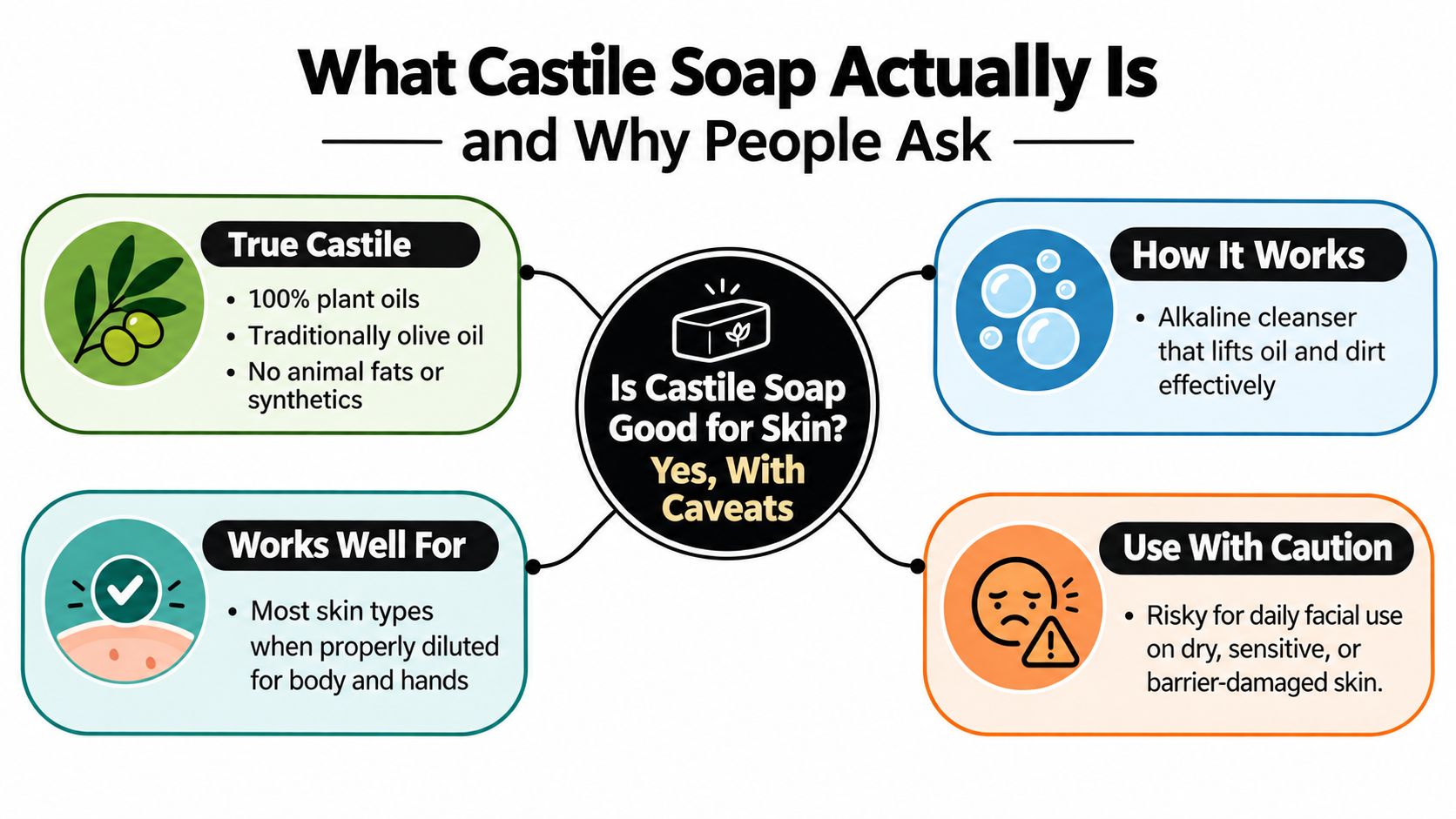
Why it confuses so many people
The phrase “good for skin” hides a bunch of different questions:
- Good for what area? Your hands are not your cheeks.
- Good for which skin type? Oily skin and eczema-prone skin don't react the same way.
- Good how often? Once in a while is different from every day.
- Good in what form? A concentrated liquid behaves differently from a fully diluted wash.
That's why one person says castile soap feels fresh and simple, while another says it left their face tight and stingy. Both can be telling the truth.
Think of it like juice concentrate
A bottle of castile soap is a lot like frozen orange juice concentrate. You wouldn't spoon it straight into a glass and decide orange juice is harsh. You'd mix it with water first and judge the finished drink, not the concentrate.
Castile soap works the same way. Dilution changes the experience. Water hardness changes it too. In soft water, it may rinse more easily and feel smoother. In hard water, some people notice more residue or that “draggy” feeling on skin.
Practical rule: Don't ask whether castile soap is good or bad in the abstract. Ask whether this concentration, on this part of your body, at this frequency, works for your skin.
The question keeps coming up because refill culture, low-waste bathrooms, and ingredient-conscious shopping have pushed more people toward concentrated products. That's a good shift in many ways. Supporting good companies who care about both product quality and waste reduction can absolutely align with skin care values. The trick is staying honest about what your skin tolerates.
A Short History of Castile Soap
Castile soap's story starts with geography more than trend. In the Mediterranean world, soapmakers had access to abundant olive oil. Over time, olive-oil-based soaps became part of a broader soapmaking tradition stretching through the Levant and Mediterranean region, and the style later became closely associated with the Crown of Castile in Spain, where it was produced on a larger scale and exported widely (history of castile soap and Mediterranean soapmaking).
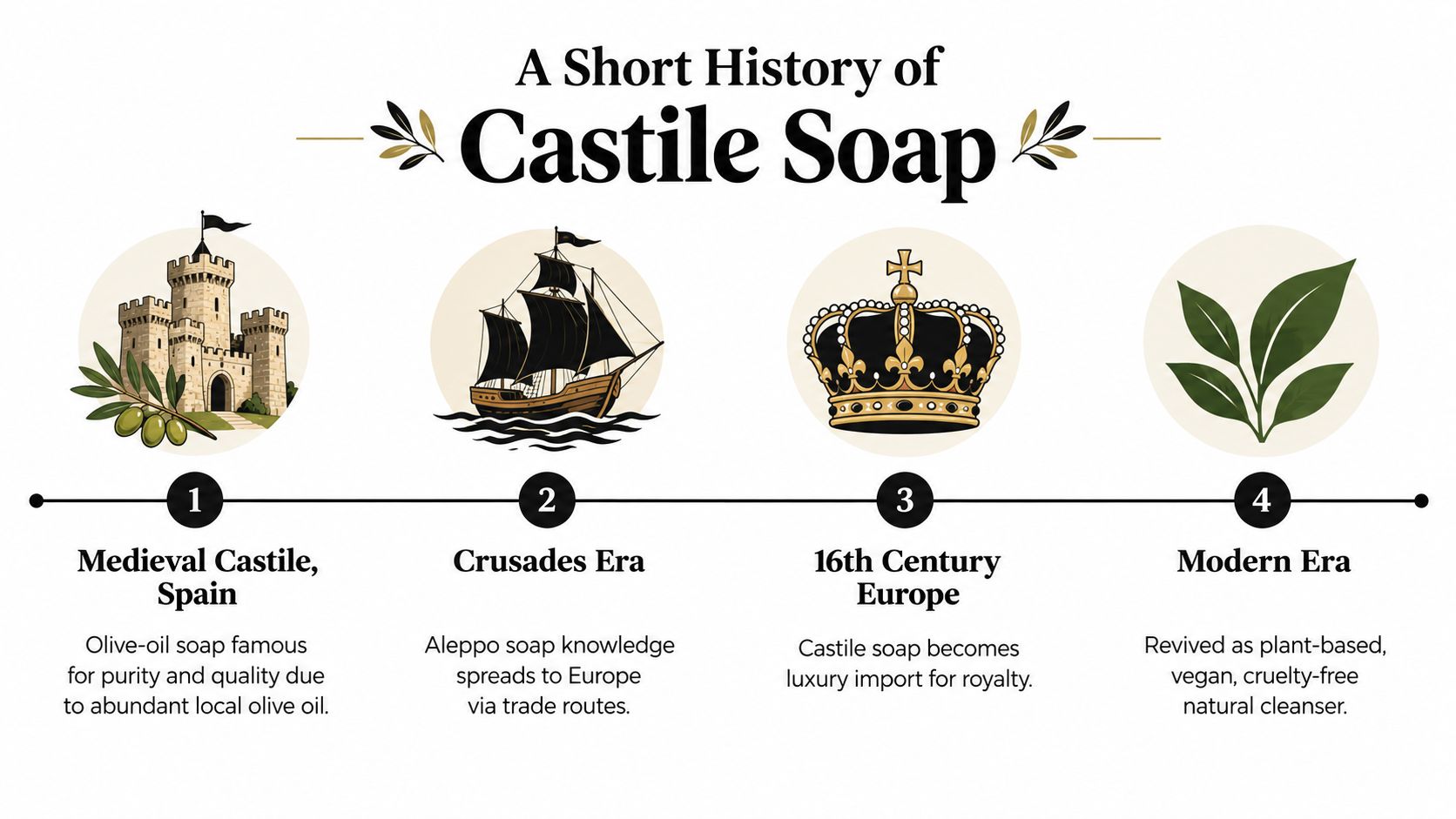
A useful historical anchor appears in a 1567 London port record documenting imports of “Castile soap” through Antwerp. That tells you this wasn't some tiny local curiosity. By the 16th century, it had real commercial weight.
Why the history matters for your skin
I like this part of the story because it clears up a modern misunderstanding. Castile soap didn't become famous because people had discovered a magically pH-balanced cleanser. It became famous because it was a well-made, desirable true soap built from the fats available in that region.
That old-world soapmaking method matters because saponification naturally yields an alkaline product. In other words, the chemistry wasn't an accident. It came with the category.
Later, liquid castile soap became much more familiar in American households through brands that brought the format into everyday use. Today, refill shops and low-waste home care companies have revived the same appeal for modern reasons: one concentrated cleaner, fewer bottles, simpler ingredient lists, and easier support for companies whose values match your own.
This short visual gives the historical arc some shape:
A simple takeaway from the timeline
Castile soap is both old and modern at once.
- Old in method because it belongs to the long line of true soaps.
- Modern in appeal because concentrated refills fit low-waste living.
- Unchanged in chemistry because traditional soap is still alkaline even when the branding looks softer and greener.
That's why the answer to “is Castile soap good for skin?” can't come from marketing language alone. The label tells you values. The chemistry tells you how it may feel.
How Castile Soap Interacts with Your Skin
Your outer skin barrier works a bit like a brick wall. The skin cells are the bricks. The lipids between them are the mortar. When that wall is in good shape, it holds moisture in and helps keep irritation out.
Skin's surface is naturally acidic, usually around pH 4.5 to 5.5, while castile soap is a true soap and typically sits around pH 9 to 10. Dr. Bronner's overview of soap pH and skin explains that alkaline cleansers can raise skin pH, increase erythema, and increase transepidermal water loss, which helps explain why castile soap may feel drying or irritating for some people, especially those with sensitive or eczema-prone skin (soap pH and skin microbiome overview).
What the pH gap feels like in real life
Don't walk out of the shower saying, “My acid mantle has been disrupted.” They say:
- “My skin feels tight.”
- “It's squeaky clean, but kind of stripped.”
- “My cheeks sting after I rinse.”
- “My hands are fine, but my face hates it.”
That squeaky feeling gets mistaken for extra-clean skin. Often it's your barrier telling you some protective oil and water balance has been disturbed.
Skin can feel clean without feeling squeaky. Squeak is not always success.
Why some people love it and others don't
On oilier or more resilient skin, castile soap can feel clarifying. It cuts through sunscreen, sweat, and body oil very effectively. On drier or more reactive skin, the same cleansing action may feel rough around the edges.
Controlled skin-barrier research helps explain why. Washing with soap and water can raise skin pH and disrupt barrier function, and in-use testing found alkaline soaps can increase transepidermal water loss and erythema, both signs of greater barrier stress (controlled research on alkaline soap and skin barrier disruption).
Typical pH Ranges of Common Cleansers
| Cleanser Type | Typical pH Range | Effect on Acid Mantle |
|---|---|---|
| Healthy skin surface | 4.5 to 5.5 | Supports the skin's normal acidic surface |
| True castile soap | 9 to 10 | More likely to raise skin pH and feel drying on vulnerable skin |
| Conventional true soap bar | Alkaline | Similar concern, though formulas vary |
| pH-balanced syndet cleanser | Closer to skin's acidic range | Often gentler for dry, sensitive, or eczema-prone skin |
The ingredient that can soften the blow
One detail people miss is that not all soap experiences are equally harsh. The evidence summarized in the pH discussion above also suggests that glycerin and other humectants can reduce some barrier disruption associated with alkaline soap use. If you want a plain-English explainer on why that matters, this guide on what glycerin does is useful.
That doesn't turn castile soap into a facial cleanser for everyone. It does explain why some formulas feel kinder than others, and why following with moisturizer often changes the whole experience.
Castile Soap vs Conventional Soaps and Cleansers
The fairest comparison isn't “natural” versus “chemical.” Everything here is chemistry. The useful comparison is true soap versus detergent cleansers, plus the practical routine questions that come with each.
The trade-offs that actually matter
A classic bar soap and a liquid castile soap share one big trait: both are true soaps, so both tend to be alkaline. A syndet cleanser, by contrast, is usually formulated closer to skin's preferred range, which is why many dermatology routines lean that way for dry or reactive skin.
Conventional liquid body washes can feel smoother and less stripping, but they often come with more packaging, more additives, and less ingredient transparency. Some are excellent. Some are just perfumed foam in plastic.
If you like comparison shopping, the Blushing Ivy soap guide is a useful example of how scent, texture, and paired hand care can affect the way a soap fits into daily life, especially if frequent handwashing is part of your routine.
Castile Soap vs Conventional Soaps and Cleansers
| Cleanser Type | Typical pH | Skin-Barrier Impact | Fragrance/Additives | Packaging |
|---|---|---|---|---|
| Castile soap | Alkaline, typically around 9 to 10 | Can feel drying with frequent use, especially on the face | Often simpler ingredient lists, sometimes unscented | Often sold as concentrate or refill |
| Conventional bar soap | Alkaline | Similar true-soap barrier concerns | Varies widely | Often low-packaging |
| Conventional body wash | Varies | May feel milder, depending on formula | Often more fragrance and additives | Usually plastic bottles |
| Syndet bar or cleanser | Often closer to skin's range | Often gentler for sensitive or eczema-prone skin | Varies by brand | Can be low-waste if bought as a bar |
Where castile soap wins and loses
Here's the honest version.
- It wins on ingredient simplicity for shoppers who want plant-oil-based soap without a lot of extras.
- It wins on refill logic if you're trying to reduce single-use bottles.
- It loses on daily facial use for many people with dryness, sensitivity, or barrier damage.
- It ties on body cleansing for plenty of households, especially when diluted.
- It often loses for eczema routines where a pH-balanced syndet is usually the safer bet.
For people who want one bottle to cover more jobs, castile soap has appeal. For people who need the gentlest face cleanser possible, “real soap” often isn't the category to start with. If you're sorting out myths around germ-killing claims at the same time, this explainer on what makes soap antibacterial helps separate soap chemistry from marketing language.
Matching Castile Soap to Skin Types and Uses
This is the section most need. Not philosophy. Not ingredient tribalism. Just: where can I use it, how often, and what does my skin type suggest?
Face versus body
Your body can often tolerate things your face won't. Shoulders, back, legs, and hands usually have a sturdier relationship with alkaline cleansers than the thinner, more exposed skin around your cheeks and eyes.
Independent medical coverage has noted that castile soap is more alkaline than many detergents and may be more drying, especially when used undiluted, and that people with eczema or sensitive skin should be cautious and patch test first (Wirecutter guidance on castile soap uses and skin caution).
A practical way to consider it.
- Body use: often workable for many people, especially if diluted.
- Face use: much more individual, with dry and sensitive skin usually tolerating it poorly.
- Hands: often fine, though frequent washing still calls for hand cream.
Skin-type quick guide
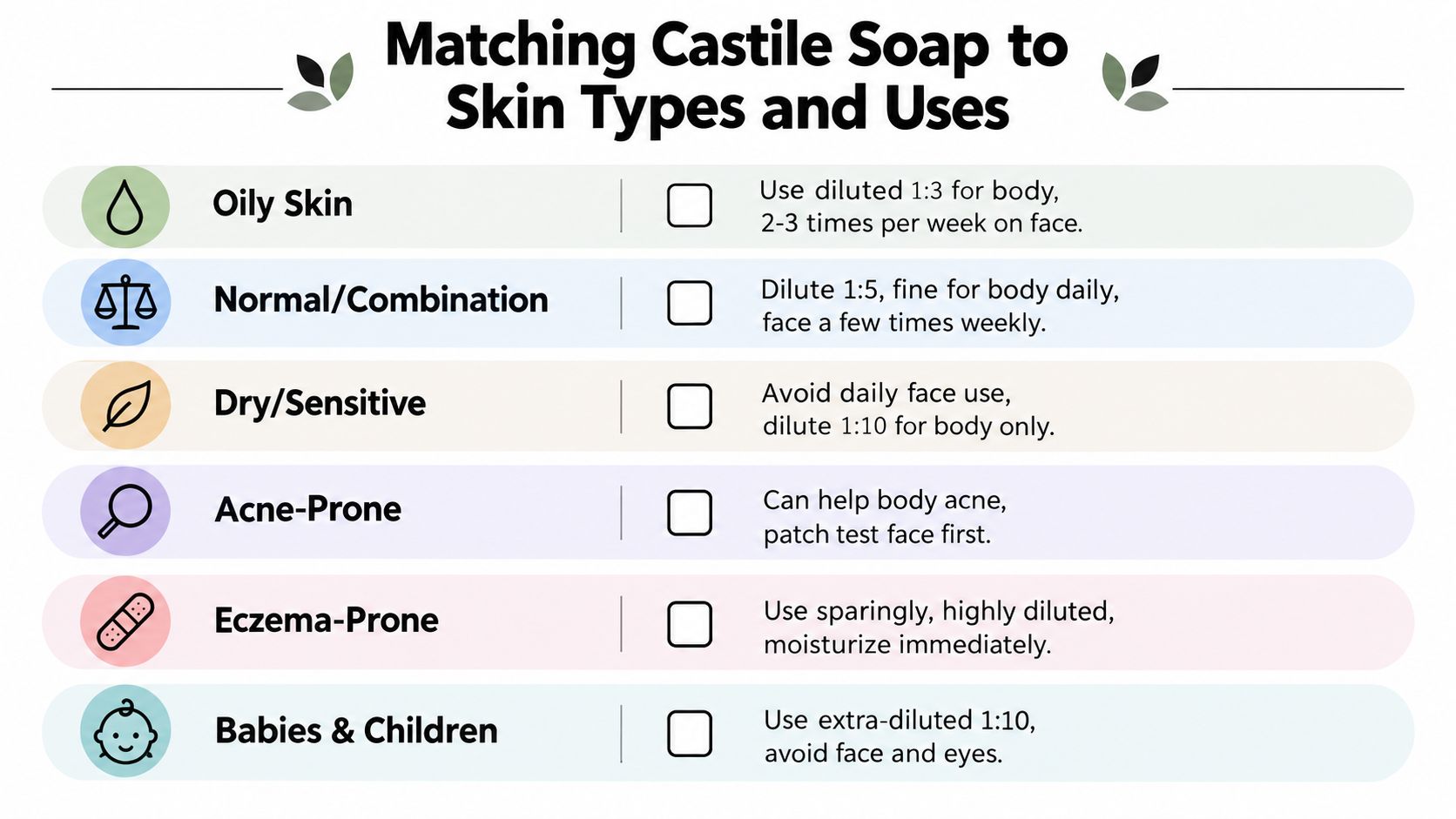
- Oily skin: Castile soap may feel refreshing on the body and may be tolerable on the face a few times a week if well diluted.
- Combination skin: Often does fine on the body, but the face may need a selective approach. Some people use it only on the oilier parts of the face and keep a gentler cleanser for the rest.
- Normal skin: Usually the easiest match for occasional use.
- Dry skin: Better reserved for body use, and even then in a lighter dilution.
- Sensitive skin: Proceed carefully. Patch test first, keep contact short, and stop early if you notice tightness or stinging.
- Mature skin: Often prefers cleansers that leave more moisture behind, especially on the face.
A simple filter: The drier and more reactive your skin is, the more castile soap should move away from your face and toward occasional body use only.
Acne, eczema, and kids
Acne adds a layer of confusion because “stronger” can sound better. In reality, over-cleansing can leave skin irritated and paradoxically harder to manage. Castile soap may be reasonable for body acne, especially on the chest or back, but facial acne doesn't automatically mean your barrier can handle an alkaline wash.
For eczema-prone skin, I'd be more conservative. Dermatology-oriented commentary has emphasized that repeated use of alkaline cleansers can disrupt the barrier and microbiome, which is exactly the situation eczema skin is already trying to calm (acid mantle and castile soap discussion).
Babies and children deserve extra caution. A highly diluted use on the body may be tolerated by some children, but I wouldn't treat castile soap as a casual everyday face wash for little ones. Eyes, cheeks, and already-dry patches don't need the challenge.
A few product-minded examples
If you like simple routines and aligned values, a castile soap can make sense as one product in a broader lineup, not your only answer. Some households keep a true soap for hands and body, then pair it with a pH-balanced facial cleanser and a plain moisturizer. Others choose a gentler liquid hand and body soap, such as a low-waste option like Fillaree Charcoal Hand & Body Soap, when they want skin washing to stay simple without forcing facial skin into a one-soap-fits-all routine.
Supporting good companies who care can include choosing refills, unscented versions, and products that tell you clearly how to use them, not just how pure they are.
Safe Dilution and How Often to Use It
Good results with castile soap usually come from restraint. Smaller amount, more water, shorter contact.
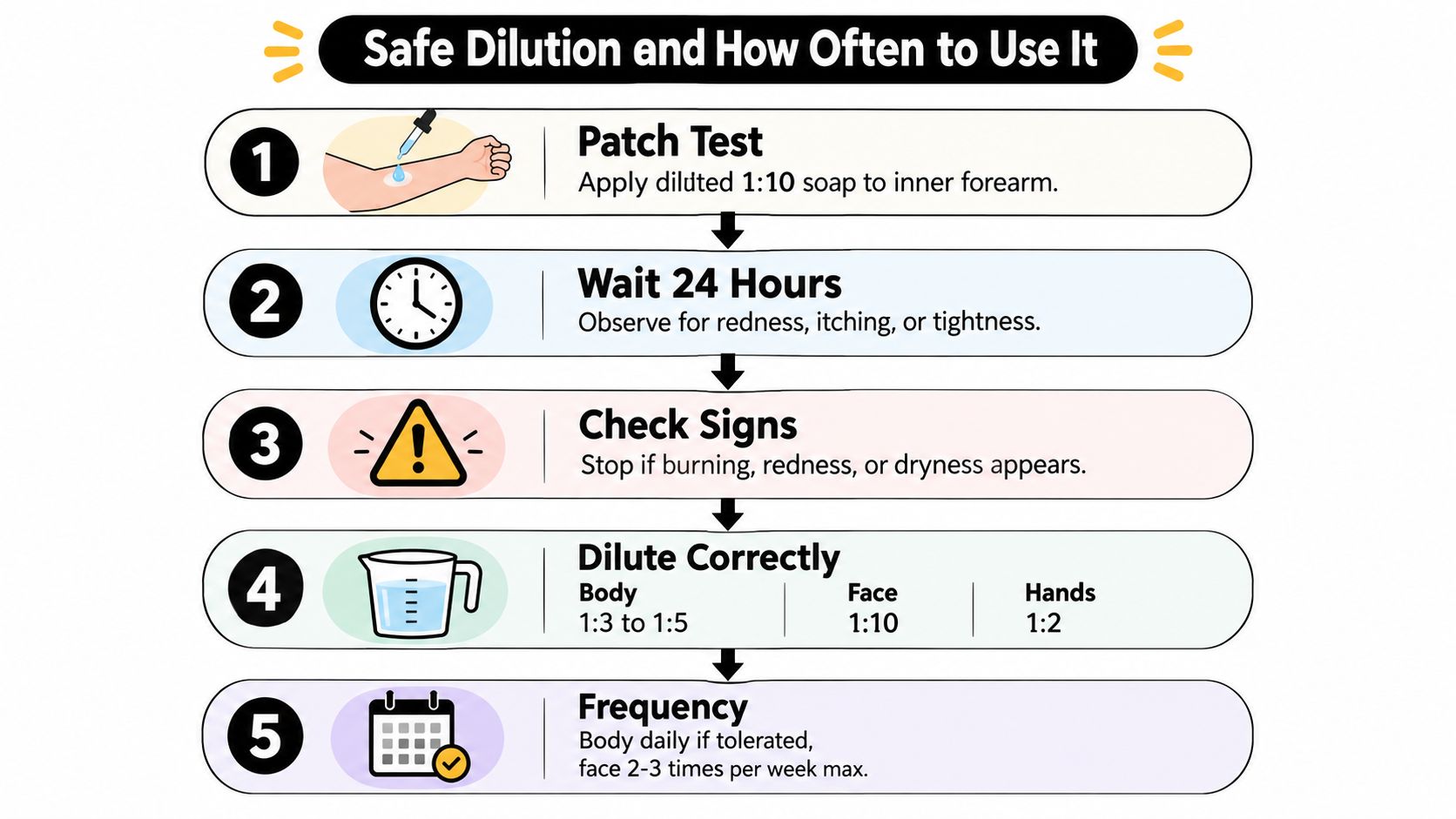
A patch test you can do tonight
Use this before trying castile soap on your face, chest, or on skin that gets angry easily.
- Mix a starter dilution. Try 1:10 soap to water.
- Apply it to a small area. The inner forearm is a practical spot.
- Rinse after a short wash. Don't leave it sitting.
- Wait a full day. Watch for redness, itching, dryness, burning, or unusual tightness.
- Stop if you react. If the area feels off, that's useful information, not failure.
Starting dilutions that make sense
These aren't sacred rules. They're reasonable starting points.
- Hands: around 1:2
- Body wash: around 1:3 to 1:5
- Face, if you're testing it at all: around 1:10
- Baby or child body use: keep it extra diluted, around 1:10, and avoid the face and eyes
- Household cleaning: separate from skin care. Don't assume a cleaning dilution belongs on skin
Frequency matters as much as dilution
Research on soap and barrier stress points to a practical takeaway: reduce frequency, avoid long contact times, and pair with moisturizer if you prefer using true soap regularly. That means many adults can do fine with castile soap on the body as often as they tolerate it, while facial use should stay occasional, especially for non-sensitive skin rather than reactive skin.
If castile soap leaves you reaching for heavier moisturizer every single time, your skin is giving you a clear review.
Storage and refilling
Once you dilute a soap, you're changing how it behaves in everyday use. Mix modest amounts, store them in a clean bottle, and don't top off yesterday's diluted leftovers with fresh soap and water forever. Wash the container first.
If you're using a foaming dispenser or refill bottle, this walkthrough on how to refill a foam soap dispenser is handy because a good dispenser setup can make a gentle, diluted product much easier to use consistently.
Skin Health Meets Low-Waste Values
The conversation gets more interesting. Castile soap often enters the bathroom through a sustainability door, not a dermatology door.
That makes sense. A concentrated, biodegradable, plant-based soap fits the values of people trying to buy less plastic, support thoughtful brands, and simplify what sits around the sink. Castile soap also has a long reputation as a multi-use product, which appeals to households that want fewer bottles and less clutter.
When the sustainable choice is also the practical one
Castile soap earns its reputation best when you use it in the roles it handles well.
When Castile Soap Wins the Sustainability Case
| Use Case | Form Choice | Skin Suitability | Waste/Water Verdict |
|---|---|---|---|
| Hand washing | Liquid refill | Usually suitable for many adults if tolerated | Strong refill case |
| Body washing | Liquid refill or bar | Often suitable when diluted and matched to skin type | Good low-waste option if it replaces repeated bottle buying |
| Daily facial cleansing | Usually not the strongest fit | Less suitable for dry, sensitive, or eczema-prone skin | Weak sustainability case if it causes dryness and gets abandoned |
| Travel | Bar castile | Depends on skin tolerance | Efficient and low-packaging |
| Household multi-use cleaning | Liquid concentrate | Not a skin question | Strong waste-reduction logic |
The eco-honest part people skip
A product isn't automatically the most sustainable choice just because it's biodegradable or traditional. If it dries your face out so much that you stop using it, buy a second cleanser, and leave the first bottle under the sink, the low-waste theory didn't survive contact with real life.
That's why I think the best sustainability lens is practical rather than ideological:
- Choose liquid refills when you want one concentrate for hands, body, and some home uses.
- Choose bars when you want lighter packaging and easier travel.
- Choose a different facial cleanser if your skin barrier says no.
- Support companies whose values match yours by looking for refill systems, plain formulas, transparent instructions, and products that don't guilt you for needing something gentler.
Low-waste living works best when the product gets used consistently, by the people in your actual household, in a way that doesn't create a second problem.
The Honest Bottom Line on Castile Soap
So, is Castile soap good for skin?
For many people, yes on the body and hands, no on the daily face routine. It tends to suit normal, oily, and some combination skin better when it's diluted and used with a light hand. It also suits households that want one cleaner to cover multiple jobs and prefer refillable, plant-based basics from good companies who care about both formula simplicity and waste reduction.
Who should limit it or skip it? People with dry, sensitive, eczema-prone, or barrier-damaged facial skin. Also anyone using strong acne treatments or exfoliating actives who already has a fragile barrier. For babies under six months, I'd keep things simpler and gentler rather than assuming a traditional soap is automatically the right fit.
The one lesson that matters most
The label “natural” doesn't tell you enough. Dilution and frequency matter more.
If you want one next step, try a 1:4 dilution patch test on your inner forearm tonight. See how your skin feels after a short wash and a day of observation. If your skin stays calm, you've learned something useful. If it gets tight, itchy, or red, you've learned something useful too.
That's the whole point. Your skin doesn't care about trends. It cares about what happens after you rinse.
If you want low-waste body and home care that fits real routines, Fillaree offers refillable soaps and cleaners designed to cut down on single-use plastic without making things complicated. You can explore their refill model, body-care options, and home essentials at Fillaree.