
Mild Glycerin Soap: A Practical, Values-Aligned Guide
What if the word mild on a soap label tells you less than the way your skin behaves after washing? A bar can contain glycerin and still leave your hands tight, itchy, or red if the rest of the formula is strongly alkaline, heavily fragranced, or too aggressive for your routine.
A useful choice starts with better questions. What is glycerin doing in the bar? How can you tell whether “gentle” reflects measurable skin comfort rather than packaging language? Does “refillable” describe a real system, and does the company behind the product verify its wider environmental and social claims?
This guide follows the evidence without promising a universal solution. You'll learn how glycerin works, how researchers evaluate mildness through transepidermal water loss, erythema, friction, and pH, how to compare soap types, how to investigate irritation, and how to support good companies that care about their products, workers, communities, and environmental impact.
Table of Contents
- What Shoppers Need from Mild Glycerin Soap: Comfort Without Stripping
- Glycerin Explained Through a Simple Analogy
- What Mild Means on Sensitive Skin, Measured
- How Glycerin Soap Compares to Other Soap Types
- How to Evaluate a Refillable Soap Brand
- Reading Ingredient Lists Without Losing Your Mind
- Choosing Companies That Walk the Talk
- A Five-Step Routine for Picking Your Next Bar
What Shoppers Need from Mild Glycerin Soap: Comfort Without Stripping
What should a mild glycerin soap do after washing? It should remove sweat, oil, and everyday dirt while leaving skin comfortable rather than tight, itchy, or stinging. At the sink, that matters when hands are washed repeatedly. In the shower, it may mean less post-wash tightness and less immediate need for lotion.
The label needs careful interpretation. Mild and gentle have no single formula behind them. One bar may use glycerin as a humectant. Another may be called glycerin soap because it contains added glycerol. A third may be a syndet bar, using synthetic surfactants selected for a more skin-compatible cleansing system. Since glycerin is only one ingredient, these products can feel quite different.
The questions that matter
Start with the parts of the formula and product system that affect real use:
- What cleans the skin? Identify the soap or surfactant system, rather than judging the highlighted ingredient alone.
- How alkaline is the finished product? A higher pH can affect comfort even when glycerin is present.
- What else is in the bar? Fragrance, essential oils, botanical extracts, colorants, and preservatives may be more relevant than glycerin for someone with a particular sensitivity.
- How does skin respond after repeated use? A bar that feels fine once may become uncomfortable during frequent hand washing.
- Can the company support its refill and values claims? Reusable-looking packaging does not, by itself, show that a refill system works or that company practices meet a meaningful standard.
A 2022 comparative study examined alkaline soap, creamy soap, glycerin soap, and a syndet while measuring skin responses. Its findings support a limited conclusion: glycerin soap can be milder than strongly alkaline traditional soap, but mildness is comparative, not guaranteed for every person. Look at your own response, particularly if you have eczema, a damaged barrier, or a history of contact reactions. The comparative clinical evidence is summarized here.
A sound choice connects measurable comfort with ingredient clarity. Consider signs such as transepidermal water loss, erythema, and pH when evidence is available, then examine the refill pathway and company-level verification, including standards such as B Corp certification. The useful product is one whose formula, use instructions, environmental claims, and social commitments you can understand and check.
Glycerin Explained Through a Simple Analogy
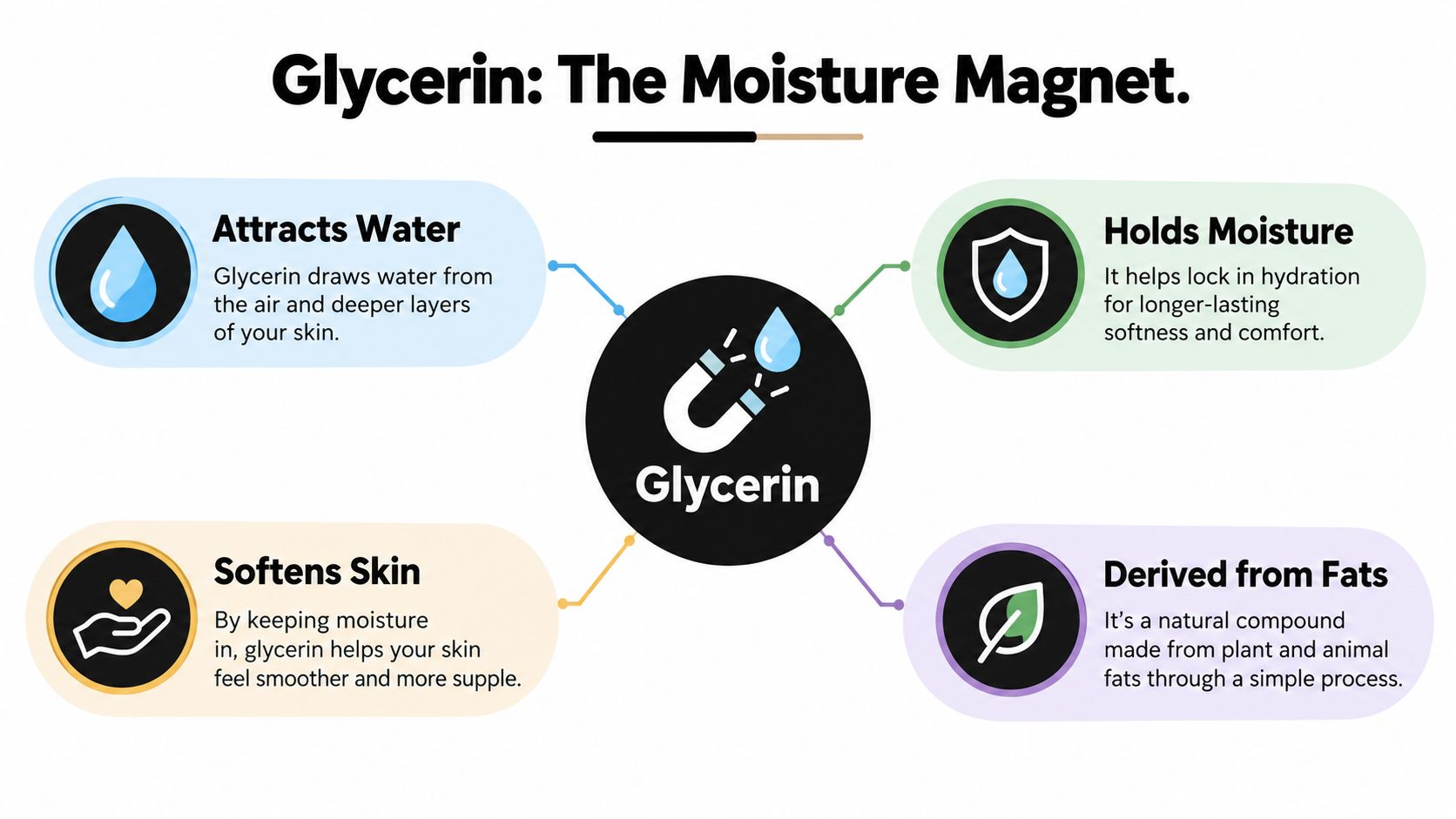
Think of glycerin, also called glycerol, as a small moisture magnet. It attracts and holds water, helping the outer layer of skin maintain a more comfortable water balance. Formulators call this type of ingredient a humectant.
That analogy needs one important qualification. Glycerin doesn't behave identically in every bathroom or formula. Its water-binding performance depends on humidity and the formulation's water activity. In very dry conditions, glycerol can still support skin comfort by helping prevent skin lipids from shifting from a flexible state into more rigid crystalline phases. So glycerin can help, but it isn't a guarantee that every glycerin bar will moisturize every person in every climate.
Where glycerin comes from
Glycerin forms naturally when fats or oils react with an alkali during saponification, the traditional soapmaking reaction. Historical patent records show that manufacturers were developing ways to retain or recover glycerin during soap production by the late 1930s. Later formulations explored substantially higher glycerin levels, including one formulation described in a patent at up to 50% glycerin and another at up to 20%, demonstrating that glycerin became a deliberate formulation variable rather than merely an incidental by-product. The patent record provides this formulation history.
That history also explains why “glycerin soap” isn't one standardized recipe. Concentration, soap type, water content, pH, surfactants, fragrance, and supporting ingredients can vary substantially.
Three formulation knobs
| Variable | What It Controls | What to Look For |
|---|---|---|
| Glycerin level | Water binding and after-wash feel | Glycerin listed clearly, with realistic moisturizing language |
| Alkalinity | How strongly the cleanser shifts skin pH | Finished-product pH information, especially for sensitive skin |
| Surfactant load | Cleansing strength and potential barrier disturbance | A formula that cleans effectively without an aggressive, squeaky finish |
A useful way to remember this is that glycerin is one knob, not the whole control panel. A high-glycerin bar can still feel harsh if alkalinity or cleansing strength is excessive. Conversely, a modestly glycerin-containing formula may feel comfortable when its cleansing system and pH are well balanced.
For a plain-language explanation of glycerin's role, this guide to what glycerin does is a useful companion. The main lesson is simple: judge the complete formula, not the ingredient spotlight.
What Mild Means on Sensitive Skin, Measured
What does “mild” mean once the bar touches sensitive skin? It means more than a gentle-sounding label. Researchers assess how cleansing affects the skin barrier and surface environment, then connect those measurements with sensations such as tightness, warmth, or redness.
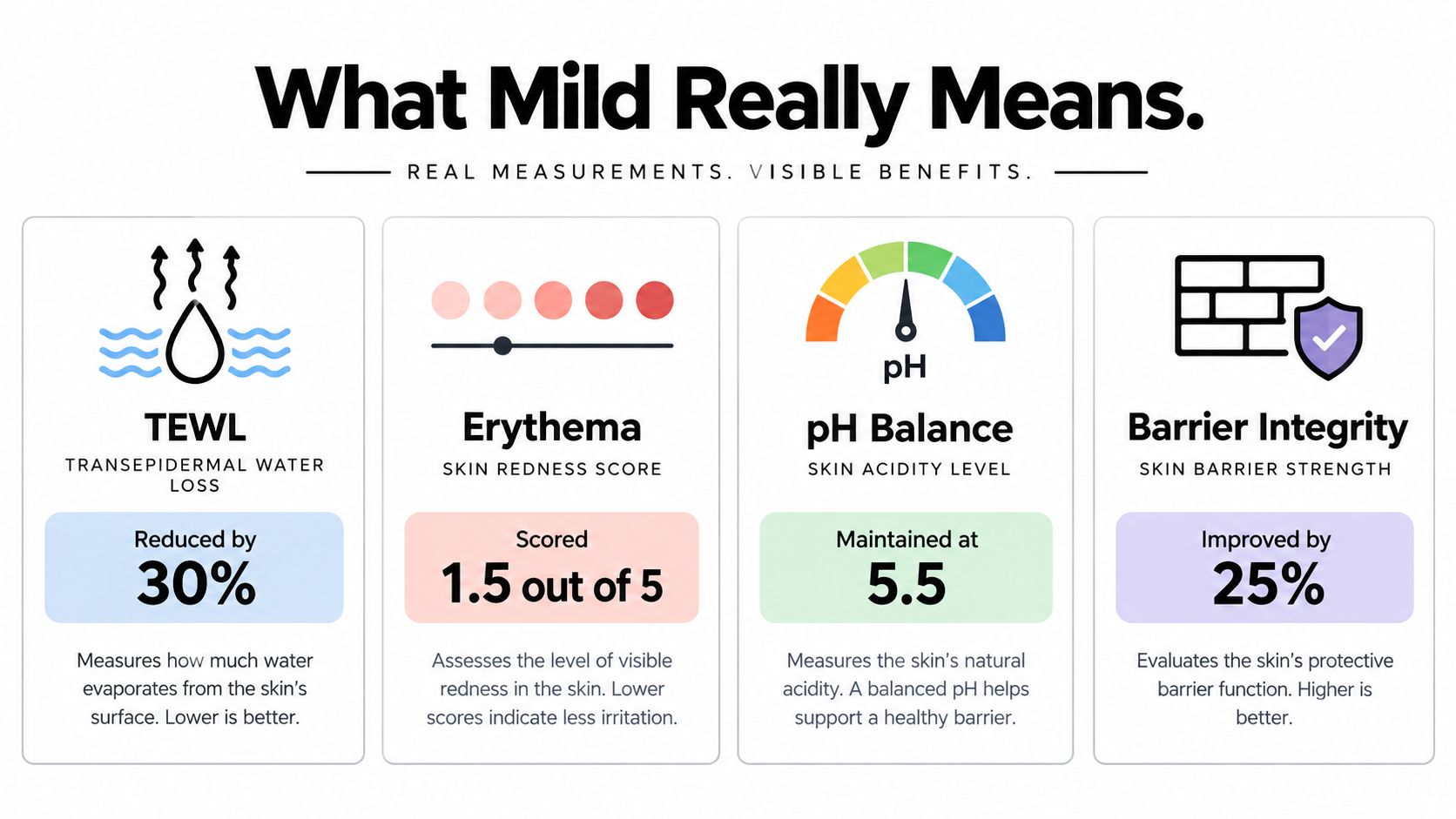
Transepidermal water loss, or TEWL, measures water moving out through the skin. An increase can signal barrier disturbance. Erythema is visible redness. Skin pH shows whether washing shifts the skin's naturally acidic surface. Friction offers another clue, because a rougher interaction can make cleansing feel less comfortable.
A 2022 study divided 60 healthy participants into four groups of 15. Each group washed one forearm at least four times daily for seven days, while researchers recorded these outcomes. Alkaline soap caused significantly greater erythema than glycerin and creamy soaps. It also increased skin pH and TEWL. The study details and measurements are reported in the Journal of Cosmetic Dermatology.
Reading the measurements in daily life
The results do not mean glycerin soap leaves the barrier completely unchanged. In the comparative study, every product produced a significant TEWL increase after the first wash. Mildness is better understood as the scale, duration, and redness associated with that response.
An earlier single-dose patch study in the same journal tested four formulations on 20 healthy volunteers, using 8% soap solutions. Traditional alkaline soap produced significant increases in TEWL and erythema. The effects from glycerin, syndet, and other formulations were transient, with TEWL returning to baseline by 72 hours. This comparison supports a practical point: a product can cause a short-lived response without producing the same degree of ongoing disruption as a harsher cleanser.
For shoppers, the measurements translate into useful questions:
- Lower or less persistent TEWL suggests less barrier disturbance.
- Less erythema means less visible redness after washing.
- A smaller pH shift indicates greater respect for the skin's surface environment.
- Lower friction and reduced tightness can support a more comfortable after-wash feel.
Practical rule: Rinse thoroughly, choose lukewarm water instead of very hot water, and apply moisturizer soon after drying. Immediate moisturizer application has been shown to reduce post-soap increases in TEWL and skin pH, while glycerin is one humectant that can support barrier recovery. See the hand-washing evidence in this PubMed record.
A formula may suit sensitive skin as a starting point while still feeling wrong during a flare or for a particular user. For reactive hands, this fragrance-free bar soap guide for sensitive skin offers another way to assess a bar beyond the word glycerin.
How Glycerin Soap Compares to Other Soap Types
Glycerin soap sits between several familiar categories. It may be a traditional alkaline soap that retains naturally formed glycerin, a formulation with added glycerin, or a product marketed around a clear, soft, or moisturizing feel. A syndet, by contrast, uses synthetic detergent ingredients and can be formulated closer to skin-compatible pH.
The category labels help, but they don't settle the decision. A traditional bar can work well for someone who likes a strong cleanse and tolerates alkalinity. A syndet can be a practical option for reactive skin. A glycerin bar may offer a comfortable middle ground when the complete formula is well balanced.
A quick comparison
| Soap Type | Typical pH | Best For | Tradeoffs |
|---|---|---|---|
| Glycerin soap | Varies by formula | People seeking a traditional or humectant-supported cleanse | “Glycerin” doesn't reveal the finished pH, fragrance strategy, or surfactant strength |
| Traditional alkaline bar | Alkaline | Users who prefer a firm, effective traditional soap feel | Higher alkalinity can increase pH shift, TEWL, and redness for some users |
| Syndet bar | Often formulated closer to skin-compatible pH | Sensitive, dry, or dermatologist-managed skin routines | May feel less like traditional soap and may use more unfamiliar ingredient names |
The choice depends on what your skin reports. If a traditional bar leaves you comfortable and you don't experience tightness, redness, or itching, there may be no reason to change solely because another category is fashionable. If repeated washing leaves your hands rough or visibly red, a lower-irritation formula deserves consideration.
A syndet is not automatically better because it isn't traditional soap. Fragrance, surfactant selection, preservatives, and the rest of the formula still matter. Likewise, a glycerin bar isn't automatically milder because glycerin is present.
For occasional sensitivity, a well-formulated glycerin soap may be a reasonable trial. For actively inflamed, cracked, or eczema-prone skin, a fragrance-free, pH-aware cleanser recommended by a dermatologist may be the more cautious starting point. Your skin's response should decide, not the category name.
How to Evaluate a Refillable Soap Brand
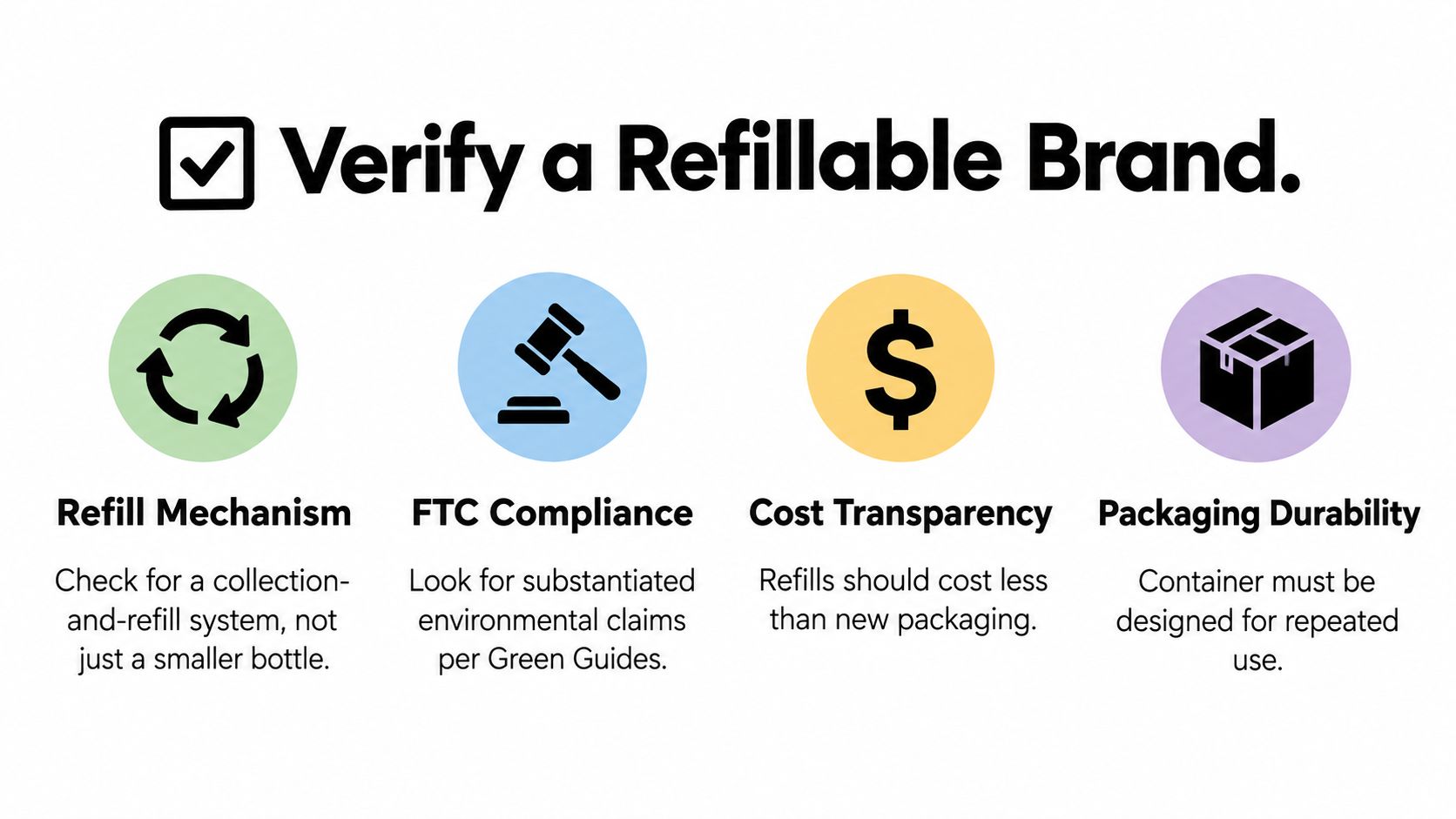
What does “refillable” mean in practice? A label alone cannot answer that. The U.S. Federal Trade Commission's Green Guides say an unqualified “refillable” claim should point to a way consumers can refill the original package, either through collection and refilling or by purchasing a refill product. The FTC's Green Guides summary explains the standard.
A useful evaluation follows the container through its next use. Check whether the brand explains:
- Where the refill comes from, such as a bulk soap station, mail-back service, or clearly identified refill product.
- What happens to used packaging, including whether customers return, reuse, recycle, or dispose of it.
- Whether the container is built for repeated use. FTC guidance says a collected container should withstand at least three refill cycles.
- Whether the system fits your location and routine. A faraway station or unavailable refill format may offer little practical benefit at home.
Fillaree provides a concrete example. Its refill pathway includes 70+ partner refill stations, 0.5-gallon home refill boxes that can top up a standard bottle up to eight times, and a take-back program that washes and sanitizes refill bags for reuse. These details connect the refillable label to specific replenishment and recovery steps.
Your best option depends on your household. A local bulk store may suit someone who shops nearby, while delivered refills may work better for another customer. Judge the claim by the behavior it supports, not by the package material or a recycling symbol alone. For a company-level check, look for clear information about how its refill system operates, so your ingredient choices and environmental values align from the soap formula to the container's next use.
Reading Ingredient Lists Without Losing Your Mind
What does a glycerin bar contain besides glycerin? Start there. Glycerin can help the skin hold water, but it does not erase the possible effects of fragrance, essential oils, colorants, preservatives, botanical extracts, or frequent washing.
Read the list as a formula, much like reading a recipe rather than judging one ingredient in isolation. A short list can still contain a fragrance component that bothers you, while a longer list may include useful emollients or barrier-compatible additions. “Natural” describes an origin, not a guaranteed tolerance. This overview of top natural ingredients for skin can help separate ingredient source from likely skin response.
Check four questions as you read:
- What provides the cleansing? Look for glycerin or glycerol, then identify whether the base is traditional soap or a syndet-style surfactant system.
- What adds scent or color? Note whether the bar is unscented, fragranced, or scented with essential oils. Check colorants and botanical extracts if you have reacted to cosmetics before.
- What supports the skin feel? Emollients and other barrier-compatible ingredients may change how the bar feels after rinsing.
- What does the maker measure? Finished-product pH, testing details, and clear ingredient explanations offer more useful information than a broad “mild” claim. Mildness is an outcome to assess through signs such as tightness, stinging, redness, and, where available, measures such as transepidermal water loss and erythema.
Glycerin itself has a useful safety record, with limits. The Cosmetic Ingredient Review assessment reported that 50% glycerin was not irritating to 420 patients with dermatitis under occlusion, and that 25% glycerin was not an irritant in patch testing. The same evidence included occasional positive reactions and clinical reports of rare contact dermatitis involving glycerin-containing products. “Glycerin is safe for everyone” goes beyond the evidence. The safety assessment is available here.
Irritation is usually about the combination, not a single ingredient.
Immediate burning, tightness, or stinging after a new bar suggests irritation or barrier disruption. A delayed, recurring itchy rash can fit allergic contact dermatitis. Stop the product, change one item at a time, and seek dermatology care if symptoms persist, spread, or become severe.
A controlled patch test can reduce guesswork, but it cannot replace medical evaluation. The cleanser matters too: caprylyl capryl glucoside shows why shoppers should examine the cleansing ingredient, not only the presence of glycerin.
Choosing Companies That Walk the Talk
A product can have a thoughtful formula and still come from a company that provides little information about workers, suppliers, packaging, or environmental impact. Values-aligned shopping therefore needs two filters: what is in the product and how the company operates.
B Corp Certification offers one whole-business framework. B Lab describes the assessment as covering impact on workers, communities, the environment, customers, and governance, including supply-chain inputs, employee benefits, and charitable giving. Its updated standards require performance across seven areas:
- Purpose and stakeholder governance
- Climate action
- Human rights
- Fair work
- Environmental stewardship and circularity
- Justice, equity, diversity, and inclusion
- Government affairs and collective action
The framework includes independently verified thresholds and improvement milestones after three and five years. B Lab describes the updated standards and certification expectations here.
Questions worth asking
A responsible soap company should be able to explain its ingredients, testing, packaging, suppliers, worker practices, and environmental goals without hiding behind broad words such as “clean,” “green,” or “non-toxic.” The FTC warns that general environmental claims are difficult to substantiate and says “non-toxic” claims need evidence addressing safety for people and the environment, or a clear statement of which one the claim concerns. Read the FTC's environmental marketing guidance.
Look for public impact reporting and clear accountability. B Lab's standards require certified companies to establish a public purpose, have the highest governing body monitor social and environmental impact, and report progress annually. That emphasis on continuous improvement is more informative than a one-time campaign about a recyclable bottle. B Lab explains these accountability mechanics here.
The same habit applies beyond personal care. If you're evaluating household choices more broadly, this guide to Green bedding for your bedroom offers another example of why materials and company claims should be considered together.
A Five-Step Routine for Picking Your Next Bar
Use this routine the next time you compare a mild glycerin soap. It keeps the decision concrete without pretending one formula can suit every household.
- Check the formulation basics. Confirm that glycerin is part of a clearly described formula. Look for the cleansing base, fragrance approach, and any available finished-product pH information.
- Test the mildness claim against skin biology. Ask whether the product's promise relates to reduced tightness, redness, or barrier disturbance. The terms TEWL, erythema, and pH give you a more useful framework than “gentle” alone.
- Verify the refill pathway. Find the actual mechanism. Can you buy bulk soap, return packaging, use a mail-back system, or visit a practical refill station? If the page only displays a refillable label, keep investigating.
- Read for likely irritants. Check fragrance, essential oils, botanical extracts, preservatives, and colorants. If you're prone to reactions, introduce one new product at a time and patch test cautiously. A practical guide on how to evaluate bath product ingredients can support that label-reading habit.
- Check the company's accountability. Look for independent certification, public reporting, supplier standards, worker information, and specific environmental claims. A product may fit your skin while the company fails your values, or the reverse, so assess both.
Choosing a mild glycerin soap is a small, repeatable decision. The aim isn't to find a magical bar. It's to make your next purchase confident rather than hopeful, then pay attention to how your skin responds over time.
Fillaree offers refillable liquid hand and body soap made with saponified organic vegetable oils and vegetable glycerin, including an unscented option described for sensitive skin, alongside refill bottles and bulk formats. Visit Fillaree to explore a soap routine that connects ingredient clarity with a practical low-waste refill system.