
Non Comedogenic Soap: A Practical Guide to Choosing
The most popular advice about non-comedogenic soap is also the least complete: check for the label, buy the product, and assume your pores are protected. That shortcut misses the details that often decide whether a cleanser feels comfortable or leaves your skin congested, including pH, surfactant harshness, the oils in the formula, and how cleanly the product rinses away.
“Non-comedogenic” can be a useful first filter, but it isn't a guarantee of clear skin. A better approach is to treat the claim as an invitation to inspect the entire formula, then test it gradually on your own skin. That approach also creates room for more thoughtful buying, including low-waste packaging, refill systems, and companies that support their ingredient and sustainability claims with independent standards.
Table of Contents
- What Non Comedogenic Soap Means
- How Pore-Clogging Happens in Real Skin
- Ingredients Worth Watching on Every Label
- How to Read a Soap Label Like a Formulator
- Choosing the Right Formula for Your Skin Type
- Testing a New Soap Without Wrecking Your Skin
- Buying Soap That Aligns With Your Values
- Non Comedogenic Soap Myths and FAQ
What Non Comedogenic Soap Means
Non-comedogenic means a product is formulated or assessed as less likely to block pores or encourage comedones, the technical term for clogged pores such as blackheads and whiteheads. The term grew from cosmetic science, where researchers examined whether ingredients could contribute to comedone formation. Early testing used the rabbit ear assay, developed by Albert Kligman and James Fulton, because rabbit ears are highly sensitive to comedone formation. That work shifted acne-related claims from anecdote toward measurable screening, although later dermatology reviews questioned how closely rabbit-ear results match human skin (historical background on the term and testing).
The label remains less precise than it sounds. In the United States, non-comedogenic has no federal definition, no required testing protocol, and no certification threshold. The FDA says cosmetics generally do not require premarket approval and that it does not keep a list of approved cosmetic claims. A product can therefore reach shelves without prior government review of a claim such as “non-comedogenic” (FDA cosmetics laws and regulations).
What the label promises
A label claim usually reflects the manufacturer's judgment that the formula is less likely to clog pores. Some companies commission non-comedogenicity testing, which may use clinical examinations and photographs after regular use. The testing overview describes this approach as objective evidence for products made for acne-prone skin (non-comedogenicity testing overview).
That evidence describes a formula under particular testing conditions, not a universal result. Every person will not tolerate the soap in the same way, and the claim does not provide a universally accepted comedogenicity score. Skin type, climate, shaving, medication, hormones, and the rest of your routine can alter the outcome.
A more useful reading is to treat the claim like a first-pass screen. Check the ingredient system, pH, surfactant behavior, and whether the soap rinses cleanly. Those details matter for comfort and for buying choices such as refillable, low-waste packaging. Fillaree's refill-friendly, third-party-certified formulas offer one example of matching product performance with purchasing values.
Practical rule: Use “non-comedogenic” as a starting filter, then assess the formula and your own response.
For comparison with a treatment cleanser, an acne face wash shows how an acne-focused product approaches cleansing and active ingredients. Fillaree's guide to what makes soap antibacterial adds context for interpreting antibacterial language.
How Pore-Clogging Happens in Real Skin
A clogged kitchen sink offers a useful comparison. Cooking oil can congeal around the drain, mix with soap scum, and leave a narrowing surface where scraps and residue collect. A pore can respond in a comparable way when sebum, dead skin cells, and leftover product gather inside a follicle.
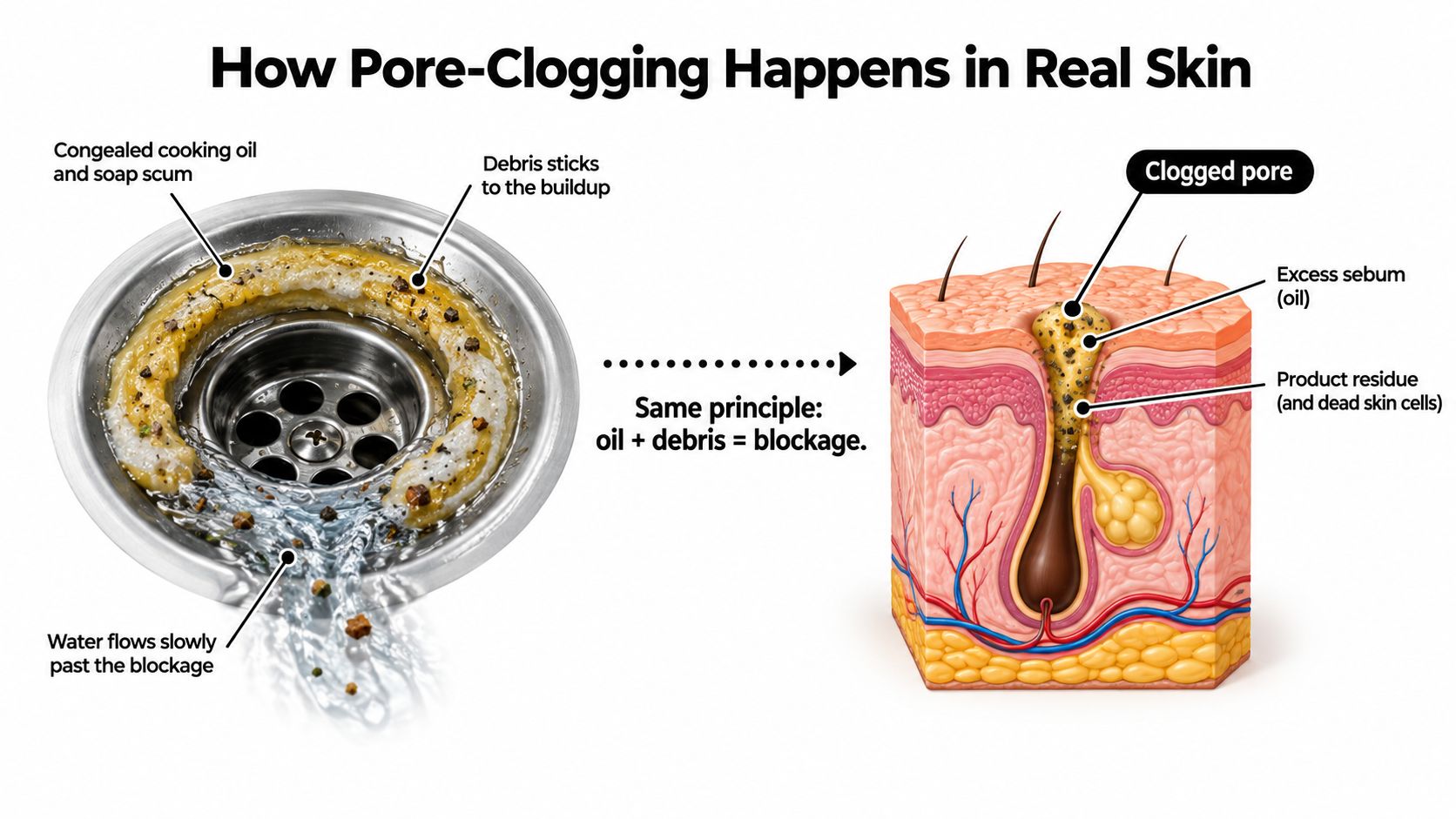
Three formulation details help explain the process.
Surfactants and residue affect both comfort and what remains after washing. Harsh detergents can remove too much surface oil and disturb the lipid barrier, leaving skin tight, irritated, or more reactive. A cleanser that leaves a film adds material around the follicle, especially with frequent washing or incomplete rinsing. Rinse behavior matters as much as the label claim.
The lipid choice also changes the finish. Heavy occlusive ingredients may remain on the stratum corneum after rinsing. A 2025 dermatology review recommends examining low-residue surfactant systems and avoiding heavy occlusive lipids that may persist on skin (2025 review of comedogenicity and formulation). This does not make every oil problematic. The oil, its concentration, the surrounding formula, and your skin work together. Ingredients used for conditioning, such as cetyl alcohol and skin, need the same formula-level reading.
pH is another part of the picture. Healthy skin surface pH is roughly 4.7 to 5.5, while conventional soaps commonly fall around 8.5 to 11.0, or even 10 to 11 (DermNet guidance on soaps and cleansers). An alkaline cleanser can raise skin pH, swell proteins, disturb intercellular lipids, weaken the barrier, and alter the microbiome. For acne-prone skin, that combination may increase irritation and reduce comfort.
These effects can stack together. A high-pH bar may create a squeaky-clean feel while stripping the barrier and leaving a residue-prone formula behind. A product can therefore carry a non-comedogenic claim yet still cause bumps for one user. Skin encounters the complete formula, contact time, rinse quality, and use frequency, not a label in isolation.
Formulation choices also shape lower-waste shopping. A refill-friendly product can reduce packaging without changing the need to check pH, surfactants, lipids, and rinse feel. Fillaree's third-party-certified, refillable formulas provide one example of matching those practical checks with purchasing values.
Ingredients Worth Watching on Every Label
A pore-clogging list is a screening tool, not a verdict. Concentration, the surrounding formula, skin type, and individual response all affect how an ingredient behaves. Read the tiers below as prompts for closer inspection, not as a universal blacklist.
| Risk Tier | Ingredients to Watch | Common Soap Sources | Recommended Action |
|---|---|---|---|
| Higher caution | Isopropyl myristate, isopropyl palmitate, isostearyl isostearate, myristyl myristate, lanolin, acetylated lanolin, D&C red dyes | Creamy bars, rich cleansing bases, tinted or heavily conditioned products | Be cautious when these appear near the top, especially if you develop closed comedones |
| Moderate, formula-dependent | Coconut oil, cocoa butter, wheat germ oil, oleic acid, sodium lauryl sulfate, heavy fragrance components | Traditional oil-based soaps, rich body bars, strongly scented formulas | Patch-test and monitor the rinse feel, dryness, and delayed bumps |
| Generally safer standouts | Glycerin, sorbitol, sucrose cocoate, decyl glucoside, sodium cocoyl isethionate, hemp seed oil in moderation, squalane | Syndet bars, gentle liquid cleansers, lightweight moisturizing formulas | Reasonable ingredients to try, while still checking the complete formula |
The richer the product feels, the more closely its rinse behavior deserves attention. Coconut oil, cocoa butter, wheat germ oil, and isopropyl myristate are commonly flagged in ingredient guidance, while glycerin-based formulas are generally described as gentler options for oily or acne-prone skin (ingredient guidance for non-comedogenic bar soaps).
How to use the tiers
For a facial cleanser, inspect the first part of the ingredient list for a higher-caution emollient paired with a creamy, slow-rinsing base. A moderate ingredient can still work well in a formula that rinses cleanly, so patch-testing gives you more useful information than the ingredient name alone.
Cleaning claims need the same careful reading. Review ingredients in antibacterial soap before treating “antibacterial” as a synonym for acne-safe. An emulsifier such as polysorbate may help oil and water stay mixed, and this explanation of polysorbate in skincare and soap can clarify why it appears on a label.
Those details also matter for low-waste purchases. Refillable, third-party-certified formulas from Fillaree show how packaging preferences can sit alongside ingredient, rinse, and skin-tolerance checks.
How to Read a Soap Label Like a Formulator
Turn the bottle or box around before you fall for the front label. The first part of the ingredient list reveals the formula's backbone, and ingredients are generally listed in descending order of concentration under FDA labeling rules.
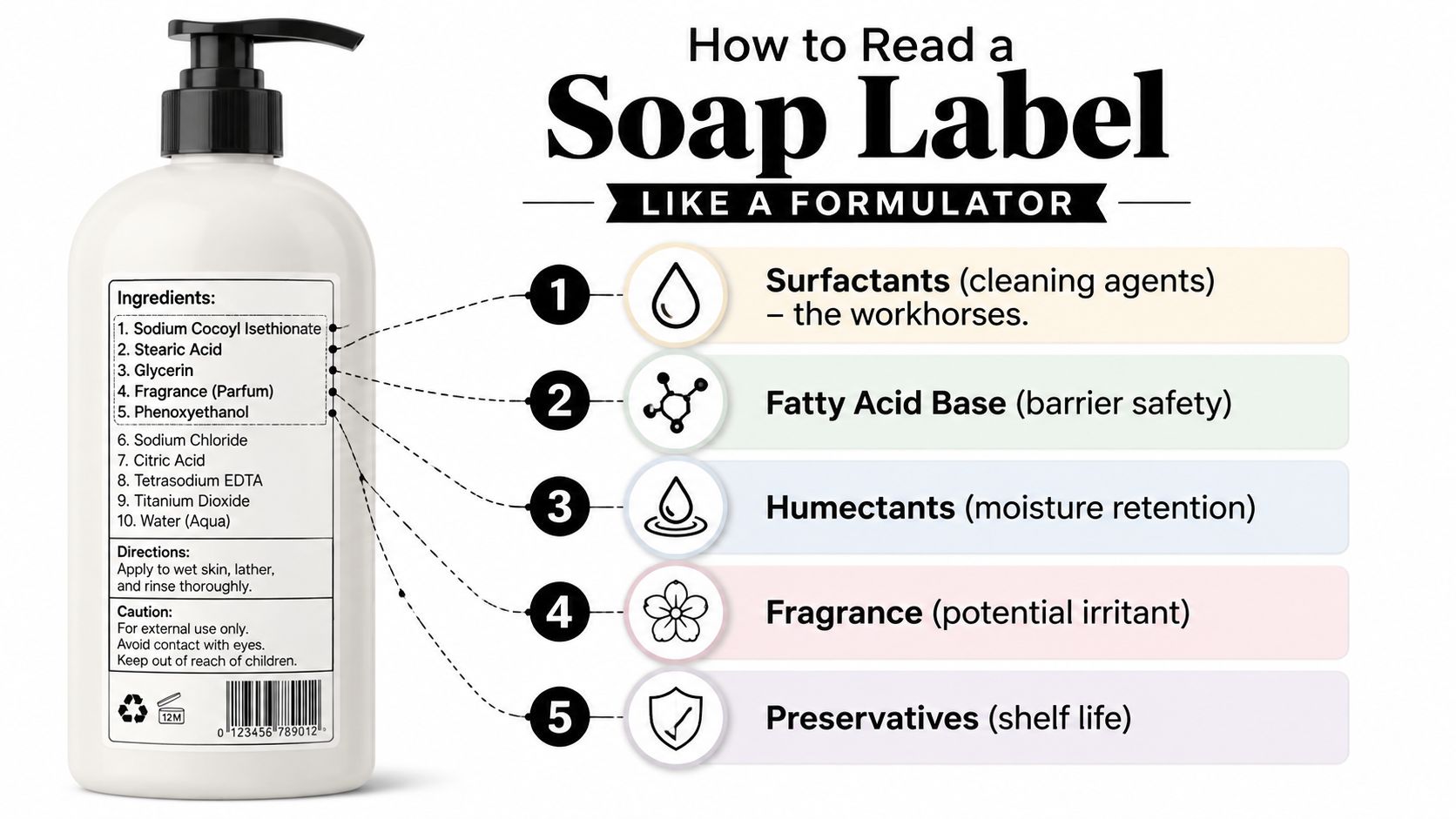
Start with the first five ingredients
Look for the cleaning system first. Sodium cocoyl isethionate and decyl glucoside are examples of milder surfactants that can cleanse without the aggressive feel associated with some traditional detergents. The next ingredients may show the fatty-acid base, humectants such as glycerin, water, fragrance, or preservatives.
A formula with glycerin near the front may feel more comfortable for skin that becomes tight after washing. A formula led by heavy oils may feel creamy but leave more residue, especially if the bar is traditional soap rather than a syndet cleanser.
Notice what the label hides
“Fragrance” or “parfum” doesn't tell you which aromatic materials are present. That doesn't mean every fragranced product is harmful, but it makes it harder to identify a trigger if your skin reacts. Essential oils can also irritate sensitive skin, even when the package says “unscented,” so check the full list rather than relying on one front-label word.
Be wary when isopropyl myristate or isopropyl palmitate appears high on the list, or when harsh sulfates appear without conditioning or barrier-supportive ingredients. Traditional saponified soaps also tend to be more alkaline, while true castile and syndet bars typically fall between pH 5 and 7, depending on the formulation and testing.
Before buying, ask:
- What cleans: Are the surfactants mild enough for frequent use?
- What remains: Does the formula contain rich oils or waxy ingredients likely to rinse slowly?
- What supports comfort: Is glycerin or another humectant included?
- What adds scent: Does the label identify fragrance or essential oils clearly?
- What is the pH: Has the brand disclosed a tested range or product-specific result?
A transparent label can't guarantee compatibility, but it gives you far more useful information than the claim alone.
Choosing the Right Formula for Your Skin Type
Your skin type narrows the choices, but it does not decide everything. The useful questions are how the formula cleans, whether it rinses fully, and how it leaves your skin feeling afterward. pH, surfactant system, and residue often matter more than the word “soap” on the package.
| Skin Type | Best Format | Look For | Avoid |
|---|---|---|---|
| Acne-prone | Syndet bar or gentle gel cleanser | Glycerin, low-residue surfactants, salicylic acid, niacinamide, low-risk oils | Heavy occlusives, harsh detergents, strongly scented formulas |
| Oily | Light gel, syndet bar, or balanced liquid wash | Tea tree or charcoal in moderation, humectants, easy-rinsing surfactants | Over-stripping formulas and repeated scrubbing |
| Sensitive or eczema-prone | Fragrance-free syndet bar or simple liquid cleanser | Minimal ingredients, oat, allantoin, ceramide-supportive bases | Fragrance, essential oils, aggressive sulfates, long ingredient lists |
| Normal or combination | Gentle daily bar or cleanser, with occasional clarifying option | A comfortable rinse, moderate cleansing, targeted actives only when needed | Rotating too many new products at once |
Acne-prone skin
A syndet bar can be a practical choice because it may be formulated closer to skin-compatible pH than traditional soap. Look for sodium cocoyl isethionate, decyl glucoside, glycerin, or another mild cleansing base. A targeted active, such as salicylic acid, may suit skin prone to blocked pores. Benzoyl peroxide, azelaic acid, tea tree oil, and alpha hydroxy acids also appear in acne-focused cleansers for concerns involving pores, bacteria, or inflammation (acne cleanser ingredient guidance).
The rinse matters too. A cleanser that removes oil effectively but leaves a tight, squeaky finish may encourage over-washing, while a low-residue formula is easier to use consistently.
Oily and sensitive skin
Oily skin can feel clean without feeling stripped. Choose a light formula with balanced humectants and surfactants that rinse readily. Tea tree or charcoal may fit some routines in moderation, but repeated scrubbing and aggressive cleansing can make comfort harder to maintain.
Sensitive skin usually benefits from fewer variables. Fragrance-free removes one common source of uncertainty, though it does not guarantee irritation-free use. For more product-selection context, these sensitive skin face wash recommendations provide a useful comparison point.
Bar or liquid
Choose a bar for less packaging, simple storage, and a refill-friendly routine when its formula rinses clean. Choose liquid when controlled dispensing, a softer texture, or refills make consistent use easier. Fillaree's refillable, third-party-certified formulas offer a concrete example of pairing formulation choices with lower-waste shopping.
For body acne, either format can work. The format itself does not clear acne. The cleansing system, active ingredients, rinse behavior, and washing habits matter more.
Testing a New Soap Without Wrecking Your Skin
A careful trial can tell you more than a confident label. Test the product in stages so you can separate irritation from congestion and avoid changing several products at the same time.
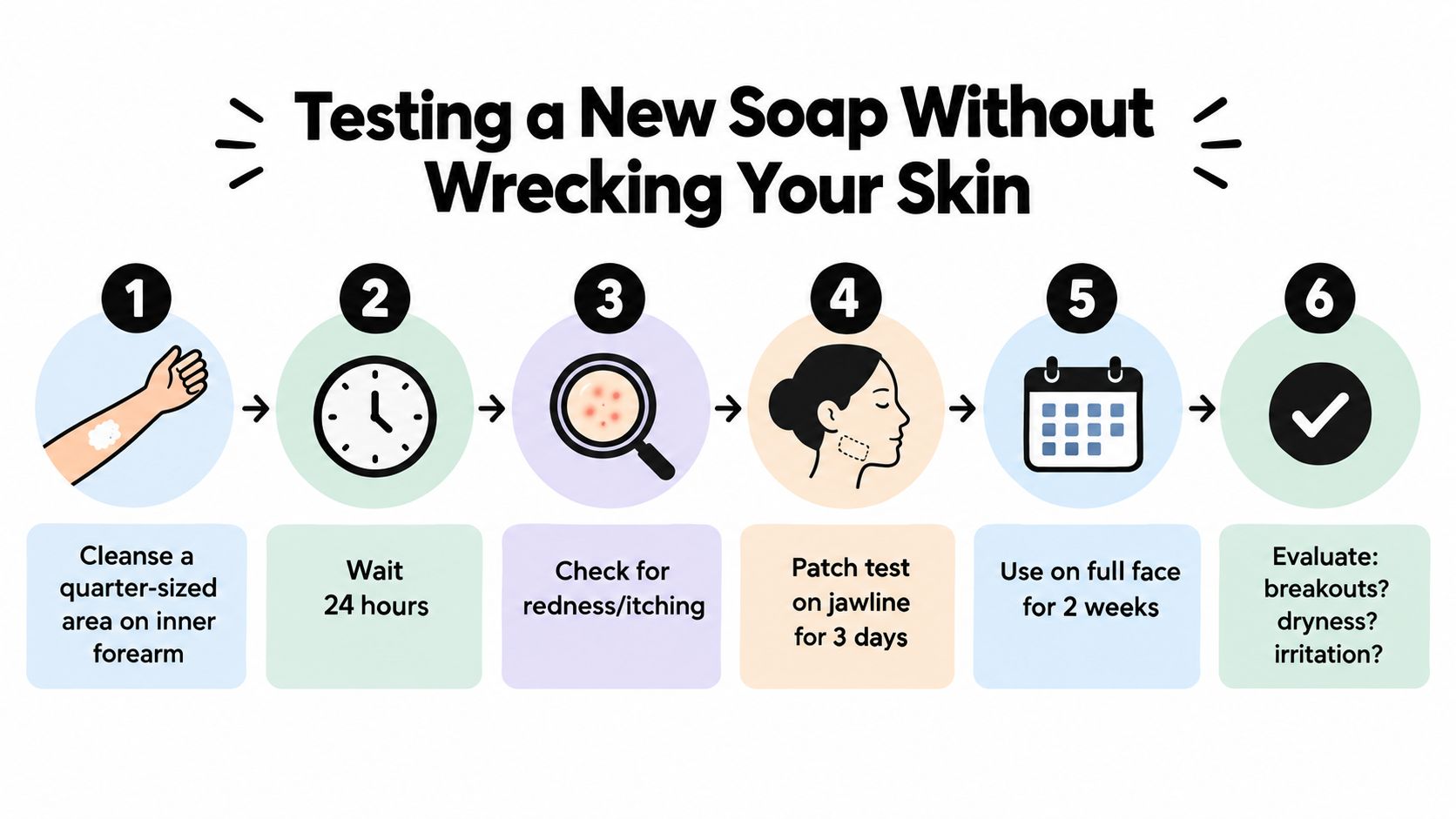
Begin with a small area
Use the soap on a quarter-sized area on the inner forearm or behind the ear twice daily for 48 to 72 hours. Rinse normally, pat dry, and watch for redness, itching, burning, swelling, or new bumps. A reaction that appears quickly and feels itchy or raw suggests irritation or contact sensitivity rather than the gradual clogged-pore pattern many people associate with acne.
If the area remains comfortable, move to a small section along the jawline for several days. Don't apply a new cleanser to irritated, sunburned, or broken skin, because the result won't tell you how the product performs under normal conditions.
Stop immediately if you develop intense burning, swelling, hives, marked redness, or a rapidly worsening rash. Seek medical advice for a severe or persistent reaction.
Run a controlled face trial
For a two-week face trial, introduce only one new soap and keep the rest of your routine minimal. Take a photo on day zero, day seven, and day fourteen under similar lighting. In a notes app, rate oiliness, texture, dryness, and breakouts using a simple personal scale, then record whether the product rinsed clean or left a film.
“Purging” is often misunderstood. A cleanser that doesn't contain a proven pore-clearing active shouldn't be assumed to purge your skin. New irritation, widespread bumps, or worsening discomfort is a reason to stop rather than push through.
Consistency makes the notes useful. Patterns become easier to spot when you record the product, frequency, water temperature, rinse time, and any other new skincare exposure.
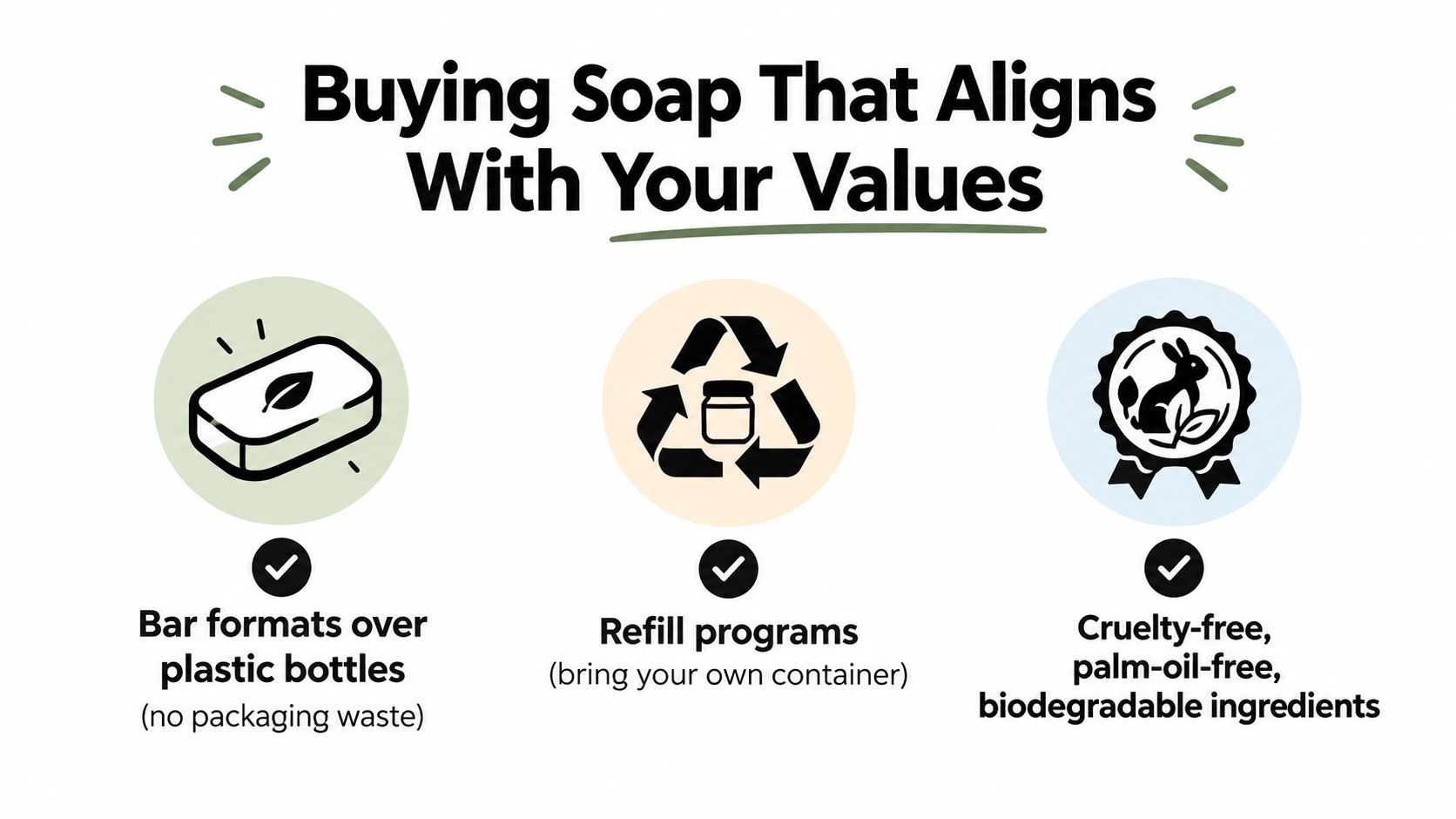
Buying Soap That Aligns With Your Values
A cleanser that suits your pores but creates unnecessary waste may not fit the rest of your household values. The practical solution isn't to ignore skin compatibility for sustainability. It's to evaluate both at the same time.
Start with the packaging. A bar can reduce packaging compared with a plastic-bottled body wash, while a liquid refill can make sense when you need a pump, share products with family, or prefer precise dispensing. Research on soap consumption and hygiene-product design recommends biodegradable, non-toxic ingredients alongside reusable and recyclable packaging, and circular refill systems have been studied as a way to reduce single-use bottles and replacement costs (research on refillable soap systems and sustainable design).
Look beyond “natural”
Third-party certifications can provide more accountability than self-declared words such as “clean,” “gentle,” or “natural.” Depending on the product and claim, shoppers may look for standards such as USDA Organic, EWG Verified, Leaping Bunny, or B Corp. These labels don't all evaluate the same thing, so read what each certification covers.
Ingredient transparency matters too. Decyl glucoside and sodium cocoyl isethionate are examples of mild cleansing ingredients worth investigating when you want a gentler surfactant system. Packaging choices such as aluminum containers, recycled materials, reusable bottles, and refill pouches can reduce waste at the source, but the company should explain how its program works rather than relying on vague sustainability language.
A practical example
Fillaree offers refillable soap and body-care products, including formulas made with plant-based ingredients and an unscented hand-soap refill positioned for sensitive skin. Its model connects product use with a circular refill system, so a shopper can consider cleanser feel, ingredient transparency, packaging, and company values in the same purchase decision.
Supporting companies that care about both formulation and waste reduction makes your routine more coherent. You're not forced to choose between a skin-conscious cleanser and a lower-waste habit when a brand explains how its formulas, packaging, certifications, and refill process fit together.
Non Comedogenic Soap Myths and FAQ
Myth: Non-comedogenic means acne-free for everyone. The label describes an intended pore-clogging profile, not a guaranteed result. In the United States, the claim is not federally standardized, and skin responses differ. A formula may still irritate you, rinse poorly, or conflict with products already in your routine.
Myth: Soap alone clears breakouts. Cleansing removes oil, sweat, and surface debris from the skin's surface. It usually does not address every process behind acne. Depending on your tolerance and needs, an acne routine may also use salicylic acid, benzoyl peroxide, azelaic acid, tea tree oil, or alpha hydroxy acids. A cleanser guide for acne-prone skin can help clarify the different roles these products play.
Myth: A higher pH cleans deeper. Alkaline soap does not clean better because its pH is higher. Traditional soap can raise the skin's surface pH and disturb barrier lipids, while a milder cleanser closer to the skin's natural environment may feel more comfortable for frequent use. The useful question is not only whether a bar is labeled non-comedogenic, but also how its cleansing system and pH behave after rinsing.
Myth: Natural oils can't clog pores. “Natural” describes an ingredient's origin, not how it behaves in every formula or on every face. Coconut oil, cocoa butter, wheat germ oil, and some esters may be poor matches for clog-prone skin. Ingredient names are clues, not a final verdict, because concentration, the complete formula, and your individual response all matter.
Myth: All fragrance is unsafe. Fragrance is not automatically a problem for everyone. Still, fragrance blends and essential oils can make a reaction harder to identify. If your skin is sensitive, begin with a simpler, fragrance-free formula so you can assess the cleanser without several variables changing at once.
Common questions
Is non-comedogenic soap safe for rosacea? Not automatically. Rosacea-prone skin may react to fragrance, harsh surfactants, heat, or rubbing. Choose a mild cleanser, patch-test it, and ask a dermatologist about ongoing flushing or bumps.
Can kids use it? Children may use a gentle cleanser suitable for their age and skin. Adult acne treatments should not be added to a child's routine by assumption. Fragrance-free, low-irritant formulas are a sensible starting point, and persistent rashes or acne-like eruptions warrant clinical advice.
Does soap expire? Smell, color, texture, and cleansing performance can change over time, especially with heat and moisture. Follow the package guidance, keep bars dry between uses, and replace anything that looks or smells altered.
Does antibacterial soap help acne-prone skin? Antibacterial wording does not show that a cleanser addresses clogged pores. Harsh cleansing may add irritation, so compare pH, surfactant system, rinse behavior, and suitable acne actives instead.
Choose a transparent, fragrance-free formula with a mild cleansing system, patch-test it, and observe your skin over two weeks. For lower-waste shopping, Fillaree offers refillable soaps and body-care options, including an unscented refill, with formulas and refill choices presented at Fillaree.