
Non Toxic All Purpose Cleaner: A Practical Guide
You're standing in the cleaning aisle with a bottle in one hand and a label full of promises in the other. “Natural,” “gentle,” and “plant powered” sound reassuring, but the ingredient list still reads like a chemistry textbook, and you're not sure whether the product will remove kitchen grease or just leave a pleasant scent behind.
That uncertainty is understandable. A non toxic all purpose cleaner shouldn't be judged by its front label alone. The useful questions are more practical: What ingredients does it contain? How does it perform on grease, mineral residue, and everyday soil? Is it appropriate for the surface, the people using it, and the indoor air? Does the packaging reduce waste, or does a green formula still arrive in a disposable bottle?
By the time you finish, you'll have a straightforward way to compare formulas, recognize meaningful testing, match cleaners to surfaces, and decide whether a refill system fits your home. You'll also be better equipped to support good companies that care about effective products, transparent ingredients, responsible packaging, and the communities affected by their work.
Table of Contents
- Why Non Toxic Cleaners Deserve Scrutiny
- What Makes a Cleaner Safer
- Ingredients to Avoid and What to Look For Instead
- Certifications and Testing That Actually Mean Something
- Choosing the Right Cleaner for Different Home Surfaces
- The Case for Refillable and Low-Waste Cleaning Systems
- Your Non Toxic Cleaning Decision Framework
Why Non Toxic Cleaners Deserve Scrutiny
A kitchen counter can hold several kinds of soil at once: greasy film near the stove, crumbs around the toaster, fingerprints on cabinet handles, and a faint ring from a wet glass. One spray may be used across the kitchen, bathroom, entryway, and home office, so its real performance and formulation matter more than reassuring words on the label.
All-purpose cleaners are used regularly in kitchens and bathrooms, according to the NCBI fact sheet on household cleaning products. Repeated use brings repeated contact with sprayed droplets, treated surfaces, skin, and wastewater. A formula that seems acceptable for occasional heavy cleaning deserves closer examination when it is misted throughout a home every day.
Exposure follows ordinary routines
Spraying can release ingredients into indoor air before a cloth reaches the surface. Wet residue may touch skin around counters, tables, floors, and bathroom fixtures. Rinsing also sends ingredients into wastewater, making effects on aquatic environments part of the safety question.
“Non toxic” is not a complete scientific description, and a conventional cleaner is not automatically harmful in every use. The practical test is to consider hazard and exposure together. A highly irritating ingredient in a concentrated spray creates a different concern from a mild ingredient used in a controlled wipe, even when both products use green language.
Cleaning performance belongs in the same evaluation. A product that leaves grease behind may prompt repeated spraying, more wiping, or a stronger follow-up product. That gap between a “non toxic” marketing claim and actual soil removal is why ingredient transparency, directions, and evidence matter. For readers applying the same standard to vehicles, this guide to why non-toxic car cleaners matter offers useful context about frequently touched interiors.
The EPA's greener-cleaning guidance points to reduced corrosive or strongly irritating substances and low volatile organic compound content as useful characteristics of preferable products. The EPA Safer Choice program evaluates ingredients, performance, pH, packaging, and environmental considerations instead of accepting a vague claim at face value.
Practical rule: Treat “natural” as a starting point for questions, not proof that a cleaner is safer or effective.
Refill systems add another question: can the formula clean reliably while the container stays in circulation? A safer choice should handle the job in front of you, limit unnecessary exposure, and reduce packaging waste rather than rename the same disposable routine.
What Makes a Cleaner Safer
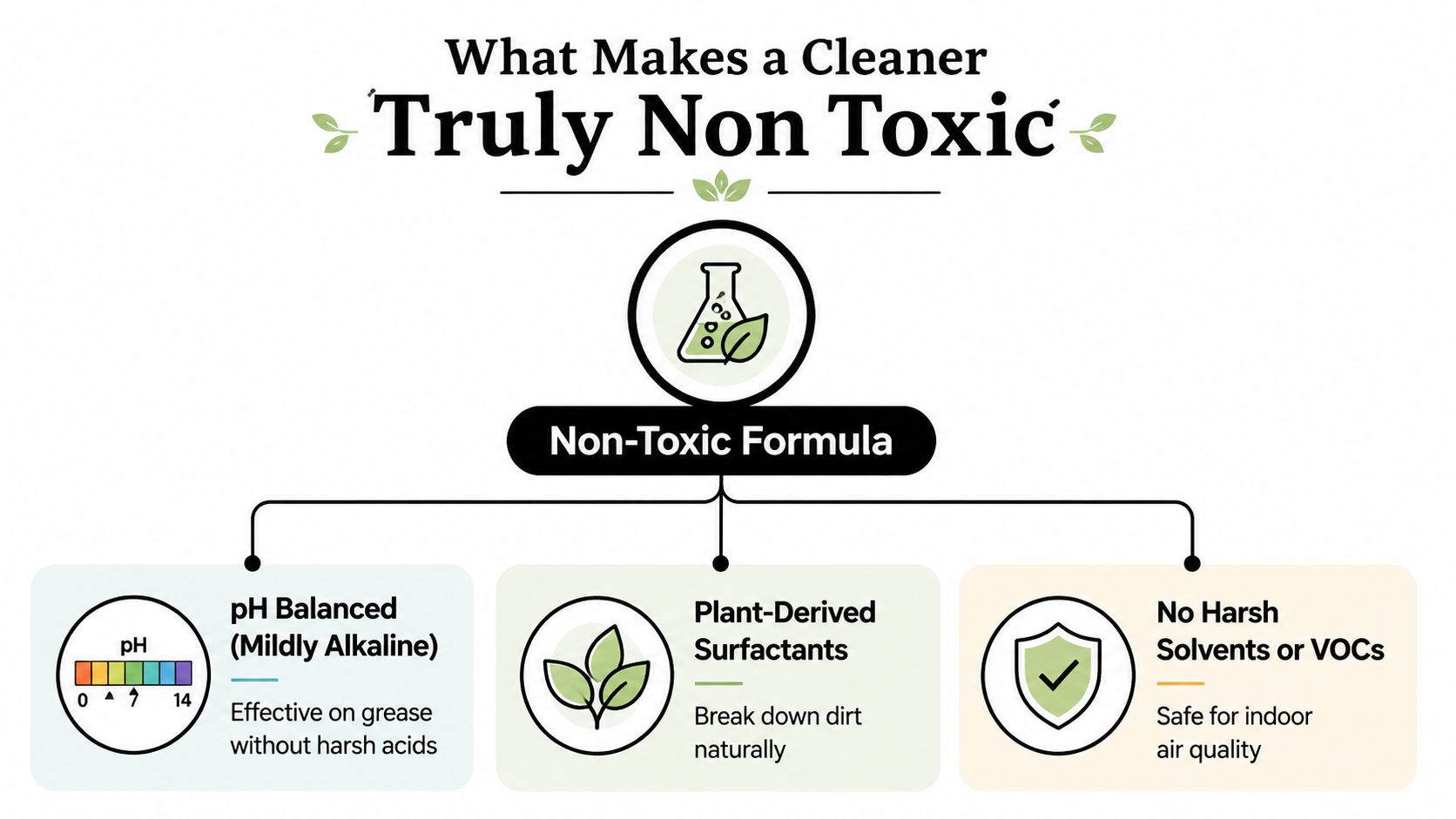
A cleaner's safety and performance begin with its formulation, not the wording on its label. Cleaning works like a coordinated system: water carries ingredients across the surface, surfactants loosen soil, and supporting ingredients keep that soil suspended until a cloth or rinse removes it. If one part is poorly chosen, a product may sound safer while cleaning less effectively.
pH sets the boundaries
For broad-purpose cleaning, formulation references commonly place products around pH 7.5 to 10.5, as described in the IKW all-purpose cleaner formulation reference. This mildly to moderately alkaline range can help lift soil and support surfactant performance without the extreme causticity associated with heavy-duty degreasers.
A mildly alkaline formula often suits sealed countertops, finished tile, and other hard, non-porous surfaces. Stronger alkaline products may remove heavy oil faster, yet they can also raise the risk of dulling, sealant damage, or skin and eye irritation. One safety-assessment example in the same reference lists pH 9.3 to 9.7, while a commercial safety data sheet lists pH 8.5 to 9.5. These examples show the balanced ranges shoppers may encounter. They are not universal requirements.
Surfactants do the lifting
Surfactants connect water with oily soil. One end interacts with water while the other attaches to grime, helping detach particles and surround them so the cloth can carry them away. Plant-derived surfactants can perform this work without making a cleaner ineffective.
A Safer Choice-style example contains water, plant-derived surfactants, citric acid, and potassium sorbate. Chelators such as citrate can reduce interference from hard-water minerals and improve rinseability. That distinction matters in practice. A surfactant-forward cleaner is suited to routine soil removal, while a formula around pH 13 is positioned as a heavy-duty degreaser with substantially stronger irritation and eye-damage hazards, as shown in the Simple Green safety data sheet.
Packaging also belongs in the evaluation. A refillable system is a stronger option when its formula cleans consistently and the container stays in circulation, rather than replacing disposable bottles without improving results. For facilities that use wipes, choose non toxic wipes for facilities by separating routine cleaning from disinfecting and checking the product's actual purpose, not just its marketing language.
Ingredients to Avoid and What to Look For Instead
Ingredient literacy is more useful than memorizing a long blacklist. Start by asking what a product needs to do, then look for ingredients that support that job without adding unnecessary fragrance, harsh solvents, or aggressive disinfecting chemistry.
Quaternary ammonium compounds, often called quats, deserve particular attention in disinfecting sprays and wipes. The 2019 review of cleaning-product ingredients describes the diversity of surfactants, solvents, fragrances, preservatives, and quaternary ammonium compounds found in household cleaners, while also noting that hazard information isn't equally clear across ingredient classes. For everyday soil, a surfactant-based cleaner may be more appropriate than a disinfectant formula.
Synthetic fragrance is another label that deserves scrutiny. “Fragrance” or “parfum” can describe a blend rather than a complete ingredient list, making it difficult for a shopper to know what creates the scent. Fragrance-free products, or brands that disclose their fragrance components, make a more informed choice possible for people sensitive to odors.
| Avoid These | Why They're Problematic | Look For Instead |
|---|---|---|
| Quaternary ammonium compounds | They're common in disinfecting products and may irritate skin or airways, particularly with frequent or undiluted exposure. | A surfactant-forward cleaner for ordinary dirt, or a clearly identified disinfectant used only when the task requires it. |
| Chlorine bleach and ammonia | They're aggressive chemistries, and mixing them can create dangerous fumes. | Separate, purpose-specific products, with no mixing and careful label compliance. |
| Strong solvents and high-VOC formulas | They can produce noticeable odors and add to indoor-air exposure during spraying. | Low-VOC or low-emission formulas with water, surfactants, and transparent supporting ingredients. |
| Undisclosed fragrance blends | The catch-all term gives shoppers limited information about the scent mixture. | Fragrance-free products or clearly disclosed fragrance components. |
| Excessively alkaline degreasers | They may remove heavy oil quickly but carry greater risks for skin, eyes, finishes, and sealants. | Mildly alkaline chemistry for frequent cleaning, with a specialist degreaser reserved for exceptional soil. |
| Ingredients with aquatic toxicity concerns | What enters the drain can affect water systems, so environmental safety belongs in the evaluation. | Products screened against meaningful aquatic and persistence criteria. |
A useful ingredient to investigate rather than fear automatically is caprylyl/capryl glucoside, a plant-derived surfactant used in cleansing formulas. This explanation of caprylyl capryl glucoside can help you understand why a name that sounds technical isn't automatically a red flag.
Look for a full ingredient disclosure, clear directions, and a product type that matches the task. A brand that explains what each ingredient does gives you more useful information than a bottle covered in broad claims.
Certifications and Testing That Actually Mean Something
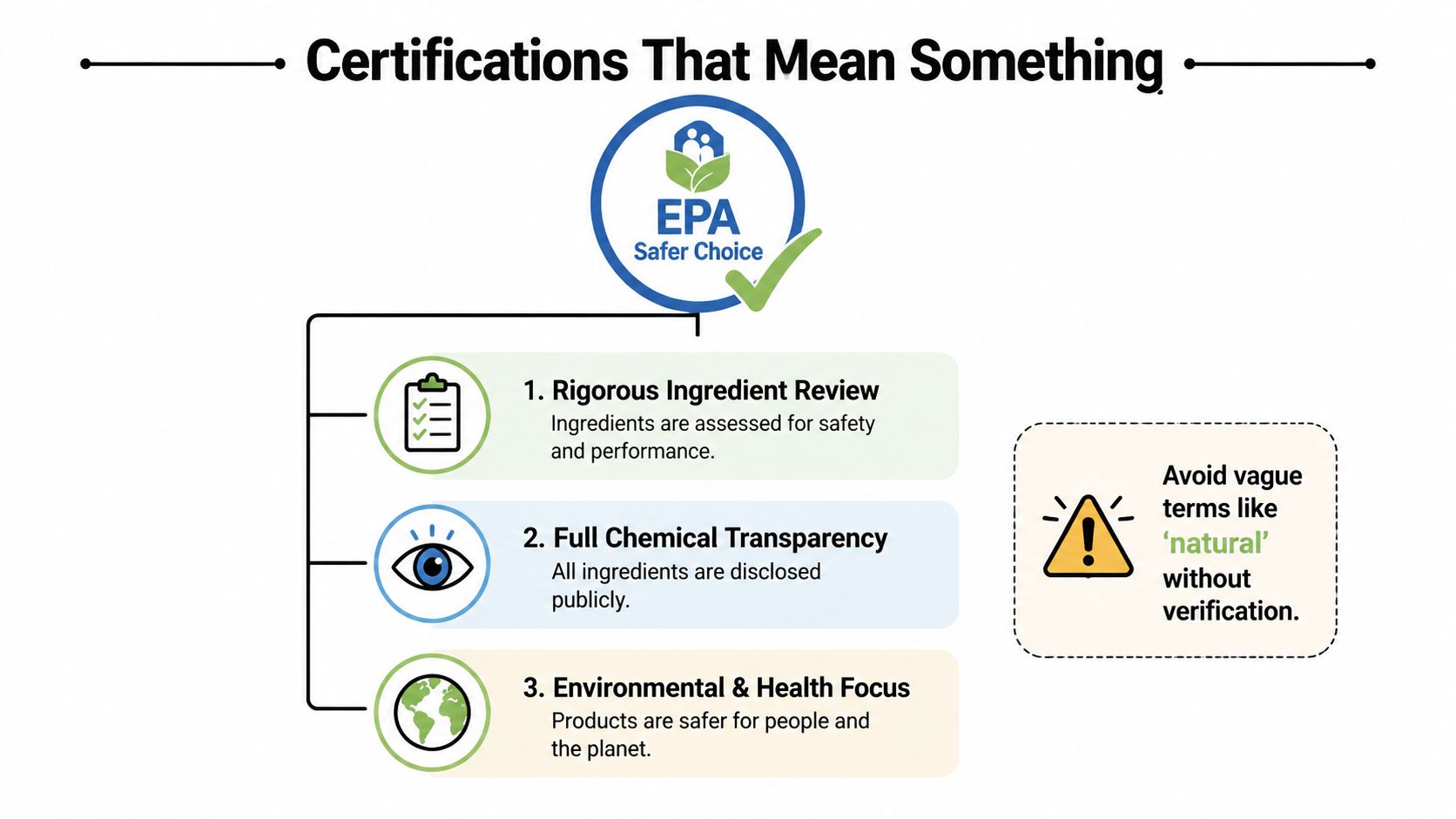
A bottle can look responsible on the shelf while offering little evidence about its formula or performance. A green leaf, gentle colors, and the word “natural” describe an impression, not a testing standard. Certifications matter when they define requirements, review the complete formula, and check whether the finished product works as claimed.
EPA Safer Choice is a useful benchmark
The U.S. EPA launched Safer Choice in 2012, following the earlier Design for the Environment labeling initiative. Participation is voluntary, but companies applying for the label submit the full formula for review. EPA scientists evaluate ingredients against criteria covering carcinogenicity, reproductive and developmental toxicity, persistent bioaccumulative toxicity, aquatic toxicity thresholds, and packaging requirements, as documented in the EPA program history and criteria.
The program also evaluates pH and cleaning performance. That pairing addresses the practical gap between safer-sounding marketing and a cleaner that removes the soil it claims to handle. A formula needs both a credible safety review and useful results.
By 2025 to 2026, nearly 2,000 products qualified to carry the Safer Choice label, according to the EPA reference above. NSF reports that more than 2,000 products currently bear the label and cites a projection that the sustainable cleaning-products market could reach $111.2 billion by 2026 in its Safer Choice overview. The sources present the product counts differently, so keep them as separate reported figures rather than combining them.
Read labels below the certification
Safer Choice-labeled products do not contain known carcinogens or reproductive or developmental toxicants, and the program screens minor ingredients, including dyes and fragrances. The EPA criteria for Safer Choice products explain the standards behind that review. Eligible categories include all-purpose, window, tub and tile, laundry, floor-care, pet-care, and car-care products.
Third-party testing can provide another useful check, but the label alone proves little. Ask who conducted the testing, what sample or claim they examined, and whether the result covers safety, cleaning performance, disinfection, or packaging. This guide to what third-party testing means helps distinguish a defined evaluation from a vague badge.
Choosing the Right Cleaner for Different Home Surfaces
A bottle labeled non toxic can still perform poorly, while a well-formulated cleaner can remove routine soil without relying on harsh chemistry. Choose according to the surface and the mess. An all-purpose cleaner suits compatible everyday grime, but it is not automatically a disinfectant, limescale remover, stone-safe formula, or heavy-duty degreaser.
Kitchen surfaces
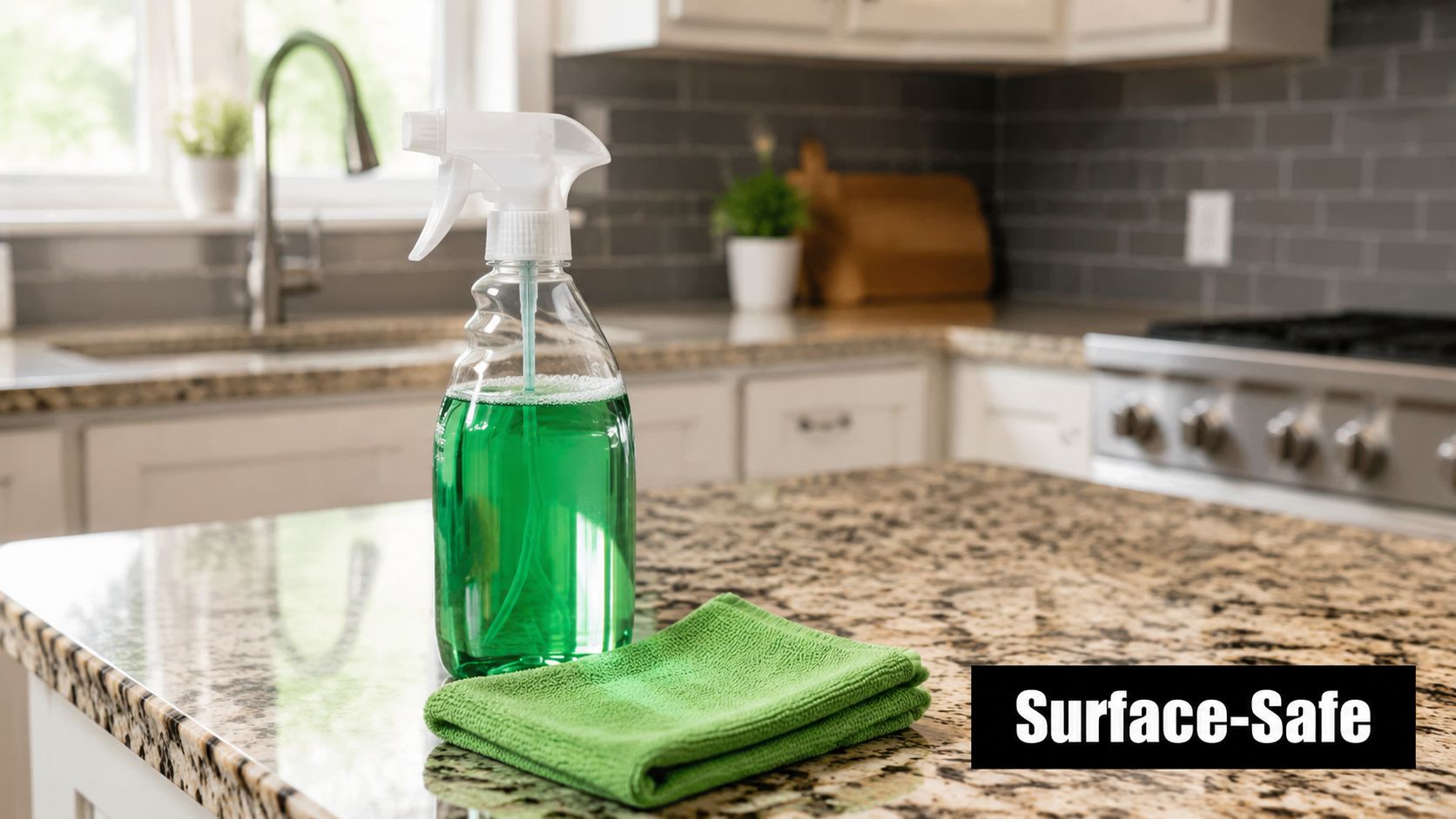
Sealed countertops, stainless steel, finished cabinet fronts, and other hard, non-porous surfaces usually need controlled application. Spray the cloth instead of flooding the surface, wipe in one direction, and use a clean damp cloth if the directions require rinsing. This limits overspray and reduces residue, two practical tests of whether a “green” product works well at home.
Granite and other natural stone surfaces require more caution because sealants and finishes differ. Test an unfamiliar formula in a hidden area, follow the surface manufacturer's guidance, and do not treat a pleasant scent as evidence of compatibility. For stuck-on grease, give a surfactant-based cleaner time to loosen the soil before choosing a highly caustic degreaser.
A product such as Loyaltie plant-based cleaning spray lists decyl glucoside and cocamidopropyl betaine among its cleaning ingredients and is positioned for multi-surface use. Specific ingredient disclosure offers more useful information than a vague “green” badge, but the product label and finish instructions still determine whether it belongs on your counter.
Bathroom and high-touch areas
Tile, porcelain, sealed fixtures, door handles, and light switches often need soil removal rather than repeated disinfection. An all-purpose cleaner can address soap film and daily grime. Hard-water deposits may need a citric-acid or other descaling product, used according to its directions.
Cleaning removes soil. Disinfecting uses a product registered and labeled for reducing specified microorganisms, with the stated contact time. If illness control or another higher-risk situation calls for disinfection, select that type of product rather than assuming an all-purpose spray can do both jobs. Never combine cleaners.
Dilution and testing
Concentrates depend on accurate dilution. Too little product may leave grime behind, while too much can create residue and increase exposure without improving cleaning. Follow the manufacturer's ratio, use a measuring mark or dedicated container, and never mix an all-purpose cleaner with bleach, ammonia, or another formula. Testing a small area first helps reveal streaking, residue, or damage before the cleaner reaches the whole surface.
The Case for Refillable and Low-Waste Cleaning Systems
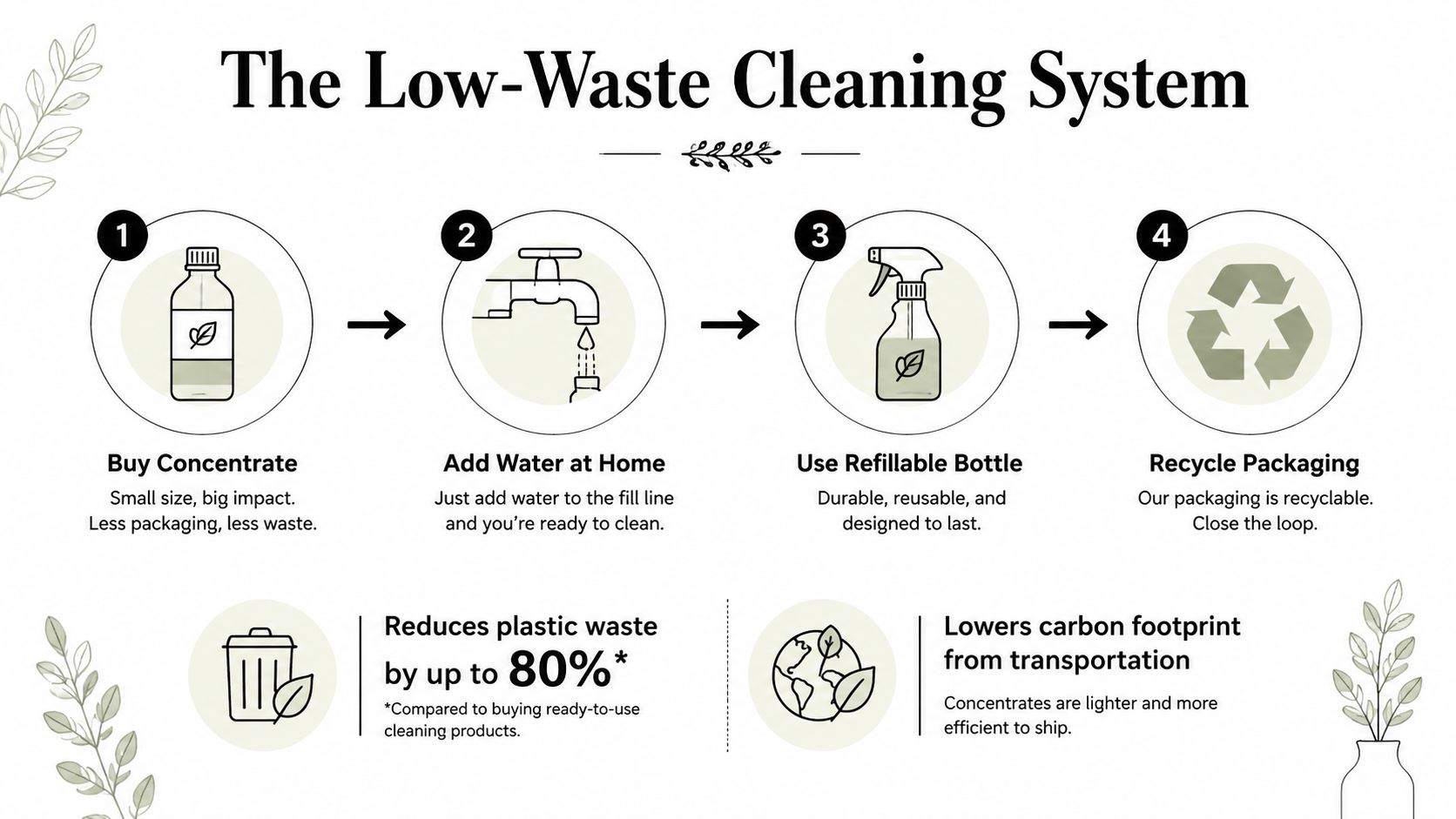
A safer formula still creates waste if every use requires another water-heavy bottle. Refillable systems change the purchase from “buy a new container each time” to “keep the durable bottle and replace only the concentrated product or refill.”
Concentrates can reduce transport volume and weight because the household adds water at home. Reusing refill pouches or bottles also helps reduce single-use packaging waste, as explained in this guide to refillable cleaning products. The benefit depends on the refill material, shipping method, local recycling access, and whether the bottle stays in service.
A system should fit real routines
The simplest refill system follows a repeatable pattern:
- Buy concentrate: Store a smaller quantity that can become a ready-to-use cleaner.
- Add water at home: Measure carefully and follow the product's instructions.
- Use the refillable bottle: Keep a labeled bottle for each formula or cleaning task.
- Handle packaging responsibly: Reuse, return, or recycle the refill material according to the company's instructions.
This approach can reduce storage clutter, especially for households that otherwise keep separate bottles for the kitchen, bathroom, floors, and general surfaces. It also makes consumption visible. When you refill the same bottle, you notice how quickly you use a product and can adjust spraying habits, cloth choice, or cleaning frequency.
Circularity requires follow-through
“Refillable” can mean several things. A company may sell concentrated tablets, mail liquid in a pouch, operate physical refill stations, or accept packaging back for washing and reuse. Those systems have different environmental tradeoffs, so look for clear instructions and realistic end-of-life options.
If you're curious about the practical side of local refilling, this explanation of a refill station and zero-waste system shows why access and return logistics matter. The strongest systems make the lower-waste choice convenient enough to repeat.
Your Non Toxic Cleaning Decision Framework
Shopping gets easier when you stop asking whether a bottle is “clean” and start scoring it against the job you need done. A non toxic all purpose cleaner should pass four tests: credible safety review, understandable ingredients, surface compatibility, and a packaging system you can maintain.
Start with evidence
Look for EPA Safer Choice or another certification with published criteria. If there's no certification, inspect the company's formula disclosure, safety data, testing description, and directions. “Natural,” “eco,” and “plant based” can describe a product, but they don't replace verification.
Then identify the cleaning mechanism. A mildly alkaline, surfactant-forward formula is a reasonable starting point for routine hard-surface soil. A descaler, disinfectant, or specialist degreaser may be necessary for a different job, and using the wrong product can create surface damage or unnecessary exposure.
Use this shopping checklist
- Check the formula: Prefer clear ingredient information over a catch-all fragrance declaration.
- Match the product to the soil: Choose routine cleaner, descaler, disinfectant, or degreaser based on the actual task.
- Check the surface: Test first on an inconspicuous area, especially with stone, sealants, painted finishes, and delicate coatings.
- Follow dilution directions: Measure concentrates and never combine cleaning chemicals.
- Assess the refill loop: Confirm whether packaging can be returned, reused, or realistically recycled where you live.
- Try before stocking up: Buy the smallest sensible format, test it on your most common messes, and observe residue, scent, spray quality, and surface response.
A cleaner earns a permanent place under the sink by performing well in your home, not by making the boldest claim on its label.
Explain that standard to anyone who doubts safer products. Clean one familiar surface with the new formula, compare the finish and residue, and let the result speak for itself. Supporting companies that disclose ingredients, test responsibly, offer practical refills, and care about communities turns a single purchase into a more durable household habit.
Fillaree offers refillable home and body essentials, including Clean Dream Spray for nonporous surfaces such as countertops, porcelain, and bathroom fixtures, with home refills available in a 64 fl oz half-gallon format. Visit Fillaree to explore a low-waste cleaning system that fits your routine and values.