
Paraben Free Soaps: The Buyer's Guide for 2026
Is paraben-free soap safer, or does the claim just note that one preservative family is missing? That question matters because a soap formula is a system. Removing one ingredient can change how a product handles bacteria, mold, water, fragrance, packaging, storage, and repeated use.
This guide treats paraben free soaps as a formulation choice, not a safety verdict. You'll learn what parabens do, how regulators distinguish different types, what replaces them, why sensitive skin needs a full ingredient review, and how to assess refill and certification claims. The practical takeaway is simple: judge the complete formula and the company's evidence, not one attractive label phrase.
Table of Contents
- Why Paraben-Free Soaps Are Suddenly Everywhere
- What Parabens Actually Are and Why They Are in Soap
- The Health Evidence Without the Hype
- Paraben-Free Is a Preservation Trade-Off, Not a Free Pass
- Reading a Paraben-Free Label Like a Formulator
- Performance, Lather, and Sensitive Skin in the Real World
- How Fillaree Meets the Paraben-Free Standard
- A Practical Framework for Choosing Your Next Bar
Why Paraben-Free Soaps Are Suddenly Everywhere
"Paraben-free" has become familiar on soap labels because shoppers increasingly want ingredient lists that feel easier to understand and align with personal health or environmental values. Some buyers avoid parabens as a precaution, others have experienced irritation from personal-care products, and many prefer formulas that exclude particular ingredient families.
That preference is reasonable. It becomes misleading only when the label turns into a promise that the entire product is safer, gentler, or more sustainable than every conventional alternative. Paraben-free identifies what a formula doesn't contain. It doesn't explain what the product contains instead.
A liquid hand soap needs protection from contamination because it contains water and may be opened, dispensed, or touched repeatedly. A solid bar usually behaves differently during use, but its safety still depends on the recipe, manufacturing controls, storage, and how much water remains available to microbes. The word “soap” also covers products with different formulations, including true soap and synthetic-detergent cleansers, as the FDA's soap guidance explains.
What shoppers are really asking
Shoppers aren't trying to pass a chemistry exam in the soap aisle. They want to know whether a product will clean effectively, feel comfortable on their skin, last through normal use, and fit their waste-reduction goals.
Those questions require more than a paraben-free claim:
- Health: What does the evidence say about the specific preservative and its concentration?
- Skin comfort: Does the formula also contain fragrance, essential oils, harsh surfactants, or other potential irritants?
- Microbial safety: Has the finished product been tested against bacteria and mold?
- Environmental fit: Does the package get reused, or is it merely recyclable?
- Company conduct: Does the brand disclose meaningful practices rather than relying on “clean” language?
A thoughtful buyer can support good products and good companies without treating any single ingredient as a villain or a guarantee. The goal is a clear decision based on the full formula, the product format, and evidence you can verify.
What Parabens Actually Are and Why They Are in Soap
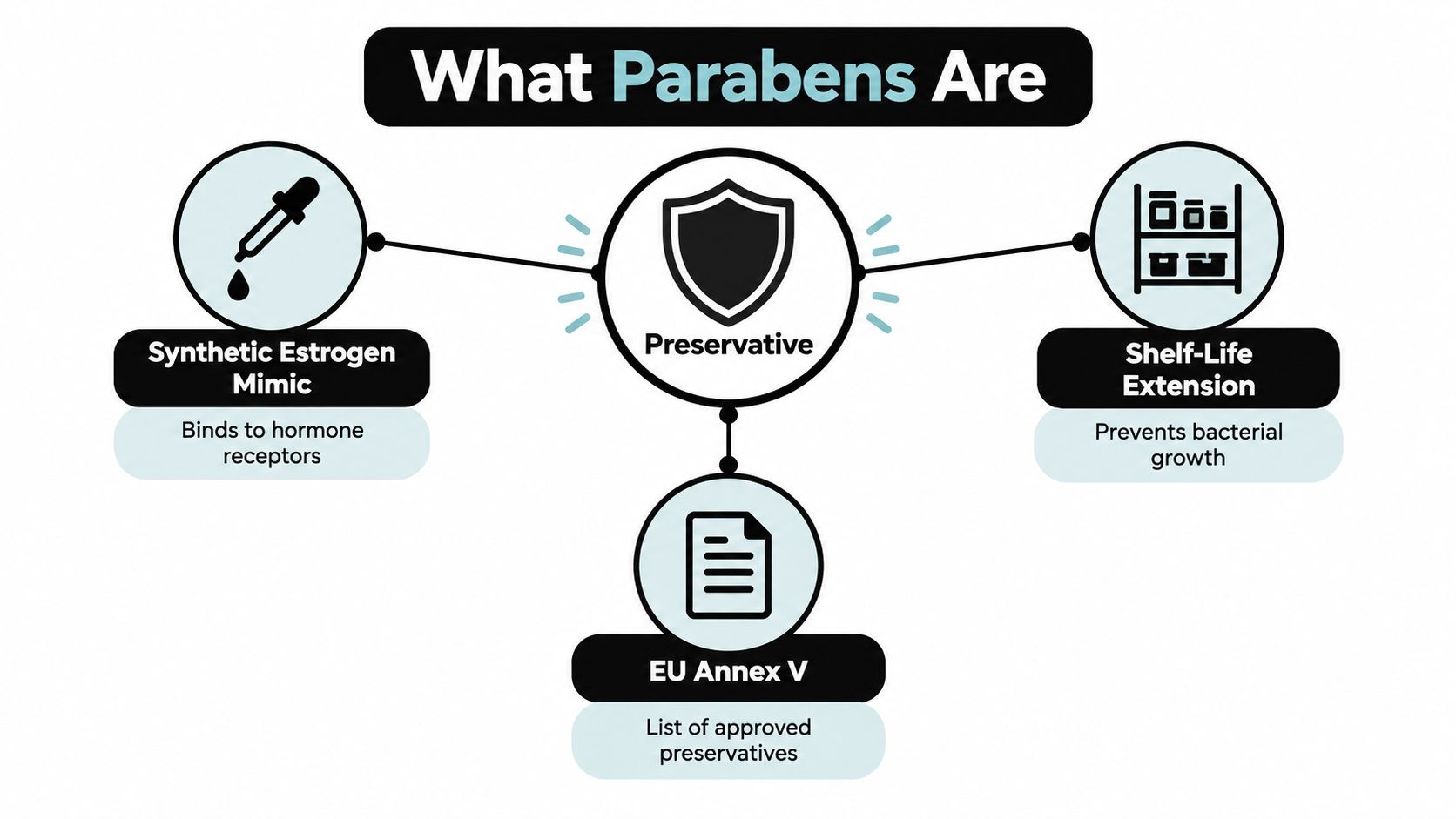
Parabens are antimicrobial preservatives. Think of them as a protective system for the shower shelf. They help suppress bacteria and mold that could grow in products containing water, giving the formula a better chance of remaining usable during storage and consumer handling.
Under Annex V of Regulation (EC) No. 1223/2009, the European Union classifies parabens as cosmetic preservatives. The cited EU framework permits a maximum of 0.4% for a single ester and 0.8% for mixtures of esters. For propylparaben and butylparaben together, the finished-cosmetic limit is 0.19%, as described in the EU regulation.
Why the names matter
You may see several related names on an ingredient list. Common examples include:
- Methylparaben
- Ethylparaben
- Propylparaben
- Butylparaben
- Isopropylparaben
- Isobutylparaben
- Phenylparaben
- Benzylparaben
- Pentylparaben
EU rules confirmed methylparaben and ethylparaben as safe at their authorized maximum concentrations, while propylparaben and butylparaben received tighter limits. The EU prohibited isopropylparaben, isobutylparaben, phenylparaben, benzylparaben, and pentylparaben in 2014 because the information needed for reassessment was insufficient. Products complying with that regulation could enter the EU market from October 30, 2014, and be made available from July 30, 2015, according to the same EU regulatory text.
This distinction is important. Regulatory treatment doesn't place every paraben into one identical toxicological category. It reflects the particular substance, available evidence, concentration, exposure, and product context.
The formulation decision
When a brand says “paraben-free,” it has made an ingredient exclusion. It hasn't necessarily removed preservation from the formula. A liquid cleanser may still need antimicrobial protection, and a brand must choose another way to control contamination.
That's why the useful question isn't “Are parabens absent?” Ask instead, “How does this product stay microbiologically safe?”
The Health Evidence Without the Hype
The health discussion becomes distorted when laboratory activity is treated as proof of everyday harm. It also becomes incomplete when concern is dismissed because a product is legally permitted. A careful reading keeps those ideas separate.
A European Commission Scientific Committee review found that in-vitro data and rodent studies available through 2005 indicated estrogenic activity for parabens. The measured potency was 3 to 6 orders of magnitude lower than 17β-estradiol, the reference hormone, and the review reported that activity generally increased as the paraben molecule's carbon chain became longer. You can read the committee's assessment in the European Commission scientific review.
Laboratory findings are not a complete risk assessment
An in-vitro result shows what can happen under controlled laboratory conditions. A rodent study can reveal biological activity and help researchers identify questions for further investigation. Neither result, by itself, tells you the health outcome for a person using a rinse-off soap in ordinary conditions.
The same EU consumer-safety materials state that animal studies generally found low toxicity and did not show that parabens cause cancer. The U.S. Food and Drug Administration says it currently lacks information showing that parabens cause human-health effects at the concentrations used in cosmetics, while also recognizing that preservatives protect products and users from microbial contamination.
A balanced conclusion: Concern about parabens can justify a personal preference, but “paraben-free” isn't proof that a product is safer.
“Chemical-free soap” is an especially unhelpful phrase. Water, oils, salts, cleansing agents, fragrances, preservatives, and the compounds created during soapmaking are all chemicals. A bar made from recognizable ingredients is still a chemical product, and the absence of parabens doesn't make it chemically empty.
A buyer who chooses paraben-free soaps may be applying a precautionary standard, avoiding a particular ingredient family, or responding to a personal experience. That choice deserves respect. It should also come with a second question: What replacement ingredients and manufacturing controls make the formula dependable?
Paraben-Free Is a Preservation Trade-Off, Not a Free Pass
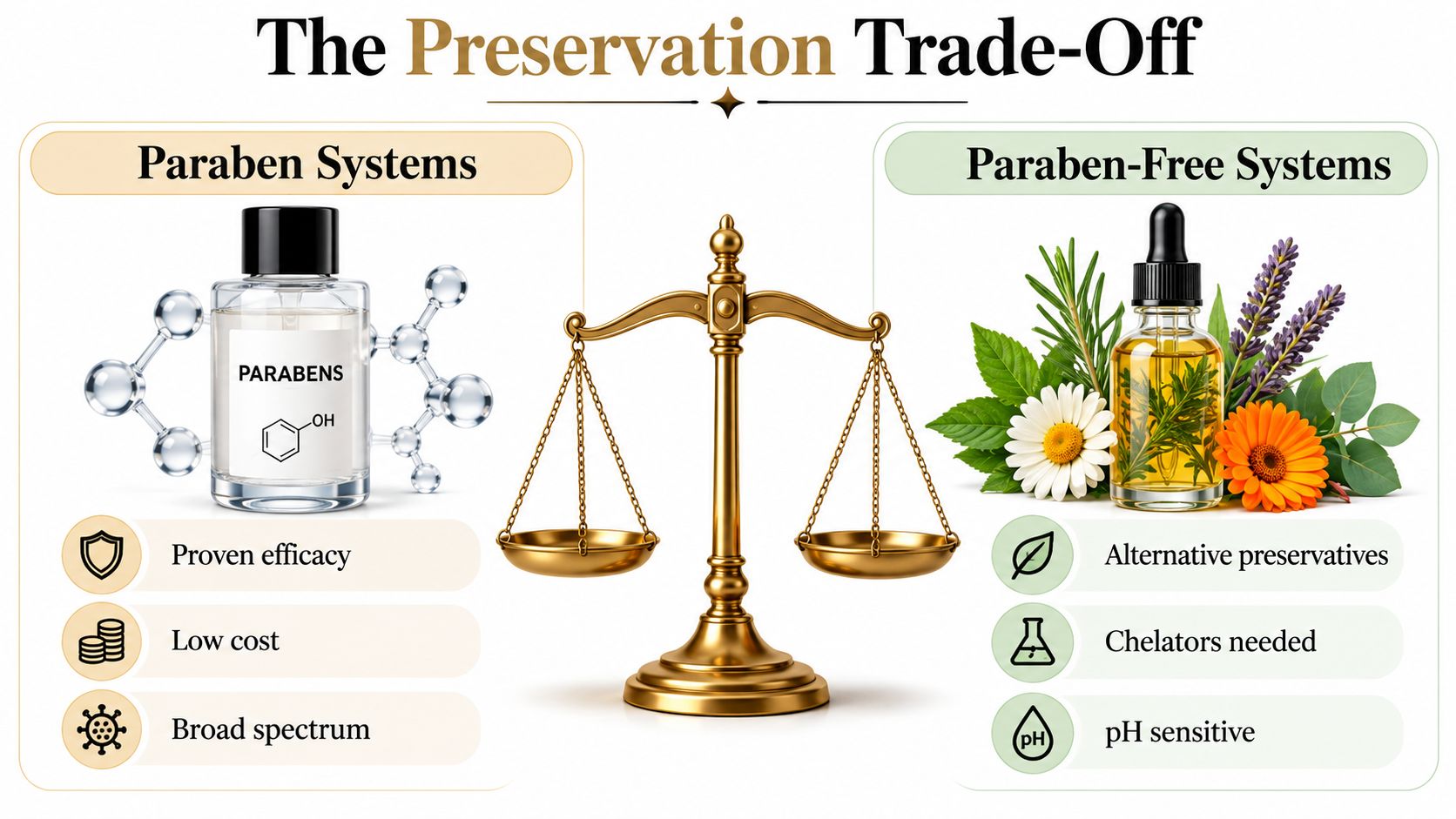
Removing parabens isn't like deleting a decorative ingredient from a recipe. It changes the preservation strategy. A formulator may use alternative preservatives, chelators that limit conditions microbes need, pH control, low-water or anhydrous design, protective packaging, and stricter manufacturing hygiene.
The FDA notes that preservatives protect both the product and its user from microbial contamination. That matters most for liquid hand and body soaps, where water and repeated wet-hand contact create opportunities for contamination. A credible product should support its preservation approach with finished-formula microbial testing, stability testing, and package-compatibility testing.
Preservation and packaging solve different problems
A refill pouch or reusable bottle can reduce packaging waste, but it doesn't automatically make a formula microbiologically stable. Refill systems need validated sanitation, storage, dispensing, and return procedures. If a brand changes the container but doesn't protect the product inside it, the environmental story is incomplete.
The same systems thinking applies to bars. A 2025 life-cycle assessment of body-soap bars reported that raw materials contributed about 34% of greenhouse-gas emissions and tap-water heating during washing contributed about 34%. Removing plastic packaging reduced modeled impacts by no more than 2–3% in the study's categories, according to the LCA technical appendix.
Those figures don't mean packaging is irrelevant. They show that a low-waste decision should consider the whole use cycle, including ingredients, water, transport, manufacturing, packaging reuse, and product waste.
What a good formula must accomplish
A paraben-free soap should still:
- Control contamination: The alternative system must work against the microbes relevant to the finished product.
- Remain stable: The preservative should work across the formula's pH, storage conditions, and intended use.
- Fit the package: The bottle, pump, pouch, or refill container shouldn't undermine protection.
- Match the format: A solid bar, liquid cleanser, and concentrated refill have different handling conditions.
- Communicate clearly: “Paraben-free” shouldn't imply “preservative-free” unless the brand can substantiate that claim.
Reading a Paraben-Free Label Like a Formulator
Start with the ingredient list, then look for the preservation system that replaced parabens. You might encounter phenoxyethanol, potassium sorbate, sodium benzoate, or essential-oil-based systems, among other approaches. Their presence doesn't automatically make a product good or bad. The relevant questions are whether the system suits the formula, whether it has been tested, and whether your skin tolerates it.
A quick label scan
Look for the following in order:
- Full disclosure: The brand should identify the ingredients rather than hiding behind broad “natural” or “clean” language.
- Preservation clues: Find the ingredients responsible for microbial control and check whether the company explains their role.
- Product format: A liquid soap deserves closer attention to preservation and dispensing than a low-water bar.
- Independent review: Certifications can assess more than one ingredient at a time.
- Packaging evidence: Ask whether containers are returned and reused, or simply placed in a recycling stream.
The EPA's Safer Choice program evaluates every ingredient in a certified product, including ingredients present at very low percentages. Its criteria cover human health, aquatic toxicity, persistence, and bioaccumulation, with thresholds including a 60-day half-life and a bioconcentration or bioaccumulation factor of 1,000, as explained in the Safer Choice standard.
Common parabens and their typical replacements
| Paraben Name | Where It Shows Up | Likely Alternative in Paraben-Free Formulas |
|---|---|---|
| Methylparaben | Water-containing cosmetics and cleansers | Sodium benzoate, potassium sorbate, or another validated preservative system |
| Ethylparaben | Personal-care formulas requiring antimicrobial protection | Phenoxyethanol or an organic-acid-based system |
| Propylparaben | Preservative blends in cosmetics | A combination of alternative preservatives, pH control, and chelation |
| Butylparaben | Preservative blends in cosmetics | A formula-specific alternative system with stability testing |
| Isopropylparaben, isobutylparaben, phenylparaben, benzylparaben, pentylparaben | Less commonly used preservative ingredients | A different preservation strategy rather than a direct one-for-one substitute |
Ingredient families can also overlap with other product concerns. If you're comparing cleansing systems and want to understand another common exclusion, this guide to why try sulfate-free formulas offers useful context. Sulfate-free and paraben-free describe different formulation decisions, so one claim shouldn't be used as evidence for the other.
Performance, Lather, and Sensitive Skin in the Real World
A paraben-free soap can lather beautifully, smell pleasant, and clean effectively. It can also have a shorter practical life, feel drying, or irritate reactive skin. The label doesn't predict the whole shower experience.
Lather depends primarily on the cleansing base, water hardness, oils, surfactants, and the way the product is used. Parabens generally function as preservatives, not as the ingredients that create foam. If a paraben-free bar lathers poorly, the reason is more likely to be the cleansing formula or how the bar is stored.
Scent creates a similar confusion. A strong fragrance may make a soap feel luxurious, but fragrance and essential oils can bother people with sensitive or eczema-prone skin. Removing parabens doesn't remove those potential triggers.
Compare the experience, not just the claim
| What you notice | What may influence it |
|---|---|
| Rich or sparse lather | Surfactant choice, oils, water hardness, and bar design |
| Strong scent | Fragrance materials or essential oils, not the preservative label |
| Product longevity | Water exposure, drainage, packaging, and preservation |
| Tight or itchy skin | Cleansing strength, fragrance, allergens, and individual sensitivity |
| Liquid-soap freshness | Preservation system, dispenser hygiene, storage, and refill handling |
Alternative preservatives can also cause irritation or allergy in some users. A person with eczema or fragrance sensitivity may benefit more from a short, transparent ingredient list and a fragrance-free option than from the words “paraben-free” alone.
For a low-waste household, a well-drained bar may suit the routine better than a liquid refill. For a shared sink, a tested liquid product in a controlled dispenser may be more practical. Readers comparing plant-based options can also explore this plant-based soap resource, then return to the ingredient list and preservation evidence before buying.
How Fillaree Meets the Paraben-Free Standard
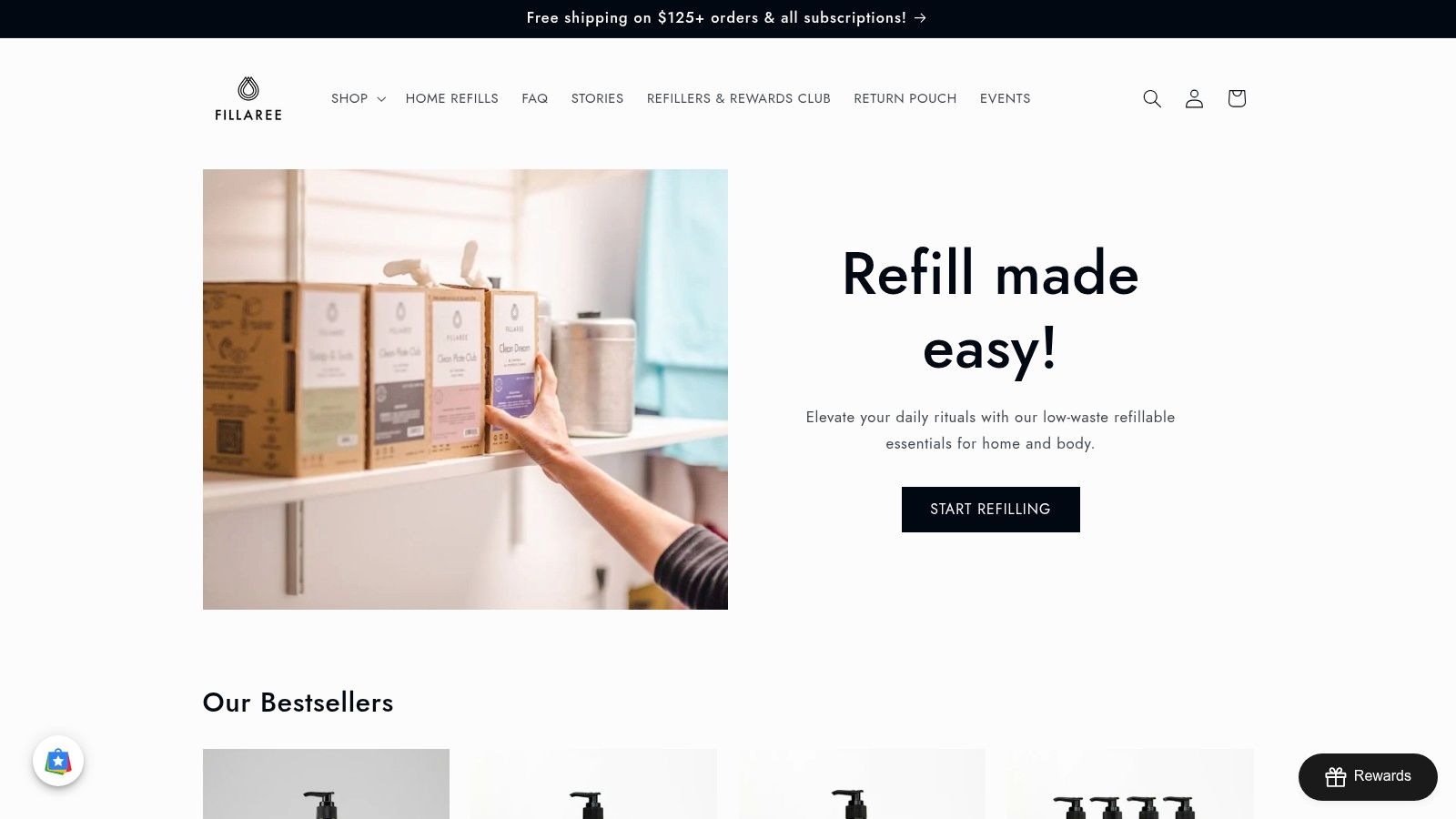
Fillaree provides a useful example of how to assess the full package rather than a missing ingredient. Its Charcoal Hand & Body Soap is described as vegan, cruelty-free, palm-oil-free, paraben-free, and phthalate-free, while its Moroccan Cedar & Vanilla Shea Butter Soap is described as a paraben-free handcrafted bar. Those claims address formula preferences, but they don't replace the need to ask how the products are tested and handled.
The brand's model combines refillable body and home essentials with a circular packaging approach. Customers can use partner refill stations, visit the Durham storefront, or order home refills in 0.5-gallon boxes that top up standard 8 oz bottles up to eight times, according to the company information provided for this guide. Fillaree also takes back used refill bags, washes and sanitizes them, and reuses them at no cost to the customer.
The evidence chain matters
Fillaree's approach connects several questions shoppers should ask:
- Formula: Is the product free from the ingredient family you want to avoid?
- Testing: Has the finished product been assessed for microbial performance?
- Waterways: Does the formula account for environmental release?
- Packaging: Can the container or refill component be returned and reused?
- Access: Can customers refill locally or order a practical home format?
The company information states that Fillaree products are third-party certified to kill harmful bacteria while remaining safe for waterways. Its refill system includes 70+ partner stations across the United States, alongside home refills and a take-back process for used bags.
The EPA says Safer Choice-certified products must pass ingredient-level human-health and environmental review, meet whole-product performance requirements, and follow environmentally conscious packaging criteria. Every chemical is evaluated regardless of concentration, as described in the EPA Safer Choice FAQ.
That standard gives shoppers a useful benchmark, even when a product carries a different certification or no certification. If a brand discusses third-party testing, learn what was tested and whether the test applies to the finished product. Fillaree's explanation of what third-party testing means is the kind of detail that helps turn a broad sustainability promise into a question you can evaluate.
A Practical Framework for Choosing Your Next Bar
You don't need to memorize every preservative name. Use a short decision path that matches the product to your priorities.
Start with skin. If you have eczema, fragrance sensitivity, or a history of reactions, prioritize a simple, fragrance-free formula and introduce new products carefully. Paraben-free can remain a preference, but it shouldn't outrank the ingredients that directly affect your skin.
Then consider format. Choose a bar if you can keep it drained between uses and want to avoid a liquid dispenser. Choose a refillable liquid if shared sinks, accessibility, or household routines make that format more useful. Neither option wins automatically because the environmental result depends on actual use, cleaning, storage, and whether packaging is genuinely reused.
Ask the brand four direct questions:
- Preservation: What system replaces parabens, and has the finished formula undergone microbial testing?
- Certification: Does an independent program evaluate the complete formula?
- Packaging: Does the company take containers or refill bags back for reuse?
- Accountability: Can you find clear information about ingredients, testing, sourcing, and waste practices?
A small routine can make the better choice easier to maintain. These habit stacking tips can help you connect refilling with an existing household task, such as ordering regular essentials or visiting a local refill station.
If you want a simpler starting point, compare the full ingredient list and format in this guide to non-toxic bar soap. The useful standard isn't perfection. It's a product that performs, suits your skin, uses a credible preservation strategy, and fits a waste system you'll follow.
Fillaree offers paraben-free hand and body soaps, refill stations, home refill boxes, and a take-back process for reusable refill bags, giving you a way to connect ingredient preferences with practical waste reduction. Visit Fillaree to compare its soap formats and choose a refill routine that fits your household.