
Phosphate Free Cleaners That Protect Waterways
You're standing at the sink with two bottles in your hand. One says “powerful.” The other says “phosphate free.” The dishes still need washing, the kids still need clean clothes, and the counter still has that sticky ring from the maple syrup bottle. So the question isn't abstract. It's simple. What happens when this goes down the drain?
That question matters more than most labels make it seem. Cleaning products don't disappear when we rinse them away. They move through pipes, into wastewater systems, and eventually affect the creeks, rivers, and lakes connected to our daily routines. For a lot of households, choosing phosphate free cleaners is one of those small decisions that feels minor at the sink but adds up across a whole community.
What makes this topic confusing is that people often hear two messages at once. One says phosphates are bad for waterways. The other says old-school cleaners worked better. Both ideas have some history behind them, but neither tells the whole story of how modern cleaning works today, or how your packaging choices matter too.
In a refill-minded place like Durham, that bigger picture feels pretty practical. Plenty of us already carry jars to the farmers market, save boxes for the next shipping run, and think twice before tossing a perfectly useful bottle. Cleaner choices fit right into that same habit of care. It's not only about swapping one ingredient. It's also about supporting good companies who care, choosing products that match your values, and building routines that protect water in more than one way.
Table of Contents
- Introduction Why Phosphate Free Matters Now
- How Phosphates Harm Waterways and Fuel Algal Blooms
- How Phosphate Free Formulas Clean Without Phosphates
- Reading Labels and Understanding Regulations
- Where Phosphate Free Cleaners Work Best at Home and Beyond
- How Refill and Circular Systems Keep Waterways Safer
- Choosing Cleaners That Match Your Values
Introduction Why Phosphate Free Matters Now
A lot of people first notice this issue in the laundry aisle or while scrubbing a casserole dish. You see “phosphate free” on the label and wonder whether it's a real environmental choice or just another bit of green packaging language.
That label has a real history behind it. A major turning point came when phosphate-free detergents moved from niche products into the mainstream. One widely cited milestone was 1970, when Sears, Roebuck & Company introduced the first successful phosphate-free detergent, and by 1989 an industry review reported that 95% of laundry detergents had become phosphate free in some markets, helping reduce phosphate in domestic wastewater by about 40% according to that review's estimate (industry review on detergent phosphate transition).
Why this still feels current
Even though that shift started decades ago, the question hasn't gone away. We still buy dish soap, sprays, powders, and specialty cleaners every week. We still send wash water somewhere. We still have to decide whether “clean” only means spotless counters, or whether it also includes cleaner downstream water.
For households trying to make sense of it, three things matter most:
- Waterway impact: Some cleaning ingredients add nutrients that don't belong in rivers and lakes.
- Performance: A phosphate free label doesn't tell you everything about how well a product handles grease, hard water, or stuck-on food.
- Whole-system choices: Bottles, refills, concentrates, and reuse all affect the footprint of a product beyond the ingredient list.
A useful way to think about it: the bottle, the formula, and the refill habit all count.
That's why phosphate free cleaners matter now. They sit at the intersection of water protection, everyday housekeeping, and low-waste living. If you've ever wanted a plainspoken way to sort through the science without needing a chemistry degree, you're in the right place.
How Phosphates Harm Waterways and Fuel Algal Blooms
Phosphates help explain one of those environmental problems that starts small in a kitchen and ends big in a lake. The easiest way to understand it is to think about fertilizer.
If you dumped way too much fertilizer on a garden bed, plants would shoot up fast, crowd each other, and throw the whole balance off. In water, phosphates can do something similar. They act like nutrients that feed algae.
The chain reaction in plain language
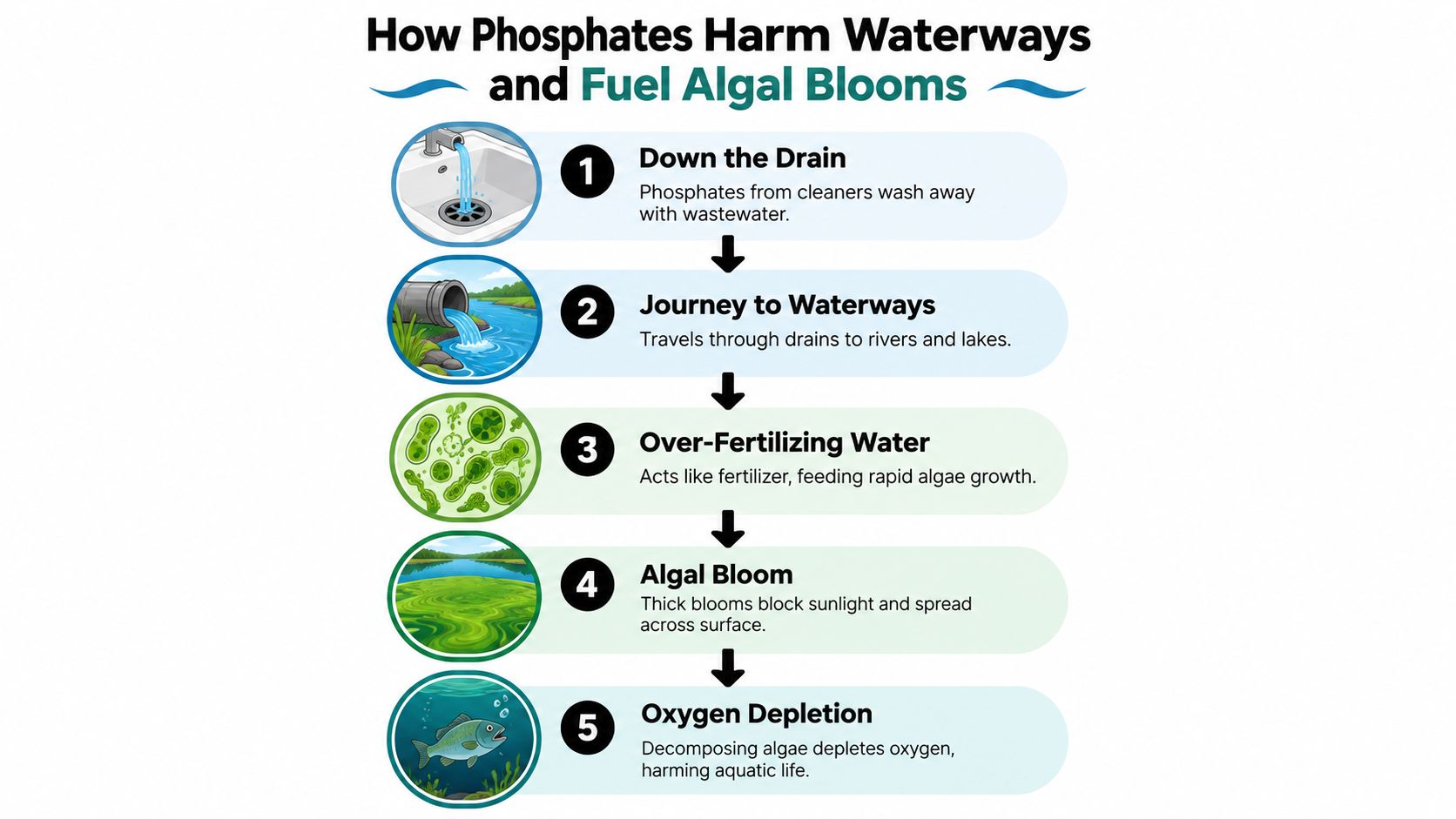
Here's the basic path:
-
You rinse a cleaner down the drain.
That wastewater leaves your home and heads into a treatment system. -
Some phosphorus reaches surface waters.
The issue isn't only one house or one load of laundry. It's the combined flow from many homes and products. -
Algae feed on the extra nutrients.
That fast growth is part of what people mean when they talk about eutrophication. -
The bloom changes the water.
Thick algae can block light and change habitat conditions. -
Oxygen drops as algae die and decompose.
Fish and other aquatic life need that oxygen.
Eutrophication is what happens when water gets overfed.
A water education source notes that phosphates in cleaning products can fuel algal blooms and dead zones, and says detergents can account for between 9% and 34% of the phosphorus found in municipal wastewater (water education overview from NEEF).
Here's a short visual explainer if you want to see the process in motion:
Why household choices still matter
People sometimes assume wastewater treatment solves everything. Treatment helps, but it doesn't erase the importance of what goes into the system in the first place. That's one reason policy makers paid attention to detergent phosphorus.
A major European Union summary stated that detergents were the third-largest source of phosphate discharges to surface waters, behind agriculture and sewage. Regulation (EU) No 259/2012, adopted in March 2012, set a maximum of 0.5 grams of phosphorus per wash for consumer laundry detergents from 30 June 2013, and 0.3 grams of phosphorus per standard dose for consumer automatic dishwasher detergents from 1 January 2017 (European Parliament and Council summary of the EU phosphate limits).
What confuses people most
The confusing part is scale. A single squirt of cleaner doesn't look dramatic. But waterways don't receive one squirt. They receive the accumulated leftovers of daily life from entire neighborhoods, schools, restaurants, offices, and apartment buildings.
That's why phosphate free cleaners aren't just a lifestyle trend. They're tied to a straightforward goal: putting fewer excess nutrients into shared water.
How Phosphate Free Formulas Clean Without Phosphates
A fair question comes up right after the waterway conversation. If phosphates worked so well, how do phosphate free cleaners still get dishes, laundry, and surfaces clean?
The short answer is that phosphorus itself isn't magic. Cleaning performance depends on the whole formula working together.
What phosphates used to do
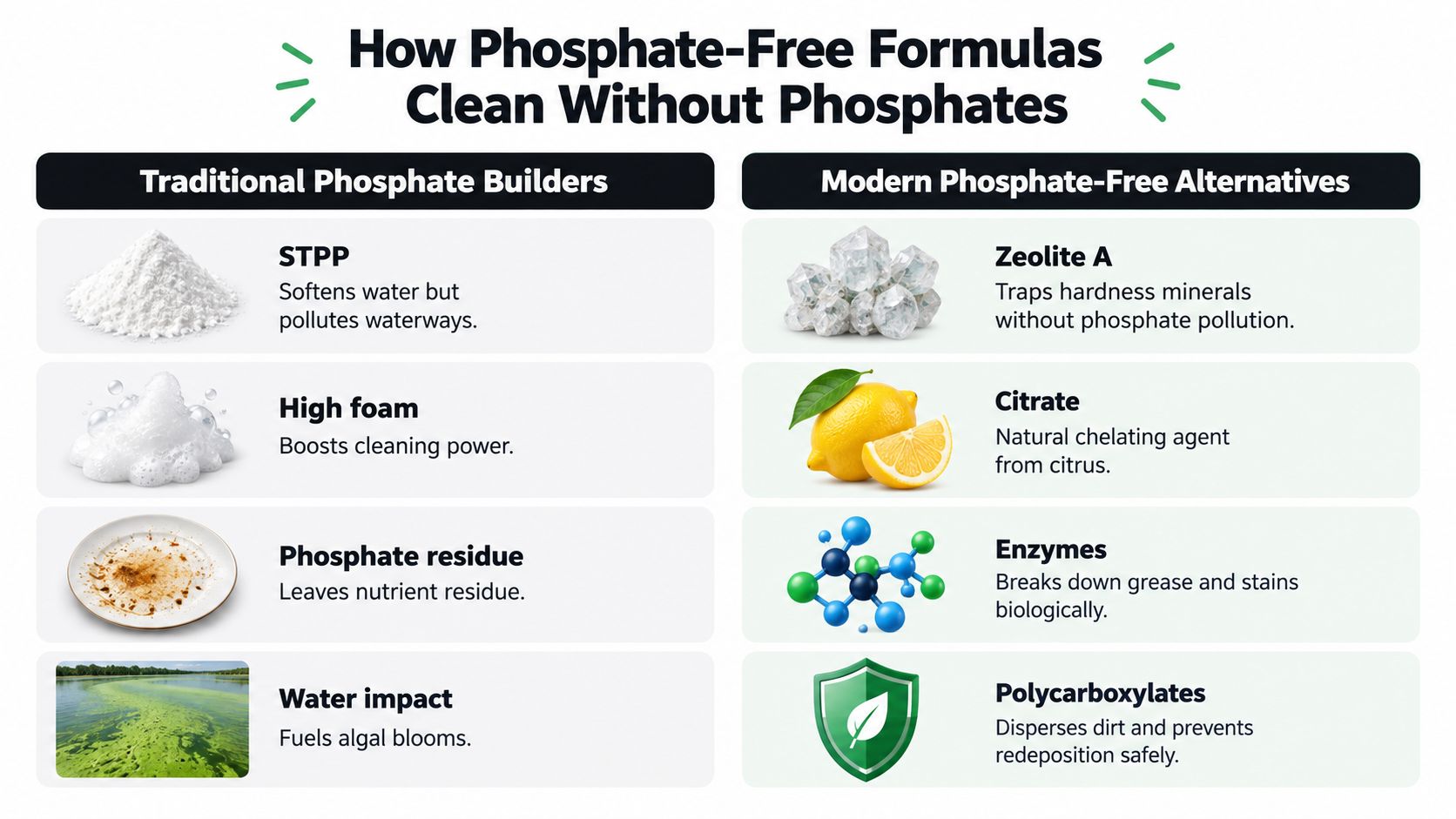
In many traditional detergents, phosphates acted as builders. Builders help cleaners deal with minerals in hard water and keep loosened dirt from settling back onto clothes or surfaces.
If you've ever washed a glass and had it dry cloudy, or laundered towels that came out stiff, you've seen the hard-water problem in everyday life. Calcium and magnesium in water can interfere with cleaning.
What modern formulas use instead
Policy and technical reviews note that phosphate free formulas can match phosphate-based performance when they use alternative builder systems such as zeolite A, citrate, dispersant polymers, surfactants, and enzymes. Those assessments say these systems can deliver a similar cleaning-efficiency range and are technically feasible in comparable price and performance bands (European Commission assessment of detergent phosphate alternatives).
That sounds technical, so here's the plain version:
- Zeolite A helps trap hardness minerals.
- Citrate helps bind minerals too.
- Surfactants lift grease and dirt off surfaces.
- Enzymes break down specific messes like food soils or stains.
- Dispersant polymers help keep dirt suspended so it can rinse away.
Why one phosphate free cleaner works better than another
This is where shoppers get tripped up. A “phosphate free” label doesn't guarantee the same result across every product category.
A technical overview of detergent alternatives points to a more nuanced reality. Product design matters more than the phosphate label alone, because cleaners may rely on ingredients such as sodium carbonate, sodium silicate, enzymes, or chelants, and those choices change performance, biodegradability, and compatibility with wastewater systems (detergent formulation discussion from UNDP materials).
Practical rule: judge the whole formula by the task you need it to do, not by one front-label claim.
Real-life examples at home
A few examples make this clearer:
- Laundry in hard water: You may need a more advanced builder and enzyme package to keep fabrics from looking dull.
- Greasy stovetop splatter: Surfactants and alkalinity matter a lot.
- Protein-heavy messes: Enzymes can help more than brute force.
- Mineral film in a dishwasher: Water chemistry matters as much as the detergent label.
Older phosphate free products sometimes earned a bad reputation because early reformulations didn't always solve all of those jobs well. Today, many do. But “many do” isn't the same as “all do.” That's why matching the cleaner to the task matters.
Reading Labels and Understanding Regulations
Once you know what phosphates do and how alternatives work, the next challenge is shopping without getting fooled by vague language. “Natural,” “green,” and “eco” can mean almost anything on the front of a bottle unless there's something specific behind the claim.
What regulations can tell you
The clearest hard standard in this space comes from the European Union. The legal text for Regulation (EU) No 259/2012 states that consumer laundry detergents cannot be placed on the market if total phosphorus content is equal to or greater than 0.5 g in the recommended dose for a standard wash, and consumer automatic dishwasher detergents face a 0.3 g phosphorus limit in the standard dosage (official EU regulation text).
In the United States, a useful signal is EPA Safer Choice. EPA describes it as a program that helps consumers, businesses, and purchasers find products that perform well while containing ingredients safer for human health and the environment, as part of pollution prevention efforts (EPA Safer Choice program overview).
How to verify claims in the aisle
A quick label read can go a long way. If you want help spotting fuzzy marketing language, this guide on how to avoid greenwashing is a handy companion when you're comparing products.
| What to Look For | What It Tells You | Example Signal |
|---|---|---|
| Clear phosphate or phosphorus language | The brand is making a specific chemical claim, not just a mood-based one | “Phosphate free” or phosphorus limits stated for the dose |
| Third-party review | Someone outside the brand has evaluated ingredients or safety criteria | EPA Safer Choice label |
| Task-specific directions | The company has thought about dosage, surfaces, or wash conditions | Separate directions for hard water, laundry, or dishwashing |
| Ingredient transparency | You can tell whether the formula relies on builders, surfactants, enzymes, or other systems | Ingredient list with recognizable functional categories |
A good skeptical habit
Don't stop at the front label. Turn the bottle around.
- Look for specificity: A precise claim is more useful than “planet friendly.”
- Check the product type: Dish detergents, laundry detergents, and surface cleaners face different performance demands.
- Notice recognition marks: Third-party labels don't answer everything, but they do give you more than a marketing promise.
A careful shopper doesn't need to memorize regulations. You just need to learn what meaningful signals look like.
Where Phosphate Free Cleaners Work Best at Home and Beyond
Most of us don't buy cleaners for abstract reasons. We buy them because coffee drips down the cabinet, soap scum builds up on the sink, and someone tracked muddy footprints through the hallway.
Phosphate free cleaners can handle a lot of daily work well, especially when the formula is matched to the job. The label matters, but the use case matters more.
Around the house
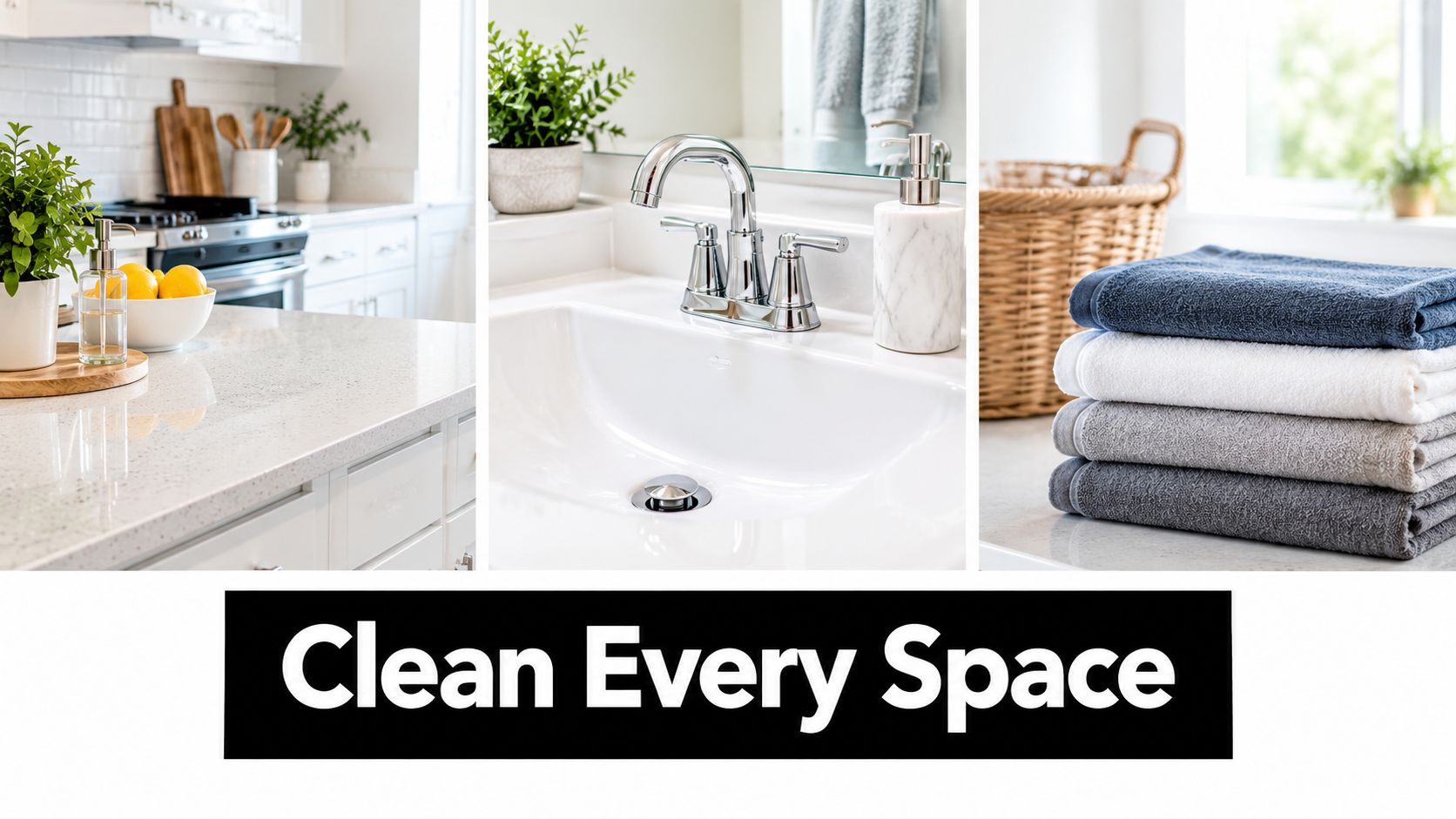
In the kitchen, a well-formulated phosphate free product can be a solid fit for counters, tables, cabinet fronts, and everyday dishwashing. In the bathroom, it can work well for routine wipe-downs on sinks, fixtures, and porcelain.
Laundry is a little more variable because wash performance depends on water hardness, soil type, and machine conditions. For everyday loads, modern formulas often do the job well. For very stubborn soils or mineral-heavy conditions, you may need to pay closer attention to product design and dosing.
Light commercial spaces
Small workplaces often need the same balance households do. Cafés want clean prep areas. Offices want soap and surface cleaners people can use often without turning the break room into a cloud of harsh fragrance. Studios, retail shops, and community spaces often benefit from products designed for steady upkeep rather than occasional deep stripping.
That's where “good products” means more than a trendy look. It means choosing brands that are clear about what their formulas are built to do and that show some care for wastewater, people, and packaging.
Examples worth noticing
One concrete example is PROSOCO's DailyKlean line, which earned the EPA Safer Choice label. PROSOCO says those products contain no phosphates, hazardous solvents, environmentally harmful surfactants, fragrances, or dyes, and the label indicates EPA scientists reviewed every ingredient (PROSOCO DailyKlean EPA Safer Choice announcement).
For dishwashing specifically, readers comparing lower-waste options may also find this look at eco dishwasher powder useful when thinking through formulation and everyday use.
Here's a practical way to match product to task:
- Routine kitchen wiping: Choose an all-purpose cleaner made for food-adjacent surfaces.
- Bathroom upkeep: Look for products that can handle soap residue and regular moisture exposure.
- Greasy messes: Favor formulas built for surfactant strength and rinseability.
- Hard-water homes: Pay attention to spotting, film, and dosage guidance.
One useful local example is Fillaree's Clean Dream Spray, which is described as working on countertops, porcelain, and bathroom fixtures. That kind of task-based description is often more helpful than broad eco language because it tells you where the product fits into real life.
How Refill and Circular Systems Keep Waterways Safer
Ingredient choice is only part of the story. A phosphate free formula in a throwaway package still solves just one problem. If you care about waterways, it helps to think in systems.
That's where refill and circular models come in. They don't replace ingredient improvements. They strengthen them.
Why the bottle matters too
Every new plastic bottle represents more material extraction, more manufacturing, and more waste management at the end. Even when a container is recyclable, many households know the frustrating truth. Recycling works unevenly, and plenty of useful packaging still gets discarded after one short life.
Refill systems change the rhythm. You keep the bottle, top it up, and skip the constant cycle of buy, empty, toss.
A water-quality review adds an important note of caution here. It points out that phosphate free isn't always automatically the better environmental choice once wastewater treatment, packaging, and reformulation tradeoffs are considered. Some substitutes can shift burden elsewhere, which is why the full system matters, not only one ingredient swap (Water Research Commission review on detergent environmental tradeoffs).
Cleaner chemistry helps. Reuse habits help too. Together they do more than either one alone.
What circular cleaning looks like in practice
In refill-focused communities, this can be very ordinary. You keep one spray bottle under the sink and refill it instead of replacing it. You buy a larger home refill for dish soap rather than a string of small bottles. A neighborhood shop collects packaging for reuse instead of treating it as instant trash.
A local refill culture also makes values visible. You can support businesses that think about what leaves the store and what comes back. That kind of relationship is different from anonymous shelf shopping.
If you're curious what a neighborhood refill model looks like, this overview of a refill station zero waste approach shows how people build those habits into ordinary routines.
Habits that stack up
A circular system can make your cleaning routine gentler in several ways:
- Less packaging churn: You reuse containers instead of cycling through one-time bottles.
- More intentional buying: Refills encourage you to choose fewer, more versatile products.
- Support for caring companies: Your money goes toward businesses that design for reuse, not just disposal.
For people who already compost, garden, mend clothes, or carry reusable mugs, refillable cleaning products feel like a natural next step. It's the same idea brought under the sink.
Choosing Cleaners That Match Your Values
By the time you finish learning about phosphate free cleaners, you realize the answer isn't “buy anything with a green leaf on it.” It's more thoughtful than that.
A good choice usually checks a few boxes at once. It avoids unnecessary phosphorus where that matters for waterways. It works for the cleaning job you have. It comes from a company that gives you enough transparency to trust what you're bringing home.
A simple values filter
If you want a no-fuss way to choose, ask yourself these questions:
- Does this protect shared water? Look for meaningful phosphate or safer chemistry signals.
- Will this work in my real home? Think about grease, hard water, laundry soils, and bathroom buildup.
- Does the company show care beyond the label? Packaging, refill options, and third-party review all say something.
- Can I stick with this habit? The best cleaner on paper won't help much if the system is too inconvenient to keep using.
For readers comparing broader low-tox routines, this Miami guide to green cleaning from Canes Cleaners is a useful outside resource because it connects product choices with practical household habits.
Progress beats perfection
You don't need to rebuild your whole cleaning shelf in one weekend. Start with one swap that you use all the time. Dish soap is a common place to begin. All-purpose spray is another. If you already know you like a product, see whether there's a refill version next.
Supporting good companies who care is part of the work too. When you buy from businesses that think about ingredients, wastewater, packaging, and reuse together, you help make those systems more normal and more available to other households.
That's the hopeful part of this. Clean water protection doesn't only happen through giant policy moves. It also happens when ordinary people make steady, informed choices in kitchens, laundry rooms, cafés, schools, and storefronts.
Phosphate free cleaners fit that kind of change well. They make science personal. They turn a label into a question about stewardship. And they let everyday home care line up a little better with the kind of community most of us want to live in.
Fillaree offers refillable home and body essentials made in Durham, including low-waste soaps and cleaners designed for everyday use and circular refill habits. If you want to pair water-conscious formulas with reusable packaging and easy refill options, visit Fillaree and take a look at how their system works.