
Soaps Without Perfume: A Gentle Guide for Sensitive Skin
Start with the ingredient list, not the front label: an analysis found allergens in 44 of 50 liquid soaps, compared with none of the bar soaps examined, while 34 liquid soaps contained surfactant allergens compared with seven bar soaps. For soaps without perfume, the safest starting point is a fully fragrance-free formula verified against its complete ingredients.
"Soaps without perfume" is a smart search when your hands sting after washing or your skin itches after a shower, but the label alone can mislead. A product marked "unscented" may still contain masking fragrance, so the goal is a formula with no perfume materials, fragranced botanicals, or hidden scent ingredients.
A gentler choice also involves more than scent. The cleanser's surfactants, preservatives, pH, packaging, refill system, and the company's environmental practices all matter. This guide will help you move from label literacy to practical format choices, then toward refilling systems that reduce single-use packaging without asking you to compromise on everyday performance.
Table of Contents
- Why So Many People Are Switching to Soaps Without Perfume
- What Fragrance-Free Really Means on a Soap Label
- Hidden Irritants Beyond Perfume in Everyday Soaps
- Choosing Between Fragrance-Free Bars, Liquids, and Syndets
- Benefits of Perfume-Free Soap for Skin and Waterways
- Refilling Your Unscented Soap the Low-Waste Way
- Supporting Soap Makers Who Share Your Values
Why So Many People Are Switching to Soaps Without Perfume
The familiar pattern often starts small. Your hands feel tight after washing dishes, a shower leaves your arms itchy, or a strong floral scent lingers on your skin long after you've dried off. You switch products, but the discomfort returns, and you begin looking for soaps without perfume.
In plain language, perfume-free soap is a cleanser made without added fragrance materials. Think of fragrance as a guest at a party nobody invited. Removing that guest can make the room more comfortable, but you still need to check who else is there. Preservatives, surfactants, essential oils, and botanical extracts can also affect people with reactive skin.
The first promise is clarity. “Unscented” doesn't always mean that fragrance materials are absent, while “fragrance-free” still deserves ingredient-level checking because labels can be incomplete or loosely understood.
The second promise is balance. A soap can be kinder to sensitive skin and kinder to the planet when its formula is carefully chosen and its packaging supports reuse.
A change you can feel
Consider two households. One person washes their hands repeatedly while cooking and gardening. Another has eczema-prone skin and needs a cleanser that won't leave the skin feeling stripped. Both may want no perfume, but they may need different surfactants, formats, and washing routines.
That's why a simple “pick fragrance-free” recommendation isn't enough. You need to know what the label means, which ingredients deserve a closer look, and whether a bar, liquid, or syndet fits your daily life.
The habit matters too
A low-waste routine doesn't require perfection. You might begin by replacing one heavily scented hand wash, keeping the dispenser you already own, and learning how the refill process works. Small, repeatable choices are easier to maintain than a complete bathroom overhaul.
By the end, you should be able to read beyond “unscented,” compare soap formats without assuming one is always gentler, and evaluate refill programs by their actual mechanics rather than their green-colored packaging.
What Fragrance-Free Really Means on a Soap Label
The most important distinction is simple: unscented and fragrance-free are not synonyms.
The U.S. Food and Drug Administration warns that “unscented” products may contain fragrance ingredients used to cover the natural odor of other ingredients. U.S. cosmetic labeling rules can also allow a fragrance formula to appear on the ingredient panel just as “Fragrance” or “Flavor,” without naming every individual component. The FDA also explains that “fragrance-free,” “hypoallergenic,” and “for sensitive skin” don't have federal standard definitions in the United States. You can review the details in the FDA's guidance on fragrances in cosmetics.
Here's an everyday analogy. If a car makes a rattling sound, turning up the radio doesn't fix the rattle. It only hides it. Masking fragrance works in much the same way. A soap may have little noticeable scent while still containing fragrance materials.
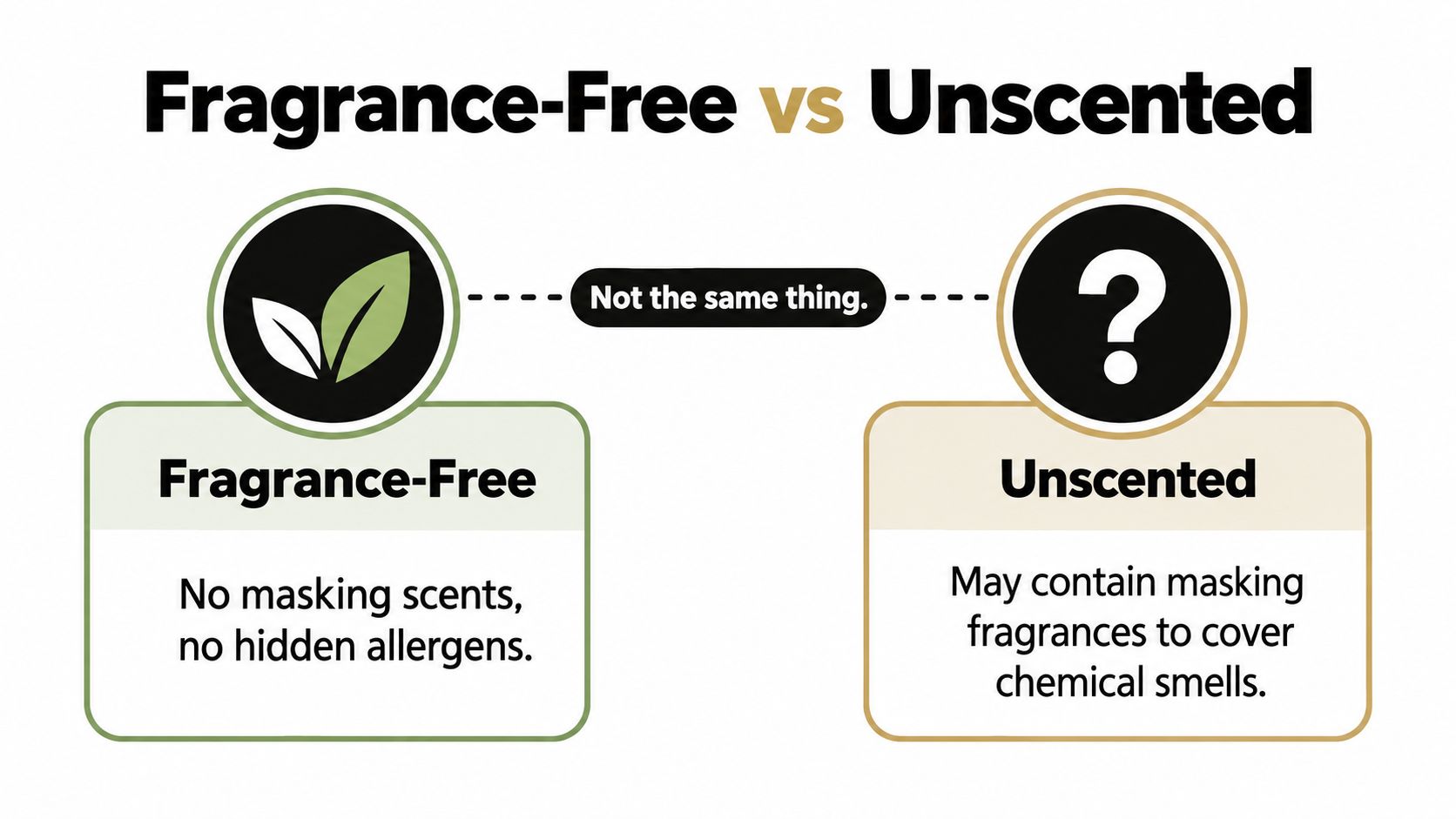
The label rule to remember: “Unscented” describes what you notice. “Fragrance-free” should describe what the formula contains, but the ingredient list is where you verify it.
A quick ingredient scan
When you're comparing soaps without perfume, use this routine:
- Read the complete panel. Don't stop at the front claim or the product name.
- Look for fragrance terms. Watch for “parfum,” “fragrance,” or language indicating a masking scent.
- Check botanical ingredients. Rose oil, citrus oils, lavender oil, and other essential oils can contain sensitizing constituents even when a product feels natural.
- Look for independent verification. Where available, a credible fragrance-free certification can provide stronger evidence than a vague marketing phrase.
The EPA's Safer Choice program has a separate Fragrance-Free label for products reviewed to confirm that they contain no fragrance materials. That kind of review doesn't eliminate the need to consider your own skin, but it gives shoppers a clearer screening signal.
Label reading also helps outside the bathroom. People who manage fragrance sensitivity in vehicles, workplaces, or shared spaces may find practical ideas in this guide to safe detailing solutions for sensitive owners, where the same principle applies: a neutral smell isn't proof that fragrance ingredients are absent.
Hidden Irritants Beyond Perfume in Everyday Soaps
Removing fragrance is useful, but it isn't the whole irritation picture. A fragrance-free liquid soap can still bother skin if its preservative system or surfactant system isn't carefully selected.
Preservatives protect water-based products from microbial growth. Surfactants lift oil and soil from the skin, allowing them to rinse away. Both jobs are necessary, yet some ingredients in these categories can cause problems for people who wash frequently or already have a damaged skin barrier.
An ingredient analysis of 50 top-selling liquid soaps and 50 bar soaps found at least one preservative allergen in 44 liquid soaps, compared with none of the bar soaps examined. It found at least one surfactant allergen in 34 liquid soaps, compared with seven bar soaps, and both differences were statistically significant at P < 0.001. Fragrance appeared in 48 body washes and 47 bar soaps, showing that the format itself doesn't tell you whether a product contains perfume. The findings are reported in this comparative analysis of bar soaps and liquid body washes.
Why repeated washing changes the experience
One handwash may feel fine, while a full day of washing leaves the skin dry and sore. Repeated exposure gives the skin less time to recover, especially around knuckles, cuticles, and small cracks. That doesn't mean every preservative or surfactant is unsuitable for every person. It means formula design deserves the same attention as the absence of perfume.
A simple ingredient list can be easier to understand and troubleshoot, but “simple” doesn't automatically mean safe or effective. The manufacturer still needs to preserve a water-based product responsibly, make sure it rinses cleanly, and test that the cleanser performs as intended.
Format isn't a shortcut
Liquid soap often feels convenient because it can be dispensed with one hand and shared easily. A bar may use a simpler preservation approach because it contains less available water. Neither observation creates a universal winner, and fragrance can appear in either format.
The same careful reading applies to cleaning products and other chemical exposures. For a broader explanation of how to think about ingredients and risk, this insight on pest control chemicals offers useful context without reducing every chemical decision to a simple good-or-bad label.
If sodium lauryl sulfate is a particular concern for your household, compare ingredient details with this guide to sodium-lauryl-sulfate-free body wash. The larger lesson remains the same: assess the whole formula, not just the scent claim.
Choosing Between Fragrance-Free Bars, Liquids, and Syndets
There isn't one perfect format for every sink, shower, or skin type. A gardener washing soil from their hands has different priorities from someone looking for a cleanser for eczema-prone skin.
Dermatology guidance favors soap-free, fragrance-free, pH-neutral cleansers for atopic skin because traditional soap can dry or irritate it. Dermatology experts have also noted that bar soaps may be preferable to body washes for some contact dermatitis patients, based on the comparative allergen findings discussed in this review of bar soaps and body washes.
| Format | Best For | Watch For | Refill Friendliness |
|---|---|---|---|
| Fragrance-free bar soap | Simple handwashing, travel, and households that prefer a water-light format | Traditional soap can feel drying for some eczema-prone users; check the full ingredients | High when the bar is sold without a disposable bottle |
| Fragrance-free liquid soap | Shared sinks, kitchens, workplaces, and people who prefer a pump | Preservatives, surfactants, dispenser hygiene, and refill packaging | High when a durable dispenser is refilled through a defined system |
| Fragrance-free syndet bar | Eczema-prone or easily irritated skin when a soap-free, pH-neutral cleanser is appropriate | Some syndets still contain ingredients that don't suit everyone; read the panel | Moderate to high, depending on wrapping and packaging |
Match the format to the task
For a kitchen or workplace, liquid soap may be easier to dispense without touching a shared bar. For travel, a solid bar avoids carrying a bottle. For atopic skin, a syndet may be more suitable than a traditional true soap, especially when it's fragrance-free and pH-neutral.
Antibacterial wording shouldn't automatically decide the purchase. Daily use still calls for a cleanser that performs well, rinses cleanly, and feels comfortable enough that you won't avoid washing your hands.
If you're considering a solid option, this guide to fragrance-free bar soap for sensitive skin can help you think through the trade-offs without treating one format as universally superior.
Benefits of Perfume-Free Soap for Skin and Waterways
A fragrance-free cleanser can simplify the skin's exposure profile. That matters most when you wash often, already experience sensitivity, or are trying to identify what triggers redness and itching.
The American Academy of Dermatology recommends fragrance-free products for people with eczema-prone skin. At the same time, a clinical report documented allergic contact dermatitis caused by rose oil in a soap marketed as fragrance-free. That example is a useful reminder that a front-label claim needs support from the full ingredient list, as explained in the American Academy of Dermatology's product guidance for eczema-prone skin.
Think of the drain as a pathway
Every ingredient that rinses from your hands or body enters a larger water system. The ingredient list is like a guest list for your home's wastewater. You don't need to fear every unfamiliar word, but you can favor formulas that disclose what they contain and avoid unnecessary additions.
That's where waterway-conscious product design becomes meaningful. A third-party certification that evaluates both bacteria-killing performance and environmental safety gives you more useful information than a general claim such as “green” or “natural.” In practice, look for evidence that the finished cleanser works for its intended use while its ingredients and packaging meet defined health and environmental requirements.
A fragrance-free product isn't automatically harmless to waterways, and a low-waste package isn't automatically gentle on skin. Good products address both sides instead of using one virtue to distract from another.
The skin and environmental questions also overlap in a practical way. A formula that performs with a modest amount, rinses without a heavy residue, and comes in a refillable package can reduce both unnecessary exposure and packaging demand.
Here's a useful question to ask before buying: What does this product add to my skin, and what does it send down the drain? That question encourages a more complete choice than scent-free marketing alone.
A third-party review can be especially valuable when you're choosing products for a shared home, office, or café. It gives buyers a way to compare documented criteria rather than relying on how reassuring the packaging looks.
Refilling Your Unscented Soap the Low-Waste Way
Once you've found a formula that suits your skin, look at the container. Replacing one disposable bottle with another material may change the package, but it doesn't necessarily change the buying pattern. A reuse system keeps a durable dispenser in service and supplies the product through repeated refills.
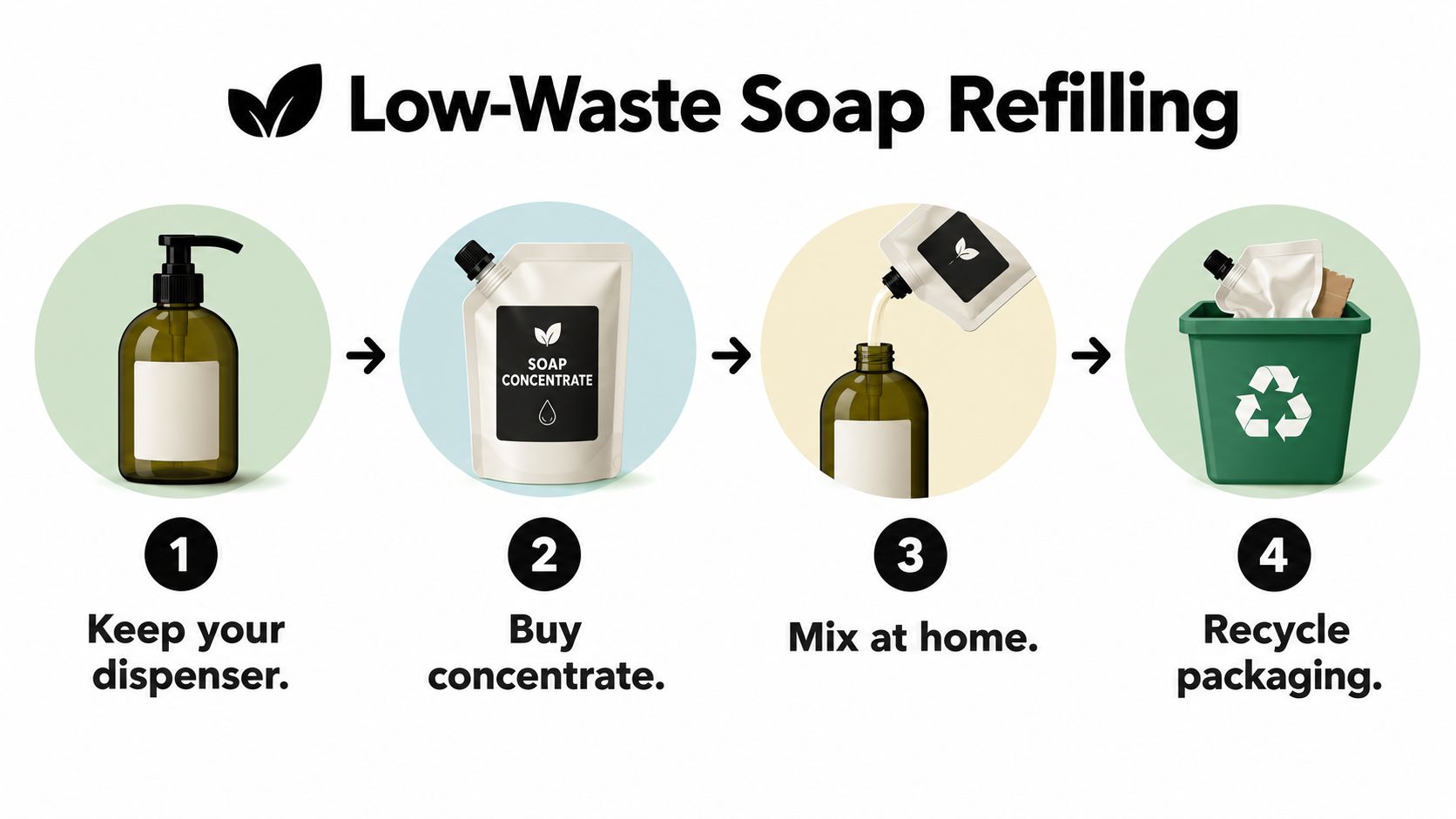
The United Nations Environment Programme defines reuse schemes as systems where one package completes multiple trips, rotations, or uses for the same purpose. Its modeling estimates that reuse schemes could reduce plastic consumption from short-lived products by 30% by 2040 compared with business as usual, and that properly implemented reuse schemes could reduce life-cycle greenhouse-gas emissions by 60% to 80% compared with single-use plastic products. These are projections and modeled outcomes, not a guarantee for every refill program, so logistics and repeated use matter. You can review the UNEP analysis of reuse schemes.
What refilling can look like
A practical system might let you bring a durable bottle to a partner station, visit a local storefront, or order a larger home refill that tops up a standard dispenser. Some programs also take back used refill bags, clean and sanitize them, and reuse them rather than asking customers to throw them away.
Choose the setup that fits your routine. A household that already passes a refill station each week may prefer in-person refilling. Someone who lives farther away may find a bulk box more practical. People with sensory sensitivities may also benefit from predictable products and containers, and this resource on touch sensitivity and sensory processing offers broader context for designing comfortable everyday routines.
A refill checklist
Before trusting a “low-waste” claim, look for:
- A defined process: The company explains where and how you refill, return, or recycle the packaging.
- Durable containers: The dispenser or refill package is designed for multiple cycles, not just presented as a greener single-use item.
- Sanitation instructions: The company tells you how to clean, dry, store, and reuse the container safely.
- Operational details: The system explains what happens after a bag or bottle comes back.
- A suitable formula: The refill itself remains fragrance-free and appropriate for your intended use.
For a home option, you can also review this guide to an unscented hand soap refill. The point isn't to buy the largest package available. It's to choose a refill path you'll use repeatedly.
Supporting Soap Makers Who Share Your Values
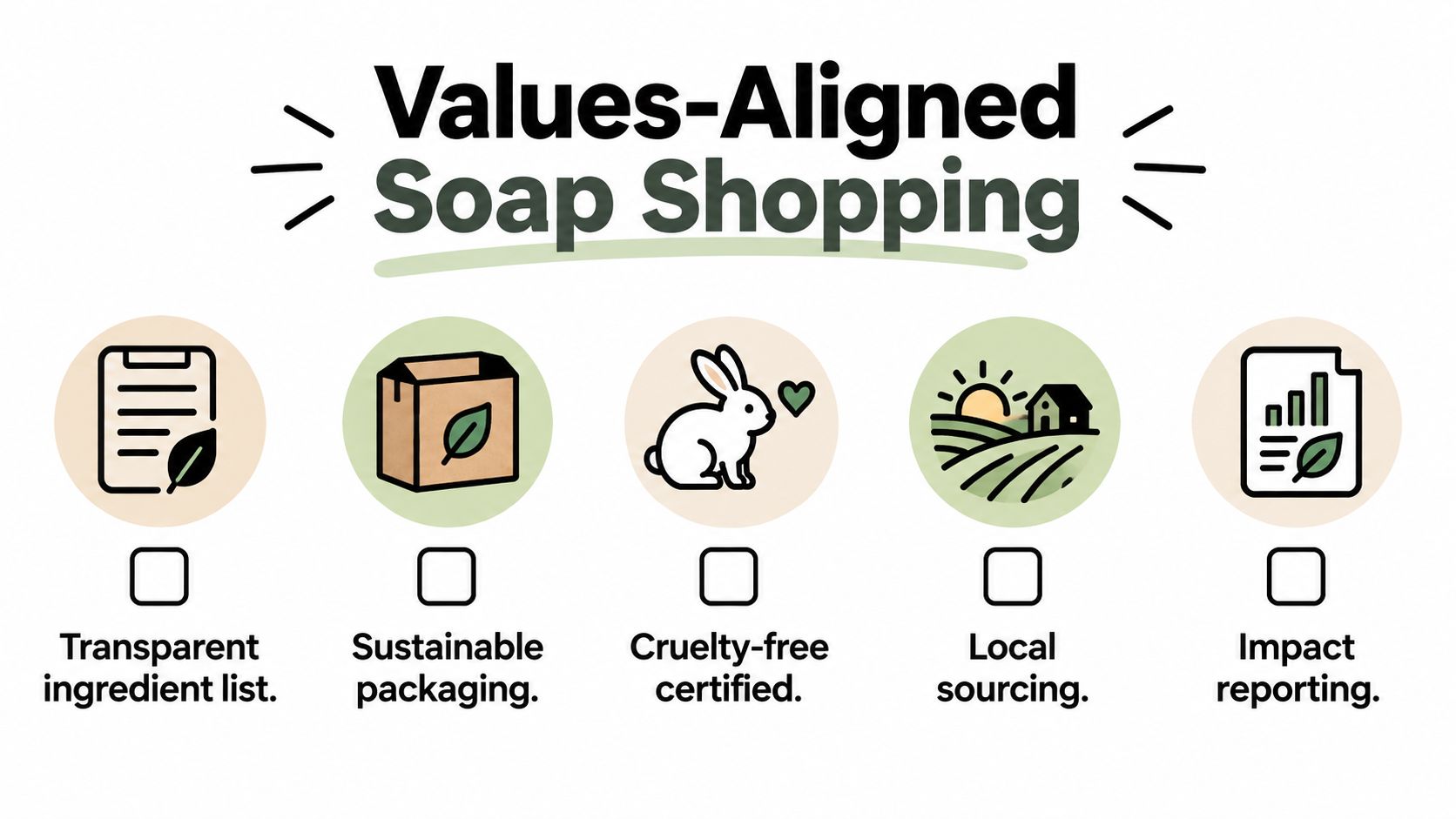
Buying from a values-aligned soap maker means looking beyond a low-waste bottle. A company may offer refills while giving little information about ingredients, workers, suppliers, or what happens to returned packaging. Good products should show their work through clear documentation and practical systems.
The EPA's Safer Choice program provides one useful example of whole-product review. A product can use the Safer Choice label only when every ingredient meets criteria for its ingredient class, while the finished product also meets requirements for human health, environmental impact, performance, and packaging. The program's separate Fragrance-Free label adds a review confirming that no fragrance materials are present. The EPA's Safer Choice FAQ explains how those standards work.
Look for evidence, not atmosphere
A pleasant brand story can be meaningful, but specific commitments are easier to evaluate. Look for:
- Ingredient disclosure: The full formula is available and easy to read.
- Refill mechanics: The company explains stations, return shipping, cleaning, or reuse.
- Packaging details: Materials and disposal instructions are clear.
- Performance evidence: The product is tested or certified for its intended use.
- Impact reporting: The company shares progress, limitations, and the people affected by its operations.
B Lab's certification framework offers another structured example. Certification requires a verified minimum score of 80 on the B Impact Assessment, which examines effects on workers, communities, customers, suppliers, and the environment. You can explore the B Lab standards and assessment framework.
Certification isn't the only proof of responsible behavior. A small soap maker may lack a formal badge while still publishing honest ingredient information, treating workers fairly, and operating a thoughtful refill program. The useful habit is to reward checkable commitments over broad words such as “natural,” “clean,” or “gentle.”
Your final shopping check
Before you add a cleanser to your cart, ask:
- Is the formula fragrance-free, and have I checked the complete ingredient list?
- Does the format suit my hands, body, skin condition, and daily routine?
- Are preservatives and surfactants selected with frequent use in mind?
- Does the product provide credible evidence of performance and waterway consideration?
- Can I refill the package through a process that supports repeated use?
- Does the company show how it treats people, materials, and its wider community?
That checklist turns a vague search for soaps without perfume into a practical way to support good products and good companies that care. You don't need to change everything at once. Start with the cleanser at your busiest sink, learn the label, and build a refill habit that feels natural in your home.
Fillaree offers unscented soaps and other refillable, low-waste home and body essentials, with refill options designed to reduce single-use packaging. Visit Fillaree to explore fragrance-free choices and find a refill routine that fits your household.