
Unscented All Purpose Cleaner: A Practical Guide
You're standing in front of the cleaning cupboard, holding a bottle labeled “fresh linen” while the kitchen already smells like citrus, lavender, and yesterday's dish soap. The counter needs wiping, the dog has tracked mud across the floor, and the last thing you want is another artificial scent hanging in the room.
That's why I switched to an unscented all purpose cleaner. The change wasn't about accepting weaker cleaning. It was about removing perfume from a product I use repeatedly, choosing clearer labels, and building a refill routine that doesn't turn every empty bottle into plastic waste.
Table of Contents
- Why Unscented All Purpose Cleaners Matter Right Now
- What Unscented Means on the Bottle
- Unscented vs Fragrance-Free vs Free and Clear
- How Unscented Cleaners Are Built to Work
- Scented vs Unscented in Real Cleaning Performance
- How to Use Unscented Cleaner on Every Surface
- Going Low-Waste With Refills and Reuse
- Common Questions Buyers Ask Before Switching
Why Unscented All Purpose Cleaners Matter Right Now
A cleaner used across counters, floors, and other everyday surfaces becomes a repeated household exposure, not an occasional purchase. The EPA's green-cleaning brochure lists all-purpose cleaners among common cleaning products used 197 times per year. That makes the formula and scent profile worth checking, especially if the bottle is sprayed or diluted several times a week.
Repeated exposure matters most when someone in the home reacts to fragranced products. A person with asthma may experience respiratory discomfort, while strong perfume can trigger symptoms for someone prone to migraines. A child playing on a freshly mopped floor inhales more residue per square foot than an adult walking past it. Keep rooms ventilated, follow the label's dilution instructions, and avoid spraying near children, pets, bedding, or food-preparation areas.
The useful rule is simple: a “clean” smell proves only that fragrance is present.
A quieter formula for everyday rooms
Fragrance does not remove grease, lift dried food, or dissolve bathroom residue. Functional ingredients such as surfactants do that work. Removing added scent can make bedrooms, nurseries, shared offices, and kitchens more comfortable, particularly when those rooms already contain cooking, pet, or personal-care odors.
The fragrance-free cleaners market, including unscented all-purpose cleaners, was estimated at USD 11,250.75 million in 2024 and projected to reach USD 19,844.32 million by 2032, with a projected 7.12% CAGR, according to Future Market Report's fragrance-free cleaners market estimate. The estimate places North America at 36.5% of the market, the United States at 21.8% of global share, and household cleaners at 45.3% of the top segment mix.
Those figures do not establish that every unscented product cleans well. They do show that fragrance-free cleaning has moved beyond a niche preference. Choose a formula that performs on your surfaces, then keep its bottle in a refill loop instead of replacing it with another disposable spray.
My practical rule: If you use a cleaner often, remove unnecessary perfume first. Then judge the formula by cleaning performance, surface compatibility, ingredient transparency, and refillability.
What Unscented Means on the Bottle
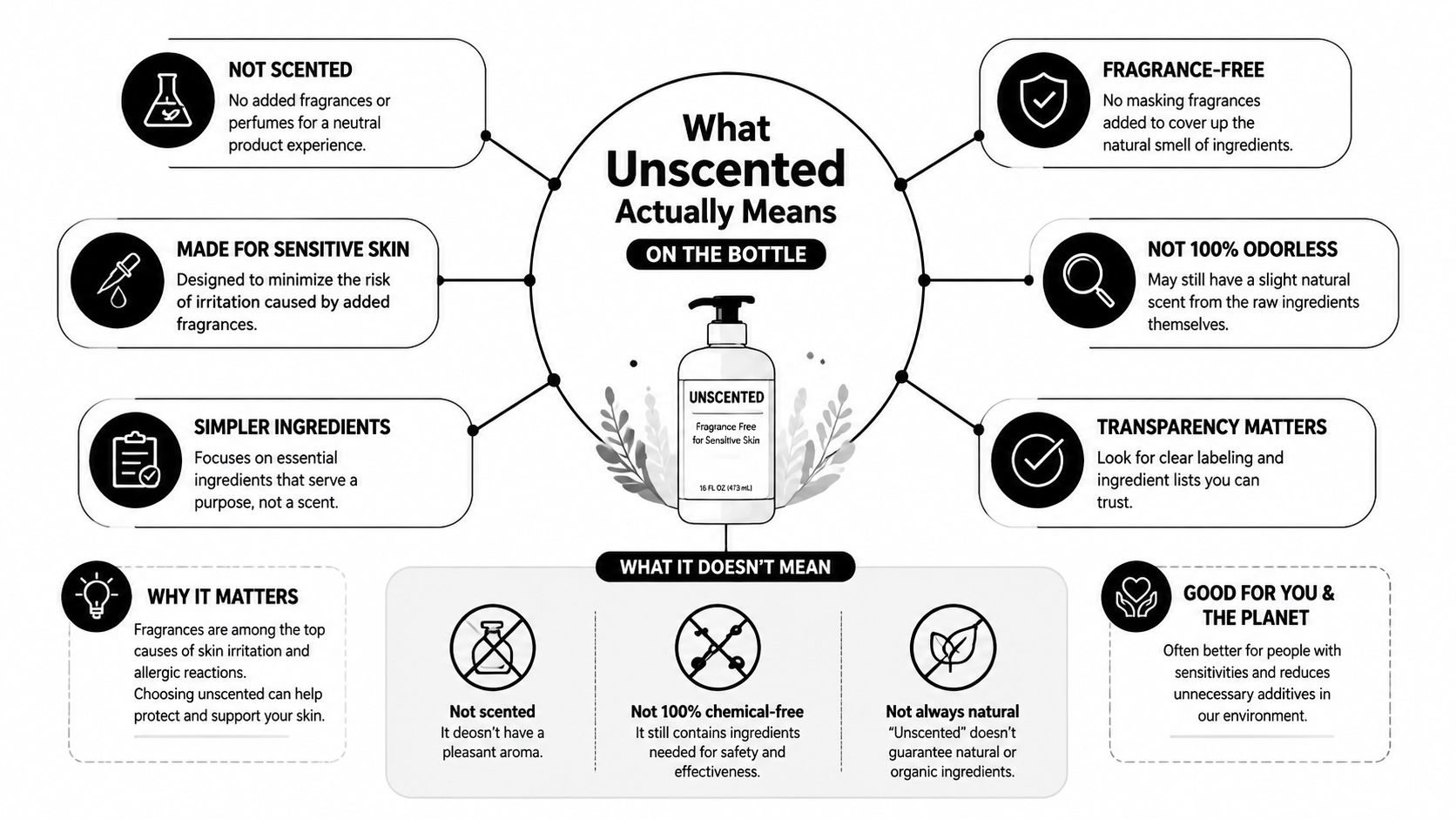
You spray an “unscented” cleaner on the counter, expecting no scent, then notice a chemical or herbal odor. The label has not necessarily failed. In everyday retail language, unscented usually means no noticeable perfume. It does not confirm that the formula contains no fragrance materials or odor-masking ingredients.
Cleaning comes from functional chemistry. Surfactants help water spread and loosen soil. Builders manage hard-water minerals. Solvents dissolve oily residue, while acids or alkalis adjust pH for specific jobs. Fragrance sits outside that cleaning work. It changes how the product or room smells, not how grime is removed.
Why a supposedly unscented spray can still smell
Surfactants, preservatives, solvents, and packaging can contribute a raw odor. Some manufacturers add materials that mask that base smell without creating an obvious floral or citrus profile. A bottle can therefore appear scent-free while still containing ingredients that bother someone avoiding fragrance-related exposure.
That gap between marketing language and ingredient reality is where greenwashing lives. Words such as “natural,” “clean,” “gentle,” and “unscented” create reassurance without specifying what the formula excludes. Fillaree's guide to avoiding greenwashing offers a useful way to assess environmental claims instead of trusting a soothing label.
Treat “unscented” as a starting point, not proof of zero fragrance. For the lowest possible scent exposure, choose a distinct fragrance-free claim, review the ingredients, and look for a certification or standard explaining how that claim was assessed. Then keep the chosen cleaner in a refill loop, so clearer labeling and lower-waste use support the same household system.
Unscented vs Fragrance-Free vs Free and Clear
A cleaner labeled unscented can still be the wrong choice for a scent-sensitive home. These labels sit close together on the shelf, but they describe different levels of disclosure and review.
Unscented usually means no noticeable perfume was added. It may still allow masking materials or ingredients that cover the formula's base odor. Fragrance-free makes a narrower, stronger claim. Under the EPA's reviewed Fragrance-Free label, no fragrance materials may be present, and chemicals that also function as fragrance are excluded. (EPA Safer Choice products)
The EPA separates unscented from fragrance-free because an unscented formula can contain odor-masking ingredients. For households managing asthma, migraines, or chemical sensitivity, I would start with a distinct fragrance-free claim, then verify the ingredients and the standard behind it. (EPA fragrance-free factsheet)
“Free and clear” is less specific. Brands often use it to suggest the absence of fragrance and dyes, but the phrase does not replace a reviewed fragrance-free claim. Treat it as a prompt to investigate, not as proof.
| Label Claim | Added Perfume | Masking Scents | Dyes | What to Check |
|---|---|---|---|---|
| Unscented | Usually no noticeable perfume | May be present | May be present | Full ingredients and fragrance disclosures |
| Fragrance-free | No fragrance materials under the reviewed claim | Should not be present | Check separately | EPA label, ingredient list, and preservative system |
| Free and clear | Usually marketed as absent | Brand meaning varies | Often excluded, but verify | Exact exclusions, certification, and ingredients |
Read for fragrance, parfum, essential-oil blends, and wording about masking or odor neutralization. “Natural fragrance” still creates a scent exposure, so natural origin does not settle the question for a reactive household.
The EPA Safer Choice program reviews minor ingredients, including dyes and fragrances, alongside the main cleaning agents. NSF notes that eligible products can include all-purpose cleaners and that the program screens ingredients for human-health and environmental safety. (NSF summary of EPA Safer Choice)
Choose the clearest claim you can verify, then buy that formula in a refill container or returnable system. The practical win is not a reassuring bottle. It is a fragrance-free cleaner whose label, ingredients, and refill loop all hold up.
How Unscented Cleaners Are Built to Work
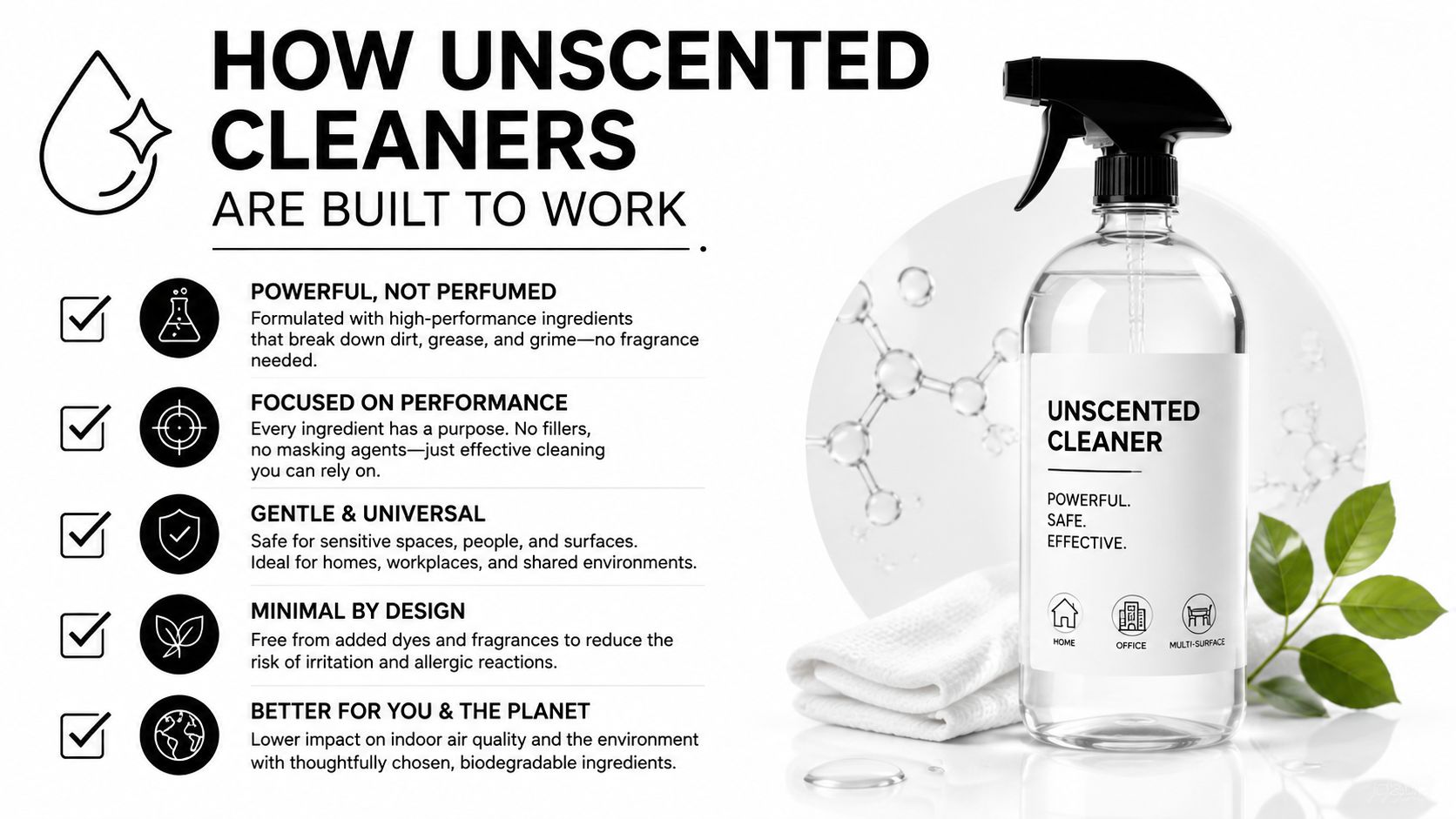
A good unscented cleaner is not just a scented cleaner with perfume removed. The manufacturer still has to balance soil removal, rinsing, preservation, surface safety, and shelf stability.
Start with surfactants. Nonionic and anionic surfactants help loosen oils, food residue, and everyday soil so a cloth can lift them away. A glucoside-based surfactant, for example, may contribute to wetting and soil removal, but the complete blend matters more than one fashionable ingredient. A plain-language look at caprylyl and capryl glucoside is available in this ingredient guide from Fillaree.
Builders such as citrate compounds can help the surfactant system work in mineral-heavy water. pH also matters. Strongly caustic formulas can create more surface risk, while a carefully designed neutral or mildly alkaline formula can handle routine soil without being unnecessarily aggressive.
Read the label like a homeowner
Use this short checklist when comparing bottles:
- Functional surfactants: The label should identify meaningful cleaning agents rather than hiding everything behind a vague “proprietary blend.”
- A builder or water conditioner: Citrate-based builders are one example of how a formula can support cleaning in hard water.
- A declared preservative: Water-based cleaners need protection against microbial growth. Fragrance-free doesn't mean preservative-free.
- Water near the beginning: Most ready-to-use sprays are water-based, so water commonly appears as the first ingredient.
- No fragrance umbrella terms: Avoid vague references to fragrance, parfum, masking agents, or essential-oil blends if scent sensitivity is the concern.
One technical neutral-cleaner example lists pH 7.0, an odorless profile, and a 1:256 dilution for normal soil, while describing broad hard-surface compatibility and a 2-year shelf life. Those specifications come from a neutral cleaner technical sheet, not from every unscented cleaner on the market. Use them as evidence that neutral, concentrated chemistry can be practical, not as a universal formula requirement.
Scented vs Unscented in Real Cleaning Performance
A scented cleaner can be excellent, and an unscented cleaner can be mediocre. The scent doesn't decide performance. The surfactant system, concentration, pH, dwell time, wiping method, and surface compatibility do.
On a greasy stovetop, a capable fragrance-free formula should loosen oil just as effectively as a scented one. If the residue is thick or baked on, give the cleaner more dwell time instead of assuming the product needs perfume. On glass and stainless steel, unscented formulas often have a practical advantage because they're less likely to leave a perfumed or oily impression that competes with a polished finish.
| Attribute | Typical Scented | Unscented |
|---|---|---|
| Grease removal | Depends on surfactants and concentration | Depends on surfactants and concentration |
| Dried food | May need dwell time and agitation | May need dwell time and agitation |
| Glass and stainless | Can leave scent or film depending on formula | Often easier to finish without competing perfume |
| Sealed wood | Surface compatibility varies | Surface compatibility varies |
| Bathroom film | Requires suitable chemistry and dwell time | Requires suitable chemistry and dwell time |
| Scent after cleaning | Noticeable perfume may remain | Little or no intentional perfume |
| Cleaning cue | Scent can create a sense of freshness | Cleanliness must be judged by the surface |
| Cost per use | Depends on dilution and packaging | Concentrate refills can improve use economics |
The U.S. EPA describes Safer Choice as a formulation standard intended to help purchasers find products that perform while using ingredients safer for people and the environment. It doesn't guarantee that a product will handle every cleaning task equally well. (EPA Safer Choice program)
In my home, unscented wins in three places: stainless steel, bedrooms, and shared spaces. There's no fragrance competing with clean laundry, candles, cooking, or fresh air. The trade-off is psychological. If you've learned to associate a strong scent with cleanliness, an unscented counter can feel unfinished even when it's clean.
How to Use Unscented Cleaner on Every Surface
A cleaner can be unscented and still be wrong for a surface. Start by checking the material, then confirm the product's compatibility chart or label. Stone, finished wood, painted surfaces, and laminate each have finishes that may haze, dull, or absorb residue.
Test before making it routine
Use a hidden corner of stone, laminate, or painted wood. Leave the cleaner for two minutes, then wipe with a white microfiber cloth. Look for color transfer, haze, or residue that a patterned towel could conceal.
Follow the label exactly. Never use a concentrate straight unless the manufacturer says to, and never mix cleaners. Keep acids, bleach products, ammonia products, and other reactive formulas separate.
Match the amount to the soil
A ready-to-use spray should wet the soil without flooding the surface. With a concentrate, use the manufacturer's printed dilution. A ratio borrowed from another product can leave too much cleaner behind or provide too little cleaning power.
Use this quick surface guide:
| Cleaning job | Practical approach |
|---|---|
| Daily dust and light soil | Use the weakest labeled dilution, especially on finished wood and surfaces wiped often. |
| Counters and appliance exteriors | Use the standard dilution for routine kitchen soil. Rinse with a damp microfiber cloth if the label requires it. |
| Greasy range hoods and bathroom film | Choose the stronger labeled dilution or an approved ready-to-use formula. Let it sit briefly, then wipe. |
| Glass and stainless steel | Spray the cloth when overspray matters. Finish with a dry microfiber cloth. |
| Finished wood | Use little moisture and dry promptly. Cleaner should never pool on the finish. |
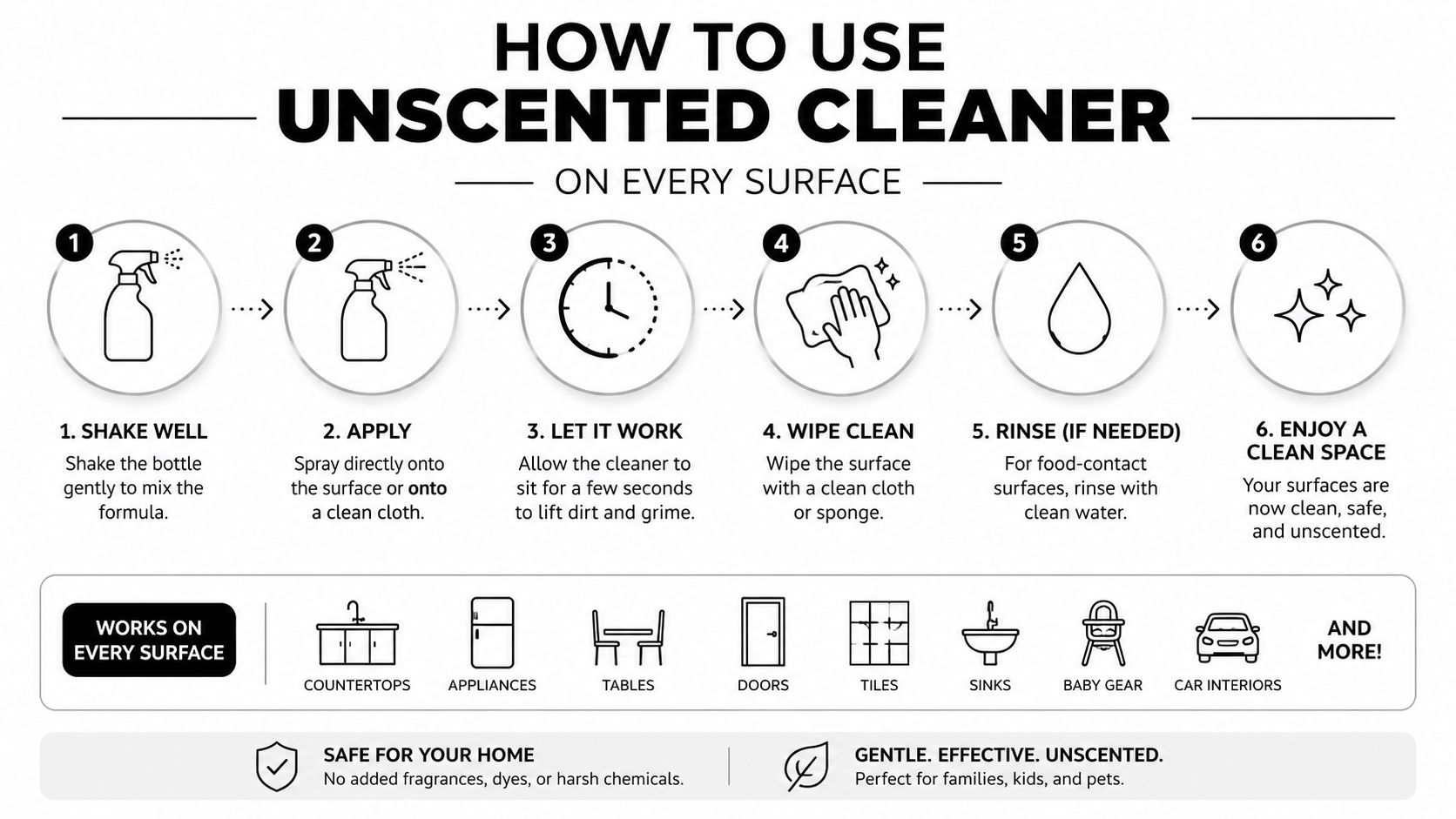
Keep unscented cleaner away from unsealed wood, unpolished natural stone, electronic screens, and raw cast iron unless the manufacturer specifically approves it. For a bedroom or shared space, spray the cloth first to control mist and keep nearby fabrics dry. The working sequence is spray, wait, wipe, dry. The pause helps loosen soil, while the final dry pass limits residue settling back onto the surface.
Going Low-Waste With Refills and Reuse
A low-waste cleaner is judged by its refill loop, not its first bottle. Keep a durable spray bottle in service, buy concentrate through a lower-waste channel, and make refilling easy enough to prevent a return to disposable replacements. Source reduction and reuse prevent waste before it needs to be managed, a principle reflected in the EPA's source reduction and reuse guidance.
Choose the refill route you'll use regularly
Pick the option that fits an existing routine. In-store refill stations suit shoppers who already pass one during regular errands. You bring the container, refill it, and avoid another complete package. Brand delivery programs work better when convenience matters, especially if concentrates arrive with other household essentials. At-home bulk refills suit households with cupboard space and a repeatable mixing routine.
Bottle design affects whether the system lasts. A sturdy bottle with a replaceable sprayer can stay useful for years. Thin plastic may crack, cloud, or develop a worn trigger after repeated handling. Before buying concentrate, check the dilution instructions, container compatibility, storage guidance, and the company's process for returned packaging.
Refill systems also include the outer packaging, pump, and shipping format. Packaging Panda's ecommerce packaging stack offers a useful look at how those components fit together.
| Refill Channel | Cost per Ounce | Packaging Waste | Convenience |
|---|---|---|---|
| In-store refill station | Varies by retailer and formula | Low when you reuse the bottle | High if a station is nearby |
| Mail-order concentrate | Varies by product and delivery | Usually lower than shipping a full bottle | High for recurring orders |
| At-home bulk refill | Varies by format and dilution | Depends on box or pouch design | High if storage and mixing are simple |
A larger refill container suits a busy household only if you can store and dispense it safely. A suitable gallon-jug pump can make transferring product less messy and easier to repeat.
The empty bottle still belongs in the system. Clean it, label it clearly, replace only the worn component, and choose the next refill by the amount of new packaging it requires. That routine matters more than choosing a refill format that looks sustainable but does not fit your household.
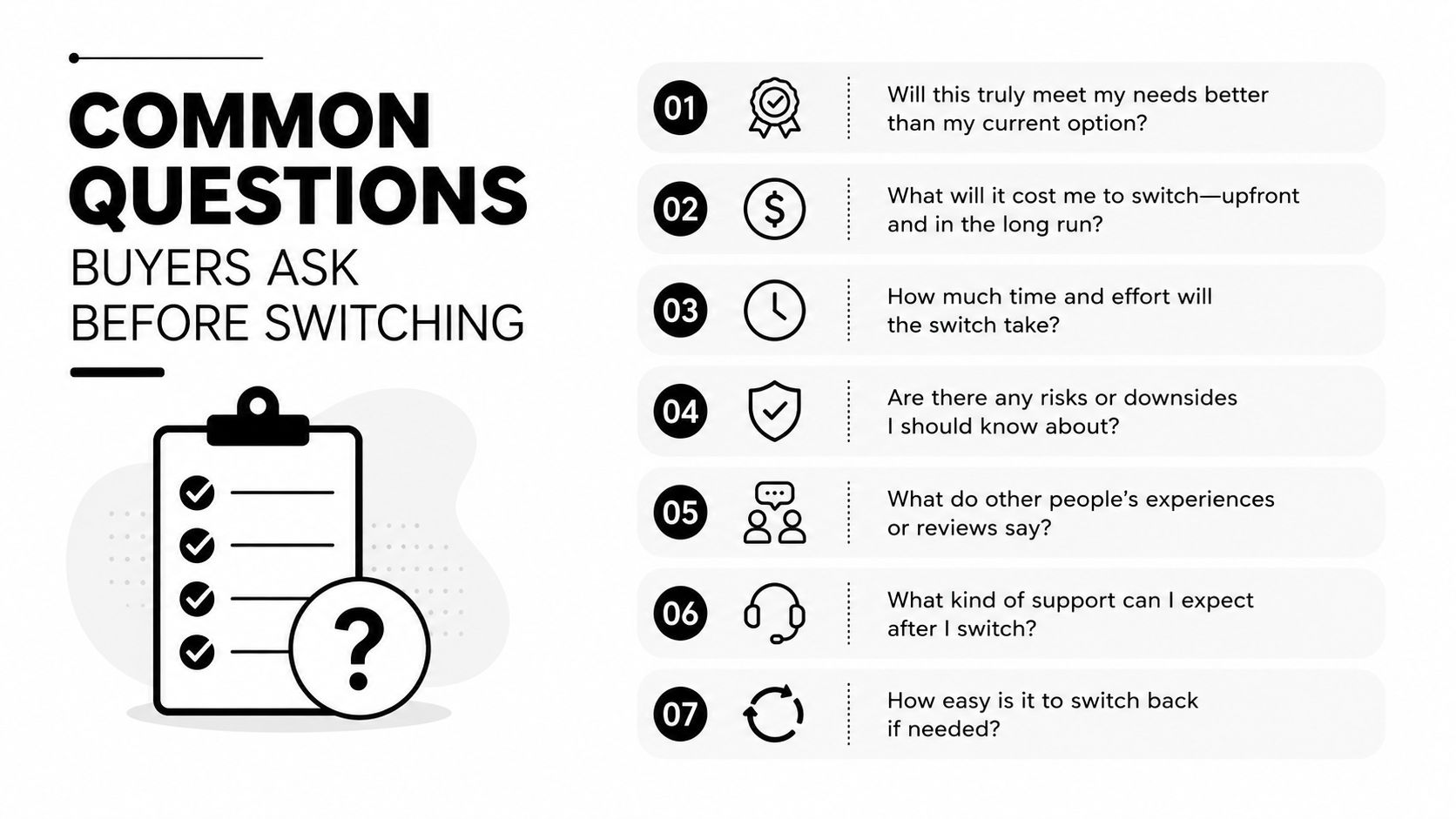
Common Questions Buyers Ask Before Switching
Are preservatives worse than fragrance?
Preservatives and fragrance do different jobs. A water-based cleaner needs protection against microbial growth, so removing perfume does not remove the need for preservation. Phenoxyethanol or sodium benzoate may appear in a fragrance-free formula without functioning as fragrance.
Check the full ingredient disclosure and the standard behind the label. The EPA's fragrance-free designation focuses on fragrance materials, while Safer Choice considers wider human-health and environmental factors. That distinction matters because unscented can describe the result you notice, not everything the formula contains.
Why does a fragrance-free cleaner leave a film?
Film usually points to too much product, hard-water residue, an incompatible surface, inadequate wiping, or a formula that requires rinsing. It does not show that fragrance-free chemistry failed.
Use less cleaner, wipe with a clean microfiber cloth, and finish with a dry pass. On glass and stainless steel, spray the cloth instead of the surface. If the haze stays, stop using that formula on the material and check the approved-surface list.
Is an unscented cleaner more expensive?
Compare cost per use, not only the bottle price. Check how much ready-to-use cleaner you receive from a concentrate, then include shipping, refill packaging, and replacement spray bottles.
Concentrate can reduce the price gap when dilution instructions are clear and measurements stay consistent. A large refill that expires before your household finishes it is a poor purchase. Choose the system you will use, reuse, and refill.
What if unscented still triggers symptoms?
Treat the reaction as a reason to inspect the formula. Look for masking agents, essential oils, preservatives, dyes, and other disclosed ingredients. Choose a simpler product with fuller disclosure, improve ventilation, and avoid spraying cleaner into the air.
If symptoms continue, keep the bottle and its SDS or ingredient sheet for a conversation with an allergist or another qualified clinician. A label alone cannot identify the cause.
Before buying, check these five points:
- The claim: Choose “fragrance-free” when avoiding fragrance materials is the priority. “Unscented” may still leave room for masking ingredients.
- The ingredients: Look for disclosed surfactants, builders, preservatives, and dyes.
- The standard: Check whether a credible third-party or EPA-linked certification applies.
- The refill loop: Confirm how the bottle, pouch, box, or bag will be reused or handled.
- The surface list: Verify that your counters, floors, fixtures, and appliances are approved.
Fillaree sells refillable home-care products, including Clean Dream Spray, an all-purpose cleaner intended for nonporous surfaces such as countertops, porcelain, and bathroom fixtures. If you want to replace a disposable spray routine, Fillaree provides home refills and low-waste options. The useful choice is the one whose label answers your questions and whose refill loop your household can maintain.