
Unscented Conditioner Guide for Sensitive Scalps
The most popular advice about unscented conditioner is also the most misleading: just choose a bottle labeled “unscented.” That label doesn't always mean the formula contains no fragrance. Some manufacturers use masking fragrance to cover the natural odor of raw ingredients, so a product can smell like nothing to you while still containing fragrance materials.
For a sensitive scalp, the front label is only the beginning. You need to distinguish unscented from fragrance-free, understand which ingredients provide slip, and choose packaging that doesn't turn a gentle routine into a stream of disposable bottles. A good conditioner should calm your wash day, work for your hair texture, and fit the values you bring to the rest of your home.
Table of Contents
- The Hidden Fragrance Loophole In Unscented Hair Care
- Why Standard Conditioners Trigger Sensitive Scalps
- How To Read Labels And Spot Safe Ingredients
- Matching The Right Formula To Your Hair Type
- Choosing Refillable Systems And Sustainable Packaging
- Practical Tips For Washing And Refilling At Home
The Hidden Fragrance Loophole In Unscented Hair Care
“Unscented” and “fragrance-free” aren't interchangeable terms. Unscented usually describes the sensory result, while fragrance-free describes what the formulator added, or deliberately didn't add, to create that result. A masking fragrance can conceal the scent of botanical extracts, preservatives, fatty materials, or other raw ingredients without producing an obvious perfume experience.
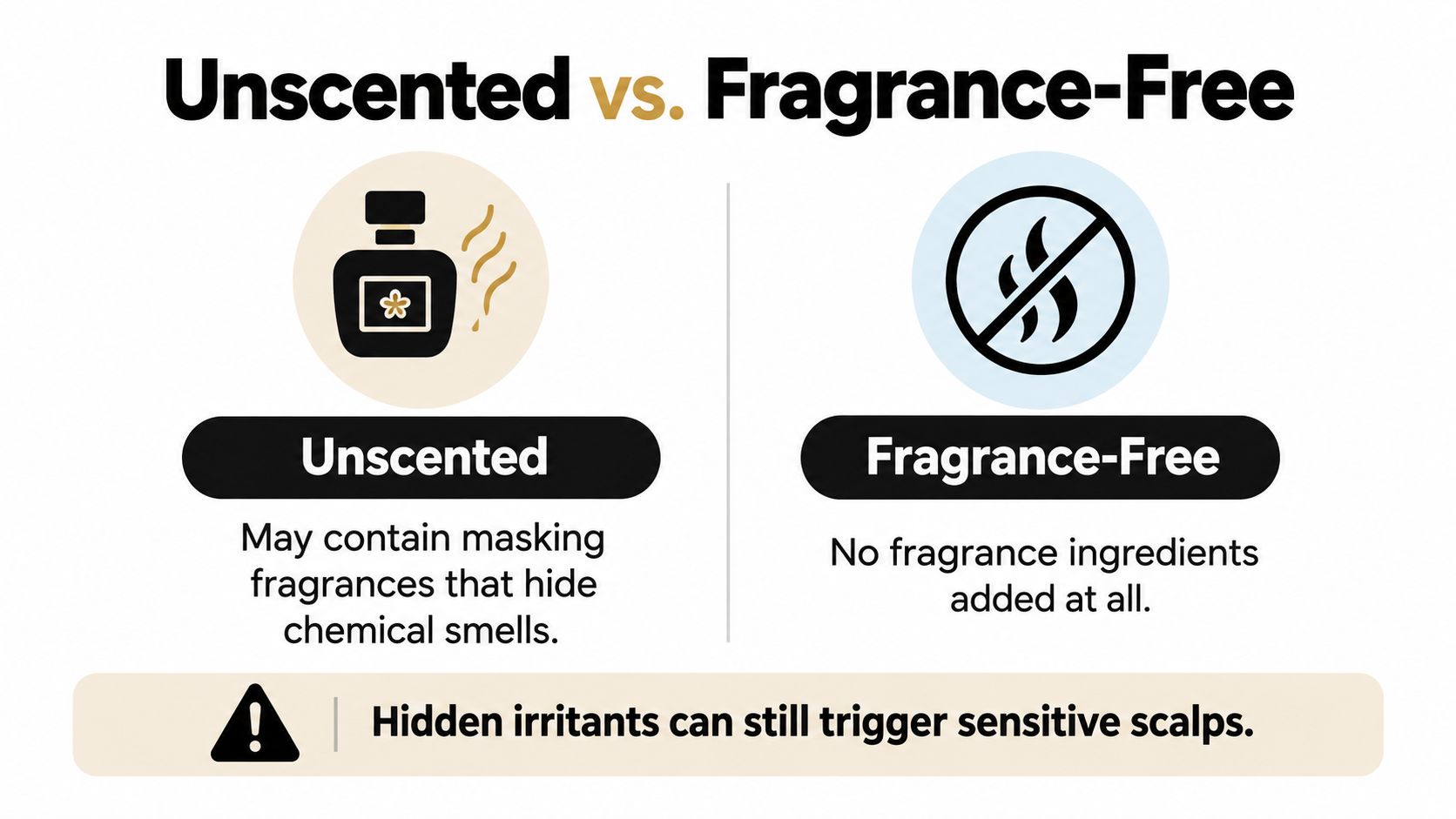
That distinction matters if your scalp reacts to scent, if you have a history of contact dermatitis, or if fragrance makes your eyes, nose, or skin uncomfortable. A fragrance-free conditioner is formulated without added fragrance ingredients. An unscented conditioner may have a neutral sensory profile, and the ingredient list is what tells you whether the formula earned that quietness naturally or achieved it through masking.
Practical rule: If fragrance avoidance is medically or personally important, look for “fragrance-free,” then confirm the ingredient list rather than relying on “unscented” alone.
What masking fragrance is doing
Conditioner ingredients don't always smell pleasant in their raw form. A formulator may add a masking material to suppress that odor, especially when a product is meant to feel neutral. The finished product may not smell perfumed, but the added fragrance still matters to someone trying to avoid fragrance exposure.
This is why “no noticeable scent” isn't the same as “no fragrance ingredients.” Retail listings can make the confusion worse by pairing “unscented” with “no fragrance added,” even though those phrases don't always communicate the same formulation standard. Read the package, then check the full INCI list if the brand publishes it.
Consumers who want a lower-waste routine can apply the same scrutiny to the company behind the bottle. A brand's approach to unscented hand soap and waste recovery can reveal whether its fragrance language and packaging choices align with the transparency it promises.
The safest mental shortcut is simple: unscented tells you how the product smells, fragrance-free tells you what was added. Neither label guarantees that every other ingredient will suit your scalp, but fragrance-free is the more useful starting point for people avoiding scent triggers.
Why Standard Conditioners Trigger Sensitive Scalps
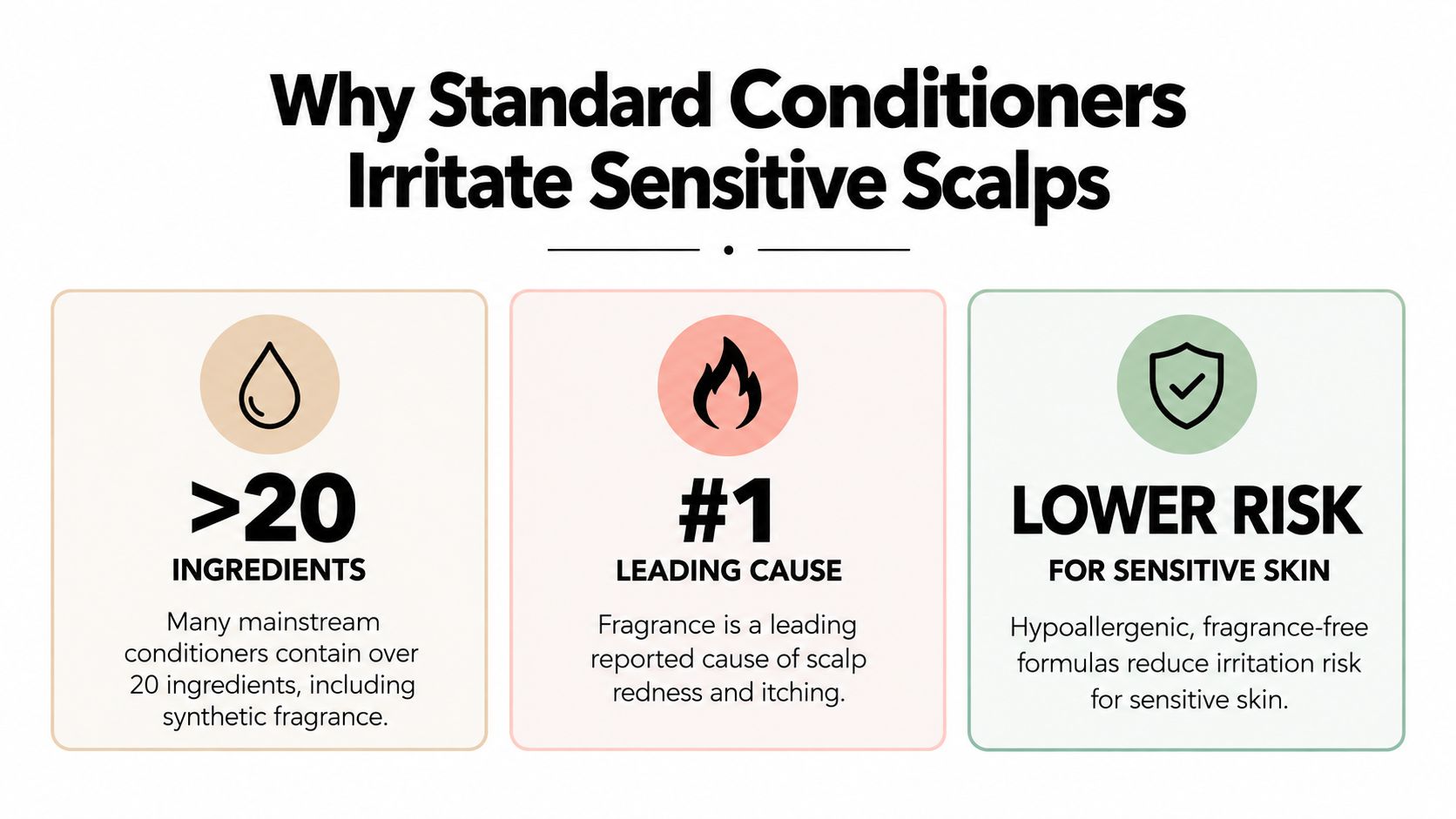
A conditioner can leave hair soft and still bother the skin it touches. The scalp, hairline, neck, ears, and hands may all encounter the formula during washing, rinsing, brushing, or sleep. If irritation appears after a new product, fragrance deserves attention because it occurs so frequently in conventional hair care.
One analysis found fragrance in 97% of hair products overall and 98% of conditioners. The same analysis identified cetylstearyl alcohol derivatives in 85% of conditioners and propylene glycol in 28%, showing why people with contact-allergy concerns often seek shorter, simpler formulas. These figures come from the analysis of fragrance and common conditioner ingredients.
Those ingredients aren't automatically harmful to everyone. Cetearyl alcohol and related fatty alcohols can help create a rich, spreadable conditioner, while propylene glycol can help retain moisture and dissolve ingredients. The point is more precise: an ingredient can be useful in a formula and still be unsuitable for a particular person.
The fragrance allergens hiding in familiar formulas
A 2026 conditioner analysis found fragrance components in 93.5% of products. It also identified linalool in 32.3%, hexyl cinnamal in 25.8%, limonene in 19.4%, and benzyl salicylate in 16.1% of the products examined. You can review the published conditioner analysis for the full context.
These names may appear as individual fragrance allergens or as components associated with fragrance blends. Essential oils and botanical extracts can also contain naturally occurring fragrance molecules. “Natural” doesn't mean nonreactive, and “clean” doesn't have a standardized meaning, so ingredient transparency matters more than the marketing vocabulary.
Look for a pattern rather than blaming one ingredient immediately. If your scalp becomes itchy after using several fragranced products, switching to a genuinely fragrance-free routine may remove a major variable. If symptoms persist, worsen, or include swelling, oozing, or significant redness, seek qualified medical advice instead of repeatedly changing products.
Why the category keeps growing
Sensitive users aren't asking for an ornamental niche product. They're shopping inside a large, expanding conditioner category. One market estimate places the global hair conditioner market at USD 5.04 billion in 2025, with a projection of USD 9.62 billion by 2034 at a 7.73% CAGR. The estimate is available through the global fragrance-free skin-care and conditioner market reference.
Broader fragrance-free personal care has also moved into mainstream territory. A separate estimate values fragrance-free skin care at USD 18.72 billion in 2024 and projects USD 31.45 billion by 2033 at a 5.9% CAGR, as reported in this fragrance-free skin-care market overview. Skin care isn't conditioner, but the direction is meaningful. People increasingly want products that respect sensitive bodies without sacrificing function.
How To Read Labels And Spot Safe Ingredients
Ingredient lists look intimidating because they use standardized cosmetic names rather than kitchen language. You don't need to memorize every term. You need a repeatable scan that separates fragrance, conditioning structure, supporting ingredients, and claims that deserve verification.
Start at the back of the bottle, not the front. Product names and words such as “pure,” “natural,” “gentle,” and “unscented” describe positioning. The INCI list shows the formula.
Use a four-part label scan
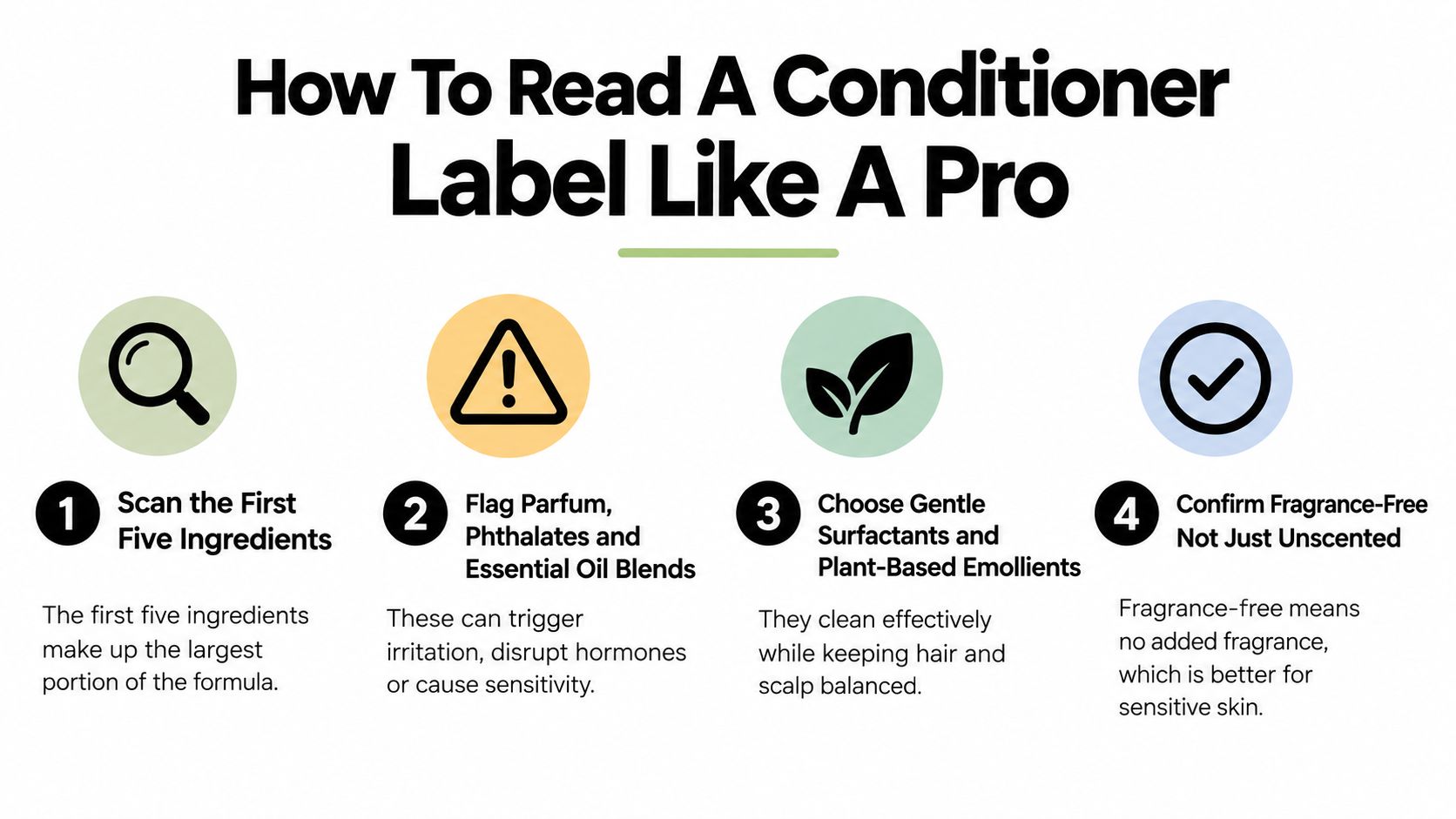
- Find fragrance language. Scan for “fragrance,” “parfum,” “perfume,” or “masking fragrance.” If the product contains essential-oil blends, check whether the individual oils and their declared allergens are listed.
- Treat botanicals with nuance. Lavender, citrus, peppermint, rosemary, tea tree, and other aromatic plant materials can contribute scent and may bother reactive users. Botanical extracts without an aromatic purpose aren't automatically a problem, but “plant-based” doesn't replace patch testing or careful observation.
- Identify the conditioning backbone. Useful names include behentrimonium chloride, behentrimonium methosulfate, cetearyl alcohol, and other fatty alcohols. Glycerin can support a moisturized feel, while oils and silicones may change softness, shine, and weight.
- Verify the claim. A bottle can say “unscented” while the list includes fragrance materials. For sensitive users, fragrance-free is the more meaningful label, but the ingredient list remains the final check.
Separate irritation concerns from ingredient fear
A short list can be easier to troubleshoot, but short doesn't automatically mean safe and long doesn't automatically mean bad. Water, cetearyl alcohol, glyceryl stearate, glycerin, coconut oil, behentrimonium chloride, sodium benzoate, and potassium sorbate appear in one independently reviewed example, 365 by Whole Foods Market Unscented Conditioner. The review describes that product as meeting strict safety standards and receiving a “GO” rating, including being free from BPA, phthalates, parabens, and other endocrine-disrupting compounds. See the independent review of 365 Unscented Conditioner.
That example illustrates an important formulation lesson. Fragrance-free doesn't mean ingredient-free. The conditioner still needs emulsifiers, moisturizers, preservatives, and conditioning agents to remain stable and useful.
If you also use extensions, a separate guide to shampoo ingredients to avoid for extensions can help you compare ingredient concerns across your broader hair routine. For a deeper look at what each conditioner component contributes, consult this ingredient guide for hair conditioner.
Use the video below as a visual companion while you practice reading labels:
Matching The Right Formula To Your Hair Type
Removing fragrance doesn't remove the mechanism that makes conditioner work. Conditioning comes primarily from cationic surfactants and deposition systems that adsorb to negatively charged hair surfaces. They reduce friction between fibers, which helps wet hair comb more easily and feel smoother after rinsing.
A recent electrokinetic comparison found wet-combing force reduction improved in the order STAC < CTAC < BTMS < BTMC. Longer-chain cationic surfactants, especially behentrimonium chloride, produced the strongest wet-combing reduction in that comparison, consistent with more stable conditioning films and stronger interactions on the hair fiber. The electrokinetic study of conditioning actives explains why scent has little to do with detangling performance.
Match weight and slip to the fiber
Fine hair usually needs enough slip to detangle without a heavy coating. Thick, coarse, curly, or highly porous hair may benefit from a richer formula with more fatty alcohols, oils, silicones, or a stronger cationic conditioning system. The right product is the one that leaves your hair manageable without making the roots limp or the ends rough.
| Hair Type | Best Conditioning Agents | Why It Works |
|---|---|---|
| Fine or easily weighed-down hair | Lightweight cationic conditioners, glycerin, modest fatty alcohol content | Adds combability and softness while limiting heaviness |
| Straight, medium-density hair | Behentrimonium chloride, cetearyl alcohol, light emollients | Balances slip, smoothness, and movement |
| Thick or coarse hair | Behentrimonium chloride, behentrimonium methosulfate, fatty alcohols, oils | Builds a richer conditioning film for detangling |
| Curly or porous hair | Strong cationic systems, fatty alcohols, plant oils, selected silicones | Reduces friction and helps retain a smoother feel |
| Dry or chemically treated hair | Rich conditioning agents, humectants, emollients, optional silicones | Supports softness where the fiber feels depleted |
These are starting points, not rigid rules. Hair density, porosity, water hardness, styling habits, and how much product you apply can change the result. Test one formula for several washes and judge wet detangling, post-rinse softness, root volume, and next-day feel rather than the scent experience.
For richer treatments, readers comparing Asian formulas may find this practical advice on Japanese hair masks useful. A hair mask can be valuable for thirsty lengths, but it doesn't need perfume to provide a conditioning film.
A fragrance-free conditioner should earn its place through performance. If you can comb through wet hair more easily, rinse without residue, and wear your hair comfortably afterward, the formula is doing its job.
Choosing Refillable Systems And Sustainable Packaging
A sensitive-scalp routine can still create unnecessary waste if every wash ends with another plastic bottle in the bin. Conditioner carries an environmental cost through both its contents and its container. Environmental reporting on conditioner found that raw ingredients account for nearly a quarter of a product's impact, while packaging contributes an average of 22%, typically because of plastic bottles. The environmental comparison of unscented conditioners also identifies two-in-one products, solid bars, and aluminum bottles as lower-waste alternatives in appropriate routines.
Packaging deserves the same careful reading as an ingredient list. Ask whether a bottle can be reused, whether a refill reduces material, whether the company accepts packaging back, and whether the system works in your household without creating inconvenient storage or cleaning problems.
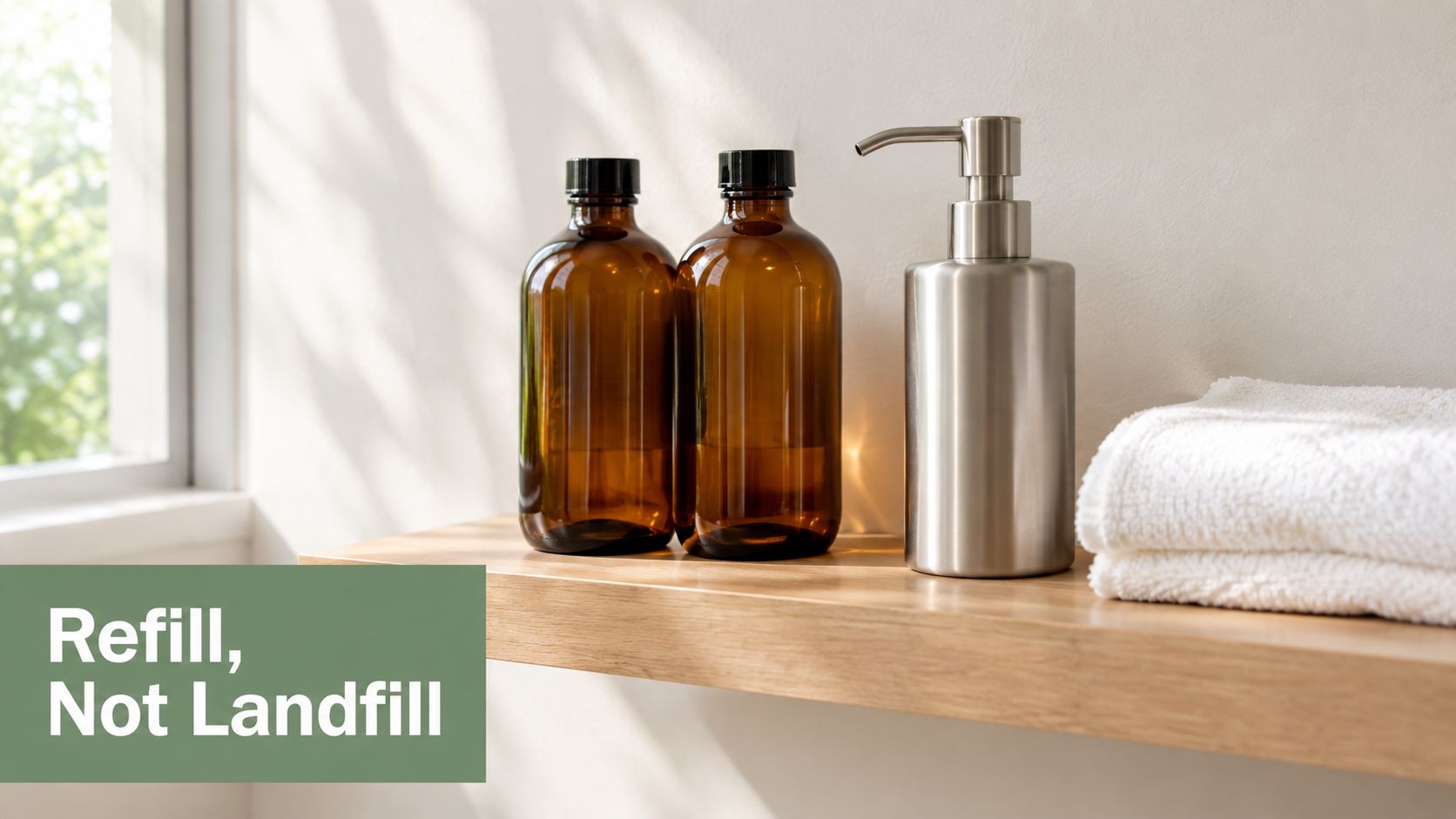
What circular refilling looks like
A refill model works best when it treats packaging as part of a managed loop rather than a disposable accessory. You keep a durable bottle, purchase a larger refill format or use a local station, and return designated packaging when the cycle ends. The company then needs a clear process for collection, washing, sanitizing, and reuse.
Fillaree is one example of that approach. The women-owned company makes refillable, low-waste home and body essentials, including conditioner available in unscented form. Its system includes 0.5-gallon home refill boxes, local partner stations, and a take-back process for used refill bags. The company says it washes and sanitizes returned bags for reuse at no cost to customers.
The model connects several kinds of care:
- Scalp care: You can choose an unscented option and avoid adding perfume to a sensitive routine.
- Material care: A refill system can reduce the need for repeated single-use bottles.
- Community care: Local refill stations give shoppers a practical way to participate beyond online purchasing.
- Business care: Buying from companies with transparent reuse systems supports the people maintaining those systems.
Read the company's sustainable packaging solutions before committing to any refill program. Look for details about material composition, returns, sanitation, and what happens after you send packaging back.
Supporting companies that match your values
Sustainability isn't only a material choice. It's also a relationship with the businesses you support. Good companies explain their formulas, acknowledge tradeoffs, design realistic refill systems, and make participation accessible to households with different budgets and routines.
SEEN offers another packaging example. Its Eco-Refill pouches are reported to use 75% less plastic by weight than traditional liter bottles, and the brand says its plastic bottles contain 25% to 50% post-consumer resin. Its paper and box materials are reported as FSC-certified. These details come from coverage of SEEN's fragrance-free conditioner and refill packaging.
No refill system eliminates every impact. Bulk formats still require materials, shipping, preservation, and responsible storage. The practical goal is a durable routine that reduces avoidable waste while giving you a formula your scalp and hair can tolerate.
Practical Tips For Washing And Refilling At Home
A gentle conditioner can still irritate if it sits on the wrong area or remains poorly rinsed. Start with the lengths, especially the mid-lengths and ends, and use less near the scalp unless your hair and product specifically need root conditioning. Work the product through wet hair with your fingers or a wide-tooth comb, then rinse until the hair feels conditioned but not coated.
Your application routine can also reveal whether the formula is right. If your hair tangles while wet, add a small amount and distribute it gradually. If the roots feel flat or the scalp feels coated, reduce the amount near the crown before abandoning the product.
A low-waste wash day
- Keep the bottle easy to use. A pump or squeeze top helps you dispense a controlled amount, which prevents the accidental overuse that often happens with slippery formulas.
- Rinse with patience. Residue can collect around the hairline, behind the ears, and at the nape. Give those areas a thorough rinse, particularly if your scalp is reactive.
- Clean the refill bottle between products. Empty it completely, wash it with warm water and a suitable cleanser, rinse away all residue, and let it dry fully before adding a new refill. Moisture and leftover product can complicate preservation.
- Store bulk refills sensibly. Keep refill boxes or pouches sealed, dry, and away from direct heat. Follow the manufacturer's storage and use guidance rather than transferring product into an unclean container.
- Change one variable at a time. If irritation appears, don't introduce a new shampoo, conditioner, mask, oil, and styling product in the same week. A simple routine makes cause and effect easier to understand.
A fragrance-free conditioner can become part of a broader low-waste habit without demanding perfection. Reusing a bottle, choosing a refill, returning eligible packaging, and supporting a local station are small actions, but they become meaningful when households repeat them.
Your scalp doesn't need a complicated ritual. It needs a formula whose ingredients you understand, a conditioning system suited to your hair, careful application, and packaging that respects the resources behind the product.
Fillaree offers refillable hair and body essentials, including an unscented conditioner option for people who want fragrance-conscious care with less disposable packaging. Visit Fillaree to explore home refills and local refill options, then choose a system you can realistically keep using.