
Vegan Friendly Body Wash: What It Means and How to Choose
You're standing in the body-wash aisle with two bottles in your hands. One carries a Leaping Bunny logo, the other says vegan in large green lettering, and both promise a cleaner, kinder shower. The ingredient lists are printed in tiny type, while words such as natural, plant-based, clean, cruelty-free, and hypoallergenic seem to overlap without meaning the same thing.
That confusion is reasonable. A vegan-friendly body wash can avoid animal-derived ingredients and still contain fragrance allergens, use poorly documented palm-derived materials, or arrive in a single-use plastic bottle. The useful question isn't only whether a formula is vegan. You also need to ask who verified the claim, how the ingredients were sourced, how the product was tested for safety, and what happens to the packaging after the last shower.
Table of Contents
- Standing in the Aisle Trying to Read a Body Wash Label
- What Vegan-Friendly Body Wash Means
- Ingredients to Watch For and Their Plant Based Swaps
- Certifications and Labels Worth Trusting
- Where Vegan Body Wash Claims Often Fall Short
- Skin and Environmental Benefits of Going Plant Based
- Why Refillable Packaging Closes the Loop Vegan Labels Cannot
- A Simple Way to Choose Your Next Vegan Body Wash
Standing in the Aisle Trying to Read a Body Wash Label
The shopper usually starts with the front label. A leaf illustration suggests plants, a “clean” badge suggests safety, and a cruelty-free rabbit suggests animal welfare. Then the bottle turns around, and the ingredient list introduces names that sound technical rather than reassuring: surfactants, humectants, preservatives, parfum, and botanical extracts.
A vegan-friendly body wash generally means the formula contains no animal-derived ingredients. That doesn't automatically make it organic, fragrance-free, gentle, biodegradable, or low-impact. A cruelty-free claim addresses animal testing, while a plant-based claim may describe only some ingredients. “Natural” has its own marketing meaning and doesn't tell you whether every raw material is traceable.
The quiet problem is that shoppers often treat these terms as one promise. They aren't. A product can be vegan but irritating, cruelty-free but not vegan, plant-derived but linked to uncertain agriculture, or beautifully packaged but wasteful once the bottle is empty.
The questions hidden inside one purchase
Before choosing, separate the decision into four checks:
- Formula: Are the cleansing agents and supporting ingredients free from animal origin?
- Verification: Does an independent certification support the claim?
- Skin tolerance: Is the product fragrance-free or otherwise suitable for your skin?
- Packaging: Can you refill, return, reuse, or recycle the container?
That last question matters because an ethically sourced formula still travels in a physical package. A body wash can meet one value while falling short on another.
This guide follows the label from the ingredient list to the supply chain and finally to the empty bottle. You'll see why glycerin needs a source check, why vegan and cruelty-free marks should be read separately, and how refill systems can support companies that care about both product performance and waste reduction.
What Vegan-Friendly Body Wash Means
At the shelf, two body washes may both show leaves, flowers, and the word “plant.” Only one may have documentation for every raw material. Vegan describes the formula's animal origin status, not its color, scent, skin feel, or packaging. A cleanser qualifies only when the brand can account for the complete formula, including minor ingredients, processing aids, and supplier materials.
An INCI name often cannot answer that question by itself. Glycerin, for example, may come from vegetable oils, petrochemical synthesis, or animal fat. The useful follow-up is not “Is glycerin vegan?” but “Which supplier made this batch, what feedstock was used, and can the brand verify it?” The same tracing problem applies to conditioning agents and specialty materials whose names do not reveal their origin.
The Vegan Society's guide to animal-derived cosmetic ingredients.pdf) identifies glycerine as a widely used cosmetic ingredient that can be animal-derived. It also describes lanolin as coming from sheep's wool and collagen as sourced from animal tissues. These examples show why a plant illustration is not evidence. The label is the starting point, while supplier records provide the missing chain of proof.
Vegan and cruelty-free answer different questions
Vegan asks, “What is in the bottle?” Cruelty-free asks, “Was the product or its ingredients tested on animals?” The two claims overlap in some certifications, but they describe different checks.
A body wash can use no animal-derived materials and still lack a dependable cruelty-free verification. A cruelty-free formula can contain milk protein, beeswax, lanolin, or another animal-derived ingredient. The Vegetarian Society guidance on vegan cosmetics explains that vegan cosmetics contain no animal-derived ingredients and are not tested on animals, while cruelty-free status alone addresses animal testing.
A useful brand response should identify the source of uncertain materials, explain how suppliers are screened, and cover the whole formula rather than highlighting only its headline ingredients. If the answer stops at “plant-based,” treat that as partial information.
For a practical example of how Fillaree's plant-based soap approach connects formulation with a lower-waste routine, examine what happens after the product is used.
Practical rule: Treat “vegan” as an ingredient-sourcing claim. Check sensitivity, environmental impact, animal testing, and packaging separately.
Ingredients to Watch For and Their Plant Based Swaps
Standing in the aisle, start by sorting ingredients according to their job. A surfactant lifts oil and dirt, an emollient improves slip, a humectant helps hold water, and a specialty ingredient changes color, texture, or skin feel. A plant based swap does not need to copy an animal-derived material molecule for molecule. It needs to perform the same function without animal origin.
Common cleansing systems use plant-derived or synthetic surfactants such as sodium cocoyl isethionate, coco-glucoside, lauryl glucoside, and sodium lauroyl methyl isethionate. Brands can blend them for foam and cleansing without animal inputs. Glycerin may reduce a stripped feeling, citric acid can adjust pH, and glyceryl oleate can improve after-feel. An Amazon listing for an ATTITUDE sensitive-skin vegan body wash with glucoside surfactants shows how these choices appear in a finished formula.
Compare ingredients by function
| Function in Formula | Common Non-Vegan Ingredient | Plant Based Swap |
|---|---|---|
| Cleansing and foam | Sodium tallowate | Sodium cocoate or decyl glucoside |
| Emollient and occlusive feel | Lanolin or beeswax | Plant squalane, shea butter, or candelilla wax |
| Moisture support | Animal-derived glycerin | Vegetable glycerin |
| Protein conditioning | Collagen, elastin, or silk amino acids | Hydrolyzed oat, rice, or quinoa protein |
| Color | Carmine | Beet-derived color |
| Fatty-acid structure | Stearic acid from animal fat | Vegetable stearic acid |
| Skin-conditioning specialty ingredient | Animal-derived allantoin | Comfrey-extract allantoin |
Surfactants require closer checking. The same INCI name can represent different sources, so a name such as “cocoate” or “stearic acid” does not prove the supply chain is plant based. Supplier documentation or a recognized vegan certification fills that gap. Plant-derived also does not automatically mean low-impact. Crops, processing, transport, and packaging still shape the product's footprint.
Read the formula as a system
A mild cleanser rarely depends on one hero ingredient. Nonionic alkyl polyglucosides and isethionates can form the cleansing backbone, while humectants and conditioning agents influence how skin feels after rinsing. Water-based products also need preservation because they can support microbial growth. Independent category examples discuss microbiological and stability testing under EU cosmetics rules and production in ISO-certified facilities, showing that vegan formulation requires quality control alongside ingredient exclusion. (Example of vegan body-wash preservation and quality claims) A vegan bottle still creates waste after use, so refillable packaging remains a separate part of the sustainability decision.
Certifications and Labels Worth Trusting
Front-of-pack language is useful only when you know what it verifies. A vegan logo can address animal-derived ingredients, while a cruelty-free logo can address testing. Neither one automatically confirms that a body wash is fragrance-free, palm-free, hypoallergenic, or packaged without single-use plastic.
The Vegan Society's Vegan Trademark is designed to verify that registered products avoid animal-derived ingredients. The organization reported in 2025 that more than 35,000 cosmetics and toiletries products carried its Vegan Trademark, within about 70,000 registered trademarked products across categories. A separate 2025 summary reported that cosmetics and toiletries represented 45% of more than 65,000 trademarked products, illustrating how established vegan certification has become in beauty and personal care. (The Vegan Society's 2025 vegan beauty overview)
What each mark tells you
| Certification | What It Verifies | Verified By | What It Misses |
|---|---|---|---|
| Vegan Society Vegan Trademark | Vegan ingredient status and relevant sourcing requirements | The Vegan Society | Skin sensitivity, fragrance safety, and packaging impact |
| Leaping Bunny | No animal testing through the relevant supply chain | Cruelty Free International's Leaping Bunny program | Whether ingredients are vegan |
| PETA Beauty Without Bunnies | Brand's cruelty-free or vegan declaration, depending on listing | PETA's program | The deeper independent verification provided by some other standards |
| EWG Verified | Ingredient transparency and safety-screening criteria | Environmental Working Group | Vegan status on its own |
Leaping Bunny certification is especially useful for the testing question. The program covered 2,328 beauty brands as of May 2025, according to The Vegan Society's summary, but that number doesn't turn Leaping Bunny into a vegan certification. (Fillaree's explanation of Leaping Bunny certification)
Regulatory rules don't erase label ambiguity
In the European Union, animal testing for cosmetic products has been banned since 2004. Animal testing for cosmetic ingredients was banned from 11 March 2009, and the marketing ban for cosmetics tested on animals took effect on 11 March 2009, with certain longer-term toxicology endpoints covered from 11 March 2013. The U.S. Food and Drug Administration states that federal law doesn't specifically require animal testing for cosmetics and doesn't subject cosmetics to premarket approval. (European Commission memorandum on the EU cosmetics testing and marketing bans)
That regulatory backdrop makes third-party marks valuable, particularly in the United States. For broader shopping guidance, Momotaro Apotheca's overview of cruelty free personal care products is a useful companion when comparing testing claims.
Turn the bottle around. Look for fragrance, parfum, preservatives, and fatty-acid ingredients rather than trusting only the front sticker. If the brand doesn't explain the source of a potentially animal-derived material, certification or a direct answer from the manufacturer carries more weight than a vague “plant-powered” slogan.
Where Vegan Body Wash Claims Often Fall Short
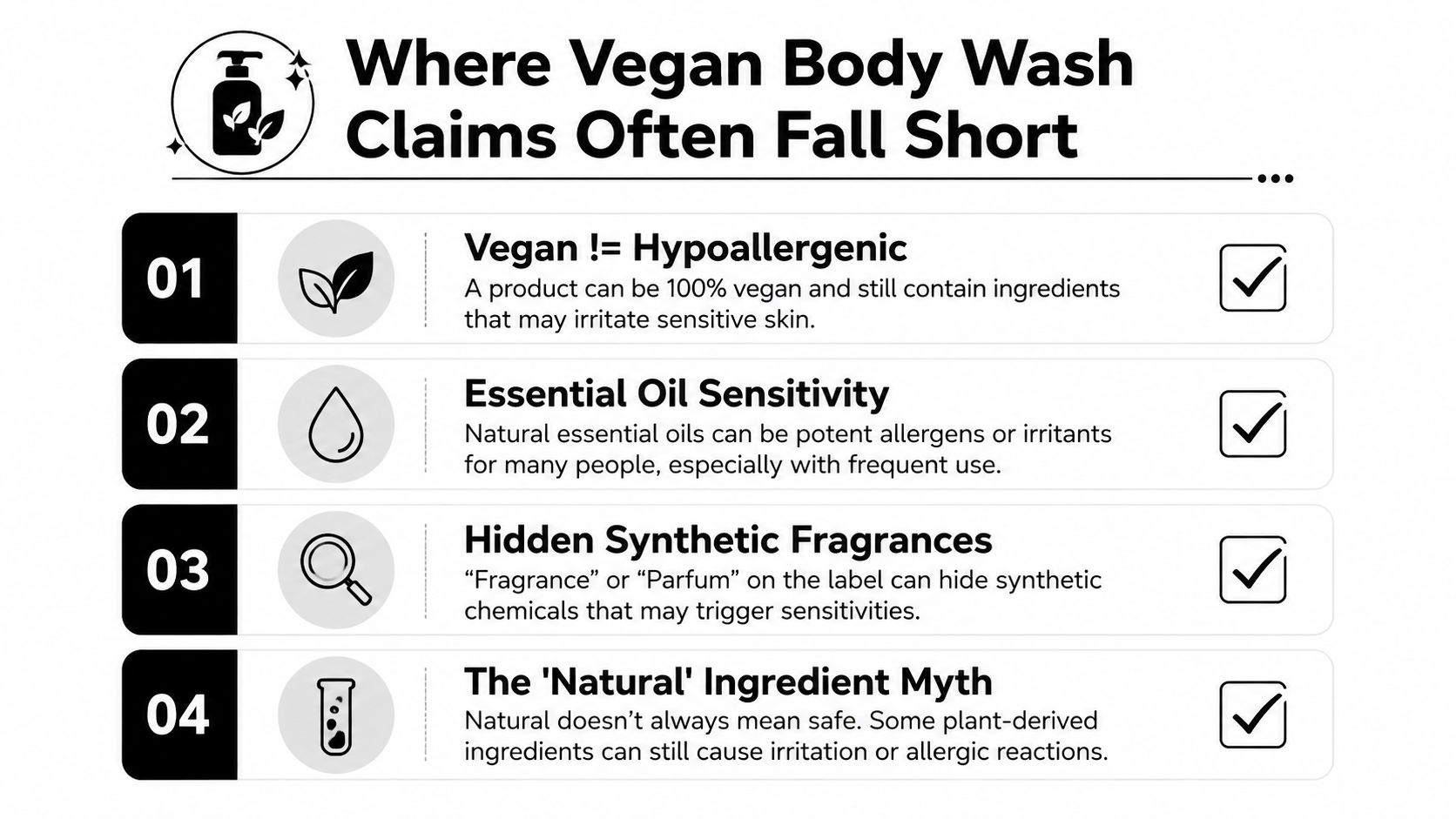
A vegan label solves one problem, not every problem. It can tell you that animal-derived ingredients aren't part of the formula, but it doesn't tell you how your skin will react or whether the raw materials came from a responsible supply chain.
Vegan isn't the same as hypoallergenic. Coconut-derived surfactants can still bother reactive skin, and essential oils such as citrus or ylang-ylang may irritate some users. A product can be ethically aligned and still be the wrong cleanser for skin that stings, flakes, or develops contact reactions.
Plant origin doesn't settle the land-use question
“Plant-derived” describes origin, not farming practice. Palm-linked glycerin or stearic acid may raise sourcing questions, while coconut and sunflower inputs have their own agricultural footprints. A vegan formula can therefore need the same supply-chain scrutiny as any other product.
Ask whether the brand identifies the source of major oils and fatty acids, uses certified sustainable palm where relevant, or offers a non-palm alternative. If the answer is only “natural” or “made with botanicals,” you still don't know enough to judge traceability.
Fragrance deserves its own check
The word fragrance or parfum can represent a blend rather than a transparent list of every aromatic component. Essential oils can also contribute scent allergens, including limonene and linalool. Vegan status doesn't remove those possibilities.
A short, readable ingredient list isn't proof of safety, but it makes questions easier to answer. Look for fragrance-free options if your skin is reactive, and don't assume “natural fragrance” is automatically milder. Greenwashing often appears as a missing certification, broad claims without sourcing details, or marketing copy that names plants while avoiding the actual INCI list.
A vegan-friendly body wash should pass two tests: it aligns with your ethics, and your skin tolerates it comfortably.
Skin and Environmental Benefits of Going Plant Based
Standing under warm water, a body wash can feel gentle while its environmental profile remains unclear. A plant-based formula needs two separate checks: how it treats skin during use, and what happens to its ingredients after they enter the drain.
Gentle performance comes from balance
Every cleanser relies on chemistry. The useful question is whether its cleansing system removes sweat and oil without leaving tightness, and whether its preservative system keeps a water-based product safe throughout its shelf life.
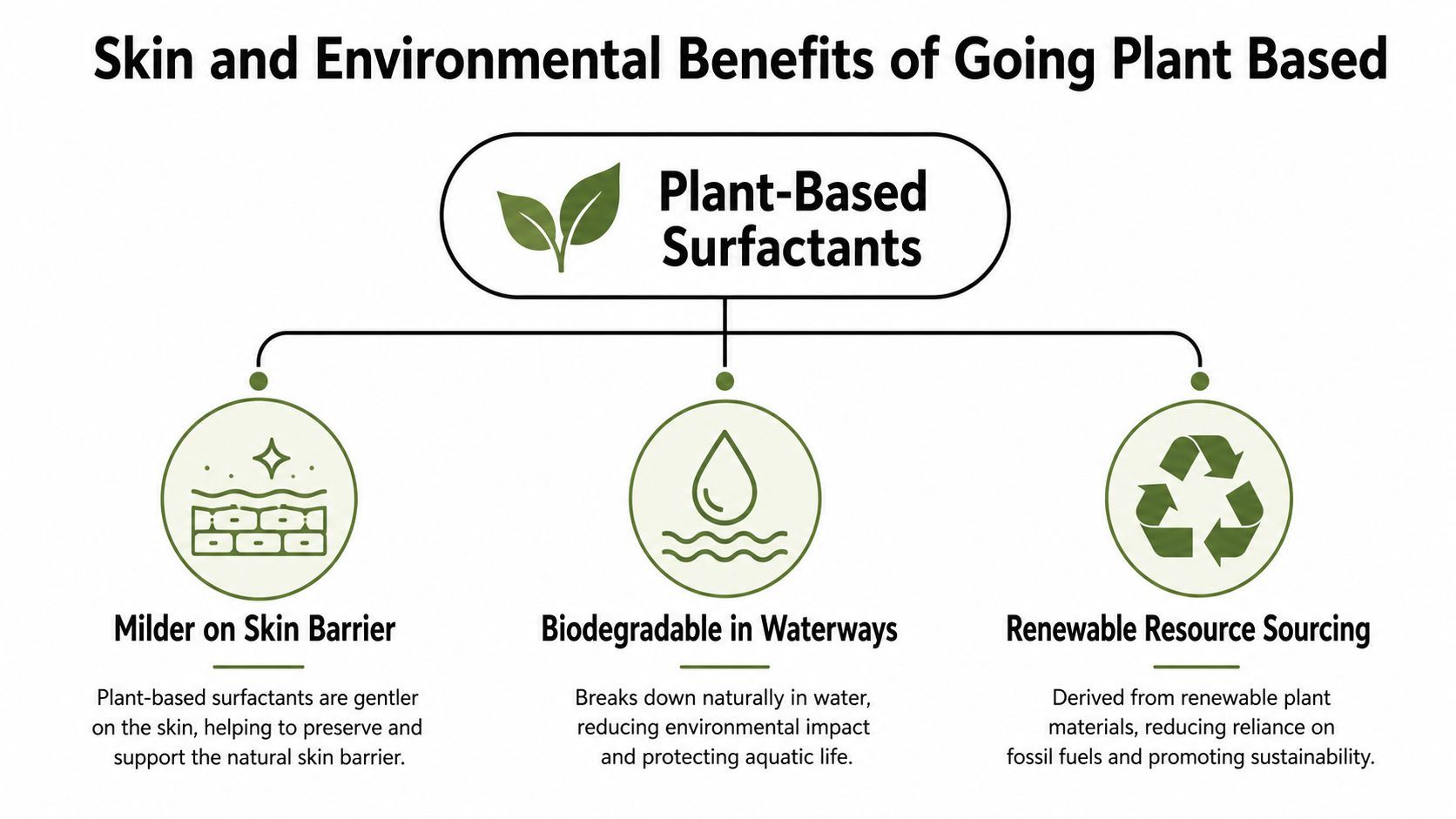
Humectants such as glycerin and panthenol help hold water at the skin surface. They do not form the same occlusive film associated with lanolin, so the rinse can feel lighter. People with very dry skin may still need a separate moisturizer after showering. Fragrance-free choices can also make sense for reactive skin, since “natural” scent does not guarantee low irritation.
Environmental performance requires a different lens. Plant-derived ingredients can biodegrade readily under suitable conditions, but biodegradation and aquatic safety are not the same test. An ingredient may break down while still affecting aquatic organisms during that process. Brands should therefore provide, or make available, information about biodegradability, aquatic toxicity, and the treatment conditions assumed by those assessments.
The wastewater system matters too. A formula rinsed into a municipal treatment plant faces different conditions from one entering a household septic system. Avoid treating “plant-based” as a complete environmental verdict. Feedstock, processing, transport, and end-of-life conditions all shape the result.
Plant origin also leaves sourcing questions open. Coconut, sunflower, and palm inputs have different agricultural footprints, so look for information about origin, certified sustainable palm where relevant, or non-palm alternatives.
For a related view of how ingredient choices connect with daily sustainability, read about the benefits of plant-based oral care. The same rule applies here: assess the full formula and supply chain, not only the word “plant.”
Why Refillable Packaging Closes the Loop Vegan Labels Cannot
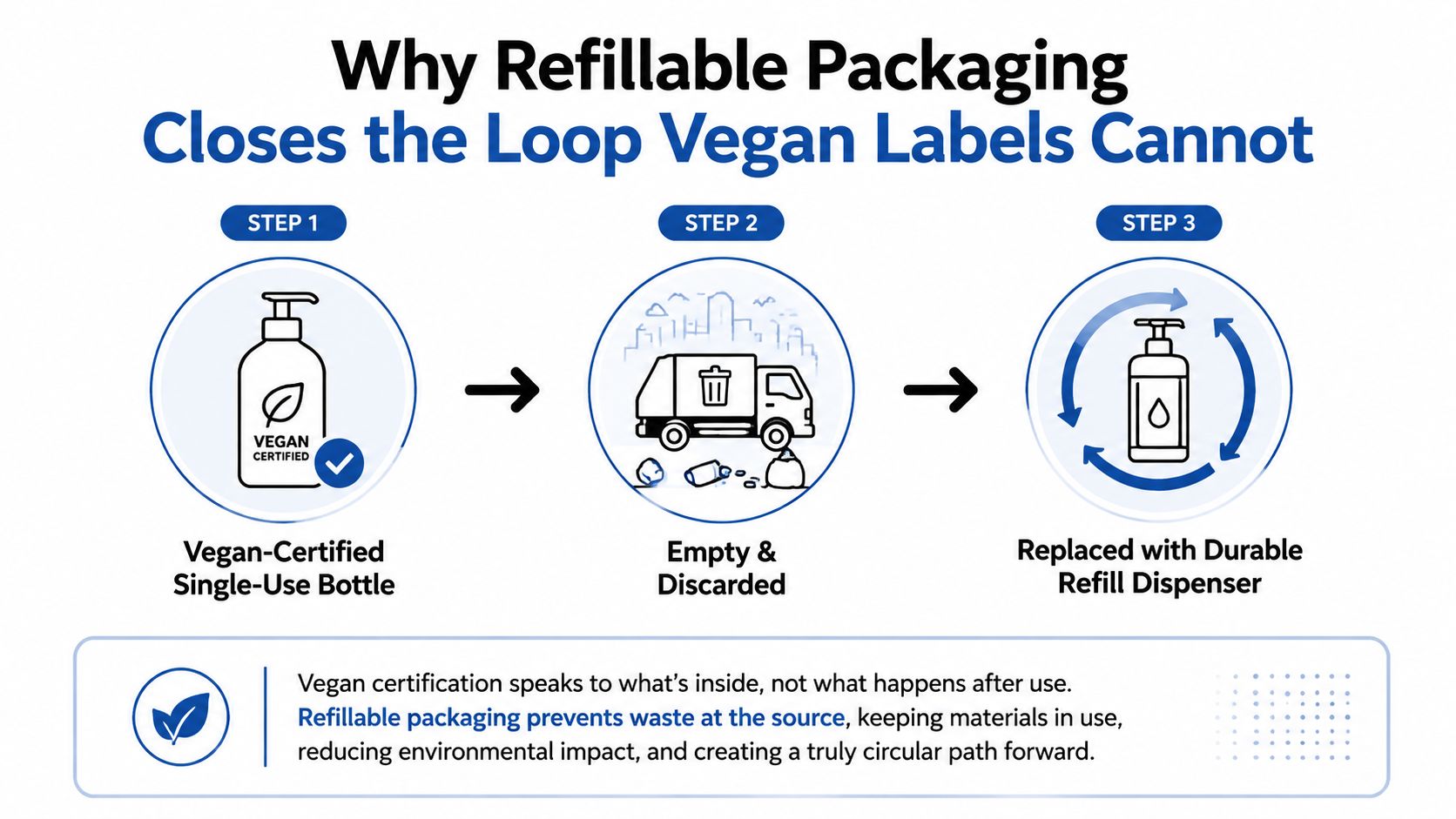
A vegan-certified bottle can still become single-use waste. The formula may avoid animal-derived inputs, but the container still needs to be produced, transported, emptied, and managed after the final pump.
A refill model changes the physical routine. You keep a durable dispenser, then replenish it through a pouch, bulk station, tablet system, or another lower-waste format. Fillaree reports a circular model built around returnable refill bags that are washed and sanitized for reuse, along with a network of 70+ U.S. partner refill stations. (Fillaree's refill and circular packaging system)
Follow the container through its life
A useful refill system has three visible parts:
- A durable primary bottle: Glass or aluminum can remain in the bathroom while you replace only the product inside.
- A returnable or recyclable refill format: The pouch or container carries more product with less packaging than repeatedly buying a new dispenser.
- A recovery pathway: The brand explains whether customers return, wash, sanitize, reuse, or recycle the packaging.
That third step separates a circular promise from a vague low-waste claim. Fillaree describes returnable packaging and a process for sending used bags back, which gives customers a defined action rather than leaving disposal entirely to municipal recycling systems. Its returnable packaging process shows how the loop is intended to work.
Supporting good companies who care means looking for this kind of accountability. The product should work in the shower, but the company should also explain what happens before and after that shower.
Packaging test: If the brand can't tell you what to do with the empty refill, the loop isn't clear enough yet.
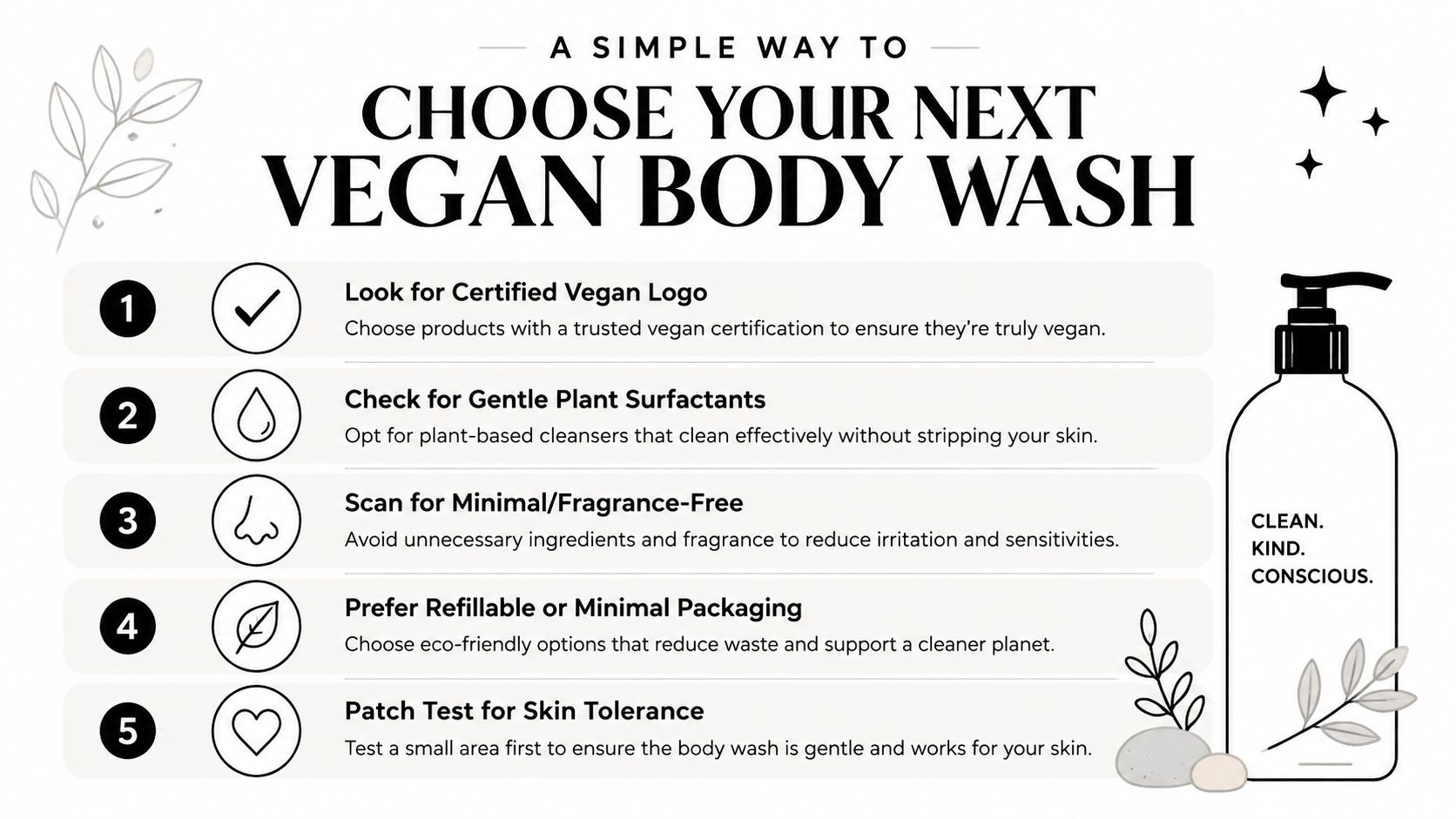
A Simple Way to Choose Your Next Vegan Body Wash
Use the label in a fixed order so attractive packaging doesn't make the decision for you.
Start with verification. Look for The Vegan Society's Vegan Trademark or another recognized vegan certification. A word such as “natural” or “plant-powered” can be useful context, but it isn't a substitute for a standard that reviews ingredient origin.
Check the cleansing base. Favor clearly identified mild surfactants such as glucosides, isethionates, or other documented plant-derived systems. If you see an ingredient that could come from animal or vegetable sources, ask the brand how it was sourced rather than guessing.
Match the formula to your skin
Dry skin may prefer a cleanser with glycerin and conditioning ingredients. Sensitive skin often does better with a shorter formula and no added fragrance or essential-oil blend. Patch-test a small amount first, then pay attention to tightness, stinging, itching, and redness after rinsing.
Your shopping checklist can stay simple:
- Animal-derived flags: Check for lanolin, tallow derivatives, collagen, keratin, beeswax, honey, carmine, and unclear glycerin.
- Scent information: Treat parfum, fragrance, limonene, and linalool as reasons to investigate if you react easily.
- Packaging pathway: Prefer refillable bottles, returnable pouches, refill stations, or a bar format when the formula suits you.
- Company transparency: Look for clear answers about supplier origin, testing, preservation, and disposal.
A two-week trial can reveal more than a promising front label. Note how the body wash lathers, rinses, and feels after the shower, then decide whether the formula deserves a permanent place in your routine. If you're evaluating broader household water choices alongside personal care, a guide to compare water filtration systems can help you separate product claims from practical criteria.
For a starting point, Fillaree's refillable vegan body wash option combines a vegan and cruelty-free body soap format with organic vegetable oils and a refill infrastructure that includes partner stations and returned refill bags. Choose it because those specific features match your priorities, then confirm the scent and skin feel work for you.
Fillaree offers refillable, low-waste body and home essentials, including vegan and cruelty-free body soap options, returnable refill bags, and access to partner refill stations. Visit Fillaree to explore a body-wash routine that connects animal-free ingredients with a practical packaging recovery system.