
What Are Parabens? Uses, Risks and Safer Alternatives
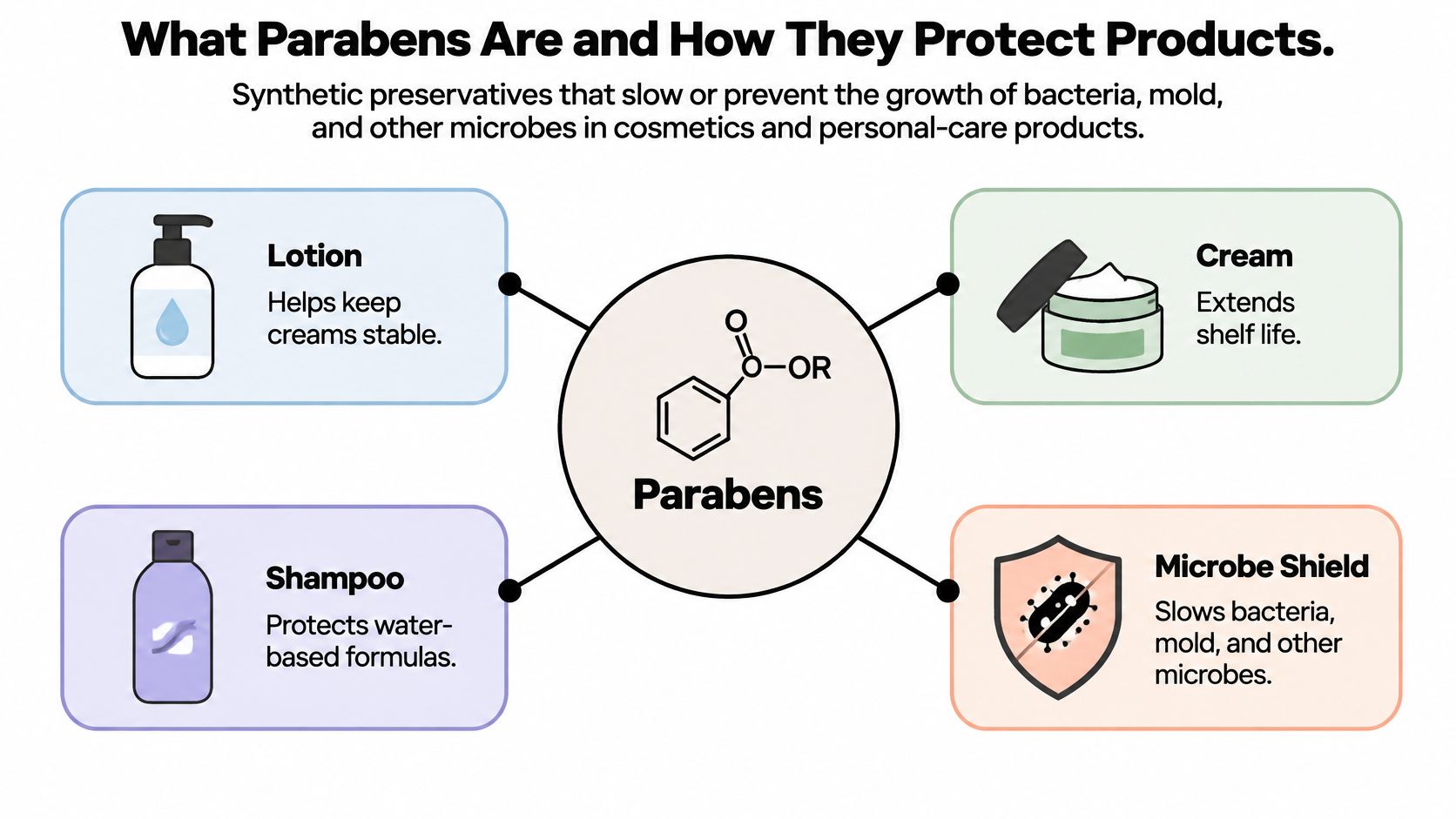
Parabens are synthetic preservatives that slow or prevent the growth of bacteria, mold and other microbes in cosmetics and personal-care products. The four common cosmetic parabens are methylparaben, ethylparaben, propylparaben and butylparaben.
If a label tells you what a product leaves out, does it also tell you how that product stays protected after opening? That's the gap behind many conversations about paraben-free products. Understanding what parabens do, how exposure happens and how finished formulas are evaluated is more useful than treating an ingredient's presence as a yes-or-no safety verdict.
Table of Contents
- What Parabens Are and How They Protect Products
- What Research Says About Exposure, Health and Waste
- Paraben Limits and Regulatory Status Compared
- How to Lower Your Paraben Exposure
- Safer Alternatives to Parabens and Their Trade-offs
- Choose Products That Match Your Values
What Parabens Are and How They Protect Products
A jar of lotion isn't just a mixture that softens skin. Its water-containing formula also needs protection while it sits on a bathroom shelf, travels in a bag and gets opened repeatedly.
Each time someone dips fingers into a cream jar, they create another opportunity to introduce microorganisms. Preservatives help control that contamination so the product remains suitable for its intended use.
Why water-based products need protection
The FDA's guide to parabens in cosmetics explains that preservatives protect cosmetics against microbial growth and identifies methylparaben, ethylparaben, propylparaben and butylparaben as common examples. Water-containing products such as lotions, shampoos, creams and liquid cleansers need particular attention because their formulas can support microorganisms.
Think of preservation as part of a product's protective design, alongside its packaging and instructions. The formula must work not only when it leaves the factory, but also during ordinary use.
Consider a shampoo bottle that gets opened repeatedly in a damp shower. If its formula needs preservation but has none, keeping the cap closed afterward won't solve the underlying problem. You also can't assign every unpreserved shampoo a reliable countdown to contamination, because ingredients, packaging and handling differ.
Parabens aren't detergents, fragrances or cleaning agents. In shampoo, cleansing ingredients remove oil and dirt, fragrance supplies scent, and preservatives help protect what remains inside the bottle. Those are separate jobs.
The infographic summarizes that protective role.
The four common cosmetic parabens
The names can look technical, but recognizing the -paraben ending makes ingredient lists easier to read. Short-chain and long-chain describe differences in molecular structure, not how long a product lasts.
| Paraben | Chain length | Typical products |
|---|---|---|
| Methylparaben | Short chain | Lotions, creams, shampoos |
| Ethylparaben | Short chain | Creams, cleansers, lotions |
| Propylparaben | Long chain | Lotions, shampoos, creams |
| Butylparaben | Long chain | Creams, liquid cleansers |
These product examples aren't exclusive assignments. A cream may contain a combination of preservatives, while another cream uses a different preservation system altogether.
A familiar ingredient name also doesn't reveal its concentration. Reading a label can tell you that methylparaben is present, but it doesn't provide everything needed to assess the finished formula.
Practical rule: Evaluate the protection a product needs, not just the ingredient a label promises to exclude.
Preservation is a safety function
The FDA's cosmetics safety questions and answers describes parabens as preservatives that prevent potentially harmful bacteria from growing and states that they haven't been shown to be harmful at the very small amounts used in cosmetics. That position doesn't mean every conceivable exposure is harmless. It addresses their use in cosmetic products.
For a household choosing good products, the practical question is whether the manufacturer has designed a suitable preservation system for the formula and packaging. A pump bottle, a wide-mouth jar and a refill container present different handling situations.
Removing a preservative isn't automatically an improvement if the replacement formula lacks adequate protection. Conversely, choosing a well-formulated paraben-free product is a reasonable preference. A preservative's purpose is protection; its safety depends on concentration and use, not presence alone.
What Research Says About Exposure, Health and Waste
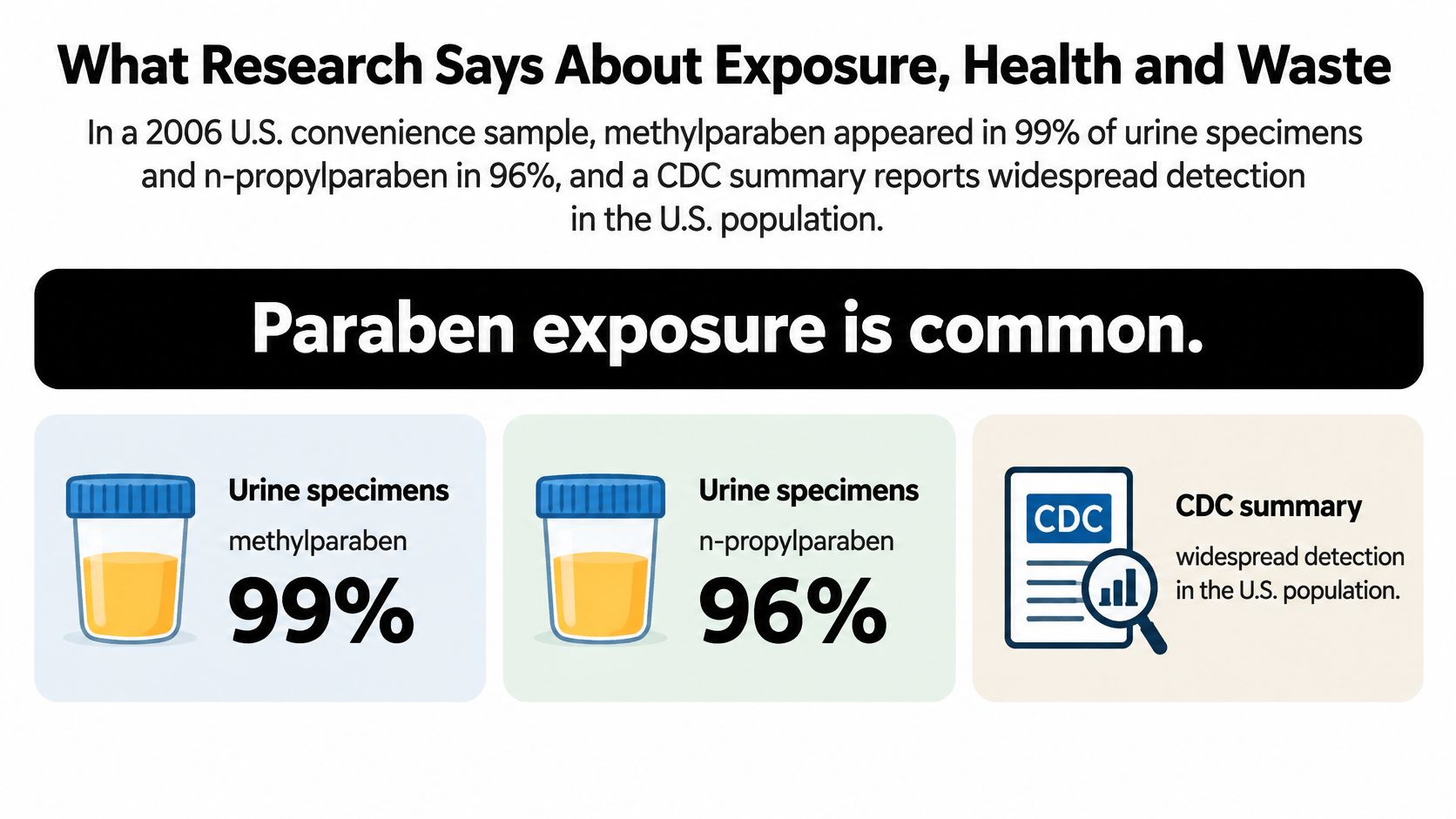
Paraben exposure is common, but detection isn't a diagnosis. In a U.S. convenience sample reported in 2006, methylparaben was detected in 99% of urine specimens and n-propylparaben in 96%, according to the CDC biomonitoring summary. The same summary reports similar median concentrations in a subsample of the nationally representative National Health and Nutrition Examination Survey conducted in 2005–2006.
The distinction between a convenience sample and a nationally representative survey matters. The first finding describes the specimens tested, not a precise estimate of every American's exposure.
This visual highlights the detection findings.
What a urine measurement can tell you
Biomonitoring establishes that exposure occurred and that a substance or its measured form reached a detectable level. It doesn't, by itself, establish disease, identify the responsible product or show that a harmful dose reached a particular tissue.
Hormone-related concerns deserve the same precision. Parabens' estrogen-like activity is substantially weaker than naturally occurring human estrogen, while scientists continue investigating potential hormone-related effects. Biological activity, exposure and demonstrated harm are different questions.
A useful way to interpret a headline is to ask:
- What was measured? Detection, a laboratory response and an illness outcome aren't interchangeable.
- Under what conditions? The compound, dose and exposure route affect interpretation.
- What conclusion fits? A finding can justify further investigation without proving that ordinary product use causes disease.
For an accompanying visual explanation, the video below offers another format for exploring the topic.
Wastewater findings need context too
A 2026 wastewater, river and sediment study found incomplete removal of some parabens, with hospital wastewater influent measurements reaching 34.4 ± 3.6 micrograms per liter for methylparaben and 30.9 ± 5.4 micrograms per liter for propylparaben. Those are measurements before treatment in a particular wastewater setting, not concentrations in household drinking water.
By contrast, a municipal wastewater study in Guangzhou measured total influent concentrations of 94.2 to 957 nanograms per liter and effluent concentrations of 0.89 to 14.7 nanograms per liter, with dissolved-phase removal exceeding 96%. The researchers judged the measured effluent levels unlikely to pose an environmental risk to aquatic ecosystems.
These findings aren't contradictory. Treatment conditions, incoming waste and individual compounds differ. The honest conclusion is that dose, exposure and treatment performance matter, and environmental detection alone doesn't establish ecological harm.
Paraben Limits and Regulatory Status Compared
European rules distinguish between permitted parabens rather than giving every member of the family the same allowance. The EU regulation amending cosmetic preservative requirements provides a 0.4% individual limit and 0.8% mixture limit for relevant permitted esters, while documenting an SCCS conclusion concerning 0.19% combined propylparaben and butylparaben.
Those figures need their regulatory context. An assessment conclusion isn't necessarily the same thing as a current authorization, and the broader individual limit isn't permission to use every paraben at that concentration.
Paraben limits and regulatory status by rule
| Rule | Region | Limit or status |
|---|---|---|
| Single paraben ester | EU | Maximum 0.4% of finished cosmetic for applicable permitted esters |
| Mixture of paraben esters | EU | Maximum 0.8% total, subject to ingredient-specific restrictions |
| Propylparaben plus butylparaben combined | EU, SCCS conclusion documented in the regulation | Maximum 0.19% in finished cosmetics in that assessment context |
| Propylparaben as a preservative | EU, SCCS assessment | Safe up to 0.14% in the cited assessment |
| Leave-on products for infant nappy area | EU, SCCS | Extra uncertainty flagged; additional caution advised |
| Premarket approval of cosmetic ingredients | US | Generally not required, except for color additives |
The European Scientific Committee on Consumer Safety's paraben assessment material describes propylparaben as safe up to 0.14% when used as a preservative and flags additional uncertainty around leave-on products applied to infants' nappy areas. Immature metabolism and damaged skin are relevant considerations in that setting.
Don't treat this table as a formulation recipe. Manufacturers need to check the current legal text, ingredient identity, applicable restrictions and finished-product assessment.
What the differences mean for a shopper
In the United States, manufacturers are responsible for ensuring cosmetic safety under labeled or customary use. The absence of a general premarket ingredient-approval requirement doesn't remove that responsibility.
For consumers, an ingredient list is a starting point rather than a complete safety dossier. It won't usually provide the concentration, aggregate exposure calculation or evidence supporting preservation.
A paraben-free claim tells you what was excluded. It doesn't establish that the replacement system is safer or better tested.
Products intended for infants or damaged skin require especially careful selection. Choose products designed for that purpose rather than adapting an ordinary body lotion because its front label sounds gentle.
A useful label offers complete ingredient disclosure, intended-use instructions and clear storage information. A useful manufacturer can explain why the formula needs preservation and how the finished product was evaluated. Those details are more informative than vague clean-beauty language.
How to Lower Your Paraben Exposure
Cosmetics aren't the only possible source. A 2025 worldwide systematic analysis of parabens in food identified them in categories including dairy products, vegetables and eggs; reported European concentrations remained within regulatory limits, but the authors warned that cumulative exposure across foods could potentially exceed the acceptable daily intake.
That warning isn't a finding that every person exceeds an intake limit. It highlights why a shampoo label can't describe someone's total exposure.
Start with the routine you actually have
Say you use lotion, shampoo and deodorant, take a prescription medicine and eat a varied diet. Those activities can involve different routes and sources of exposure, so replacing a cosmetic doesn't eliminate everything else.
Specific compound, concentration, frequency and route are more useful considerations than whether packaging says natural. You don't need to turn your bathroom into a laboratory to make sensible changes.
- Keep leave-on products purposeful. If you don't want or need a particular lotion, serum or styling product, skipping it simplifies your routine without sacrificing a product that serves you well.
- Respect the product's intended life. Check its expiry date or period-after-opening symbol, and write the opening date on the container if you tend to forget. Keeping an old product isn't a sensible exposure-reduction strategy.
- Keep taking medicines as directed. Ask a pharmacist about excipients if you have concerns about a regular prescription. Don't stop treatment or substitute a medicine based on a cosmetic ingredient discussion.
- Avoid untested homemade replacements. Adding water, herbal tea or fresh plant material to a mixture creates preservation questions. A kitchen recipe isn't evidence that the finished formula will resist contamination.
- Review repeated exposure across categories. Replace products gradually when there's a suitable alternative, rather than discarding everything with an unfamiliar name.
Make food choices without creating a new fear
Favor fresh, minimally processed foods where practical and maintain dietary variety, but don't treat those choices as a guaranteed paraben-removal method. The food analysis doesn't justify avoiding vegetables, dairy or eggs as entire categories.
A manageable approach: Change an unnecessary habit before restricting a useful product or nutritious food.
For hair care, our guide to shampoo without parabens and sulfates can help separate preservation choices from cleansing choices. Those ingredient groups perform different jobs, so evaluate whether the replacement cleans effectively and suits your scalp rather than relying on exclusions alone.
Safer Alternatives to Parabens and Their Trade-offs
No preservative is a universal substitute for parabens. A suitable alternative has to work with the product's ingredients, acidity, packaging and expected handling. The options below are formulation approaches, not a ranking from safest to least safe.
Paraben alternatives and packaging options compared
| Option | Best suited for | Trade-off |
|---|---|---|
| Phenoxyethanol | Broad-spectrum preservation systems in leave-on and rinse-off products | Must meet applicable concentration requirements; some sensitive skin reacts |
| Potassium sorbate | Suitable water-based creams and lotions | Works best at acidic pH; may need partners for adequate coverage |
| Sodium benzoate | Acidic products such as toners and cleansers | Activity depends on low pH |
| Benzyl alcohol | Selected preservation systems, including some formulas without added fragrance | Can need complementary preservatives and may irritate some skin |
| Anhydrous formulas, meaning no water | Balms, powders and oil-based products | A waterless format doesn't suit every product or handling situation |
| Airless pump packaging | Limiting contact with air and fingers after opening | Doesn't replace preservation in water-based formulas |
Phenoxyethanol can be part of a broad-coverage system, but its presence alone doesn't prove that a formula has adequate protection. A person's skin may also tolerate one well-tested formula better than another containing the same preservative.
Potassium sorbate and sodium benzoate illustrate why pH matters. They can be useful in appropriately acidic formulas, but a manufacturer can't swap them into any lotion and expect equivalent performance.
Benzyl alcohol requires similar care. Its name doesn't mean a formula necessarily contains added perfume, although people avoiding a known allergen should still read the full ingredient list.
Packaging helps, but testing decides
Waterless balms and powders take a different approach by avoiding a water-containing formula. Their handling still matters, especially if wet fingers or bathroom splashes introduce water.
Airless pumps can reduce direct contact with the contents. They're helpful packaging tools, not proof that a water-based product needs no preservation.
The same distinction applies to home care: a cleaner's ability to remove dirt or kill bacteria during use is different from its ability to resist contamination in the container. Our soaps are third-party certified to kill harmful bacteria, but that credential shouldn't be confused with a claim about every aspect of formula preservation.
Ingredient roles also matter beyond preservatives. Our explanation of what polysorbate is helps distinguish formulation functions, while Mouthology's resource on choosing a non-toxic toothpaste offers another setting in which to practice reading ingredient claims critically.
A preservative-free claim is only as useful as the evidence supporting the finished product. Apply that standard to every brand, including ours.
Choose Products That Match Your Values
Supporting good companies who care means looking for specific practices, not the strongest promise on the front label. Transparency, waste reduction and responsible manufacturing can guide the same purchase without requiring you to fear conventional preservatives.
A checklist for your next shopping trip
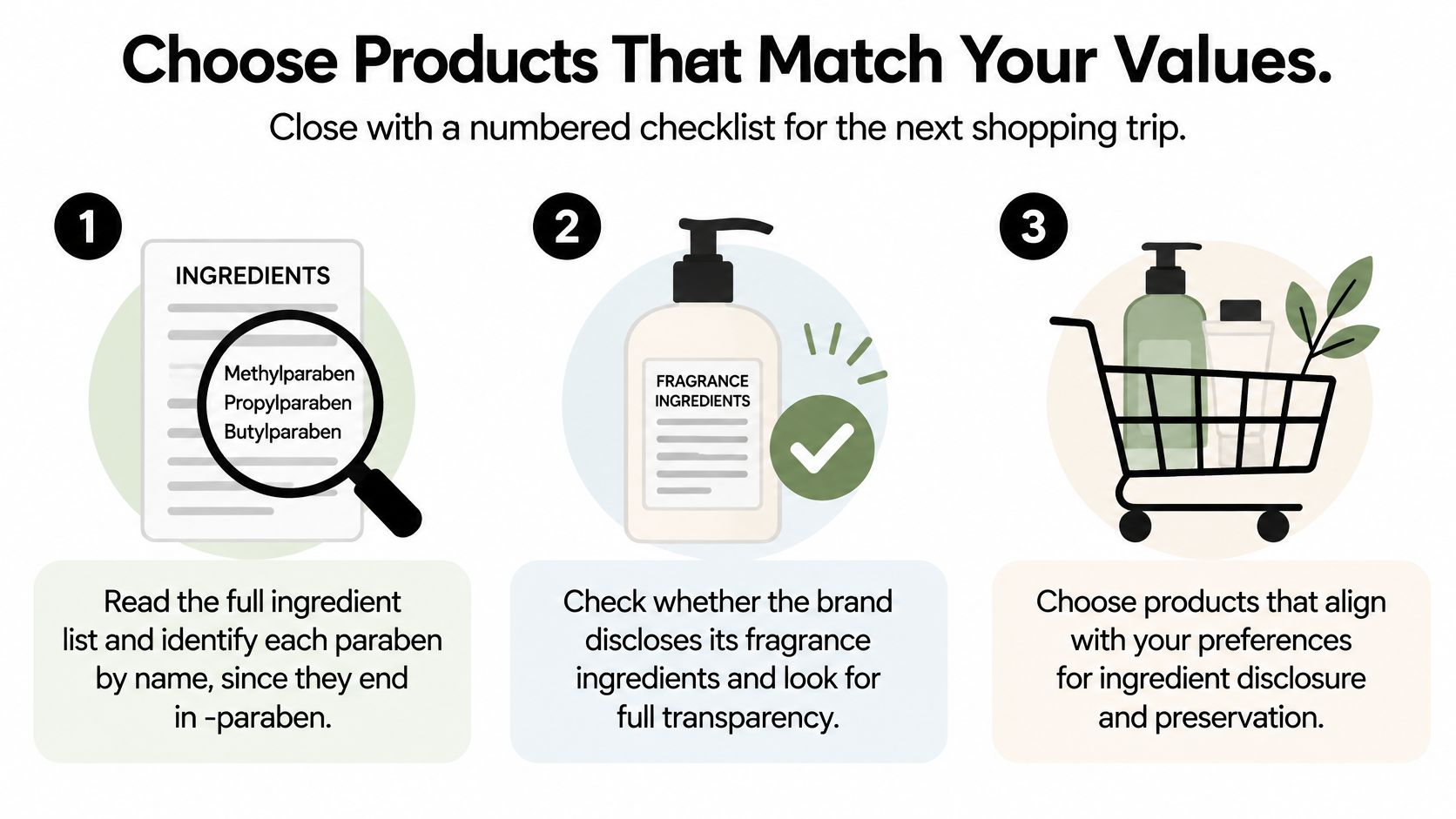
- Read the full ingredient list. Identify names ending in -paraben, then consider whether their presence conflicts with your preferences. An unfamiliar name isn't itself a reason to reject a product.
- Look for meaningful evidence. Check whether concentrations or testing information are disclosed where relevant. Our guide to what third-party testing means can help you distinguish an independent assessment from an unsupported claim.
- Check practical handling details. Notice water near the top of the list, find the period-after-opening symbol and keep containers closed between uses.
- Choose purpose-built products for vulnerable skin. Infant nappy-area products and products for damaged skin deserve closer scrutiny than an ordinary cosmetic purchase.
- Consider the container's next use. Durable, refillable or concentrated formats can fit a lower-waste routine. Buy an amount you can realistically finish.
- Match the company's practices to your priorities. Look for complete ingredient information, a clear preservation rationale and instructions for handling packaging after use.
Use the visual checklist as a reminder to look beyond front-label claims.
Reward answers that help you decide
Good product information should address ordinary questions about use and removal as well as ingredients. For a different personal-care example, you can find answers about peelable polish from Peela and assess whether the information answers your actual questions before buying.
Don't use ingredient-list length as a safety score. A long list deserves a closer read, not automatic rejection.
This week, review one shelf and flag water-based products whose preservation or handling instructions you don't understand. When one runs out, choose a transparent alternative that meets your needs instead of replacing everything at once.
We offer refillable home and body essentials, with unscented versions of most of our products; all our products are biodegradable, grey-water safe and septic safe. Visit Fillaree to compare ingredient lists and refill options, then choose a replacement that fits your preservation preferences and lower-waste routine.