
Biodegradable Floor Cleaner: How to Choose and Use One
What if the word biodegradable on your bottle only describes one ingredient, at a dose you'll never use? That's the gap most shoppers miss. A biodegradable floor cleaner earns its claim from the whole formula, how fast it breaks down, what it breaks down into, and how much you pour into the bucket. Check those four things and you'll separate good products from green wording fast.
Table of Contents
- Biodegradable Thresholds to Check on the Label
- Ingredient Red Flags and What to Look For First
- Ecolabel Dilution Limits Behind Safe Use
- How to Mix and Apply Floor Cleaner Step by Step
- When Plain Cleaner Is Enough and When to Disinfect
- Safe Disposal of Leftover Cleaner and Rinse Water
- Refill Systems and Certifications Worth Backing
- Confirm the Label Before Your Next Refill
Biodegradable Thresholds to Check on the Label
| Test or Standard | Pass Threshold | Window | What It Covers |
|---|---|---|---|
| US federal cleaning-product standard, DOC removal | At least 70% dissolved organic carbon removed | 28 days | Finished formula |
| US federal cleaning-product standard, CO2 | At least 60% of theoretical carbon dioxide | 28 days | Finished formula |
| US federal cleaning-product standard, oxygen demand | At least 60% of theoretical oxygen demand | 28 days | Finished formula |
| EU detergent rule for surfactants | 60% mineralization | 28 days | Surfactants |
| OECD 301 ready biodegradability | 70% DOC removal or 60% ThOD/ThCO2 | 28 days, with the 10-day window after 10% biodegradation | Each organic ingredient and the full formula |
How to Read Each Row
Start with the US rows. Under the U.S. federal cleaning-product standard in 40 CFR 1700.3, a product qualifies when, within 28 days, it removes at least 70% of dissolved organic carbon, produces at least 60% of its theoretical carbon dioxide, or consumes at least 60% of its theoretical oxygen demand. The same standard recognizes OECD Guidelines 301A to F, OECD 306, OECD 310, and ISO 14593:1999. If a label names one of those methods and beats one threshold, you've got evidence. If it only says plant-based, natural, or eco-friendly, you don't.
The EU row is narrower. The EU summary of Regulation (EC) No. 648/2004 on detergents sets at least 60% mineralization within 28 days for surfactants. That's useful, but it doesn't prove the fragrance, solvent, or preservative broke down too.
The 10-Day Window Matters
Ready biodegradability isn't just about the final percentage. The OECD Test No. 301 on ready biodegradability requires the pass level within the 10-day window after biodegradation reaches 10%, using benchmarks of 70% DOC removal or 60% ThOD/ThCO2 for respirometric methods. A result that only gets there after day 28 doesn't count as readily biodegradable.
Practical rule: Copy the test method name from the label or maker's website and check it against this table before you buy.
Ask three questions every time. Was the finished formula tested, not just one ingredient? Which method was used? Did the reported figure beat a threshold above? A maker who can't answer is asking you to trust adjectives instead of data. I wouldn't.
Ingredient Red Flags and What to Look For First
Check the surfactant first. It's the ingredient that lifts grease and soil, and it's usually the largest organic load going down your drain. A good sign is a surfactant named by type with a biodegradation result attached. A red flag is vague plant-derived wording with no method, no percentage, and no date.
The rest of the formula matters too. Recent European detergent-policy negotiations published in the Official Journal distinguish surfactants from water-soluble films, polymers, and other intentionally added organic substances, while investigating separate criteria for non-surfactant ingredients present at 10% or more of the non-water formulation. In plain terms, solvents, preservatives, fragrances, dyes, chelators, and persistent films can outlast a well behaved surfactant.
Toxicity Changes the Bar
Biodegradation speed means more when aquatic toxicity is high. The EPA Safer Choice criteria for surfactants state that surfactants with acute aquatic toxicity of 1 ppm or less must biodegrade within the 10-day window without producing chemicals of concern, those above 1 and up to 10 ppm face the same 10-day requirement, and those above 10 ppm may qualify with biodegradation within 28 days. A product can degrade and still harm aquatic organisms in the short term.
If pets walk the floor right after mopping, the Canes Cleaners guide to dog-safe floors is a useful companion check on residue and paw contact. For ingredient origin claims, compare the label against our notes on biobased cleaning products and what the term covers, because biobased doesn't automatically mean biodegradable.
Run this quick check in the store:
- Full list first: Write down each organic ingredient you can find.
- Degradation products: Ask whether the maker can name what ingredients break down into.
- Use dilution: Confirm the claim covers the formula at the dose you'll use.
Mark any ingredient you can't find test data for. That marked list is your real risk, not the front label.
Ecolabel Dilution Limits Behind Safe Use
| Product Type | Aerobic Limit | Anaerobic Limit |
|---|---|---|
| Ready-to-use all-purpose cleaner | 3.00 g/L aerobically non-biodegradable organic compounds | 55.00 g/L anaerobically non-biodegradable compounds |
| Undiluted all-purpose cleaner | 0.20 g/L aerobically non-biodegradable organic compounds | 0.50 g/L anaerobically non-biodegradable compounds |
| Surfactant classed as hazardous to aquatic life | Must be readily biodegradable aerobically | Must also biodegrade anaerobically |
These numbers come from the EU Ecolabel criteria for hard surface cleaning products, which set 3.00 g/L and 55.00 g/L for ready-to-use all-purpose cleaners and 0.20 g/L and 0.50 g/L for undiluted all-purpose cleaners. The criteria also require all surfactants to be readily biodegradable aerobically.
Why Your Pour Changes the Score
Dilution isn't a footnote. It's part of the environmental result. Say you mix a concentrate at double the label strength because the kitchen looks greasy. You're no longer using the product the ecolabel math assumed, and you're moving your bucket closer to the tighter undiluted logic than the ready-to-use column.
You'll see the mistake on the floor first. Over-concentrated solution leaves streaks, a tacky film, and extra rinsing. That wastes product and sends more organic load to the drain for no extra soil removal.
More cleaner doesn't mean more clean. Past the label dose, you're mostly buying residue.
Find the dilution ratio before you buy, not after you've filled the bucket. If the label won't state a ratio, don't guess. Pick a product that will.
How to Mix and Apply Floor Cleaner Step by Step
The overview is simple: mix, test, apply, rinse. The infographic below shows that sequence before the detailed steps.
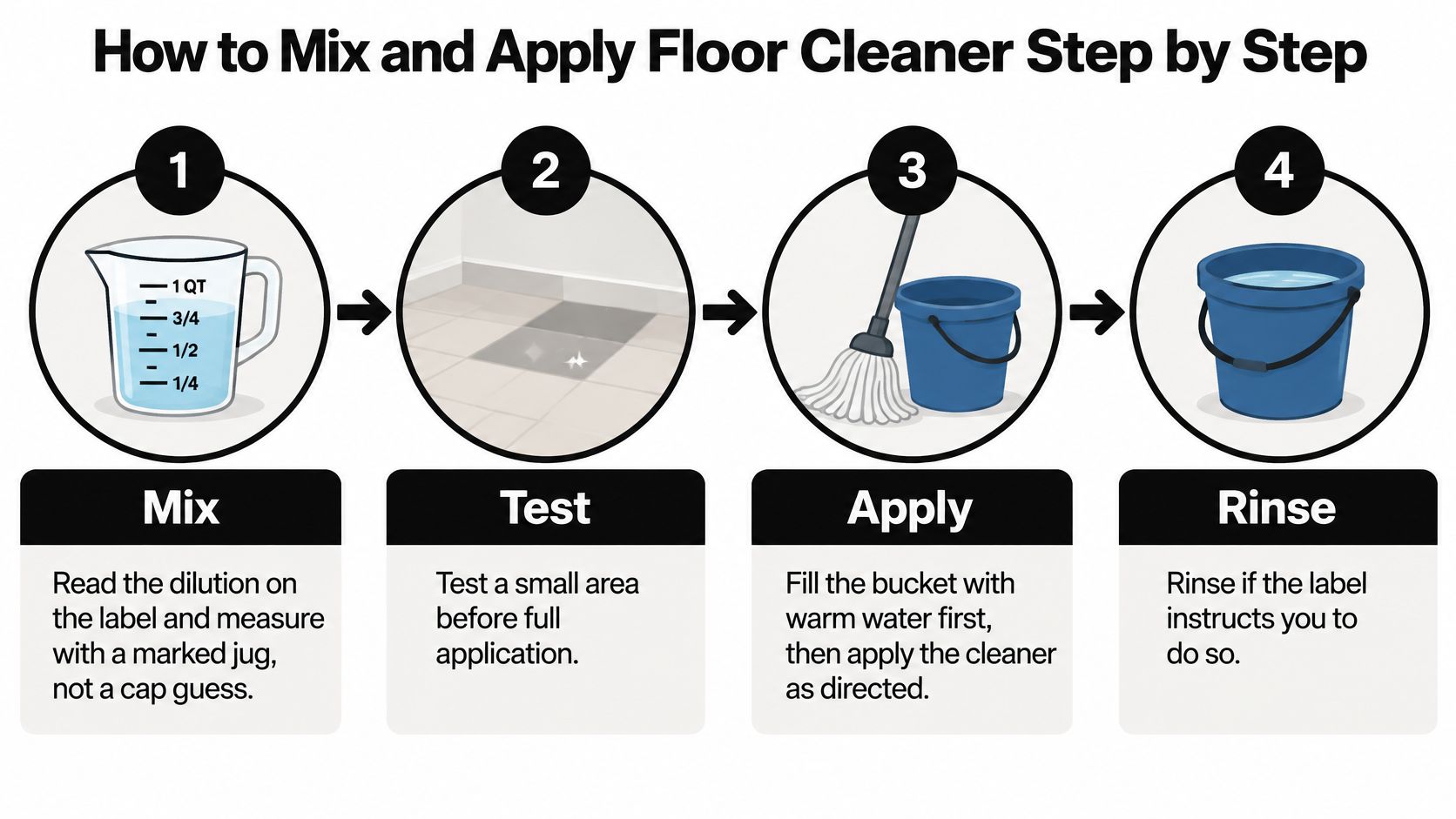
- Measure, don't guess. Read the dilution on the label and measure with a marked jug, not a cap estimate. A cap varies with every tilt, and small over-pours add up over a whole floor.
- Warm water first. Fill the bucket with warm water before adding cleaner. Cold water slows dissolving and can leave undissolved product that streaks later.
- Add and stir. Pour in the measured cleaner and stir for about ten seconds. You're looking for an even mix, not foam. Heavy foam usually means you've overdosed.
- Test a hidden corner. Apply to a small patch and let it dry for ten minutes before you judge it. Wet floors hide haze, softening, and color change that show up once dry.
Applying Without Spreading the Soil
- Dampen, don't soak. Wring the mop until it's damp and work in sections about one metre square. A soaked mop pushes dirty water into grout and edges instead of lifting it.
- Rinse glossy floors. On sealed or glossy surfaces, wipe a second time with clean water to lift any film. If you need substrate specific technique, the floor maintenance tips from Tiles Mate cover porcelain handling in practical detail.
- Dry before traffic. Air-dry or squeegee and keep feet off until the floor is fully dry. Early traffic grinds loosened soil back into a damp surface.
For our own Clean Dream all-purpose cleaner, essential oils can leave some streaks on glassy surfaces, so that clean water pass matters. Don't add extra concentrate to fix streaks. Dilution is almost always the problem.
A good result is boring in the best way. The floor dries without haze, there's no tacky sheen under your palm, and the room smells of nothing once it airs out. If your socks stick, rinse with plain water and use less next time.
When Plain Cleaner Is Enough and When to Disinfect
Routine soil removal, spill cleanup, and regulated disinfection are three different jobs. The photo below shows the second one, prompt spill cleanup, which still isn't disinfection by itself.
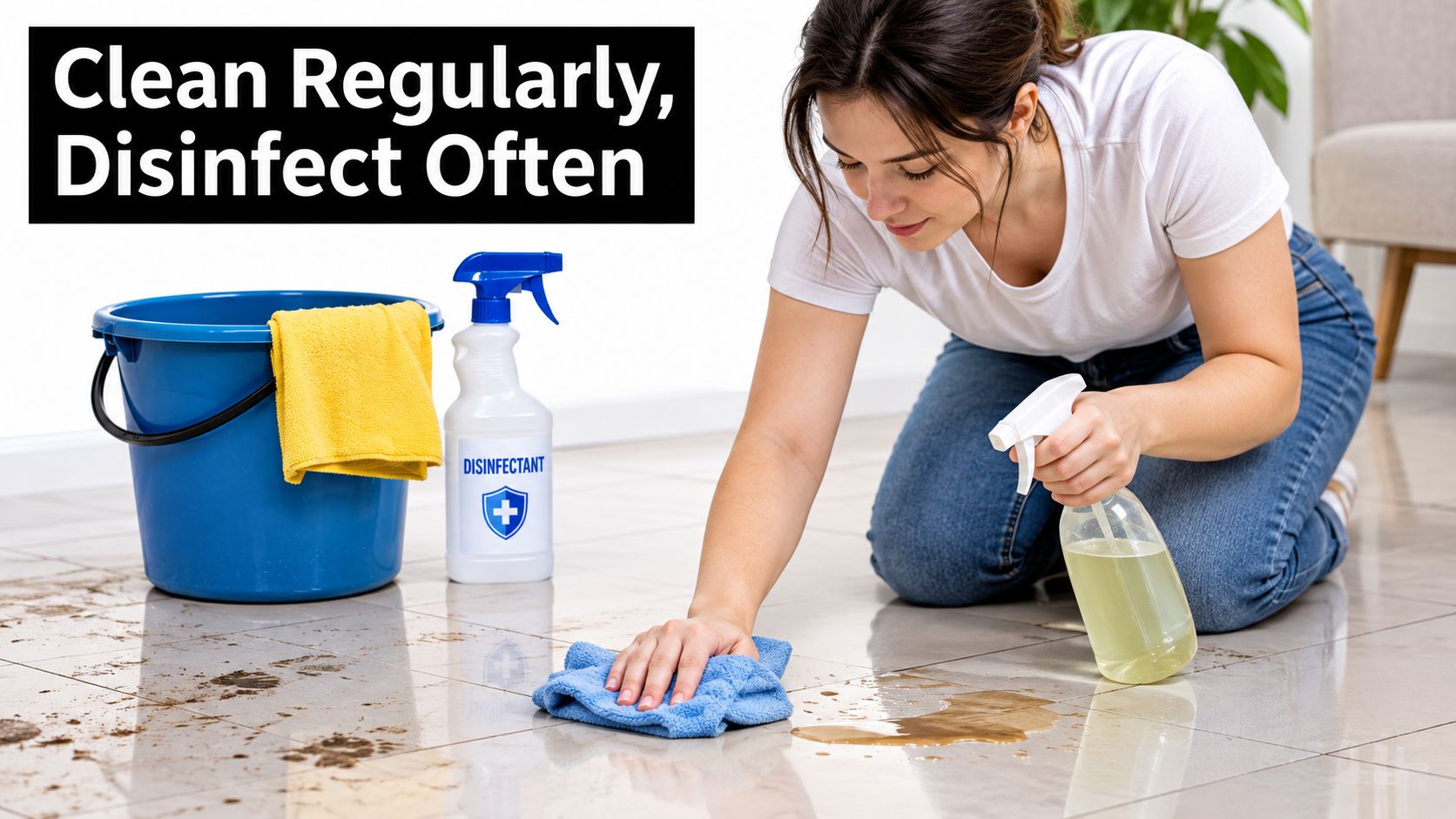
A plain biodegradable floor cleaner handles everyday dirt, grease, and tracked-in grime. Surfactants remove soil. They don't prove a product kills pathogens. Our comparison of all-purpose cleaner versus disinfectant lays out that split, and while our soaps are third-party certified to kill harmful bacteria, that certification doesn't turn every cleaner into a floor disinfectant.
Disinfection needs the right product used as directed. Independent reporting summarized by ISSA on defending disinfectant claims found no meaningful reduction in microbial contamination five or 30 days after treatment for long-lasting disinfectant claims, with some samples later exceeding microbial thresholds. Busy floors get abraded and re-contaminated, so persistent coatings aren't a substitute for cleaning.
Watch the process in the video below, then apply the decision path that follows it.
Clean first. Then disinfect only when illness, childcare rules, or a specific contamination risk calls for a registered product at its stated dilution and wet contact time. For a whole home reset beyond floors, thorough home cleaning services can handle the labor, but the same label logic applies to whatever they use.
If you can't find the contact time on the label, you're cleaning, not disinfecting.
Safe Disposal of Leftover Cleaner and Rinse Water
Every drop you mix ends up somewhere, so dose and disposal are linked. Mix only what the job needs and you'll have less to get rid of.
- Use a household drain. Pour leftover diluted solution down a sink or toilet with plenty of water. Never pour it onto garden soil, into storm drains, or into a waterway, where it bypasses treatment.
- Empty mop water indoors. Tip the bucket into the same sink and rinse the bucket there. Don't carry it outside to the lawn.
- Store concentrate safely. Keep it in its original labelled container, tightly closed and out of children's reach. Never mix it with bleach, acids, or other cleaners, since mixing can release harmful fumes.
- Respect hazard notes. If the label carries a hazardous-waste note, or leftovers include a registered disinfectant, take them to a local household hazardous waste collection point rather than the bin.
- Rinse before recycling. Rinse empty bottles, pouches, or bags and check local rules for caps and trigger sprays.
The common slips are pouring mop water outside and topping up a bottle with a different product. Good disposal looks uneventful: a clean bucket, an empty rinsed container, and nothing left sitting in the sink.
Refill Systems and Certifications Worth Backing
Supporting good companies who care means backing systems you'll continue using. A refill model works like this: buy concentrate or a refill, transfer it into a reusable bottle at home, and return the refill packaging for washing and reuse. Our circular refill system takes back customers' bags, washes them, and reuses them for the next refill, and we cover the cost.
One habit keeps that loop working. Rinse refill bags within a few days of emptying them, because soap residue left longer can harden and make bags unusable. Refill only the same product type and keep the bottle labelled with its dilution. Our guide to bulk cleaning products and refill formats helps you judge whether bulk suits your household.
Certifications give you a second check beyond the liquid. The EPA announcement of 2023 Safer Choice Partner of the Year winners describes Safer Choice as evaluating cleaning products and ingredients as safer alternatives for human health and the environment for consumers and facilities such as schools and offices. In that same 2023 example, EPA reported 84% of Clorox packaging was recyclable, reusable, or compostable, an 8-percentage-point increase since 2021. That figure is company specific, not a universal standard.
That's the standard to apply. Dated, measurable numbers with a stated method beat the word sustainable every time. Aligned values show up in published data, returned packaging, and ingredient review, not slogans.
Confirm the Label Before Your Next Refill
Run these five checks before your next purchase. They take minutes and they'll save you from paying for wording.
- Threshold check. Confirm a test method and numerical result for the full formula, not one ingredient.
- Dilution check. Find the use dilution on the label and don't guess the ratio.
- Ingredient scan. Look for named surfactants and flag unnamed fragrances, dyes, chelators, and persistent films. Mark any organic ingredient without test data.
- Job check. Decide whether you need disinfection. If you do, choose a registered product with its contact time printed on the label.
- Refill check. If you buy the same cleaner often, choose a refill or reusable format and confirm how its packaging is returned.
Test us against the same list. All Fillaree products are biodegradable, grey-water safe and septic safe, and our refill bags are taken back, washed, and reused at no cost. Compare our label, dilution directions, and return process with any other biodegradable floor cleaner on your shelf.
Pick one product this week, run the five checks, and write down the dilution you'll use on the bottle. That one written number does more than any front label promise.
Ready to clean with a refill loop that matches the label checks above? Visit Fillaree to explore our refillable, biodegradable home essentials, find a refill option that fits your routine, and put your next bottle to the five-check test before it reaches your floor.