
Fragrance Free Conditioner: A Complete Guide
The most popular advice is also the least reliable: “Choose an unscented conditioner.” A product can lack an obvious perfume smell and still contain masking fragrance, essential oils, botanical extracts, or individual fragrance allergens. If your scalp reacts easily, scent, or the absence of it, doesn't tell you enough.
A fragrance-free conditioner should help you reduce avoidable exposure while still delivering slip, moisture, detangling, and manageable hair. The sustainable version of that choice goes further: look for transparent formulas, packaging you can refill, and companies whose production and take-back practices match the low-waste routine you want in your bathroom.
Table of Contents
- The Truth About Unscented and Fragrance Free Hair Care
- Clinical Benefits for Sensitive Scalps and Hair Health
- Ingredients to Avoid and Functional Alternatives to Seek
- Matching the Right Formula to Your Hair Type
- Building a Low-Waste Routine with Refillable Conditioners
- Voting With Your Dollar for Better Beauty Standards
The Truth About Unscented and Fragrance Free Hair Care
“Unscented” and “fragrance free” aren't interchangeable labels. Unscented can mean that a manufacturer has added a masking fragrance to cover the natural odor of raw ingredients. The finished product may smell neutral, but the formula can still contain fragrance materials that matter to someone with a reactive scalp.
Fragrance free is a more useful starting point because it signals that perfume ingredients aren't included for scent or odor masking. It still isn't a guarantee that every person will tolerate the product. Preservatives, dyes, plant extracts, and other ingredients can cause problems, so the full ingredient list deserves more attention than the front label.
Why the category is harder to shop than it looks
An independent Amazon-tracking report estimated the U.S. fragrance-free conditioner category at about $663,000 in annual revenue, with roughly 344,000 searches per year, 100,000 units sold annually, an average price of $10.45, and an 18.4% search-to-purchase conversion rate. The report also found a concentrated market: the top five brands held 100% of demand, the top five products captured 97% of clicks, and 391 sellers competed across 123 tracked products. These figures describe a small but highly competitive, brand-dominated niche, not proof that any particular product is suitable for you. (independent fragrance-free conditioner market analysis)
That concentration can make shopping feel deceptively simple. A familiar bottle may dominate search results while offering limited detail about botanical ingredients, masking fragrance, or broader irritant avoidance.
Practical rule: Treat “unscented” as a prompt to inspect the ingredient list, not as a safety certification.
Look for clear wording around fragrance, parfum, masking fragrance, essential oils, and allergen disclosure. A useful example is Vanicream Conditioner for Sensitive Skin, which is listed as free of dyes, fragrance, masking fragrance, lanolin, parabens, and formaldehyde releasers. That broader approach is more informative than just promising a neutral smell. (Vanicream Conditioner ingredient exclusions)
Clinical Benefits for Sensitive Scalps and Hair Health
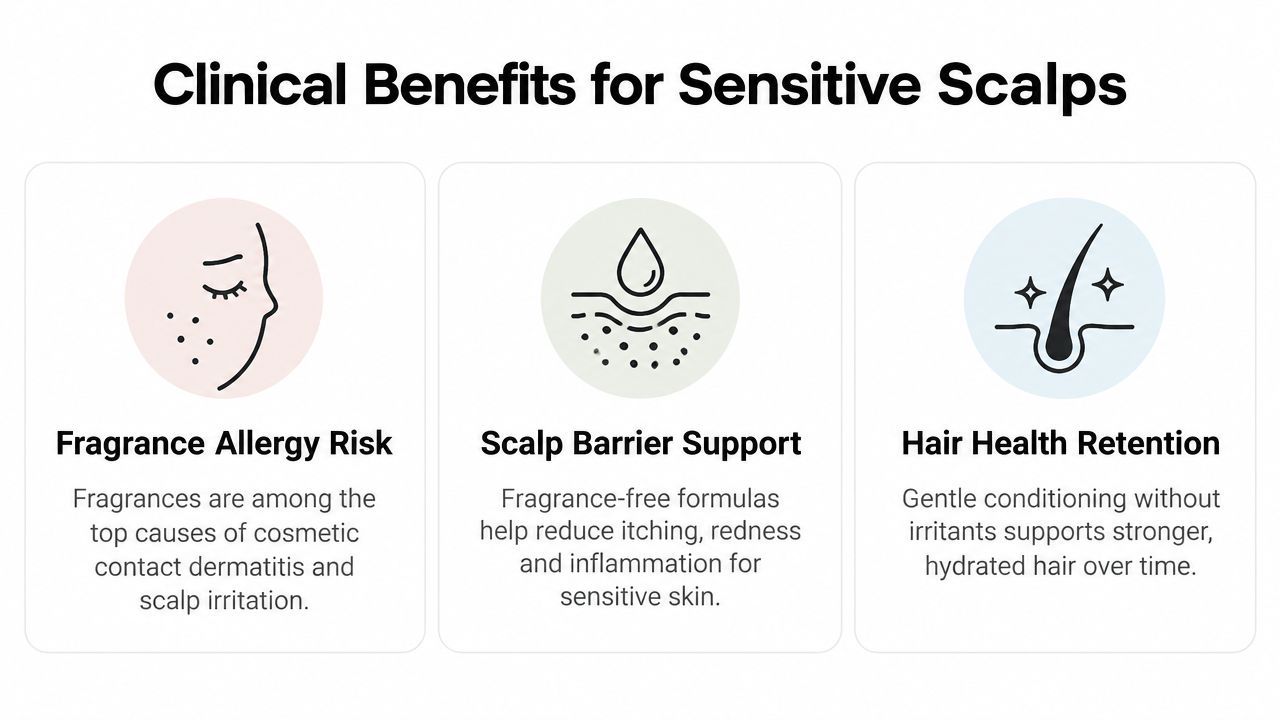
Fragrance ingredients aren't merely decorative. The European Commission's Scientific Committee on Consumer Safety identifies fragrance exposure as capable of triggering allergic contact dermatitis, irritant contact dermatitis, photosensitivity, contact urticaria, and pigmented contact dermatitis. Its assessment derived a conservative safety threshold of 0.8 µg/cm², corresponding to 0.01% or 100 ppm in cosmetic products for safe use. (European Commission fragrance safety assessment)
Conditioner is usually rinsed away, but it still contacts the scalp, hairline, neck, and ears during application. Removing added fragrance can therefore reduce exposure to common sensitizers. It doesn't diagnose eczema or treat dermatitis, and it won't prevent every reaction, but it removes one avoidable source of concern from a routine that already touches sensitive skin.
What the clinical evidence actually shows
A Harvard-linked randomized controlled study cited by SEEN examined a fragrance-free shampoo and conditioner regimen in 22 patients with female pattern hair loss. Over six months, the regimen was associated with a 44% reduction in hair shedding in the women studied. The result applies to that specific regimen and study group, not automatically to every fragrance-free conditioner on the shelf. (clinical research summarized by SEEN)
The same product line reported dermatologist-graded improvement in dry scalp for 93% of users after four weeks, along with up to 59% less hair breakage and up to 74% less frizz in combination regimens. These are product-testing findings, so they should be read as evidence of measured performance in particular testing contexts rather than a universal promise.
Watch the accompanying explainer for a visual overview of why ingredient choices matter for sensitive scalps.
Ingredients to Avoid and Functional Alternatives to Seek
A short ingredient list is only a starting point. Read the back label through two lenses: which materials could irritate my skin, and which materials give the conditioner its performance? “Unscented” may describe the absence of perfume while leaving room for fragrant plant extracts or essential oils.
Start with scent-related terms. Essential oils and botanical extracts can sound mild, but naturally derived ingredients may still contain sensitizing constituents. Limonene and linalool are common examples, particularly if scented products have caused a reaction before. A “sensitive” label also needs scrutiny. The formula may avoid conventional perfume yet include several plant extracts or preservatives.
Families comparing personal-care labels can use this guide to safe baby products for helpful context. “Natural” and “gentle” describe marketing positions, not complete explanations of ingredient safety.
How the conditioning system creates slip
Removing fragrance does not create softness by itself. Technical literature explains that cationic surfactants help form the lamellar gel network found in conditioners. Their positive charge counteracts the negative charge on hair fibers, allowing the formula to lubricate strands and reduce static. Damaged hair usually carries a more negatively charged surface, so conditioner deposits there more readily. The result is lower friction at a very small scale, helping strands slide past one another during detangling. (technical review of conditioner mechanisms)
That is why a fragrance-free formula can still provide substantial slip. Fatty alcohols help build the creamy structure, while conditioning agents create the smooth, lubricated feel. This ingredient guide to hair conditioner offers a closer look at how these components function together.
| Ingredient Category | Examples to Avoid, Irritants | Functional Alternatives, Soothers and Conditioners |
|---|---|---|
| Scent materials | Fragrance, parfum, masking fragrance, essential oils | A formula with no added scent materials |
| Potential botanical triggers | Heavily layered botanical extracts, citrus oils, limonene, linalool | A simpler formula with clearly disclosed ingredients |
| Conditioning agents | No need to reject conditioning agents simply because they have technical names | Behentrimonium chloride, stearamidopropyl dimethylamine, and other cationic systems |
| Texture and slip | Very rich oils may overwhelm fine hair | Cetearyl alcohol, cetyl alcohol, and balanced emulsions |
| Hydration support | Ingredients that leave the scalp uncomfortable or heavily coated | Glycerin, panthenol, aloe, sodium hyaluronate, jojoba, shea, or coconut oil |
A fragrance-free label may list water, fatty alcohols such as cetearyl alcohol or cetyl alcohol, conditioning agents such as behentrimonium chloride or stearamidopropyl dimethylamine, and humectants such as glycerin. (Urtekram fragrance-free sensitive-scalp conditioner label)
Matching the Right Formula to Your Hair Type
A fragrance-free conditioner isn't a hair type. Fine, straight hair and dense, coily hair can both need reduced irritant exposure, but they won't necessarily thrive on the same texture or deposit level.
Fine hair and easily weighed-down strands
Choose a lighter emulsion and apply it mainly from the mid-lengths to the ends. Glycerin and aloe can support a hydrated feel without the richness of a heavy butter, although your local climate and hair porosity still affect the result. Rinse thoroughly, then adjust the amount before changing the entire formula.
Fine hair often benefits from a conditioner that gives slip without leaving a coated finish. Fatty alcohols and cationic conditioning agents can provide that structure, so don't reject a product merely because the ingredient list includes technical-sounding materials.
Thick, curly, and coily hair
Dense curls and coils usually need more emollient support to retain moisture and improve definition. Shea butter, jojoba oil, coconut oil, and avocado oil can bring richness, while conditioning agents help strands separate during washing. Work in sections if needed, distribute with your fingers or a wide-tooth comb, and let the product sit long enough for the hair to feel slippery before rinsing.
Fragrance-free care doesn't require sacrificing curl clumping. The performance comes from water balance, emollients, humectants, and the conditioning network, not from a perfume note. This guide to choosing conditioner for curly hair can help you compare richer and lighter approaches.
Dry, eczema-prone, or reactive scalps
Keep the conditioner off the scalp unless the product is specifically designed for scalp use. Choose transparent labeling and avoid assuming that plant-based ingredients are automatically calming. The National Eczema Association lists a fragrance-free conditioner featuring niacinamide, panthenol, sodium hyaluronate, avocado oil, coconut oil, and aloe, an example of how moisture and barrier-supportive ingredients can sit alongside fragrance avoidance. (National Eczema Association fragrance-free conditioner listing)
Patch test a new product on a small area first, and stop using it if burning, itching, redness, or persistent discomfort develops. If scalp symptoms continue, seek advice from a qualified healthcare professional rather than rotating through more products.
Building a Low-Waste Routine with Refillable Conditioners
Sensitive-skin care and environmental care can reinforce each other, but only if the packaging system works in daily life. Buying a large bottle that you dislike, can't tolerate, or rarely finish creates waste. A refillable system makes more sense when the formula suits your hair, the container is durable, and the refill process is convenient.
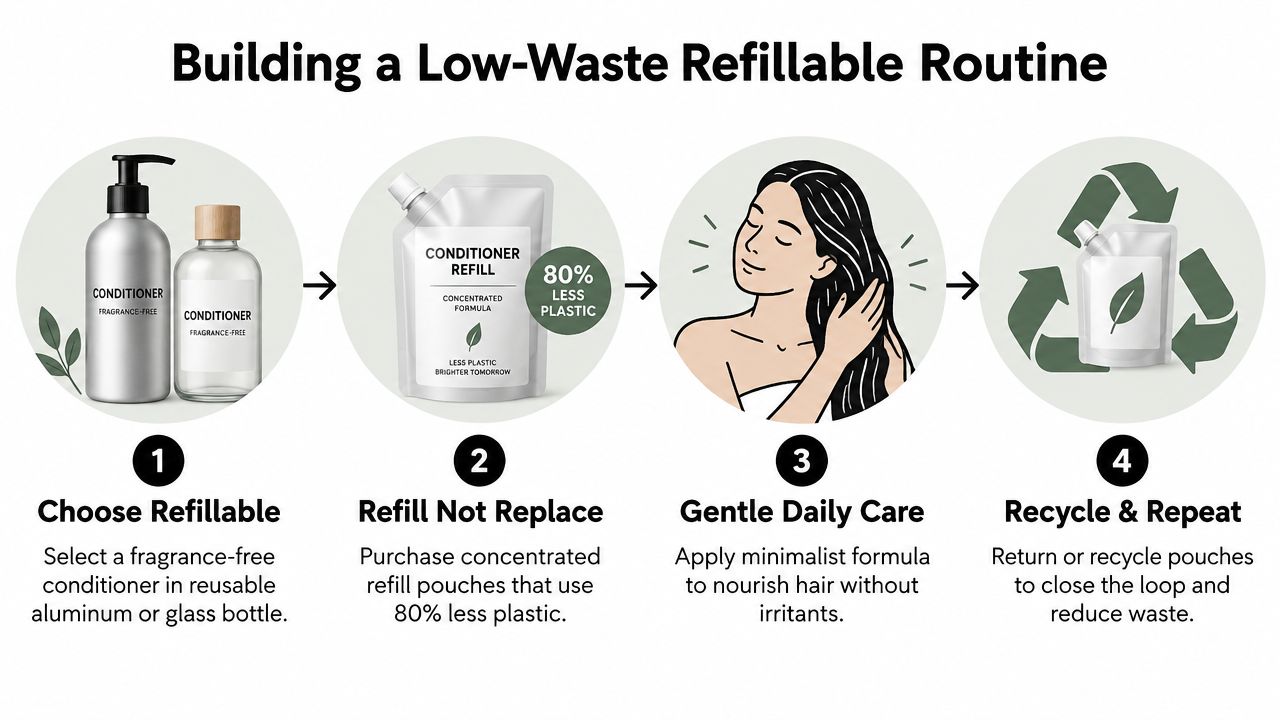
Look for a reusable aluminum or glass bottle, a refill format that stores well, and clear instructions for cleaning or returning packaging. Home refills can reduce the need to replace a bottle every time you run out, while local refill stations make the routine easier for people who prefer shopping in person.
What circular use looks like
Fillaree is a women-owned manufacturing company based in Durham, North Carolina, offering unscented options, including conditioner, through refillable packaging. Its Home Refill System uses 0.5-gallon boxes that can top up standard 8 oz bottles up to eight times, and the company takes back used refill bags, washes and sanitizes them, and reuses them at no cost to the customer. (Fillaree low-waste shampoo and conditioner system)
That model turns “buy less packaging” into a repeatable household habit. Customers can also use 70+ partner stations across the United States or visit Fillaree's Durham storefront, giving the same product system a local and home-delivery pathway.
Before switching, ask three practical questions:
- Can I finish the formula? A refill only reduces waste if the conditioner performs well enough to become part of your normal routine.
- Can I keep the container clean? Follow the manufacturer's instructions rather than mixing old and new product in an unwashed bottle.
- Does the company close the loop? Return programs, refill stations, and durable packaging matter more than vague sustainability language.
Voting With Your Dollar for Better Beauty Standards
A fragrance-free conditioner is a small purchase, but it communicates what you expect from personal care. You can support companies that disclose ingredients clearly, avoid using “unscented” as a substitute for transparency, and design packaging around reuse rather than disposal.
Good products can come from different kinds of companies. A sensitive-skin retailer may focus on excluding fragrance, dyes, lanolin, parabens, and formaldehyde releasers. A specialty brand may emphasize “no perfume” or limit its formula to nine essentials, while banning dyes and fragrances. (Natulique perfume-free conditioner) Those choices reflect different values, but the useful common ground is clarity.
A practical shopping checklist
- Read beyond the front label: Check for fragrance, parfum, masking fragrance, essential oils, limonene, linalool, and extensive botanical blends.
- Confirm the function: Look for cationic conditioning agents, fatty alcohols, humectants, and suitable oils or butters.
- Match the texture: Fine hair may prefer lighter hydration, while thick curls and coils may need richer emollients.
- Test thoughtfully: Introduce one new product at a time and stop if your scalp reacts.
- Consider the package: Prefer a durable bottle and a refill or return pathway you can realistically use.
- Support aligned businesses: Look for transparent formulas, responsible manufacturing, community investment, and companies that care about reducing waste.
No product is universally non-irritating, and “natural” isn't a guarantee of compatibility. The better standard is informed choice: a formula that meets your hair's needs, a label that respects your skin, and a packaging system that fits your values.
Fillaree offers refillable, low-waste hair and body essentials, including an unscented conditioner option and a Home Refill System for reducing single-use packaging. Visit Fillaree to explore fragrance-conscious conditioner choices and build a refill routine that supports both sensitive scalps and more circular bathroom habits.