
Gentle Dish Soap: What It Actually Means and Why It Matters
You've finished cooking, the kitchen is quiet, and one greasy baking sheet is still waiting in the sink. After a few minutes of scrubbing, your palms feel tight, the skin around your knuckles looks pink, and the fragrant liquid on the sponge suddenly seems less comforting than it did when you bought it. The question isn't only whether the pan is clean. It's whether your dish soap is asking your hands to pay for that result.
Gentle dish soap is often treated as a soft marketing phrase, but the useful meaning is more specific. It points to choices in surfactants, pH, fragrance, dosing, and packaging that can make repeated dishwashing more comfortable without abandoning grease-cutting performance. It also invites a broader question: can a product be kinder to skin and kinder to the systems that carry its ingredients and packaging away?
Table of Contents
- Why a Gentle Dish Soap Deserves a Second Look
- How Mild Surfactants Clean Your Dishes
- Why pH Is the Quiet Hero of Gentle Dish Soap
- Skin-Smart Choices in Dish Soap Labels
- Refill Models That Cut Plastic Without Cutting Corners
- Brands That Explain Their Formulas and Packaging
- Your Gentle Dish Soap Checklist for Everyday Use
Why a Gentle Dish Soap Deserves a Second Look
“Gentle” shouldn't mean weak, watery, or incapable of handling a roasted pan. It should describe a deliberate balance between cleaning power and the conditions of daily use. Handwashing dishes involves repeated contact with water, surfactants, food residue, and sometimes fragrance. A formula that performs well for one quick wash may feel very different after a long evening of cooking and cleanup.
The irritation hiding in an ordinary routine
Three factors often get bundled together in the promise of a powerful clean.
First, a strong surfactant system can remove not only cooking oils but also some of the lipids that help skin feel comfortable. Second, a more alkaline formula may clean aggressively while feeling drying during repeated exposure. Third, fragrance adds a sensory experience, not cleaning power, and can be a poor fit for people who notice itching, redness, or irritation after washing.
The distinction between simple dryness and allergic or contact dermatitis matters. Safety information for common dish soaps warns that prolonged or repeated contact can dry or irritate skin, while some products also carry warnings about allergic skin reactions. The safety guidance for common dish soap exposure is a useful reminder that “mild” on the front label doesn't automatically answer the skin question.
Practical rule: If your hands feel tight after washing, change the routine before assuming you need a stronger cleaner. Gloves, a fragrance-free formula, shorter contact time, and better dosing may matter more than extra foam.
A kinder formula can still loosen grease because it uses the same basic cleaning physics as any dishwashing liquid. The goal is to choose a surfactant blend that removes oily residue while reducing unnecessary harshness. A neutral or near-neutral hand dish soap can also be a more sensible choice than an automatic dishwasher detergent, which is designed for machine cleaning rather than direct skin contact.
The category itself is far from niche. One market estimate values the global dish soap and dishwashing liquid market at $24.6 billion in 2025, with projected growth to $38.9 billion by 2034 at a 5.2% CAGR (Dataintelo market estimate). Synthetic products still represented about 68.4% of global revenue in 2025, while natural-ingredient products were estimated to be growing at about 7.5% CAGR, compared with 3.8% for synthetic products. That contrast explains why gentle dish soap is both a mainstream household product and an active target for reformulation.
How Mild Surfactants Clean Your Dishes
A greasy plate can leave the sink looking clean while a thin oily film remains behind. Mild dish soap removes that film through surfactants, molecules designed to help water and oil interact. Each one has a water-loving head and an oil-loving tail, much like a tiny tadpole with two different environments in mind.
Add the soap to water, and the molecules spread through the wash. Their heads stay oriented toward the water, while their tails seek the grease. This arrangement lowers water's surface tension, so the solution spreads across the plate instead of beading around oily patches.
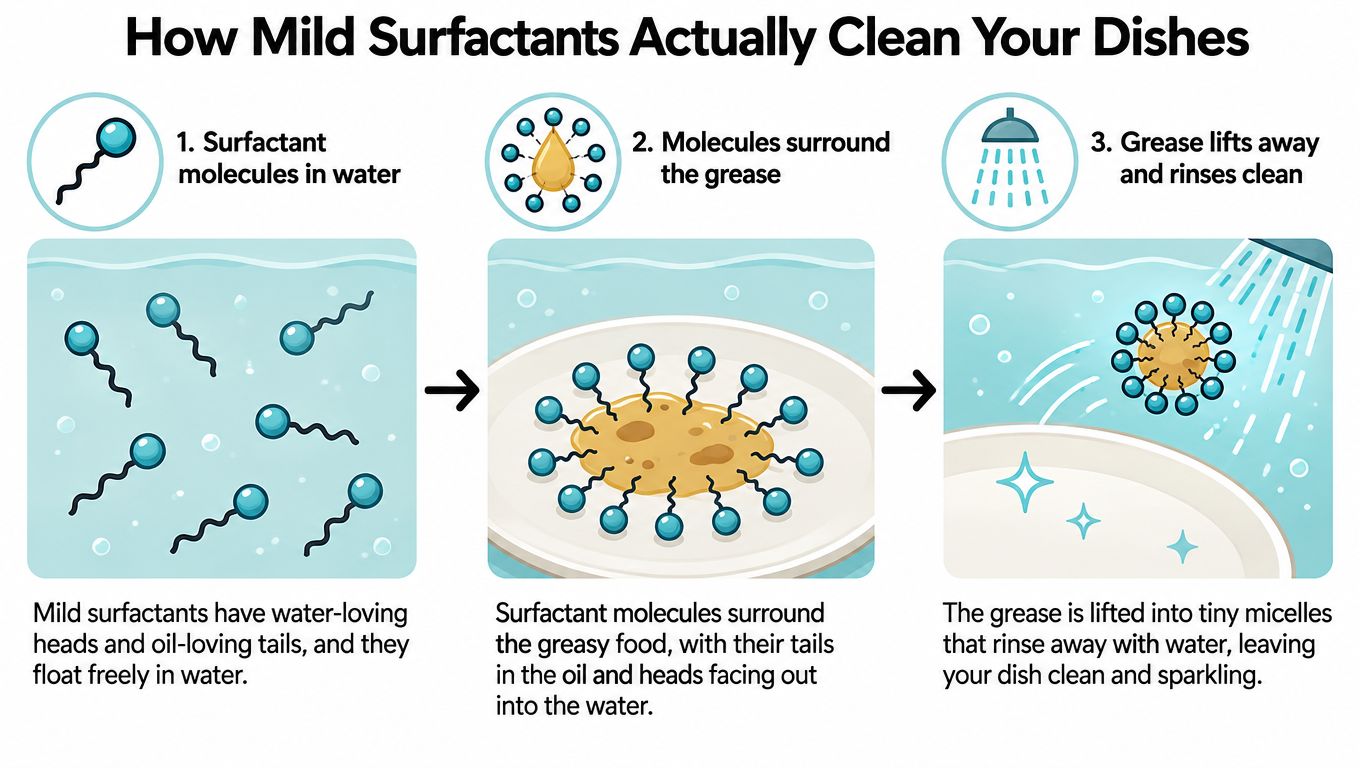
From greasy smear to rinsable micelle
The cleaning sequence has three connected stages:
- The soap spreads. Surfactant molecules travel through the water and reach the oily layer on the dish.
- The tails enter the grease. Oil-loving ends move into the fat, while water-loving heads remain exposed to the surrounding water.
- The residue lifts away. Surfactants gather around small oil droplets, creating structures called micelles. The droplets stay suspended long enough to rinse from the dish.
Water alone struggles with an oily baking sheet because oil and water resist mixing. Surfactants act as a bridge between them. Warm water can soften fats and food residue, while a sponge or brush adds the physical movement needed to lift what the formula has loosened.
Mildness comes from the blend and concentration, not from removing cleaning chemistry. Nonionic and amphoteric surfactants, including alkyl glucosides and cocamidopropyl betaine, can balance grease removal, foam, and skin comfort. Ingredient guidance describes nonionic surfactants as useful for oily soils and tolerant of hard water, while cocamidopropyl betaine can support foam and cleaning synergy as a lower-irritation co-surfactant (dishwashing surfactant ingredient guidance).
Foam can make soap feel active, but it does not establish cleaning performance by itself. The better question is how the full surfactant system handles grease and feels during repeated use.
The same practical thinking applies to packaging. A formula built for efficient dosing can pair with a refill-and-return bottle, reducing the need to replace the container each time. Ingredient choices such as caprylyl capryl glucoside also give shoppers a clearer way to examine what a cleansing system contains. If a dishwasher develops residue or odor, a carefully explained baking soda vinegar dishwasher method addresses the appliance itself, rather than confusing machine maintenance with hand dishwashing.
Why pH Is the Quiet Hero of Gentle Dish Soap
A soap can leave your hands feeling tight before you notice any redness. Its pH helps explain part of that experience. pH measures how acidic or alkaline a water-based formula is. Lower values are acidic, higher values are alkaline, and neutral sits near the middle. Hand dishwashing liquids are often described around pH 6 to 7, while broader references place many dishwashing liquids in the pH 7 to 9 range (dish soap chemistry and pH overview).
Those ranges are useful orientation points, not a promise of comfort. A soap's pH is one setting in a larger formulation, much like the temperature on a washing machine does not describe the entire wash cycle. Surfactant choice, fragrance materials, preservatives, concentration, and contact time also influence how skin responds. Two products with similar pH can therefore feel quite different.
Automatic dishwasher detergent serves another purpose. It works inside a machine with controlled heat, a rinse cycle, and food baked onto dishes. Stronger alkalinity can support that job, but it makes the product unsuitable for direct handwashing. Gentle dish soap is formulated for repeated contact with skin, not for copying the chemistry of a machine detergent.
“pH balanced” needs context. Look for a stated range, a product specifically made for hand dishwashing, and an ingredient list that explains more than a soothing label. A technical data sheet or a clear explanation of how the brand measures pH gives the claim more substance than a badge on the front of the bottle.
A home check with pH strips can offer a rough comparison. Dilute a small amount according to the packaging, dip the strip into the mixture, and compare its color with the supplied scale. Do not treat the reading as laboratory certification, and never apply undiluted soap to irritated skin.
A neutral formula also shows how cleanser design has changed. Early soap-making methods in Babylon boiled fats with alkaline materials, creating much harsher cleansers. Modern gentle dish soap refines that older chemistry into a liquid for frequent household contact.
The same care can extend beyond skin. A mild formula paired with refill-and-return packaging can reduce container replacement while keeping dosing practical. The pH discussion then becomes part of a wider design question: how can a product be kind to hands and require less disposable packaging? This guide to a pH-neutral solution explains useful terminology.
Skin-Smart Choices in Dish Soap Labels
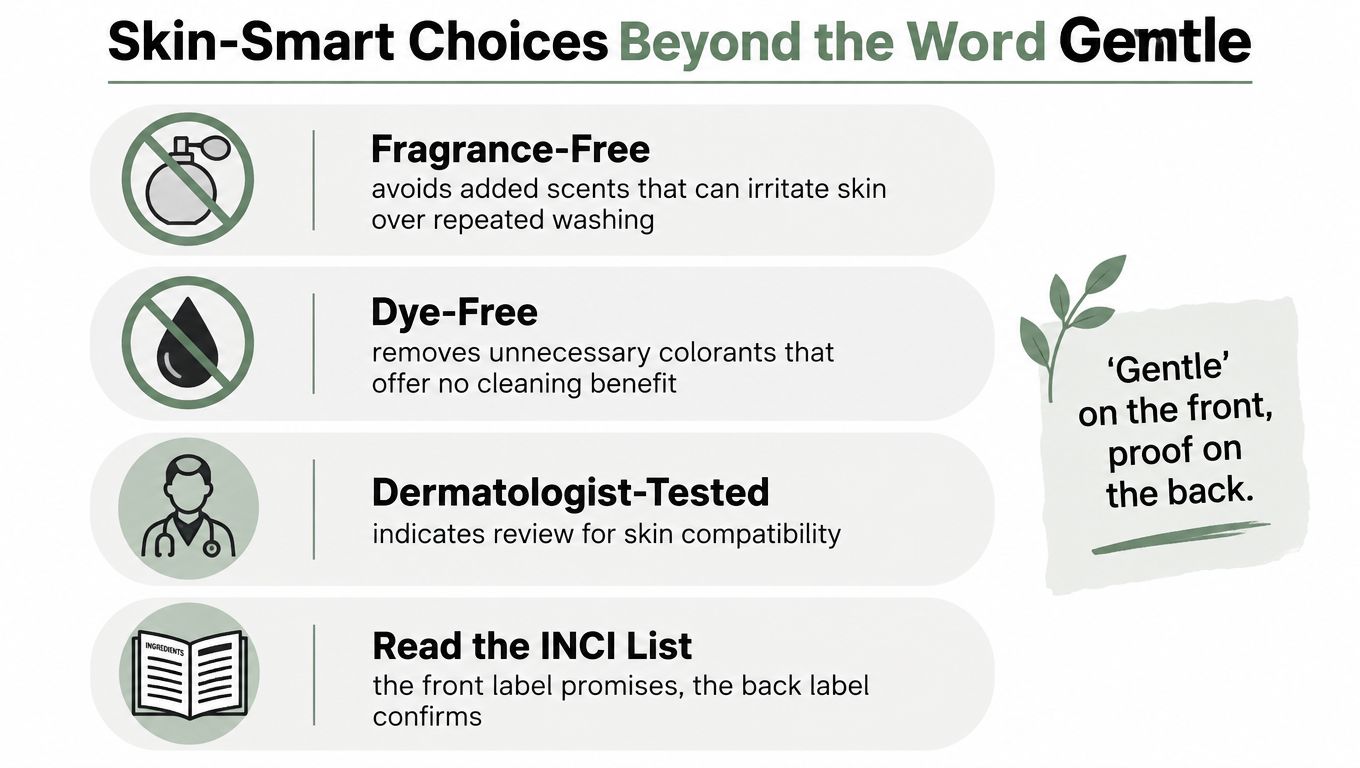
After a long sink session, your hands may feel tight while the dishes look perfectly clean. That difference is useful information. A label can suggest where to look, but the ingredient list and your skin's repeated response offer better evidence. “Fragrance-free” means the formula contains no added fragrance materials, while “dye-free” removes colorants that do not help lift food or grease. Either claim may simplify the formula for people who notice reactions, though neither guarantees that every person will tolerate the soap.
Read the label in a practical order
Start with scent. If a citrus, floral, or herbal aroma remains on your hands or dishes, try an unscented option. Fragrance-free does not mean less cleaning power. Scent and color affect the experience, while surfactants do the work of loosening grease.
Then check the surfactant family. Lauryl glucoside and coco glucoside are examples of mild, plant-derived detergents. Guidance on gentler household cleaning ingredients describes glucosides and nonionic surfactants as mild options that are generally well tolerated across many skin types (mild plant-derived dish soap guidance).
Use the label to shape the whole washing routine:
- Swap the scent first. Replace a strongly perfumed liquid with an unscented formula, then notice whether your hands feel less tight.
- Use a concentrate carefully. Concentrates can reduce packaging and transport volume, including in refill systems, but follow the dosing directions. More soap does not make dishes cleaner.
- Add a barrier step. After washing, rinse thoroughly, dry around the knuckles, and apply moisturizer if your skin needs it.
- Use gloves when appropriate. They reduce direct contact with water and surfactants during extended washing or when the water is very hot.
A refill-and-return system can extend the same care to packaging. A mild formula protects the hand-to-product relationship, while a returnable container keeps the bottle in use rather than treating each purchase as a fresh piece of waste. The label therefore deserves attention for both skin-related claims and clear instructions for reuse.
“Hypoallergenic” requires restraint. It indicates that the manufacturer expects a lower likelihood of allergic reactions, not that reactions are impossible. People with eczema, known allergies, or persistent irritation may need a dermatologist to distinguish ordinary dryness from contact dermatitis.
Your skin's repeated response is a practical test. Redness, itching, tightness, or tiny cracks around the knuckles are reasons to pause and reconsider the product or washing method. For broader low-chemical household ideas, these Everti chemical-free cleaning tips describe ways to reduce unnecessary exposure across the home.
Refill Models That Cut Plastic Without Cutting Corners
A gentle dish soap supports low-waste living more fully when its container also has a next use. Packaging changes the product's footprint, but refill models suit different households. The practical choice depends on local recycling rules, shipping distance, storage space, and whether you can wash and return containers.
Concentrated and refillable formats are part of the sustainability shift. One market analysis reports that sustainable packaging and concentrated refill systems can reduce plastic waste by up to 80% compared with conventional single-use bottles (dish detergent packaging analysis). The result varies with materials, transport, reuse rates, and disposal systems. A refill system works like a loop: the bottle, pouch, or bulk supply must return to useful service rather than stop at the first purchase.
| Model | Material | Effort | Recyclability | Best For |
|---|---|---|---|---|
| Refill pouch | Flexible plastic or single-material packaging | Order, pour, and store | Depends on local facilities and pouch design | Households that want lightweight home refills |
| Refill station | Customer-owned bottle and bulk liquid | Carry, clean, and refill in person | Reuses the primary bottle; local rules apply to other materials | Shoppers near a reliable refill store |
| Take-back program | Reusable bottle or bag managed by the brand | Return empty packaging through the stated system | Reuse depends on brand collection and sanitation | People who want a managed circular loop |
Match the system to the kitchen
Pouches collapse as they empty and may make shipping more efficient because they use less space and material. They are not automatically accepted in curbside recycling, so check local rules before placing one in a bin. One refill pouch example reports 83% less plastic than standard containers and uses a single-material design intended to simplify recycling (refill pouch example).
Refill stations avoid shipping another bottle, while asking the customer to carry a clean container. Wash and dry it before visiting the dispenser, since leftover soap or moisture can create hygiene problems. A refill station zero-waste system shows the practical details to examine, including cleaning, dispensing, transport, and the container's next destination.
Take-back programs place more work with the brand. The company may collect, sanitize, and reuse the packaging, but the loop depends on customers returning empties through the stated process. Clear instructions matter as much as the container itself.
Aluminum and glass can suit certain formulas and storage preferences, particularly when durability and scent stability matter. Thicker concentrates may be harder to dispense from some containers, and glass needs care near sinks and children. The strongest refill model is the one a household can repeat without turning every purchase into a project.
Brands That Explain Their Formulas and Packaging
A dish soap can look thoughtful on the shelf while leaving its chemistry and packaging pathway unclear. A trustworthy brand explains what its surfactants do, why the formula is mild enough for regular handwashing, and what happens after the bottle is empty. That explanation connects two kinds of care: reducing unnecessary skin irritation and keeping useful packaging in circulation.
A formula built with plant-derived surfactants, fragrance choices, or a concentrated format may reflect careful design, but an ingredient's origin does not prove that the whole product has a low impact. The label works like a recipe. It should give enough detail for you to understand the cleaning system instead of relying on a broad “naturally derived” claim.
Packaging needs the same level of clarity. A reusable bottle, refill tablet, bulk concentrate, or returnable container each creates a different routine. The company should explain whether customers refill, reuse, mail back, or otherwise pass the container into the next stage. That practical information shows whether the package was designed for repeated use or just given a greener appearance.
Questions that reveal the design
- What cleans the dish? The surfactant list should be visible, with enough information to distinguish a considered mild formula from a vague natural-products claim.
- What happens to the container? Look for a specific refill, return, or recycling route rather than a general statement about sustainability.
- What does the certification cover? A certification may apply to an ingredient, formula, manufacturing process, or package. Those are separate claims.
- What does the company ask of you? Reuse systems work only when customers can follow the cleaning, storage, return, or refill instructions without guesswork.
The circular kitchen reaches beyond one bottle. A household might pair a gentle liquid dish soap with a dish block, compostable sponge, or refillable all-purpose cleaner. The shared principle is to keep materials useful longer while choosing cleaning chemistry that respects frequent hand contact.
Clear communication also helps makers and retailers reach shoppers who care how household products are made and sold. Resources that help brands find retail creator programs can support that connection.
A considered purchase rewards specific explanations, repeatable packaging systems, and formulas that state their limits. If a return program offers no clear guidance, the brand has left part of the circular design unfinished.
Your Gentle Dish Soap Checklist for Everyday Use
The easiest way to choose a gentle dish soap is to turn a broad promise into a short inspection. You don't need to memorize every ingredient or become a chemist before washing a plate. You need enough information to judge skin contact, cleaning function, household wastewater, and packaging together.
Start with the formula
Look for plant-derived surfactant names such as decyl glucoside, coco glucoside, or other glucoside and amphoteric systems. Ingredient origin isn't the only measure of performance, but a transparent list helps you understand what you're buying.
Check whether the product gives a pH range suitable for hand dishwashing. A practical target is near neutral, roughly pH 6 to 7, while some dishwashing liquids sit higher, within the broader pH 7 to 9 range (technical pH reference). Treat pH as one useful marker, not a complete safety guarantee.
Make the routine do less work
- Choose fragrance-free and dye-free when your skin is reactive. These features remove extras that don't clean dishes.
- Use enough, not a handful. More product can create more rinsing work without improving the wash.
- Soak stubborn residue. Time and warm water can soften food before you scrub.
- Protect your hands. Gloves and moisturizer can help during long cleaning sessions.
- Choose concentrated refills. A refill system can reduce packaging when you reuse the primary bottle and follow the intended disposal or return route.
For septic households, avoid treating “natural” as a complete answer. Dish soap should not be assumed harmless just because it uses plant-derived ingredients. Read the label, follow the manufacturer's directions, and be cautious with formulas that include harsh solvents, antibacterial agents, or chlorine bleach. The aim is to avoid sending unnecessary harsh chemistry into a system that relies on living treatment processes.
Third-party labels can also help narrow the field. Depending on your priorities, look for programs such as EPA Safer Choice, EWG Verified, USDA BioPreferred, or Leaping Bunny, then check what the specific certification covers. A certification is most useful when it supports, rather than replaces, ingredient and packaging transparency.
The two pillars of a gentle routine are kinder surfactant chemistry and a refill-and-return packaging system that you can use consistently. Choose a formula that respects repeated skin contact, dose it thoughtfully, and support a company that makes the lower-waste path clear.
Fillaree offers gentle, biodegradable dish soap alongside reusable bottles and a home refill system designed for repeated use, including returnable refill packaging. Visit Fillaree to explore a practical way to pair kinder dishwashing chemistry with a lower-waste kitchen routine.