
Ph Neutral Solution: What It Is and When to Use One
You're standing in the cleaning aisle with two bottles in your hands. One says pH neutral, while the other costs less and promises to cut through anything. Later, you may find yourself comparing a face wash that leaves your skin tight with a hand soap that feels comfortable after repeated use. The label raises a simple question: what does a pH neutral solution protect, and what does it leave unanswered?
pH can influence how a formula behaves on skin, stone, metal, fabric, paint, and whatever reaches the drain. A balanced product may be a sensible choice when you want to reduce the risk of irritation, surface wear, or unwanted effects on wastewater. But pH 7 isn't a universal guarantee of gentleness, cleaning power, or environmental safety.
The useful approach is to treat neutrality as one part of a product decision. You'll want to understand what neutral means chemically, match the formula to the job, test claims when necessary, and support companies that disclose how their products work rather than relying on vague green language.
Table of Contents
- Why pH Neutral Deserves a Closer Look
- The Science of pH Without the Jargon
- Why Neutrality Matters for Skin, Surfaces, and Waterways
- Where pH Neutral Solutions Show Up in Everyday Life
- How to Test and Verify pH at Home or in the Lab
- Choosing Products That Truly Deliver on the Promise
- Common Myths Worth Leaving Behind
Why pH Neutral Deserves a Closer Look
A label saying “pH neutral” usually tries to reassure you that a liquid sits close to the middle of the familiar pH scale. That can matter when a product touches a sensitive surface or your skin repeatedly. A harshly acidic formula may attack mineral deposits effectively, while a strongly alkaline one may handle grease well, but either can create problems when used on the wrong material or used too often.
A neutral formula can be a practical starting point for routine cleaning. It may help preserve a polished stone surface, reduce the chance of chemical stress on coatings, and offer a more comfortable experience for some users. Those benefits depend on the entire formulation, though. Neutrality describes acidity and alkalinity, not every aspect of safety or performance.
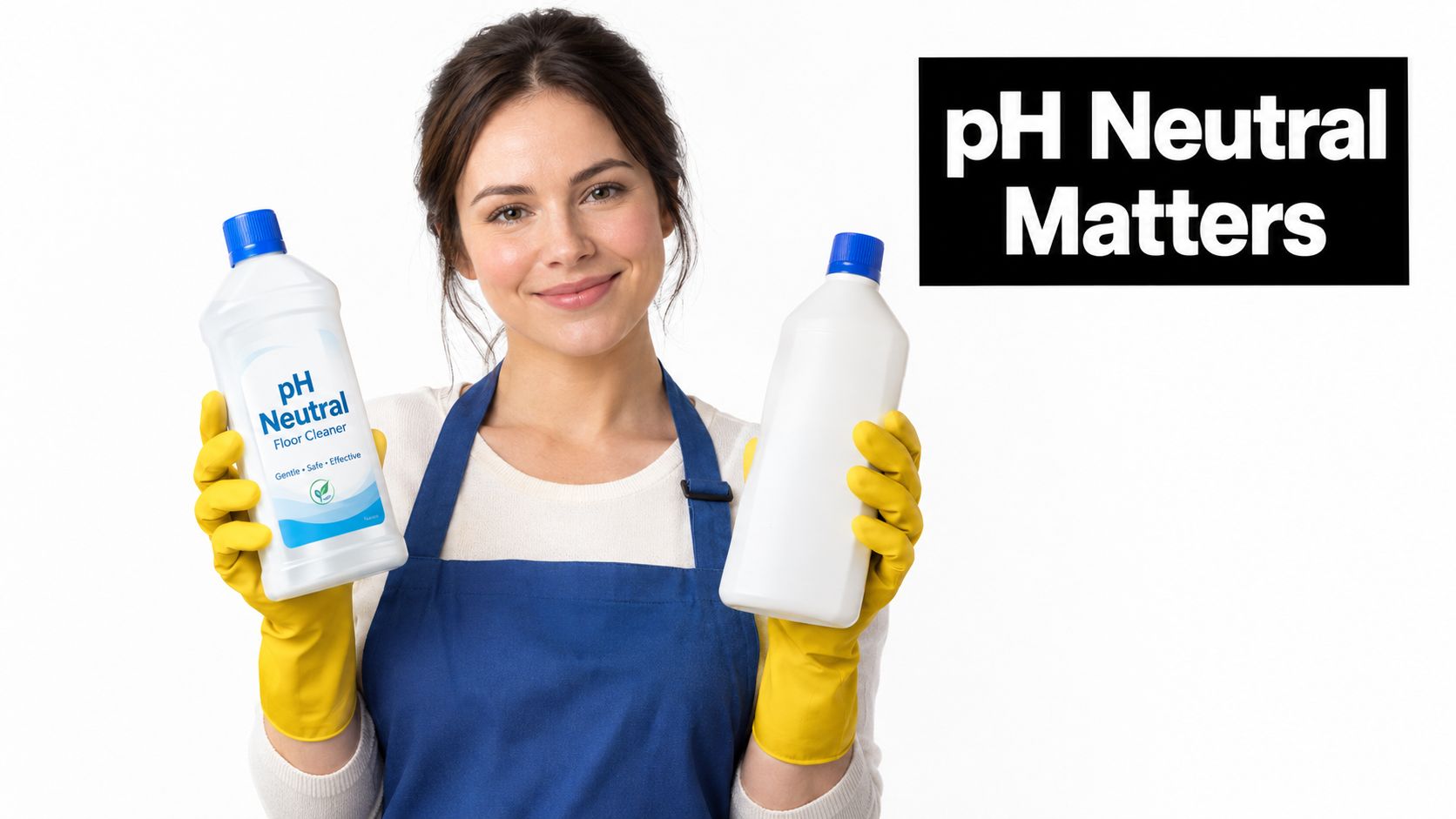
The label is a starting point
A product can have a near-neutral pH and still contain fragrance, preservatives, solvents, or surfactants that don't suit every person or surface. Conversely, a mildly acidic or alkaline product may be exactly right for a specific task, such as dissolving limescale or removing baked-on grease.
That's why “neutral” shouldn't make you stop reading. Look for a stated pH or range, instructions for dilution, material compatibility, and ingredient information. If a brand only says “balanced” without explaining what was measured, you have less information than the front label suggests.
Practical rule: Choose pH neutrality for compatibility, then evaluate the rest of the formula for the actual job.
Why context changes the meaning
Pure water provides the familiar reference point. At 25°C, equal hydrogen and hydroxide ion concentrations correspond to pH 7, which is why educational and government references commonly describe pH 7 as neutral (Britannica explains the standard pH reference). In a commercial product, however, water is mixed with salts, surfactants, solvents, fragrances, and buffering ingredients.
A buffered emergency eye-rinse product, for example, is listed at pH 7.4 and contains phosphate salts, indicating that its makers designed the mixture to remain close to physiological neutrality rather than filling a bottle with pure water (the product safety sheet lists its pH and phosphate formulation). That distinction is valuable in real life. The question isn't only whether a product says neutral. It's whether the formulation is appropriate for what it will touch, how long it will remain there, and what happens after rinsing.
The Science of pH Without the Jargon
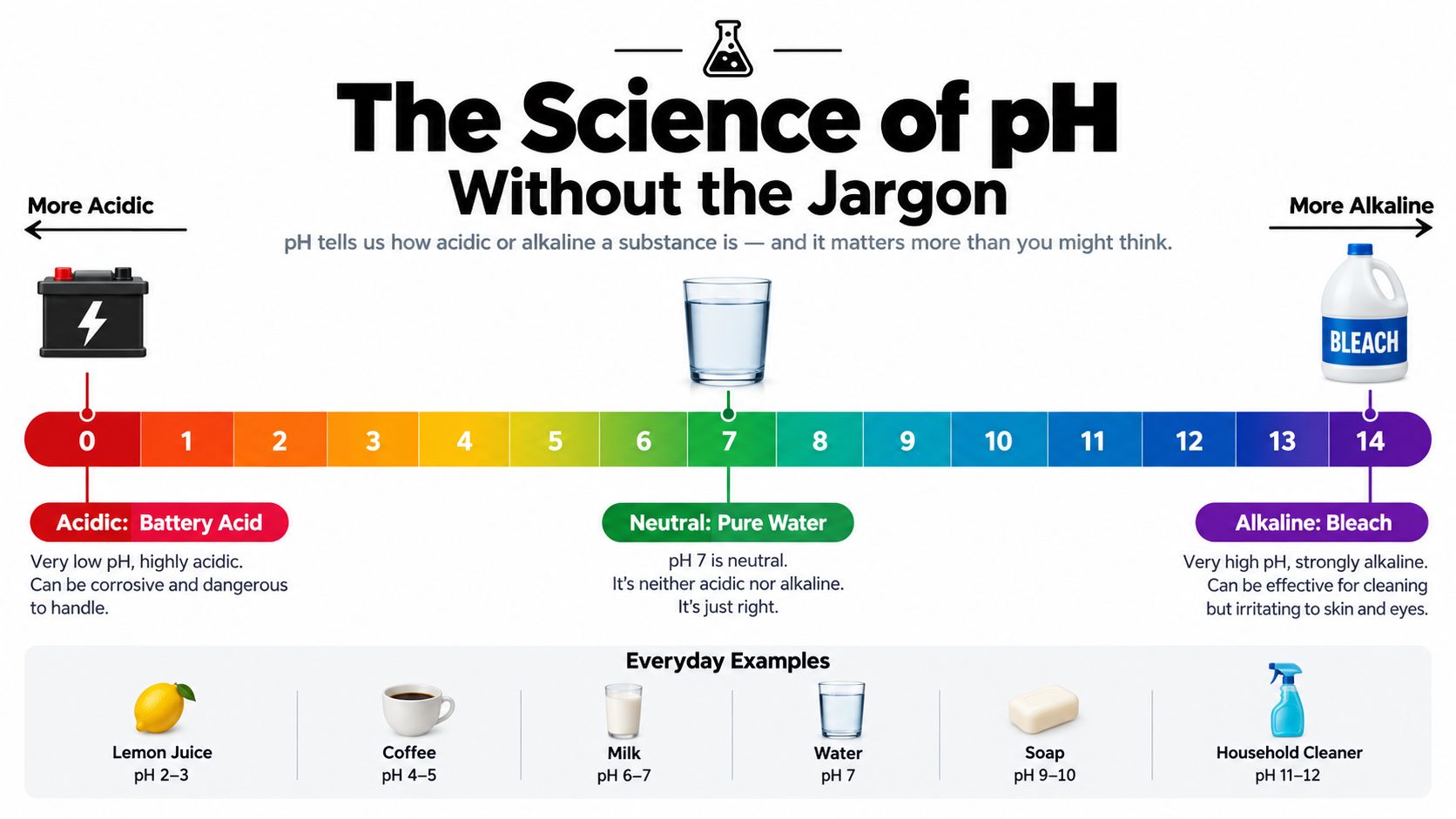
Think of pH as a reading that describes the activity of hydrogen ions in a watery liquid. More hydrogen ion activity generally means a more acidic solution. Less hydrogen ion activity, relative to hydroxide activity, indicates a more alkaline solution.
The familiar scale runs from 0 to 14. Lemonade sits on the acidic side because acids contribute hydrogen ions. Soapy water sits on the alkaline side, which helps explain its slippery feel and its ability to interact with oily residue. Pure water at 25°C sits at pH 7, the standard neutral midpoint because hydrogen and hydroxide ions are balanced (the Royal Society of Chemistry explains why pH 7 isn't always neutral).
The scale has a sharp edge
pH is logarithmic. Each whole-number step represents a tenfold change in hydrogen ion concentration, so a move from pH 6 to pH 5 is much larger than the numbers make it look. You don't need to calculate that difference while washing dishes, but it explains why a small shift can matter in a formula used repeatedly.
Neutrality itself is defined by equality between hydrogen-related and hydroxide-related activity, not by a permanent number stamped onto every liquid. In pure water at 25°C, that equality corresponds to [H₃O⁺] = [OH⁻] = 1.0 × 10⁻⁷ M and pH 7.00 (OpenStax describes the temperature dependence of neutral pH). At 100°C, the neutral point shifts to about pH 6.31 because water's autoionization changes with temperature.
That's the catch behind the common shortcut. A solution can remain chemically neutral when its pH isn't exactly 7, provided the relevant ion activities remain equal under those conditions.
Neutral doesn't mean inert
Most products aren't pure water, and a near-neutral product can still be active. A shampoo may use surfactants to lift oil, while a floor cleaner may use chelating or dispersing ingredients to help remove soil. If you're curious about one ingredient that often appears in skin-care discussions, this explanation of citric acid in skin care shows why an ingredient's role and concentration matter more than its name alone.
The useful question is therefore not “Is pH 7 always safe?” It's “How does this formula behave in the conditions where I'll use it?” That question keeps the chemistry connected to everyday decisions.
Why Neutrality Matters for Skin, Surfaces, and Waterways
Consider three ordinary situations. A person washes their hands several times during a busy day and notices that a strongly alkaline soap leaves the skin feeling rough. A homeowner sprays vinegar onto an unsealed stone counter and later sees a dull patch. Someone else rinses a powerful bathroom cleaner into a drain without considering how its chemistry may affect a septic system or nearby water.
These situations involve different materials, but the decision is similar. The solution will interact with something, and pH helps predict one part of that interaction. On skin, a balanced formula may be more comfortable for repeated use, although fragrance, surfactants, preservatives, and individual sensitivity still matter. On stone, neutrality can reduce the risk associated with acid-sensitive materials, but the surface's seal, finish, and manufacturer guidance remain important.
Three settings, three kinds of protection
Waterways add another layer. A product's pH can affect wastewater conditions, but pH alone doesn't tell you whether its surfactants biodegrade readily or whether its other ingredients pose aquatic concerns. Companies that care about discharge should explain more than the pH claim, including relevant ingredient choices and testing.
Hard water can complicate cleaning in a different way. Mineral deposits may remain even when the cleaner itself is gentle, so homeowners dealing with buildup may benefit from practical guidance on fixing hard water in Northern Colorado from SouthRay Kitchen & Bath. The right response may involve water treatment, mechanical wiping, or a targeted descaler rather than choosing a stronger everyday cleaner.
| Setting | What Neutrality Helps Preserve | What Harsh pH Can Do |
|---|---|---|
| Skin | Comfort and compatibility during routine washing | Contribute to dryness or stinging in a sensitive routine |
| Surfaces | Finishes, coatings, and materials that react poorly to extremes | Etch, dull, strip, or corrode certain surfaces |
| Waterways | A more controlled starting point for wastewater management | Shift local conditions, while other ingredients may add separate environmental concerns |
Look beyond the number
A pH-neutral cleaner isn't automatically safe for every surface, and it isn't automatically harmless after disposal. Read dilution instructions, avoid mixing products, and follow the material maker's care guidance. If a formula is intended for routine cleaning, a phosphate-free cleaner explanation can also help you understand why ingredient selection matters alongside pH.
The most responsible product choice protects the immediate user and the material, then considers the product's full path through rinsing, wastewater, packaging, and disposal.
Where pH Neutral Solutions Show Up in Everyday Life
Neutrality fits best when the task calls for compatibility and regular use, not maximum chemical reactivity. Wool, silk, baby clothing, fine china, sealed wood, and painted walls may benefit from a gentler formulation strategy because aggressive chemistry can affect fibers, finishes, or coatings.
Personal care is more nuanced. Facial cleansers, baby shampoos, and intimate washes are often designed around the needs of a particular area rather than a universal pH target. A near-neutral product may work well for one person, while another may need a formula developed for a different skin condition or use area. “Neutral” is a useful clue, not a substitute for product-specific directions.
| Use Case | Typical pH Target | Neutral? | Why / When Not |
|---|---|---|---|
| Wool, silk, or baby laundry | Near-neutral | Often useful | Helps limit stress on delicate fibers; heavy grease may need a different formula |
| Fine china and glassware | Near-neutral | Often useful | Supports routine washing and surface compatibility |
| Sealed wood, stone, and painted walls | Near-neutral | Often useful | Reduces exposure to aggressive chemistry; always check the finish |
| Facial cleanser or baby shampoo | Formula-dependent | Sometimes | Skin tolerance depends on the full formula, not pH alone |
| Intimate wash | Area-specific | Not automatically | Follow medical and product guidance rather than choosing by label alone |
| Degreaser | Alkaline may work harder | Usually not | Stronger alkalinity can help with heavy oil, but requires careful handling |
| Descaler | Acidic may work harder | Usually not | Acidity helps dissolve mineral deposits, but may damage sensitive materials |
| Aquarium or plant use | Water and species dependent | Not automatically | Test the water and follow organism-specific guidance |
Match the chemistry to the soil
A neutral all-purpose spray makes sense for everyday dust, fingerprints, and light grime on a compatible sealed surface. It may not be the right tool for baked-on oven grease or mineral scale. Using an aggressive formula for every task can create unnecessary exposure, while using a neutral product for every task can produce frustrating results.
Water quality also influences what you see in the bottle and on the surface. Before changing a household cleaner because of spotting or residue, consult practical advice from Water Filter Advisor about water treatment and filtration considerations.
Photographic processing baths, aquarium water treatment, and plant misting show why context matters outside ordinary cleaning. In each case, the desired pH depends on the material or living system involved. The rule of thumb is simple: choose near-neutral chemistry for routine compatibility, acidic chemistry for appropriate mineral problems, and alkaline chemistry for appropriate oily or protein-based soils, always following the product directions.
How to Test and Verify pH at Home or in the Lab
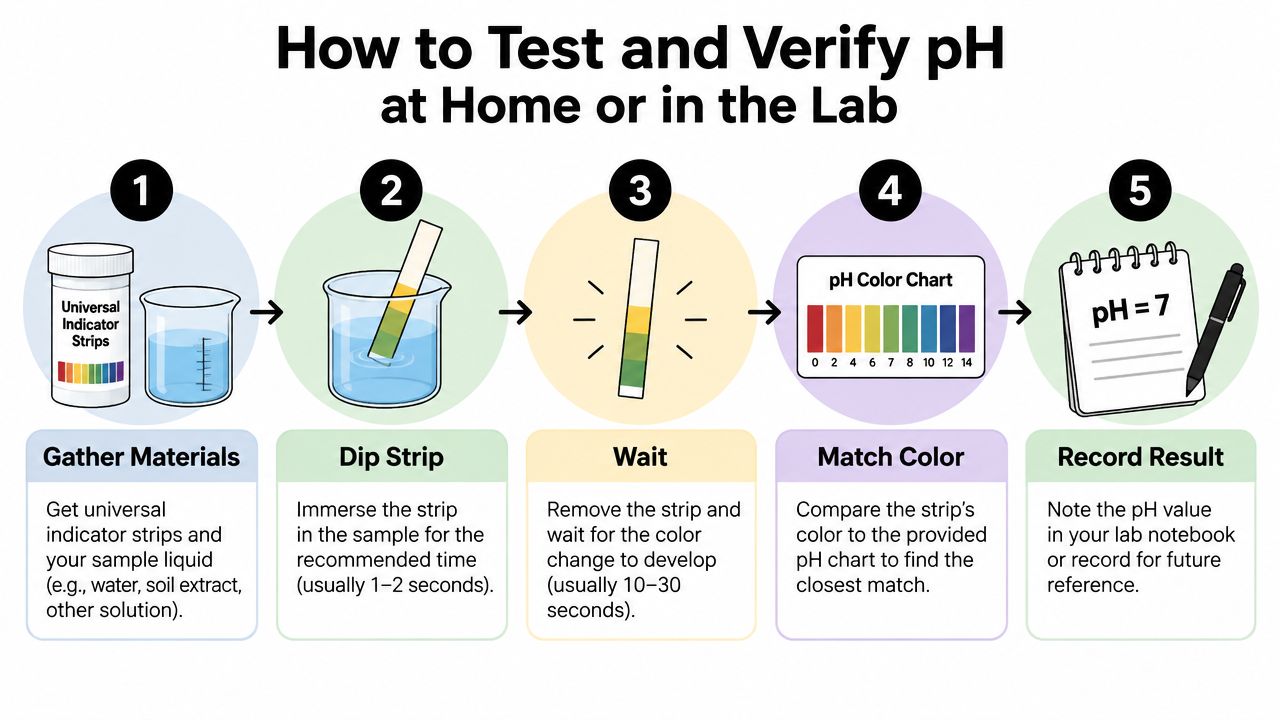
Testing a product at home can confirm whether its pH is broadly near neutral, but it won't reveal everything about the formula. Start with a clean sample, avoid touching the reactive part of a strip, and use the method according to its instructions.
A simple home check
Universal indicator strips are the easiest option for a transparent liquid. Dip the strip for the recommended time, wait for the colour to develop, and compare it with the supplied chart. Use consistent lighting because a warm or dim room can make two nearby colours look more similar than they are.
Water quality, dilution, residue on the container, and a coloured product can all distort the result. Test a fresh sample in a clean glass, and don't assume the pH of a diluted product is identical to the pH of the concentrate.
Liquid indicator drops can offer a somewhat more precise visual comparison in clear samples such as a diluted cleaner or toner. They're still limited by colour perception, and they may not work well when the sample already has a strong colour.
When a meter makes sense
A digital pH meter is the practical upgrade for repeated measurements. It needs calibration with suitable buffer solutions, rinsing between samples, and proper electrode storage. A dry or contaminated electrode can produce a confident-looking but unreliable number, so follow the meter maker's care instructions and replace the electrode when its performance declines.
Neither strips nor meters tells you how strongly a formula resists pH change. That property is related to buffering capacity. They also don't measure total alkalinity, cleaning strength, biodegradability, residue, or irritation potential.
A pH reading answers one question: how acidic or alkaline is this sample under these testing conditions?
For a formulation project, a production check, or a result with legal or safety significance, send the sample to a qualified laboratory. Professional analysis may include titration and other tests that reveal buffering behaviour and composition. When reviewing water documentation, resources on interpreting water quality COAs can help you understand why a single pH line shouldn't be read in isolation.
Choosing Products That Truly Deliver on the Promise
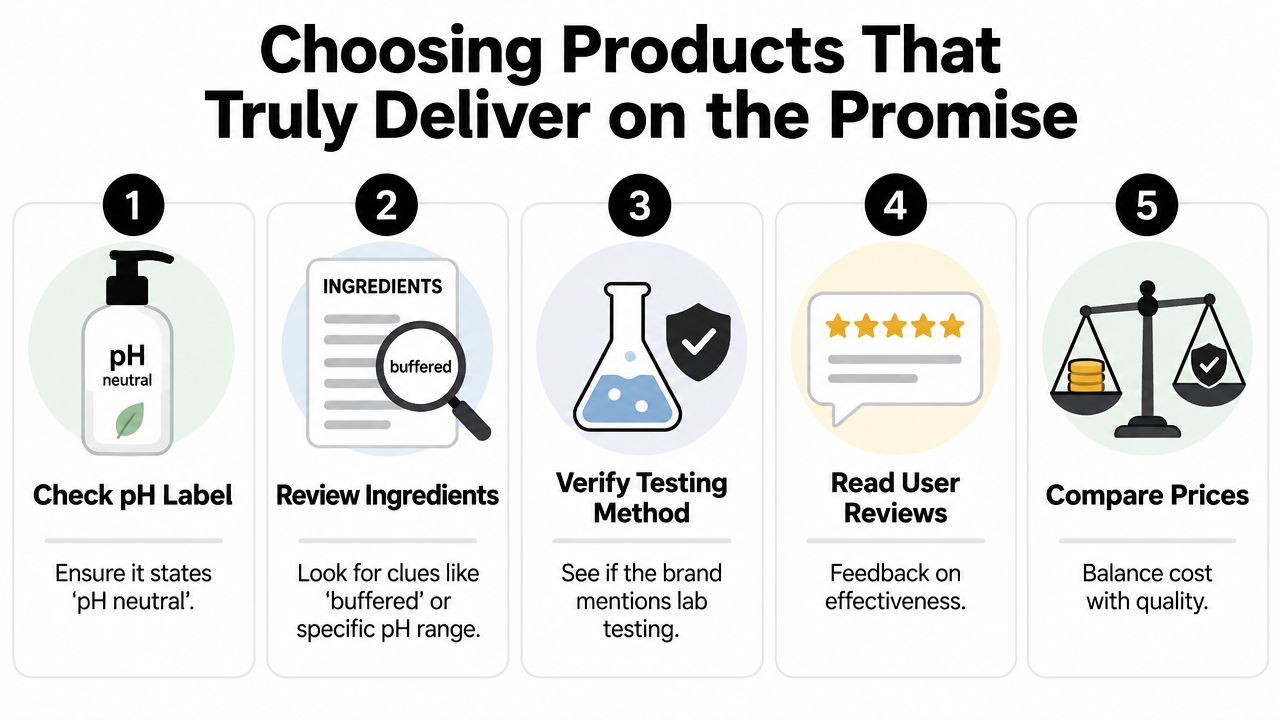
A careful shopper reads the pH claim as an invitation to investigate. Start with the number or range. “Balanced” sounds reassuring, but it doesn't tell you whether the maker measured the finished product, tested it after dilution, or just uses the word as a marketing description.
Ingredient lists can provide useful clues. A formula that avoids strong acids and caustic alkalies may be less chemically aggressive, while buffering ingredients such as citric acid or sodium citrate can help maintain a controlled range. Surfactant systems built around nonionic or amphoteric ingredients may behave differently from highly aggressive systems, but ingredient families don't guarantee suitability by themselves.
Evidence matters more than colour
Look for brands that explain their testing method, disclose a measured pH range, and publish meaningful safety or environmental information. Eco-labels can add value when their standards restrict relevant ingredients or pH ranges, but a green package design isn't evidence of a gentle formula.
Be cautious when a product makes several broad promises without details. Red flags include an unexplained “balanced” claim, an undisclosed fragrance blend, and sustainability language focused on packaging while the formula's preservatives, surfactants, or disposal guidance remain unclear.
Questions worth asking before you buy
- What was measured? Ask for the finished product's pH, the testing conditions, and whether the number applies to the concentrate or a use dilution.
- What holds the range steady? Look for information about buffering, especially if the product will be diluted in hard water.
- What does the formula do beyond pH? Check surfactants, fragrance, preservatives, solvents, and material compatibility.
- What happens after rinsing? Seek biodegradability information and clear disposal guidance rather than assuming neutral means eco-safe.
- Who stands behind the claim? Brands that share methods, testing documents, and limitations give you more to evaluate.
You can also learn to distinguish sustainability evidence from packaging theatre through this guide on how to avoid greenwashing. Supporting good companies means rewarding transparent formulation, responsible manufacturing, refill or reuse systems where practical, and honest claims that don't promise more than the chemistry can deliver.
Common Myths Worth Leaving Behind
Myth one, pH neutral always means gentle on skin. A pH 7 cleanser can still sting or dry sensitive skin if its surfactants, fragrance, preservatives, or use instructions don't suit you. Skin comfort depends on the full formula and the person using it, not one number.
Myth two, neutral automatically means safe for waterways. Neutrality describes acidity and alkalinity. It doesn't establish biodegradability, aquatic toxicity, packaging impact, or the behaviour of every ingredient after disposal. A responsible environmental assessment needs more information than pH.
Myth three, a neutral product must clean less effectively. Cleaning depends on the interaction between water, surfactants, soil, contact time, agitation, and formulation design. A neutral solution may be well suited to routine grease and dirt, while an acidic descaler or alkaline degreaser may be more appropriate for a specialized problem. The stronger option isn't automatically the better option.
Before purchasing, ask three sharper questions:
- What surfactant system does the formula use?
- What evidence supports its biodegradability and environmental profile?
- Does it suit this skin type, fabric, finish, or surface?
A product that answers those questions clearly is more useful than one that only places “pH neutral” in large letters on the front label.
Fillaree offers refillable soaps, shampoos, conditioners, dish soap, and all-purpose cleaners, with product guidance that connects pH and low-waste household care. Visit Fillaree to explore refill options and choose products from a company that combines practical formulation with reuse and waterway-conscious manufacturing.