
Half Gallon Glass Milk Jugs: Refill & Storage Guide
The most popular advice about half gallon glass milk jugs is also the least complete: “Glass is sustainable, so just reuse it.” A jug sitting empty in a cupboard isn't participating in a circular system, and a single trip through a recycling bin doesn't erase the impacts of manufacturing, washing, breakage, and transport. The useful question is more demanding: How many times will this jug be filled, and how far will it travel between uses?
A good jug can still be an excellent low-waste tool. It offers durability, a stable storage vessel, and a practical way to buy or make products in bulk. But the benefits depend on disciplined cleaning, compatible contents, reliable return logistics, and enough repeated use to spread the container's footprint across many fills.
Table of Contents
- The True Cost of Your Glass Jug
- Sanitizing Your Half Gallon Milk Jug
- The Math Behind the Reuse Loop
- Choosing the Right Formula for Your Jug
- Living the Fillaree Refill Lifestyle
- Labeling and End-of-Life Care
The True Cost of Your Glass Jug
Glass has an appealing environmental story because it can be reused and recycled. The less comfortable part is that recyclability isn't the same as recycling, and recycling isn't the same as reuse. The U.S. Environmental Protection Agency's glass packaging data estimates that Americans generated about 9.79 million tons of glass containers and packaging in 2018. Approximately 3.1 million tons were recycled, a 31.3 percent recycling rate, while 55.4 percent was landfilled and 13.4 percent was combusted with energy recovery.
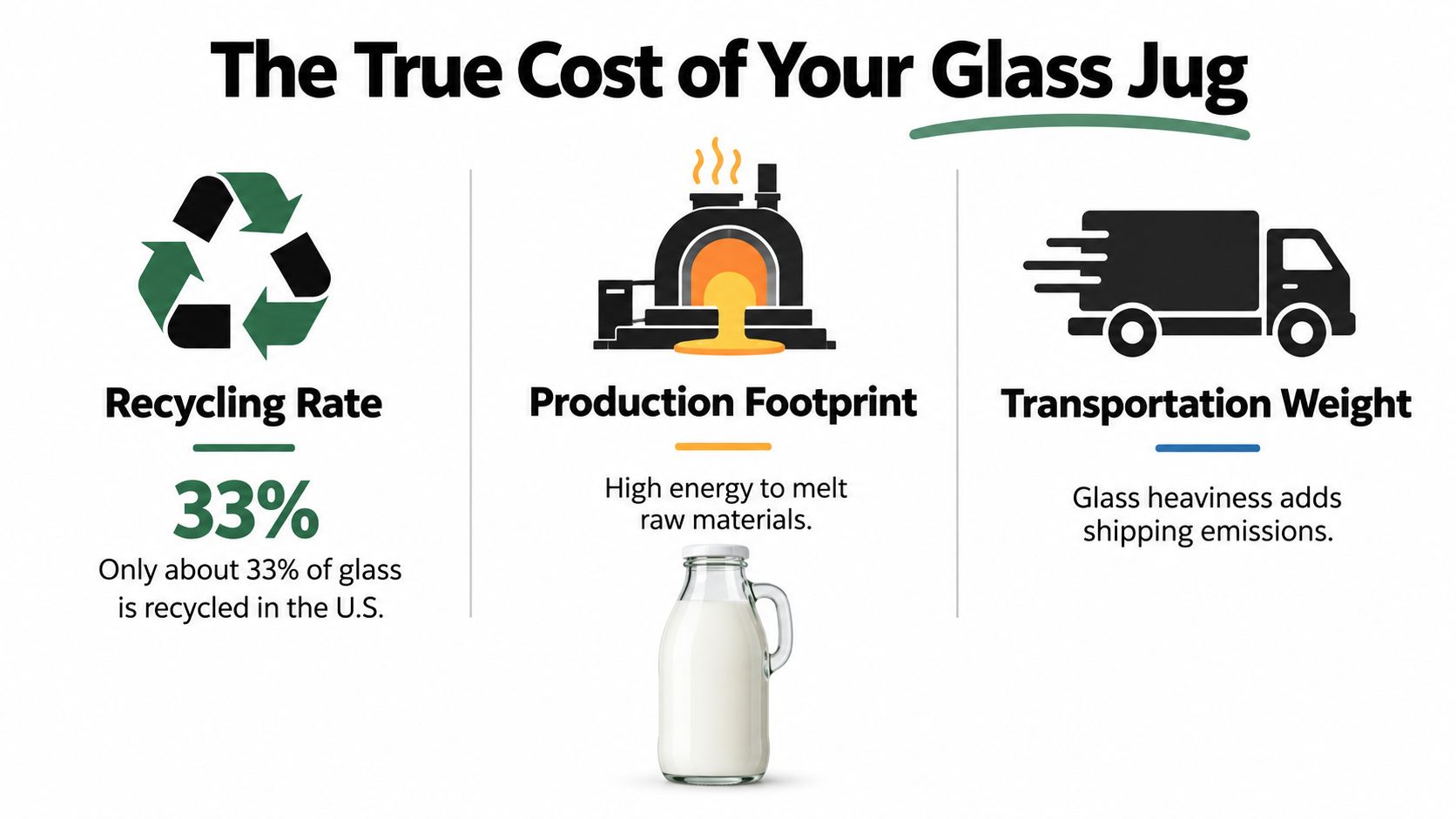
That doesn't make glass a bad material. It shows why the action after purchase matters more than the material label alone. A jug used once and then discarded has a very different profile from one that stays in circulation through refills, local returns, or household storage before it eventually reaches a glass collection program.
Reuse comes before the recycling bin
A durable container retains more value when it continues doing its original job. Washing and refilling an intact jug keeps the manufactured vessel in service, while recycling requires collection, transport, sorting, and remelting. Recycling remains important, but it belongs at the end of the jug's useful life, not automatically at the beginning.
Supporting good companies who care becomes practical rather than sentimental here. Look for businesses that make returns convenient, explain how containers are cleaned, reduce unnecessary packaging, and keep their refill routes reasonably local. A circular claim means more when customers can see the collection and cleaning steps behind it.
Practical rule: Don't ask only whether a jug is recyclable. Ask whether you'll actually reuse it, how you'll clean it, and what route it will take after you're finished.
The same principle applies at home. If you buy a half-gallon jug for bulk soap or cleaner and use it repeatedly for months, you're getting far more value from the container than if you buy several “eco-friendly” glass packages and store them unused. A good product supports a good habit when its packaging fits a routine you can maintain.
Sanitizing Your Half Gallon Milk Jug
A jug that held milk needs more than a quick rinse before it returns to service. Milk proteins cling to the inner surface, neck, cap, and gasket areas, and residue becomes harder to remove as it dries. Commercial dairies rely on controlled washing systems, but a household can adapt the same basic logic with careful sequencing.
The process has four stages, supported by dairy bottle-washing guidance:
- Inspect immediately. Reject any jug with chips, cracks, deep scratches, damaged threads, or a compromised closure. Don't assume a small rim defect is harmless. The neck takes pressure from caps, pouring, handling, and filling, and damage can worsen during washing.
- Pre-rinse while the residue is wet. Use water to remove remaining milk before proteins dry onto the glass. A pre-rinse reduces the soil that detergent must break down and makes the later wash more reliable.
- Wash with controlled conditions. Use detergent, suitable water temperature, adequate contact time, and enough spray or scrubbing coverage to reach the whole interior and exterior. Pay particular attention to the threaded neck, cap, gasket, and any molded handle where residue can hide.
- Rinse, sanitize, drain, and verify. Remove detergent, apply a suitable sanitizer according to its label, drain completely, and check the jug before filling. A clean appearance is useful, but it doesn't prove that every contamination risk has been removed.
Household cleaning is not commercial sterilization
A washed bottle isn't automatically sterile. For food reuse, keep the process consistent and avoid treating a dishwasher cycle or hot rinse as a universal guarantee. The proper sanitizing and disinfecting tips from Maid in America help clarify the difference between cleaning, sanitizing, and disinfecting, which matters when you're choosing a method for a food-contact container.
Let the jug drain fully before storage. Store it open and dry, with the closure cleaned separately, rather than trapping moisture inside. Avoid thermal shock, such as pouring a very hot liquid into a cold jug or placing hot glass on a cold surface. Sudden temperature changes can damage glass even when no crack is immediately visible.
Keep dedicated containers for different uses. A jug used for raw animal products shouldn't move casually into ready-to-eat food storage, body care, or household chemicals. For a pump or closure reference, the gallon jug pump guide is useful when adapting bulk containers to controlled dispensing.
The Math Behind the Reuse Loop
The break-even point for reusable glass isn't a universal number because the system around the bottle changes the result. A jug collected from a nearby dairy, washed in an efficient facility, and refilled repeatedly has a different profile from one shipped long distances, returned inconsistently, and replaced after a few uses.
One economic and environmental analysis of alternative milk packaging found that returnable glass milk bottles had the lowest external cost relative to plastic and paperboard when reused eight times. That's a useful consumer benchmark, not a guarantee. Other assessments identify broader feasible reuse ranges, from 10 to 40 uses when bottles remain undamaged, while historical dairy research found that glass generally needed about 30 reuses to become economical.
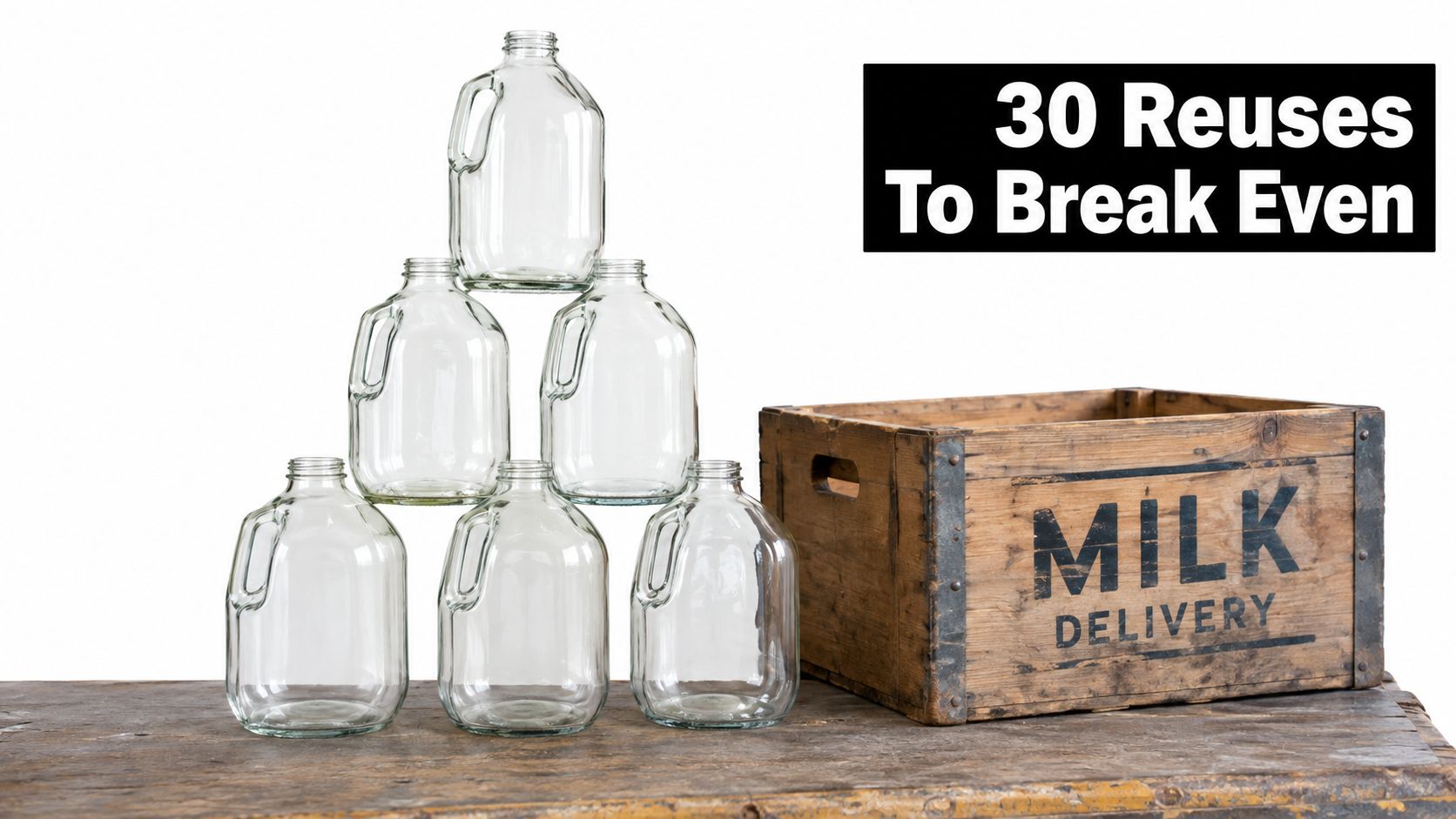
Why do those thresholds differ? Each calculation includes different assumptions about manufacturing, washing energy, transport distance, breakage, return rates, and what the alternative package would have been. Glass also carries a heavier transport burden than plastic, so a long journey can consume much of the benefit gained through additional use.
What to measure in a real household or refill program
A practical break-even review should track the full loop, not just the jug's material:
- Completed cycles: Count each accepted fill, not each time the jug moves around the kitchen.
- Return and rejection: Record how often containers come back and how many fail inspection.
- Cleaning inputs: Monitor wash water and heating energy where the system is large enough to measure them.
- Transport distance: Separate local pickup from long-distance delivery or shipping.
- Damage: Track chips, cracks, leaks, and breakage during handling.
The savings calculation guidance from Fillaree provides a useful model for thinking in actual usage rather than assumptions. The same discipline applies to environmental performance: count what happens, then compare it with a single-use baseline.
A reusable jug isn't a climate win because it's made of glass. It becomes one when the system keeps it nearby, intact, clean, and in service.
For a home user, that may mean choosing local refill stations, combining errands, and reusing the jug for a compatible product rather than ordering a heavy container from far away. For a business, it means designing a dependable return route and enough demand to keep empties moving.
Choosing the Right Formula for Your Jug
The best contents for a half-gallon jug are stable, compatible with the closure, and easy to dispense without repeated contamination. A container that works beautifully for bulk body wash may be awkward for a thin cleaner, while a jug used for food storage may require stricter hygiene than one reserved for a household product.
For body care, dedicate the jug to products such as shampoo, conditioner, body wash, or hand soap. Thick formulas benefit from a pump or controlled pourer, and a dedicated container prevents traces of household chemicals from entering a product used on skin. The half-gallon Soap Suds hand and body soap refill is the kind of bulk format that suits a container kept in a bathroom or refill cupboard.
For home care, a jug can hold bulk dish soap or a diluted all-purpose cleaner when the closure and material are compatible. Label it clearly and keep it away from food, beverages, and personal-care products. Never improvise by mixing formulas just because the jug has room. The product's chemistry, not the container's capacity, determines whether the combination is appropriate.
Match the container to the formula
| Use | What works well | What needs care |
|---|---|---|
| Body products | Dedicated storage for soap, shampoo, conditioner, or body wash | Clean pumps and closures, and avoid cross-use with cleaners |
| Household products | Bulk dish soap or compatible all-purpose cleaner | Label contents, follow dilution guidance, and keep away from food |
| Food or beverage storage | Clean, undamaged jug with a suitable closure | Maintain strict hygiene and refrigeration where required |
| Hot liquids | Only when the glass and process are designed for it | Avoid thermal shock and sudden temperature changes |
The closure deserves as much attention as the glass. Check that caps, liners, gaskets, and pumps suit the formula's acidity or alkalinity and remain leak-free. A sound jug with a degraded gasket can still contaminate a product, leak in transit, or draw dust into the opening.
Don't treat nominal capacity as the amount you should fill to the rim. Leave appropriate headspace for pouring, expansion, and safe closure. If the jug has a narrow neck, use a funnel that can be cleaned thoroughly, and wash it immediately after use rather than leaving product to dry inside.
Living the Fillaree Refill Lifestyle
A useful refill routine starts with a container you can return to without friction. Instead of collecting every attractive glass package, choose a small group of sturdy vessels, assign each one a purpose, and place them where the next refill takes place. The system works when the empty container has an obvious destination.
Fillaree offers a concrete example of that approach. The women-owned manufacturing company based in Durham, North Carolina, has made refillable, low-waste essentials for home and body since 2014, including soaps, shampoos, conditioners, dish soap, and all-purpose cleaners. Customers can use 70+ partner stations across the United States, visit the Durham storefront, or order home refills in 0.5-gallon boxes that top up standard 8 oz bottles up to eight times, according to Fillaree's company information.
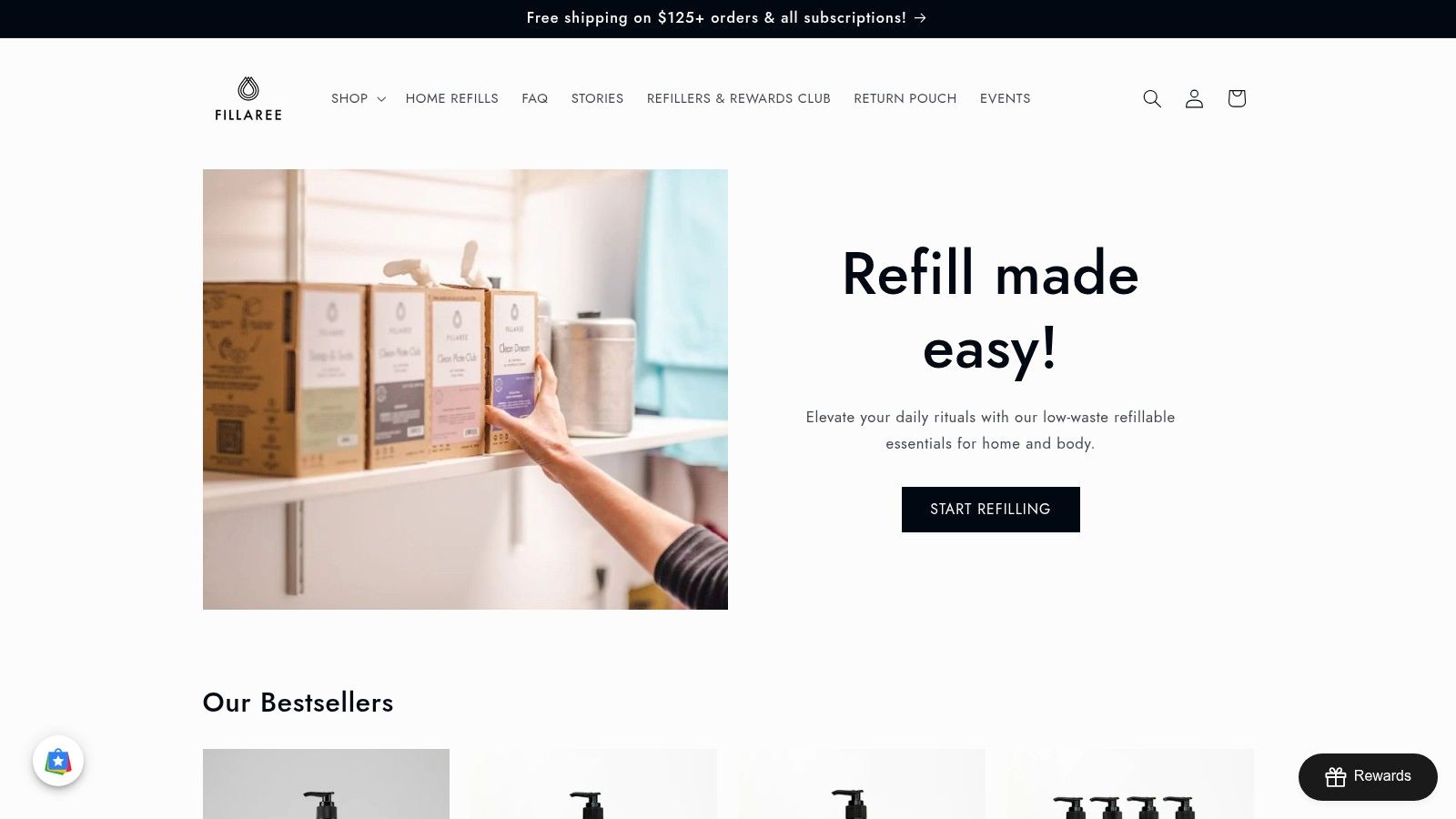
A household routine might look like this:
- Keep one jug for body care. Use it for a compatible bulk soap, with a clean pump or measured pour.
- Keep another for home care. Label it for dish soap or a specific cleaner, and don't swap it into the bathroom.
- Return or refill on an existing route. A nearby partner station, storefront visit, or planned delivery avoids unnecessary travel.
- Wash promptly after emptying. The next refill starts with a dry, inspected container rather than a bottle rescued from the back of a cabinet.
That approach supports good products and good companies who care because it rewards the infrastructure behind low-waste claims. A refill system has to consider packaging, customer behavior, collection, cleaning, and product performance together. If one part fails, the container may become clutter instead of a resource.
Here's what a home refill cycle can feel like in practice. You finish a soap container, rinse it before residue dries, let it drain, and place it with the next items going to a station. At the refill point, the clean vessel returns to service, while reusable packaging and product delivery remain part of one connected routine rather than separate sustainability gestures.
A visual example can make the system easier to understand before you set up your own storage and return habits.
The point isn't to own more containers. It's to make each one useful, clean, traceable, and easy to refill. That's the difference between a low-waste lifestyle that depends on constant vigilance and one that fits naturally into household routines.
Labeling and End-of-Life Care
A labeled jug prevents small mistakes that can undermine a good reuse system. Use a waterproof removable label or permanent marker to record the contents, intended use, and the date of the first fill. If several people share the kitchen, write the product name plainly rather than relying on a color code only one person understands.
For drinkware and household vessels that need a more finished look, personalised decals for drinkware can make ownership and purpose obvious. Choose an adhesive that stays attached during normal handling but can be removed before the jug enters a recycling stream.
Make the label part of the safety system
Keep a simple record for containers used with different products. Note whether the jug is for body care, home care, or food, and don't transfer it casually between categories. A label also helps you rotate older contents, identify a leaking closure, and avoid pouring an unknown liquid into a refill bottle.
Inspect the jug each time it returns to use. Retire it if you find:
- Chips or cracks: These can spread through handling or temperature changes.
- Deep scratches: Damage can weaken the vessel and complicate inspection.
- Damaged threads or closures: A poor seal can cause leaks or allow contamination.
- Persistent residue or odor: If cleaning doesn't restore the container, don't force another cycle.
When the jug can't safely hold another refill, recycling is the responsible final step. The EPA's glass recycling archive describes bottle and jar recycling as a closed-loop process, because recovered glass can be remanufactured into new bottles and jars. In the agency's 2012 example, glass bottles and jars represented about 11.57 million short tons of generation and 3.2 million short tons of recovery, with roughly 34 percent of glass containers and packaging recycled.
Check local collection rules before placing the jug in a bin. Remove incompatible closures if required, keep the glass free of food residue, and don't put a cracked container into a system that asks for intact bottles. Reuse first, recycle when service ends, and choose products and companies that make both stages straightforward.
Fillaree creates refillable soaps, shampoos, conditioners, dish soaps, and all-purpose cleaners through a circular system designed to reduce single-use plastic. Visit Fillaree to explore home refills, partner stations, and practical products that help keep your jugs and other containers useful for longer.