
Low or High Porosity Hair: A Simple Guide
You've just washed your hair, worked a rich conditioner through the lengths, and waited patiently before rinsing. Yet your strands still feel rough. Or perhaps water beads on the surface, your products seem to sit there, and your hair takes so long to dry that “wash day” stretches into the whole afternoon. These frustrations can feel random, but they often point to one useful clue: hair porosity.
Porosity describes how easily a hair fiber absorbs and holds moisture. Once you understand whether you have low or high porosity hair, product shopping becomes less of a guessing game. You can choose lighter or richer formulas with more confidence, adjust your routine when your hair changes, and even make lower-waste choices by buying products that match what your strands can use.
Table of Contents
- Why Your Hair Feels Different Every Day
- The Science of Your Hair Cuticle
- How to Test Your Hair at Home
- Choosing Products for Low vs High Porosity
- Your Porosity Is Dynamic, Not Fixed
- Sustainable Care for Healthier Hair
Why Your Hair Feels Different Every Day
Maya notices the problem while getting ready for work. Her shampoo rinses clean, but her conditioner seems to slide over her hair instead of sinking in. She adds more, waits longer, and rinses again. By lunchtime, her ends feel dry, while the roots still seem coated.
Her friend has the opposite experience. Water soaks into her hair immediately, but the strands feel dry again soon after styling. A moisturizing cream disappears almost as soon as she applies it, and humidity brings out frizz before the day is over.
Neither routine is automatically wrong. The two heads of hair may handle water differently because their cuticles have different levels of porosity. Low-porosity hair tends to resist water and product entry, while high-porosity hair absorbs moisture readily but can lose it quickly. The distinction comes from the condition and arrangement of the cuticle, the protective outer layer of each strand.
The clues hiding in your routine
Your everyday observations can offer a starting point:
- Water sitting on the surface: Hair that resists wetting may have tightly packed cuticles.
- A long, damp dry-down: Low-porosity fibers can take longer to become fully saturated and may also dry slowly.
- Instant absorption followed by dryness: High-porosity hair may take in water and conditioner quickly, then lose moisture just as quickly.
- A straw-like feel after washing: Hair can feel dry even when it has just absorbed water, especially when the cuticle is disrupted.
These signs aren't a diagnosis on their own. Heavy styling residue, weather, texture, and recent treatments can all affect how your hair behaves. A simple strand test can give you a useful baseline, while the most reliable professional assessments use methods such as scanning electron microscopy, dynamic vapor sorption, and gas adsorption analysis rather than a casual sink test, as explained by the New York Society of Cosmetic Chemists overview of hair porosity.
Practical rule: Don't label your entire head from one frustrating wash day. Look for repeated patterns, then test clean strands from different areas.
Porosity also gives you a better way to evaluate conditioner. Instead of asking whether a formula is “good” in the abstract, ask whether it matches your cuticle structure, how much product your hair needs, and whether the packaging supports your waste goals. A guide to finding the best conditioner for curly hair can help you think through those choices without treating every curl pattern or strand as identical.
The Science of Your Hair Cuticle
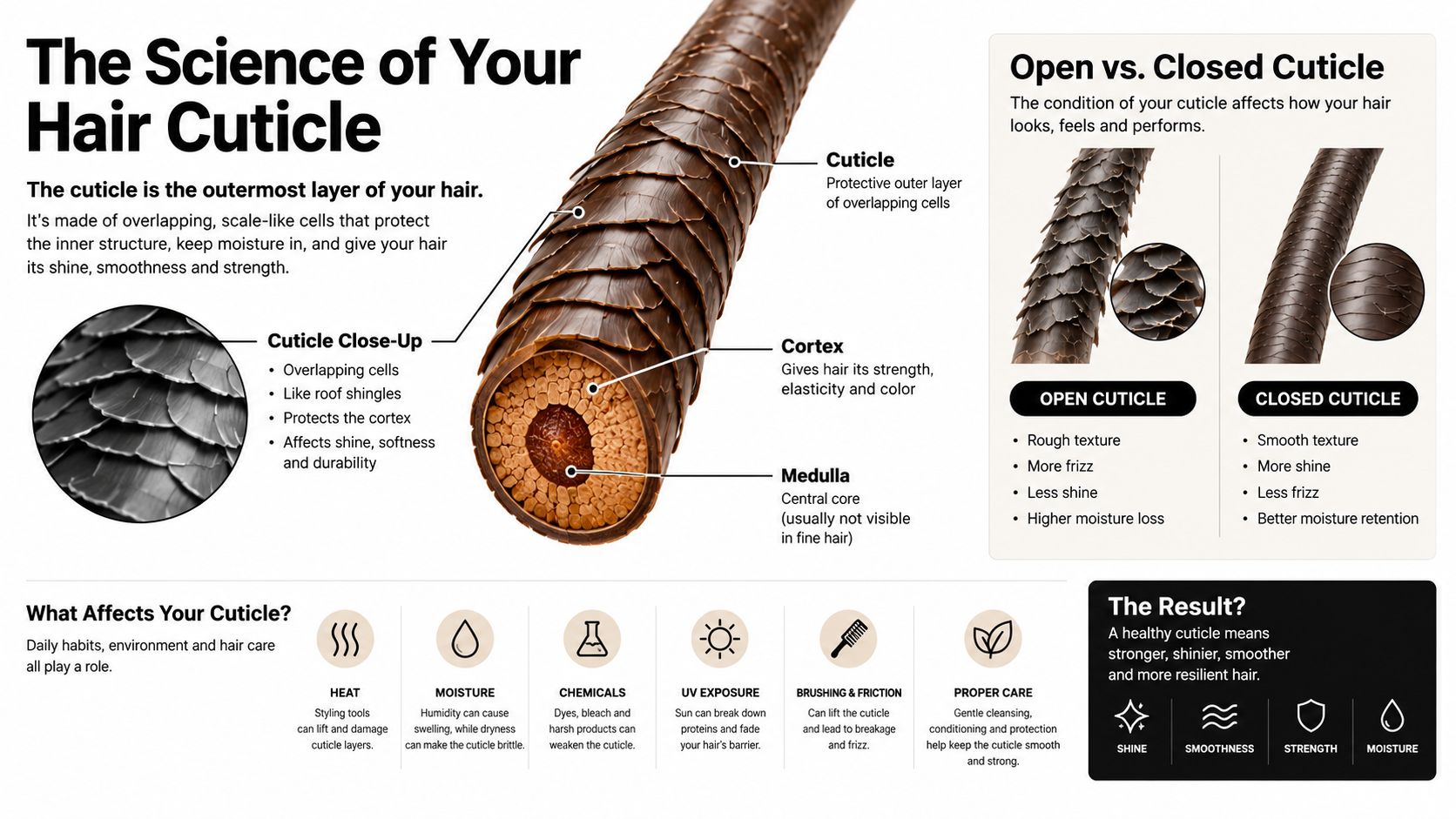
A strand of hair has a protective outer layer that works like a tiny roof. The cuticle is made of overlapping, scale-like layers, similar to shingles. When these layers lie flat and close together, they form a smoother barrier around the inner cortex. When they lift, chip, or develop gaps, water and cosmetic ingredients can pass through more easily.
That structure shapes hair porosity. Low-porosity hair has tightly packed cuticles that slow entry, so water and products may sit on the surface. High-porosity hair has lifted or damaged cuticles, allowing water in quickly while making moisture loss easier. Neither condition is a score for hair quality. Each points to a different balance of hydration, conditioning, and protection.
What the research reveals
Porosity describes measurable structure, not just a beauty label. A peer-reviewed study used gas sorption to measure hair pore volume, pore-size distribution, and surface area. Oxidative bleaching nearly tripled hair surface area in the first minute of treatment, showing how quickly chemical processing can alter the fiber. UV exposure followed a different pattern. Surface area fell during the first 200 hours, then gradually increased, according to the PubMed study on hair porosity and environmental damage.
The same research gives a closer view of those openings. Hair fiber pores were mostly around a 4 nm radius. Bleaching increased total pore volume by creating smaller pores before longer exposure combined them into fewer, larger cavities. In practical terms, chemical processing can change both the number of openings and their size and arrangement.
Water uptake explains why highly porous hair can feel dry soon after it gets wet. One academic cosmetics study measured untreated hair at 31.15%±0.63 water uptake. Chemically treated samples reached 36.15% after sodium hydroxide relaxing, while bleaching with 30-volume developer reached 0.480±0.08 in the reported porosity metric across 51 samples. The hair porosity and water-uptake report links these structural changes with the behavior you notice during washing.
A strand can be wet without being well moisturized. Water may enter a damaged fiber quickly, while its disrupted cuticle struggles to retain it. High-porosity hair often suits conditioners that leave a protective film, whereas low-porosity hair may respond better to lighter formulas that do not build a heavy layer on top.
Porosity can guide more thoughtful product choices, too. Matching the formula to your hair may reduce trial-and-error purchases, while refillable packaging can reduce reliance on new containers. The best routine supports both the fiber and a lower-waste beauty system.
How to Test Your Hair at Home
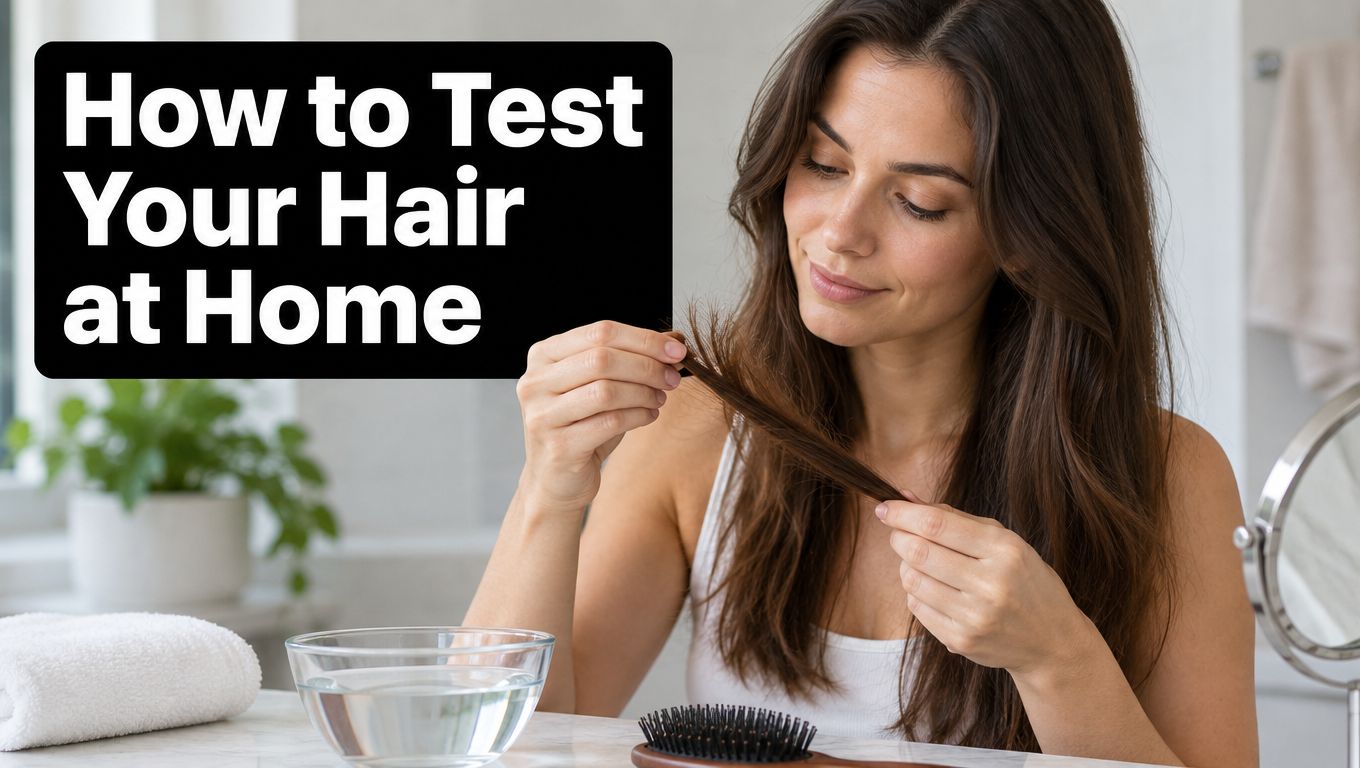
You don't need laboratory equipment to get a practical first reading. The widely used strand-in-water test takes a clean strand, room-temperature water, and a little patience. It won't replace a professional fiber analysis, but it can help you compare your hair's behavior with the routine you're using.
A simple float test
- Choose a clean strand: Use a loose strand from your brush or comb. Remove visible styling residue if possible, since buildup can change how the fiber interacts with water.
- Prepare the water: Fill a clear bowl with room-temperature water. Avoid adding shampoo, conditioner, or oil.
- Place the strand gently: Set the strand on the surface rather than pushing it under.
- Observe the result: Watch what happens over several minutes, and use ten minutes as a repeatable checkpoint.
- Record what you see: A strand that continues floating after ten minutes suggests low porosity. A strand that sinks quickly suggests high porosity.
The reasoning is straightforward. A tightly packed cuticle can resist water entry, helping the strand remain at the surface. A more open or disrupted cuticle can allow water into the fiber sooner, causing the strand to sink. The Marie Claire guide to high-porosity hair describes this floating-versus-sinking approach and the ten-minute threshold.
Treat the result as a clue
Don't make a major product overhaul based on one strand. Test another clean strand on a different day, especially if you use leave-in products or styling oils. You can also compare a strand from near the roots with one from the ends, because porosity may vary across the same head.
If your result is unclear, focus on behavior instead. Does water bead up? Does conditioner linger on the surface? Does your hair absorb moisture fast and then feel dry again? Those observations, combined with the test, are more useful than forcing yourself into a perfect category.
If you've recently colored, glossed, or chemically treated your hair, a resource such as the Boost Beauty Lounge hair gloss guide can help you understand how a gloss fits into a broader maintenance routine. Keep in mind that a cosmetic service doesn't permanently define your porosity. Your hair's condition can change as new growth appears and processed lengths remain on the head.
Choosing Products for Low vs High Porosity
Product matching gets easier when you stop treating moisture as a single ingredient category. Low-porosity hair usually needs help receiving moisture without becoming coated. High-porosity hair usually needs help keeping moisture inside after it gets there.
| Porosity Level | Cuticle State | Best Ingredients | Ingredients to Avoid |
|---|---|---|---|
| Low porosity | Tightly packed, flatter layers that slow entry | Water-based formulas, humectants, light oils, and light emollients | Heavy butters and thick oils that can sit on the surface |
| High porosity | Lifted or damaged layers with gaps that speed entry and loss | Rich moisturizers, film-forming conditioners, cationic deposition systems, and protective conditioners | Harsh ingredients such as strong alcohol-heavy formulas and sulfates when they worsen dryness |
If your hair is low porosity
Choose a conditioner that feels light in your hands and spreads easily through wet hair. Water-based formulas, humectants, light oils, and emollients are practical places to start because they can provide slip and hydration without immediately weighing down tightly packed cuticles.
A small amount may work better than a large amount. If your hair feels coated, limp, or difficult to rinse, the formula may be too rich for your strands, or you may be layering more products than the cuticle can accommodate. Gentle warmth during conditioning can help the product interact with the fiber, but use comfortable, low heat rather than aggressive temperatures.
Read the ingredient list with the same care you use when choosing food. A helpful guide to ingredients in hair conditioner can make unfamiliar terms easier to interpret, especially when you're comparing lightweight and richer formulas.
If your hair is high porosity
Start with a moisturizing cleanser and follow with a conditioner that leaves the lengths soft rather than squeaky. Richer moisturizers can help fill the gaps created by a lifted cuticle, while film-forming conditioners and cationic systems can reduce the speed at which moisture escapes.
Apply products thoroughly to the lengths and ends, where dryness often appears first. A leave-in conditioner followed by a compatible cream or light sealing oil can create a more protective finish, especially when your hair loses softness soon after washing. You don't need every rich product available. Choose a small, coherent routine and watch whether your hair stays flexible, smooth, and manageable.
Limit ingredients that make your hair feel stripped or brittle. Sources on natural hair thinning solutions can offer broader context about gentle hair handling and scalp care, but porosity-specific product choices still depend on your strand behavior rather than a universal shopping list.
Product test: Apply a new formula to one small section first. If low-porosity hair feels coated or high-porosity hair feels dry again almost immediately, adjust the formula before replacing your entire routine.
The most sustainable product is also the one you can finish. Buying a heavy mask for low-porosity hair, discovering that it sits unused, and then replacing it with another product creates unnecessary waste. A lighter conditioner that suits your hair, or a richer one that helps damaged lengths retain moisture, is a better aligned choice for both your bathroom shelf and your strands.
Your Porosity Is Dynamic, Not Fixed
You may notice your hair absorbing water quickly after a color service, then feeling more resistant at the roots a few weeks later. Porosity is not a permanent identity card. Bleach, heat, sunlight, and repeated chemical treatments can change the cuticle's condition over time. The more useful question is, “What changed my porosity?” rather than, “Which category am I stuck with forever?”
Different stressors affect the fiber in different ways. UV exposure can cause an early loss in surface area before that area gradually increases, while oxidative bleaching can produce a sharp increase in surface area soon after treatment begins. Pollution may intensify UV-related damage, so protecting hair from environmental exposure matters alongside choosing suitable after-wash products. The peer-reviewed research discussed in the Science section measures structural change rather than relying on appearance alone.
These changes also affect how much product your hair needs. A formula that works after chemical processing may feel excessive once the surface becomes less porous again. Adjusting the amount and type of product can protect your hair while reducing the chance of buying products that sit unused, an important connection between porosity care and refillable, low-waste beauty.
Read your hair in sections
One label can hide meaningful differences. Your roots may be relatively compact and resistant to moisture, while older ends become more porous after years of brushing, heat, coloring, and sunlight. Independent guidance on how hair porosity changes over time also notes that ends are typically more porous than roots.
Use that difference to shape a two-part routine:
- At the roots: Keep application light if products sit on the surface or leave the hair heavy.
- Through the lengths: Add more conditioner where the fiber feels rough, tangles easily, or loses softness quickly.
- At the ends: Detangle gently and use protective conditioning, since older ends often need more help retaining moisture.
Retest when your hair's behavior changes. A new color service, frequent hot-tool styling, extended sun exposure, or a seasonal shift can all justify reviewing your routine. You may only need to reduce heavy layers near the roots and give the ends more sealing care, rather than replacing every product.
Hair health is a moving target. Let your routine respond to the strand you have today, not the label you received months ago.
This flexible approach also prevents over-treatment. Low-porosity hair does not need increasingly heavy products because one conditioner failed to absorb. High-porosity hair does not need endless layers if one well-chosen film-forming conditioner already helps it stay soft. Observe, adjust, and choose products you can use fully, including refillable options that support both healthier hair and less waste.
Sustainable Care for Healthier Hair
A thoughtful hair routine can support more than softness and shine. It can also reduce the amount of packaging and product that ends up unused. The connection starts with choosing products according to your hair's actual needs. When low-porosity strands need a light conditioner, buying a smaller, refillable format can help you avoid a large container of a rich formula that never works. When high-porosity lengths need richer conditioning, selecting one effective product can be more sensible than collecting several half-used alternatives.
Match consumption to your routine
Refillable systems make this approach practical because you can keep a durable bottle and replenish the formula instead of replacing the entire package each time. Look for companies that explain how their refills work, use packaging thoughtfully, and take responsibility for used materials. A genuine circular system should make reuse clear, convenient, and realistic rather than shifting all the disposal work to the customer.
The same principle applies to ingredients. A brand that cares about low-waste beauty should also make it easy to understand what its formulas are designed to do. For low-porosity hair, look for a light, water-based conditioner with humectants or light emollients. For high-porosity hair, look for richer moisturization and conditioning agents that leave a protective film. The best option is the one that performs well enough for you to finish it.
Support companies with accountable practices
Supporting good companies means looking beyond attractive packaging. Check whether a business offers refill stations or home refills, designs packaging for repeated use, and explains what happens to returned materials. Consider whether the formula suits your hair before buying, because low-waste beauty still creates waste when products sit untouched in a cabinet.
Your environment can affect the routine too. Dry indoor air, cold weather, sun, and frequent washing may make porous lengths feel less comfortable. A seasonal resource such as winter hair-care tips from PRP For HairLoss can add broader maintenance ideas, while your porosity observations should guide which products you use.
A refillable shampoo or conditioner won't repair a damaged cuticle by itself. It can, however, support a better habit: buy with intention, use the right amount, finish what you own, and refill only what your hair needs. That combination respects both the fiber in your hand and the materials used to care for it.
For more ideas on reducing packaging while choosing shampoo and conditioner thoughtfully, explore this guide to zero-waste shampoo and conditioner.
Fillaree offers refillable, low-waste shampoo, conditioner, and other home and body essentials designed to make everyday care more circular. Visit Fillaree to explore options that can help you match your hair routine to its porosity while supporting a company built around reuse and thoughtful production.