
Natural Dishwashing Soap: A Practical Guide
You've just squeezed the last drop of dish soap onto a greasy pan. The empty bottle sits beside the sink, ready for the recycling bin, while you wonder whether it'll be recycled and whether the next formula will be any better for your hands or the water leaving your home.
That small decision matters because natural dishwashing soap isn't defined by green leaves on a label. It's defined by what cleans the dish, how the formula breaks down after use, how its pH affects frequent hand contact, and what happens to the packaging when the bottle is empty. The most useful choice combines ingredient transparency, measurable cleaning performance, credible certification, and a refill habit you can maintain.
Table of Contents
- Why the Bottle on Your Counter Matters Right Now
- What Natural Dishwashing Soap Actually Means
- How Plant-Based Ingredients Perform at the Sink
- Certification Cues Worth Looking For
- Is Natural Dish Soap Actually Safer for Your Hands
- Refillable Systems and the Low-Waste Habit
- Getting the Best Results From Your Natural Dish Soap
- Choosing a Natural Dish Soap Worth Your Dollar
Why the Bottle on Your Counter Matters Right Now
A conventional dish soap may combine synthetic surfactants, fragrances, dyes, and a single-use plastic bottle. The formula may clean well, yet its ingredients can behave differently after wastewater treatment, while the container creates a separate waste stream. A natural formula using plant-derived surfactants or fatty-acid soap salts approaches the job differently, with cleaning agents selected for more ready biodegradation.
Peer-reviewed research on fatty-acid soap salts, including sodium palmitate, sodium laurate, and sodium stearate, reported more than 90% biodegradation under anaerobic conditions at active-matter concentrations from 70 to 1000 mg/L over 28 to 54 days (peer-reviewed biodegradation review). The finding does not make every product labelled natural equivalent. It does show why the named surfactant matters more than a botanical image.
Practical rule: Treat “natural” as a starting clue, not proof. Check the named cleaning agents, available testing information, and whether the packaging system cuts repeated bottle disposal.
The market is shifting as well. One estimate places natural ingredients at about 31.6% of global dish soap revenue in 2025, compared with 68.4% for synthetic formulations, and projects natural ingredients to grow at 7.5% CAGR through 2034, versus 3.8% for synthetic ingredients (market estimate from Dataintelo). These are projections, not evidence that every natural product performs better. They do indicate that plant-derived surfactants, essential oils, and biodegradable packaging now reach beyond a small niche.
At the sink, judge the bottle by measurable behavior: grease removal in your water, pH and comfort during repeated washing, and what happens after the container is empty. A good purchase can also become a lower-waste routine when refills replace another discarded bottle.
What Natural Dishwashing Soap Actually Means
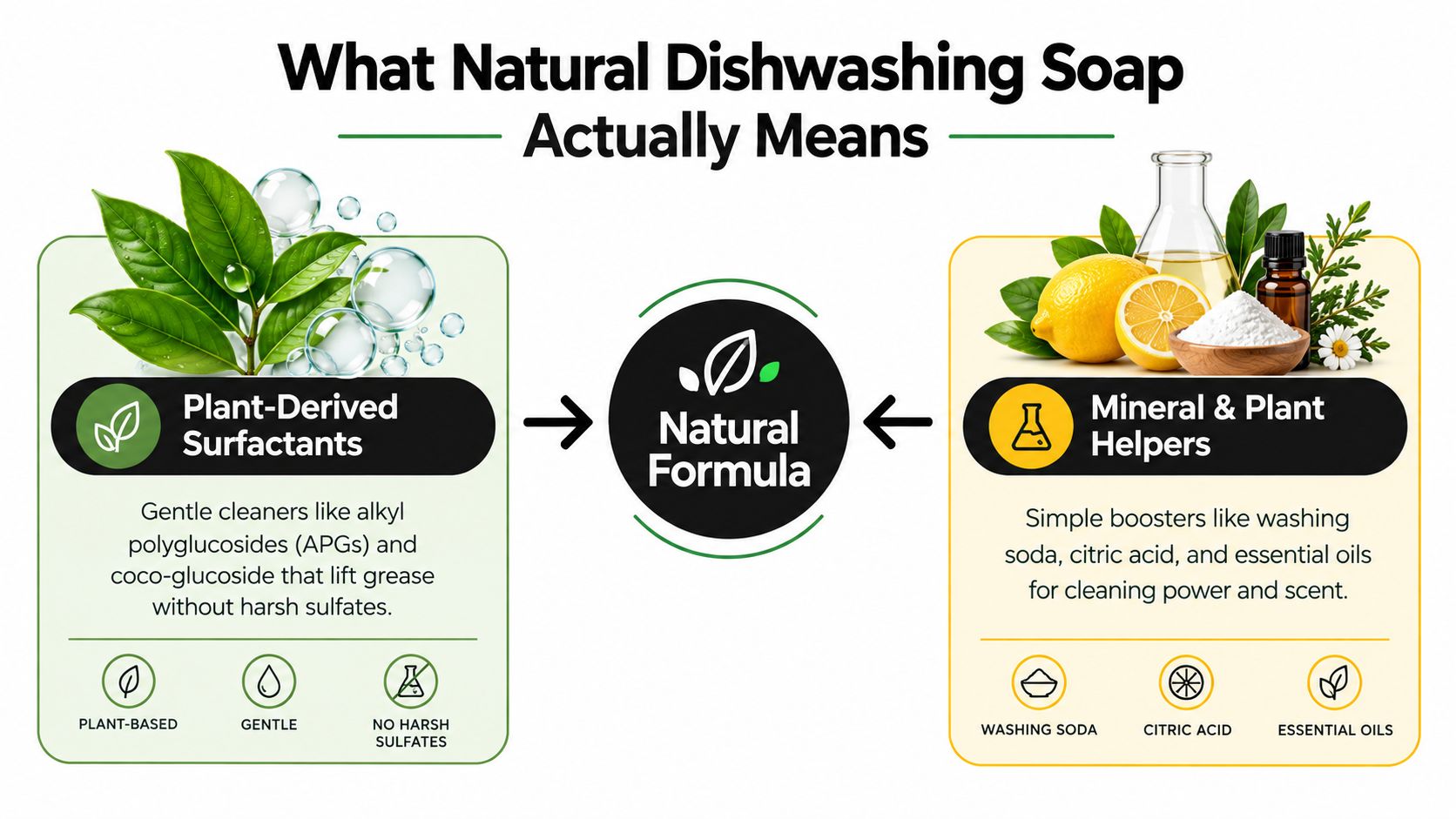
Start with the cleaning system rather than the front label. Most natural dishwashing soaps rely on one or both of two functional families.
Plant-derived surfactants
Plant-derived surfactants lower water's surface tension so water can spread across a plate, surround oily soil, and carry it away during rinsing. Common examples include alkyl polyglucosides, or APGs, coco-glucoside, and decyl glucoside. These sugar-based surfactants are often made from plant-derived fatty alcohols and sugars, although the phrase “plant-derived” doesn't by itself tell you the full manufacturing route or environmental profile.
APGs can provide effective grease removal with a different formulation profile from conventional sulfate-heavy detergents. They may also be combined with glycerin, citric acid, mineral salts, or essential oils. Each supporting ingredient has a job, but essential oils mainly contribute scent and may still bother sensitive skin.
Fatty-acid soap salts
True soap salts are made through saponification, a reaction between oils or fats and an alkaline ingredient. On a label, you might see names such as sodium cocoate or potassium oleate, reflecting fatty acids associated with coconut or sunflower oils.
These soap salts don't clean in exactly the same way as APGs. They can lift oily films, but hard-water minerals may react with soap and create a cloudy residue or reduce lather. That's why a bar soap or castile-style liquid can work beautifully in one kitchen and disappoint in another.
What the word doesn't promise
“Natural” usually signals that the cleaning action comes primarily from plant-derived surfactants, soap salts, or related ingredients instead of a conventional synthetic system. It doesn't automatically guarantee biodegradability, third-party certification, neutral pH, fragrance-free use, or zero irritation.
A product can contain naturally sourced fragrance materials that irritate your hands. A plant-derived surfactant can still be too strong for someone with a damaged skin barrier. A simple soap formula can also leave residue in hard water. Read the ingredient list, then look for evidence that matches the claim you care about.
How Plant-Based Ingredients Perform at the Sink
At the sink, “plant-based” describes an ingredient's origin, not its cleaning score. A useful comparison follows three measurable behaviors: what happens after the formula enters wastewater, how it behaves in your water, and whether it removes grease without excessive product use. The label is the starting point. Performance is the test.
Fatty-acid soap salts have evidence supporting ready biodegradation under anaerobic conditions. A peer-reviewed review reported more than 90% biodegradation for sodium palmitate, sodium laurate, and sodium stearate across the concentration and time ranges examined (biodegradation findings on fatty-acid soaps). The practical lesson is to identify the actual surfactant. “Plant-based” alone cannot show how an entire formula will behave after washing.
A separate technical study of an eco-friendly dishwasher liquid reported 95% grease removal and biodegradability above 90% in 28 days. In the same comparison, a traditional soap solution removed 75% of grease. The tested formula used pH 9 adjusted with 7 g/L citric acid, illustrating how pH and buffering can help emulsify fatty soils (technical study of an eco-friendly dishwasher liquid).
| Metric | Plant-Based, APG / Soap Salts | Conventional, SLES / SLS |
|---|---|---|
| Biodegradation | Readily degradable soap salts can perform strongly, but the full formula still matters | Product-specific evidence is needed rather than assumptions based on the word detergent |
| Grease removal | Surfactant choice, pH, and buffering can produce strong results | Often provides familiar grease cutting, though some shoppers may avoid particular ingredients |
| Hard-water behavior | Soap salts may lose lather or leave film when mineral content is high; APGs can behave differently | Synthetic surfactants often produce more consistent foam as water conditions change |
| Best shopping signal | Named surfactants paired with biodegradation or performance testing | Full ingredient disclosure and safety certification |
Foam mainly shows where soap is present. Cleaning depends more on surfactant chemistry, contact time, water temperature, agitation, and rinsing. A lower-foam formula can still remove grease well, while abundant suds can create a misleading sense of strength.
Botanical ingredients also appear in other soap categories. ArtNaturals' resource on turmeric for glowing skin provides context for botanical soap formulations, although skin soap and dish soap have different jobs and performance requirements.
For a wider discussion of plant-based soap and waste practices, see Fillaree's plant-based soap discussion. The buying habit is straightforward: match a named ingredient and test result to the behavior you want, then judge the formula by its real use at the sink.
Certification Cues Worth Looking For
A certification matters when it connects a marketing claim to a defined review process. It doesn't make every product perfect, but it gives you a stronger basis for comparison than words such as “green” or “clean.”
Three useful signals
USDA Certified Biobased focuses on the proportion of a product's ingredients that come from renewable biological sources. For example, Seventh Generation's Free & Clear liquid dish soap is labeled 95% USDA Certified Biobased, and its listed formula includes plant-derived or mineral-based ingredients such as decyl glucoside, glycerin, citric acid, sodium lauryl sulfate, and lauramine oxide (product details and label information). Biobased content tells you about renewable sourcing. It doesn't, on its own, prove that the product is fragrance-free, harmless to every user, or highly biodegradable.
EPA Safer Choice reviews ingredients and the product formula through a pollution-prevention program intended to identify products that perform while using ingredients safer for human health and the environment. The program considers ingredients that may pose serious health or environmental effects, including small-percentage materials such as fragrances and dyes (EPA Safer Choice program).
Third-party biodegradability testing can answer a different question. Testing under recognized protocols, including OECD approaches, examines whether surfactants break down under specified conditions. It's less common to see detailed results on the bottle, so check the brand's technical documentation rather than accepting a broad biodegradable claim.
| Label / Claim | What It Actually Verifies | Who Verifies It | Regulated Term? |
|---|---|---|---|
| USDA Certified Biobased | Renewable biological content | USDA BioPreferred program | A formal certification claim |
| EPA Safer Choice | Formula and ingredient safety criteria, plus product performance expectations | U.S. EPA | A formal program label |
| Third-party biodegradability | Breakdown under stated test conditions | Independent laboratory or testing body | Depends on the test and jurisdiction |
| “Plant-powered” | Usually ingredient positioning | Brand | Not a universal guarantee |
| “Eco-friendly” or “green” | Broad environmental messaging | Brand | Not a single standardized verification |
Before buying, ask whether the company names the certifier, explains the testing method, and publishes a complete ingredient list. This guide to avoiding greenwashing is a useful reminder that packaging design can make an unsupported claim look official.
Is Natural Dish Soap Actually Safer for Your Hands
A natural origin doesn't make a dish soap automatically gentle. Your hands respond to the complete formula, including surfactant strength, pH, fragrance, preservatives, exposure time, and whether you use hot water repeatedly.
The most useful verified comparison is not a blanket claim that plant-based products never irritate. A 2026 formulation study reported pH and heavy metals within acceptable safety limits for a natural-ingredient dishwashing liquid, while a 2024 analysis described a dishwashing liquid as reliable and skin-safe when its pH was near neutral and the formula contained no irritants or harmful bacteria (2026 natural-ingredient formulation study). Those findings support checking pH and safety testing, not assuming a botanical label settles the question.
What frequent washers should notice
After a long washing session, pay attention to tightness, burning, redness, scaling, or cracking. Fragrance-free and dye-free options may be a sensible starting point for sensitive hands, but even a fragrance-free cleanser can cause discomfort if the surfactant system is too strong or if you use it undiluted.
pH also deserves context. A moderately alkaline formula can help remove fatty soil, as the technical study above illustrates, but skin comfort and dish-cleaning performance aren't identical goals. A product that cleans well may still feel drying for someone who washes constantly.
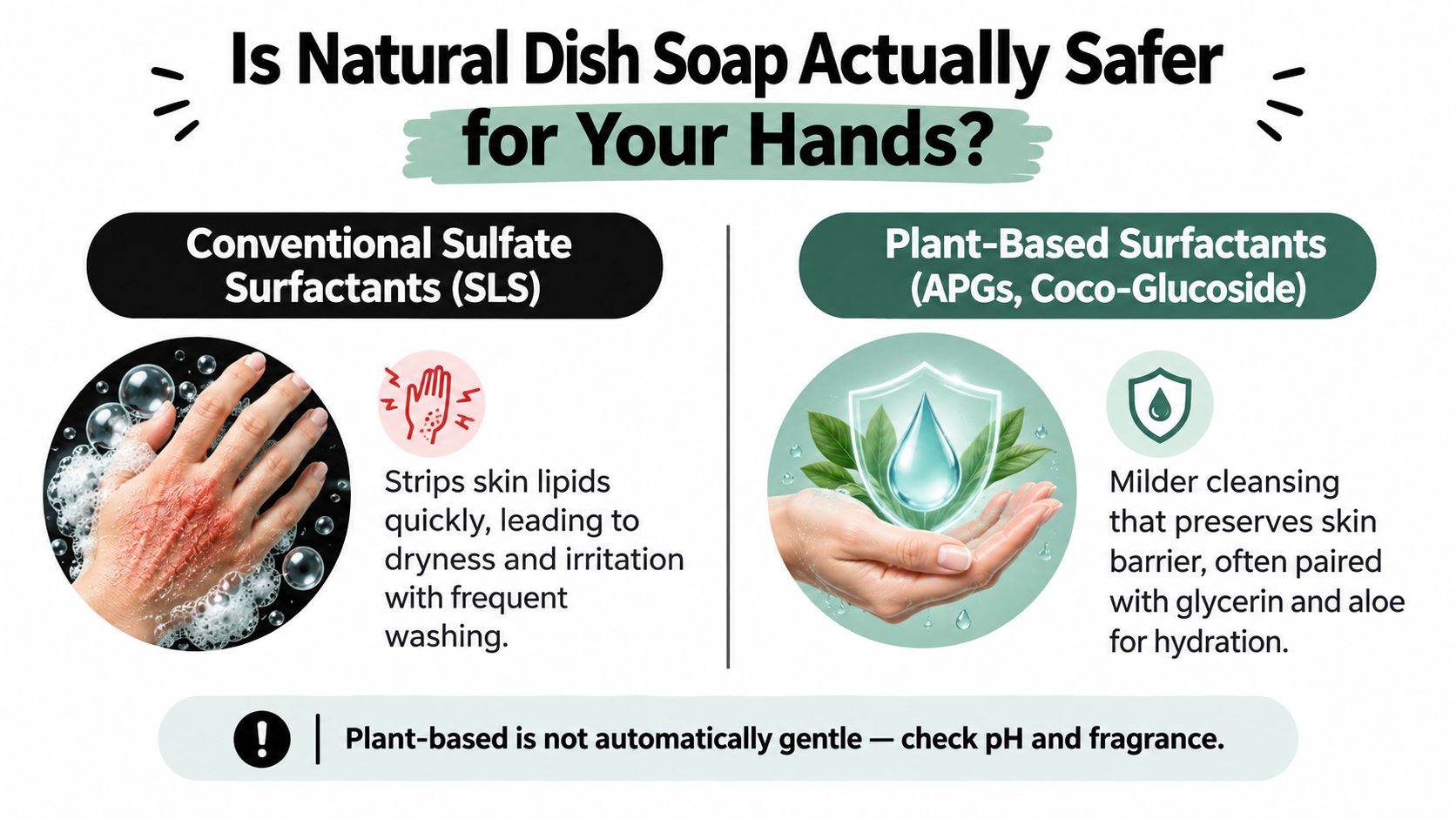
For sensitive hands: Choose a transparent, fragrance-free formula, avoid leaving concentrated soap on your skin, rinse thoroughly, and wear gloves when washing frequently.
Don't confuse “safe for skin” with “safe to ingest.” Dish soap is made to be rinsed from food-contact surfaces, not consumed. If a plate feels slick, smells strongly perfumed, or shows a visible film, rinse again and reassess the formula, water hardness, and amount used.
Refillable Systems and the Low-Waste Habit
The empty bottle is where a sustainability claim becomes a household behavior. A refill system works best when you keep a durable dispenser, replenish it with a concentrated or bulk format, and return or reuse the refill packaging instead of treating every container as disposable.
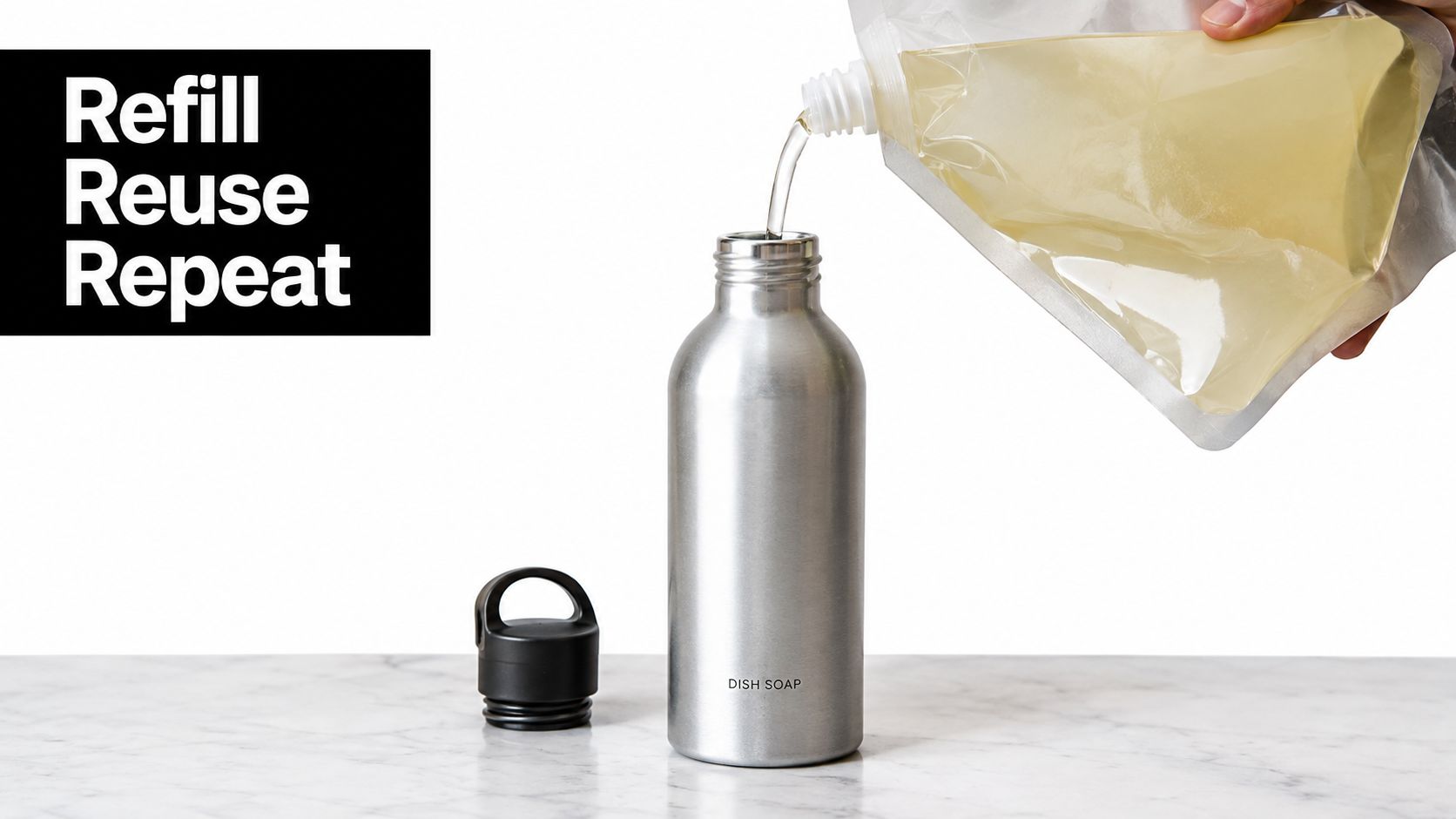
One model uses a sturdy reusable bottle paired with a larger refill. Another uses a grocery-store refill station, where you bring your container and pay for the amount dispensed. A third ships concentrates for dilution at home. These systems differ in transport, material, and cleaning requirements, so “refillable” still needs a closer look.
Industry summaries report that refillable household cleaning products can use 86% less plastic than traditional products, while refill formats can also reduce shipping volume and weight (refillable cleaning product overview). A household guide gives the habit a tangible scale: one reusable bottle refilled monthly can replace 12 plastic bottles per year, or 60 bottles over five years (refillable cleaning guide).
What to verify before joining
- Return path: Does the company take packaging back, or does it tell you to recycle it?
- Cleaning process: If containers return, does the brand explain how it washes and sanitizes them?
- Refill efficiency: Does the refill replace a meaningful amount of single-use packaging?
- Convenience: Can you refill locally, order by subscription, or store the format safely?
Fillaree offers a concrete example of a home refill approach. Its system uses 0.5-gallon boxes to top up standard 8 oz bottles up to eight times, and the company takes back used refill bags for washing, sanitizing, and reuse. For shoppers comparing options, this dish soap spray bottle guide can help explain how a reusable dispenser fits into daily kitchen use.
This video shows the physical rhythm of a refill routine, from transferring product to keeping the bottle in service:
The best system is the one you'll keep using. A return program that requires too much storage or shipping may fail in practice, while a nearby bulk station can make the low-waste choice automatic.
Getting the Best Results From Your Natural Dish Soap
Technique often matters more than shoppers expect. Before replacing a natural dishwashing soap, adjust the conditions that control cleaning.
Start with the amount
Put a few drops into warm water in a basin, or apply a modest amount to a wet sponge. A thick layer of undiluted soap can create more rinsing work without improving grease removal. Let very greasy cookware sit briefly in warm, soapy water before scrubbing.
Account for your water
Hard water can interfere with fatty-acid soap salts, reducing lather and leaving mineral spots. If you see a cloudy film, test a small batch with softened water, improve rinsing, or use the product's recommended hard-water method. Don't add vinegar directly to a soap mixture unless the manufacturer specifically says it's compatible, since acid can change soap chemistry.
Match the tool to the soil
Cellulose cloths and walnut-based scrubbers can provide useful agitation without forcing you to keep adding soap. Use a separate tool for heavily greasy pans, rinse the sponge thoroughly, and let it dry between uses.
Watch for these signals:
- Greasy film: Use warmer water, more agitation, or a little more soap.
- White spotting: Investigate hard water and rinse quality.
- Tight hands: Reduce concentrated contact, switch to fragrance-free, or wear gloves.
- Sudden foam loss: Check for a water change, a saturated sponge, or product separation before blaming the formula.
A good natural dishwashing soap should leave dishes clean without requiring a dramatic change to your routine.
Choosing a Natural Dish Soap Worth Your Dollar
A sensible purchase passes three checks.
First, inspect the ingredients. Look for named surfactants such as decyl glucoside, coco-glucoside, APGs, or soap salts such as sodium cocoate. A label that only says “plant-derived cleaners” gives you less information than one that identifies the actual cleaning agents.
Second, look for verification. USDA Certified Biobased can clarify renewable content. EPA Safer Choice adds a formula-level safety review. Independent biodegradability and performance testing can help answer what happens after use and whether the soap removes grease effectively.
Third, examine the refill infrastructure. A reusable bottle is useful, but the system becomes more meaningful when you can buy concentrated refills, use a bulk station, or return packaging for cleaning and reuse. A recyclable bottle still requires a new container each time, while a closed-loop return model keeps the package in service longer.
Don't judge value by the shelf price of the first bottle. Compare how much product you use per wash, whether refills reduce packaging, and whether the brand provides practical support for returning or reusing containers. Supporting good companies that care about ingredients, waterways, workers, and waste works best when your purchase aligns with a habit you can repeat.
Fillaree offers the Clean Plate Club dish soap and a home refill system designed for reusable bottles and returning refill bags for washing, sanitizing, and reuse. Visit Fillaree to explore the dish soap options, refill formats, and ways to build a lower-waste kitchen routine.