

Reusable Dish Soap Dispenser Guide
The old bottle was nearly empty, but the sink still looked crowded. A reusable dish soap dispenser changed that small corner from a collection of fading plastic containers into one dependable tool that could be refilled, cleaned, and kept in service.
Table of Contents
- Rethinking the Kitchen Sink
- The Real Impact of Refillable Systems
- Materials and Pump Mechanics Explained
- Choosing the Right Dispenser for Your Home
- Maintenance and Hygiene Best Practices
- Closing the Loop with Circular Refills
- Building Lasting Low-Waste Habits
Rethinking the Kitchen Sink
A kitchen sink tells the truth about household routines. There's the half-full dish soap bottle beside the sponge, another bottle waiting in the cupboard, and perhaps a container kept “just in case” even though nobody remembers what it once held. The bottles rarely empty together, labels curl at the edges, and the counter becomes a storage area for products that were designed to be discarded.
A reusable dish soap dispenser offers a different rhythm. You fill one container, use it every day, wash it when needed, and refill it rather than replacing the whole package. The change is modest, but it turns an automatic purchase into a visible habit. Each time you press the pump, you're reminded that the container has a life beyond its first use.
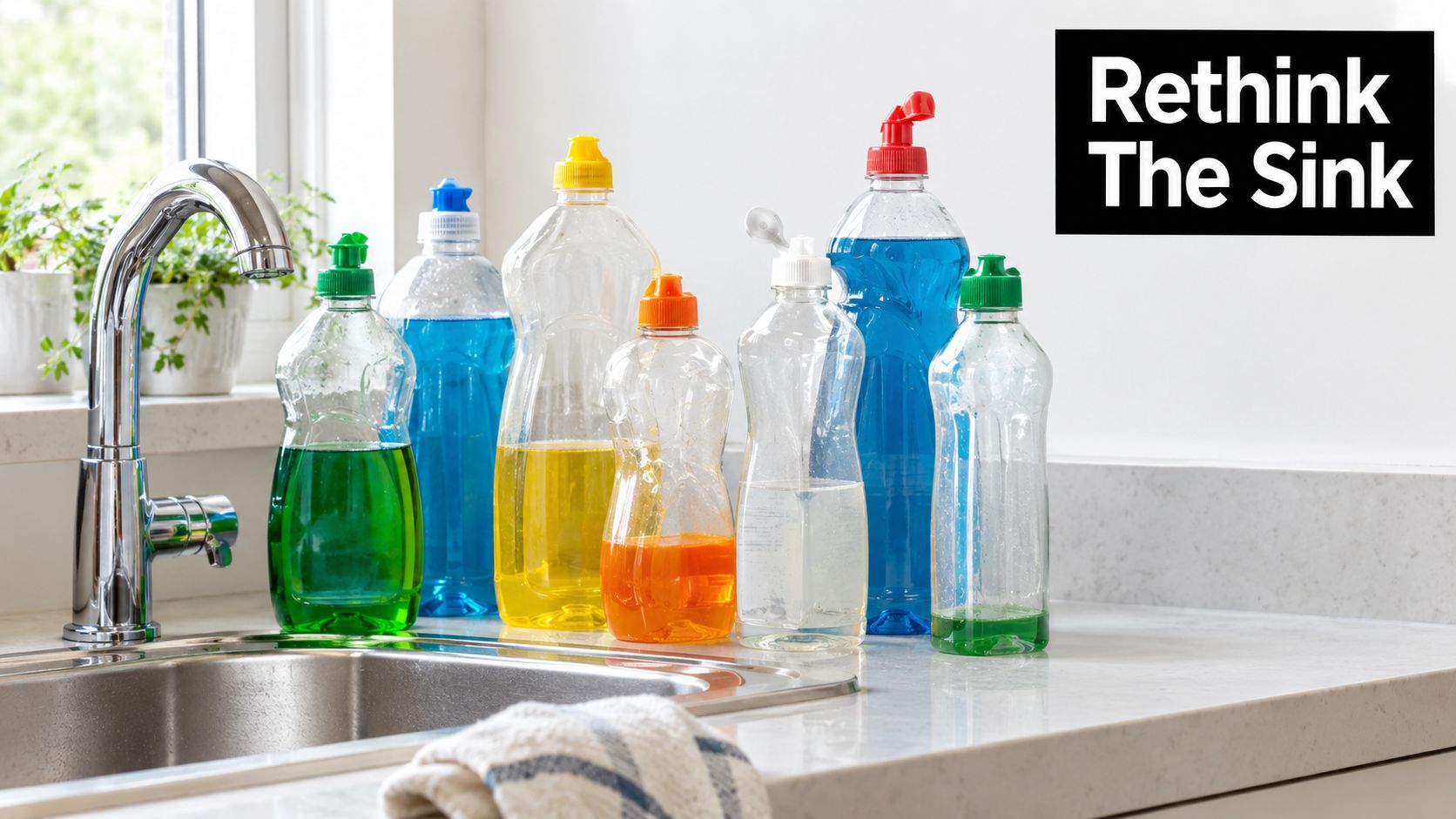
From make, take, waste to refill and repeat
The familiar household model is linear. A company makes a bottle, a shopper takes it home, and the package eventually leaves the kitchen as waste. A refill system changes the role of the container. The bottle becomes part of the routine, while the soap moves through a replenishment system.
That shift matters because sustainability becomes practical when it fits the way people already wash dishes. You don't need a dramatic renovation or a perfectly coordinated kitchen. You need a container that works with one hand, a pump that handles your soap, and a refill you'll remember to order or collect.
A useful starting point: Choose the dispenser you'll happily clean and refill, not merely the bottle that looks attractive on the first day.
Values belong at the point of use
A reusable dispenser also makes purchasing values more tangible. Choosing good products and supporting good companies that care about people, materials, and communities gives an ordinary chore a wider meaning. The decision isn't about achieving a flawless zero-waste home. It's about building a countertop that reflects intentionality, durability, and respect for resources.
The best swap is the one that survives real life. If the pump is awkward, the bottle slips on a wet counter, or cleaning feels impossible, the habit won't last. A reusable dish soap dispenser earns its place by making the lower-waste choice easy to repeat.
The Real Impact of Refillable Systems
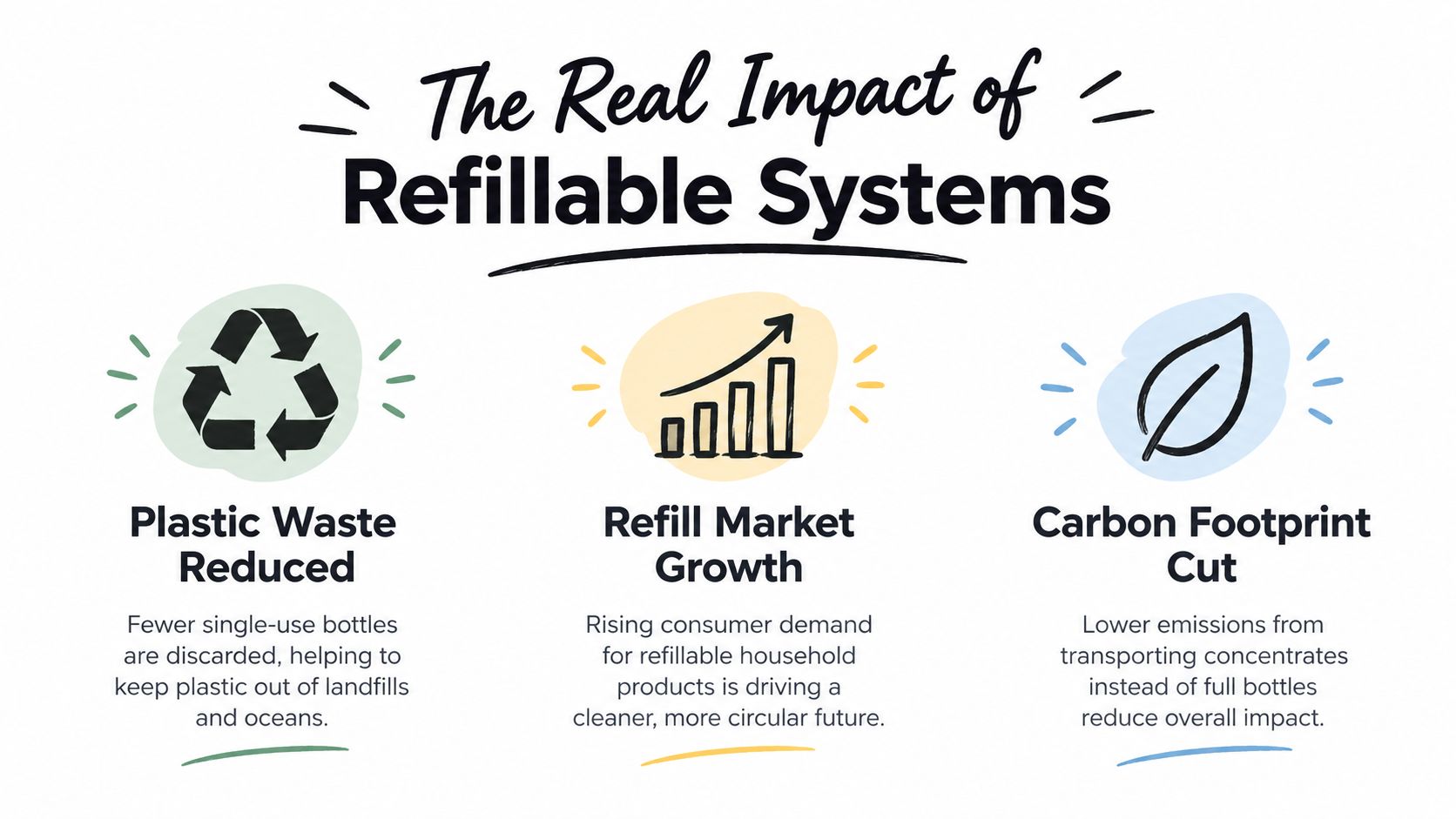
A refillable package isn't a container with a sustainability label. Reusable packaging is designed to be refilled or used again for the same purpose multiple times, and UN-backed guidance on reuse schemes describes systems ranging from bulk dispensers in stores to more involved models that include deposits, take-back, washing, and repair.
That definition puts the countertop dispenser inside a larger system. The bottle is the durable part. The soap arrives through a refill, concentrate, bulk station, or other format that reduces the need to purchase another complete package. The environmental benefit depends on whether people keep using the container and whether the refill pathway is convenient enough to become normal.
A category moving beyond the niche
The global soap dispenser market, which includes the reusable dispenser category relevant to dish soap dispensers, was valued at USD 2.56 billion in 2025 and is projected to reach USD 4.64 billion by 2034, implying a 6.94% CAGR over that forecast period, according to Mordor Intelligence's soap dispenser market analysis. North America represented 32.42% of the market in 2025, pointing to a substantial, established market for countertop dispensers and refill habits.
The same source reports another market estimate of USD 2.01 billion in 2025, projected to reach USD 3.01 billion by 2031 at a 7.09% CAGR. The estimates use different market scopes or methodologies, but they point in the same direction. Reusable dispensing hardware belongs to a growing household and hygiene category rather than a fringe experiment.
Refill habits need an ecosystem
Refill formats are also gaining ground in dish soap. In Northern America, refill pouches and bulk systems were estimated to represent 12% to 18% of liquid dishwashing volume by 2026, compared with about 5% to 7% in 2020, and the source projects 40% to 55% of unit sales by 2035, as reported in IndexBox's Northern America dish soap refill analysis. In Latin America and the Caribbean, refill products were estimated at 10% to 14% of the category by 2026, up from roughly 6% to 9% in 2023, with projected volume growth of 7% to 11% CAGR through 2035, from the same source.
For households, the lesson is simple. A permanent dispenser works best when refill packaging, local stations, delivery options, and clear labeling all support it. For label organization during a busy refill routine, an InchBug refill kit for labels can help keep containers identified and easy to manage.
Materials and Pump Mechanics Explained
A dispenser can look timeless and still fail quickly if its materials and pump don't match the kitchen environment. Water, soap residue, repeated pressing, drops, and wet hands all test the bottle and mechanism. Longevity starts with construction, not decoration.
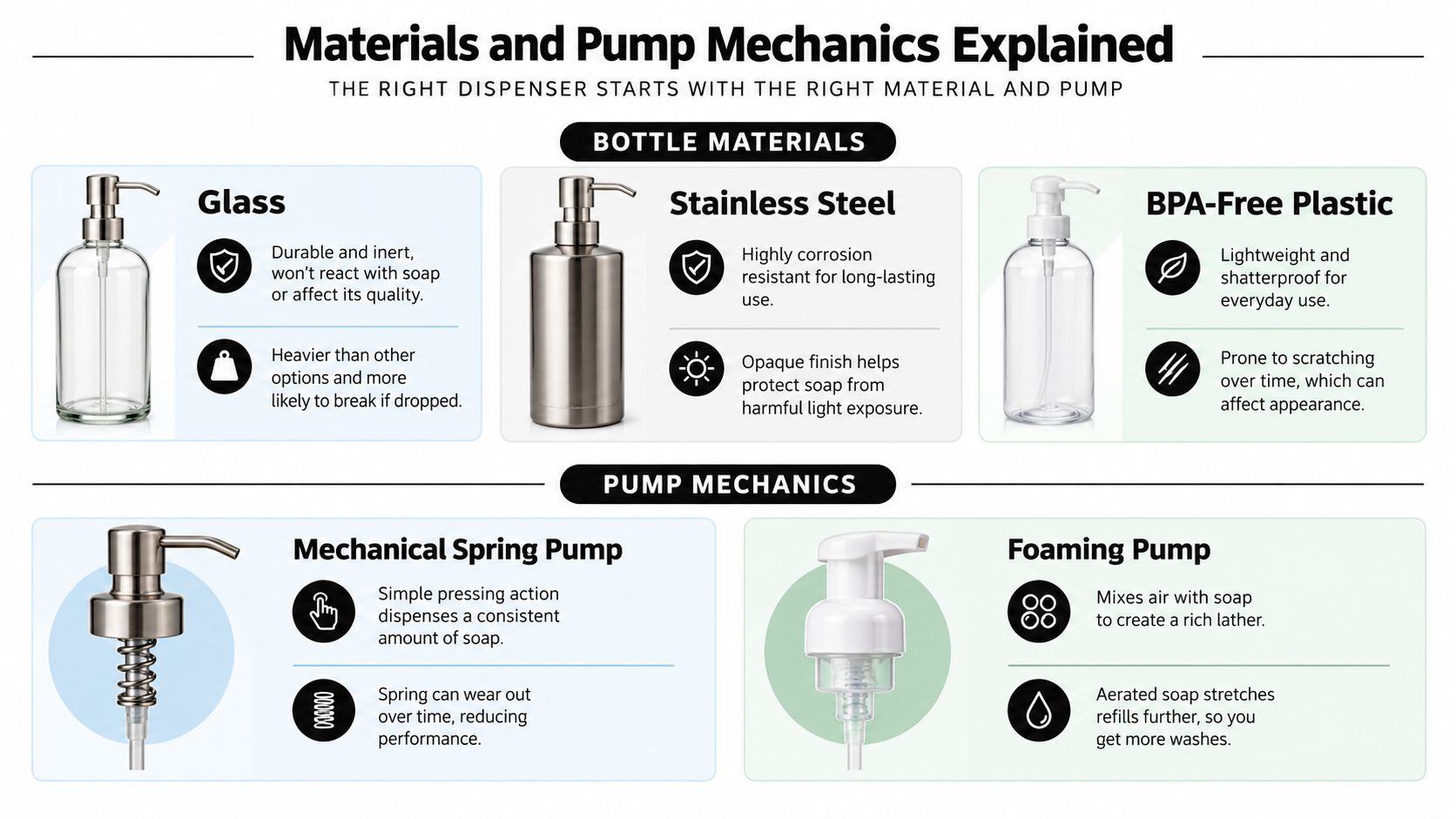
Glass is attractive, easy to inspect, and generally inert for household liquids. Its drawbacks are weight and breakage risk, especially beside a hard sink. Ceramic offers a substantial feel and can hide the soap from view, but chips and cracks can complicate cleaning. High-density plastics such as HDPE are valued for chemical resistance and impact toughness, while polypropylene, or PP, is commonly used in pump parts because it handles repeated flexing well. Stainless steel resists corrosion and blocks light, although its opacity makes the fill level harder to judge.
Bottle material is a daily decision
Think about how your sink is used rather than choosing by appearance alone.
- Glass: A strong choice when visual inspection and an inert container matter more than weight.
- Stainless steel: Useful when you want opacity, corrosion resistance, and a surface that won't show the soap's color.
- BPA-free plastic: Practical for households that need a lightweight, shatter-resistant bottle, though scratching can become a maintenance concern.
A mixed-material design can make sense. One commercial specification pairs HDPE for the bottle with PP for the pump, reflecting the different jobs each material performs. The bottle needs chemical resistance and toughness. The pump needs to tolerate repeated mechanical loading.
Pumps translate design into experience
A standard mechanical pump suits thicker liquid soap and dispenses a familiar dose with a simple press. Foam pumps mix liquid with air, producing an aerated output that can make refills stretch further in the right routine. Drop and spray mechanisms serve different dispensing patterns, so the pump should match the soap's viscosity and how much control you want over each application.
A commercial dispenser specification reports about 150,000 total dispenser cycles, with foam-pump configurations exceeding 40,000 cycles, drop pumps reaching about 30,000 cycles, and spray pumps about 23,000 cycles, as documented in this soap dispenser performance specification. Those figures aren't a promise that every household dispenser will achieve the same lifetime, but they show why pump design deserves as much attention as the bottle.
For larger refill containers, a dedicated gallon jug pump can make transferring soap less awkward and reduce spills during a refill.
Choosing the Right Dispenser for Your Home
The right dispenser depends on the person pressing it, the soap inside it, and the space around it. A single person with a compact sink may prefer a small glass bottle with a precise pump. A busy household may value a wider base, a larger opening, and a pump that can be operated with a soapy wrist.
Start with the sink. Measure the available counter space, look for splashing patterns, and check whether the base will stay stable on a damp surface. A non-slip foot can matter more than a decorative finish. If you wash dishes by hand, one-handed operation is essential. You shouldn't have to put down a plate to wrestle with the dispenser.
Use the soap as your guide
Thick, concentrated gels need a pump with a passage wide enough to avoid frequent clogging. Lighter formulas may work well with a foaming pump, provided the product is designed for that mechanism. Don't assume that every pump can handle every soap. The manufacturer's compatibility guidance is more useful than a beautiful product photograph.
Capacity should follow your refill pattern. If you refill often and have little storage, a compact container keeps the sink uncluttered. If you buy in bulk, choose a bottle that reduces the frequency of transfers without becoming too heavy to lift when full.
| Household Need | Ideal Material | Best Pump Type | Key Feature to Look For |
|---|---|---|---|
| Compact sink or light daily use | Glass or stainless steel | Mechanical spring pump | Small footprint and stable base |
| Busy household with frequent washing | Durable plastic or stainless steel | Mechanical spring pump | Comfortable one-handed action |
| Lightweight handling | BPA-free plastic | Mechanical spring pump | Shatter resistance and easy grip |
| Lower-dose washing routine | Glass or plastic | Foaming pump | Compatibility with the chosen soap |
| Visible fill level | Glass | Mechanical spring pump | Wide opening and clear measurement marks |
Make the purchase serve the routine
Hospitality products often prioritize stability and repeated use, so it can be helpful to browse soap pumps for hospitality when comparing practical designs. You don't need a commercial dispenser, but hospitality-oriented features can reveal whether a product is built around daily handling rather than occasional display.
A useful kitchen option should also be easy to refill without a funnel, easy to wipe without abrasive tools, and simple to take apart when residue appears. Fillaree's hand soap dispenser for a kitchen sink offers another reference point for thinking about coordinated, refill-ready countertop containers.
Maintenance and Hygiene Best Practices
The prettiest dispenser becomes a poor sustainability choice if its pump clogs, leaks, or develops residue that makes you abandon it. Reuse depends on maintenance. A container that stays clean and functional can remain part of your routine, while a neglected mechanism can send you back to disposable bottles.
A peer-reviewed study found that contamination in refillable pump dispensers can concentrate around the pump head and threaded interface, where stagnant liquid and moisture may support biofilm formation. The issue isn't that refilling is unsafe. The risk comes from leaving wet, stagnant residue in the parts that connect the pump to the product stream, as described in the study of microbial contamination in refillable pump dispensers.
Clean the bottle and pump separately
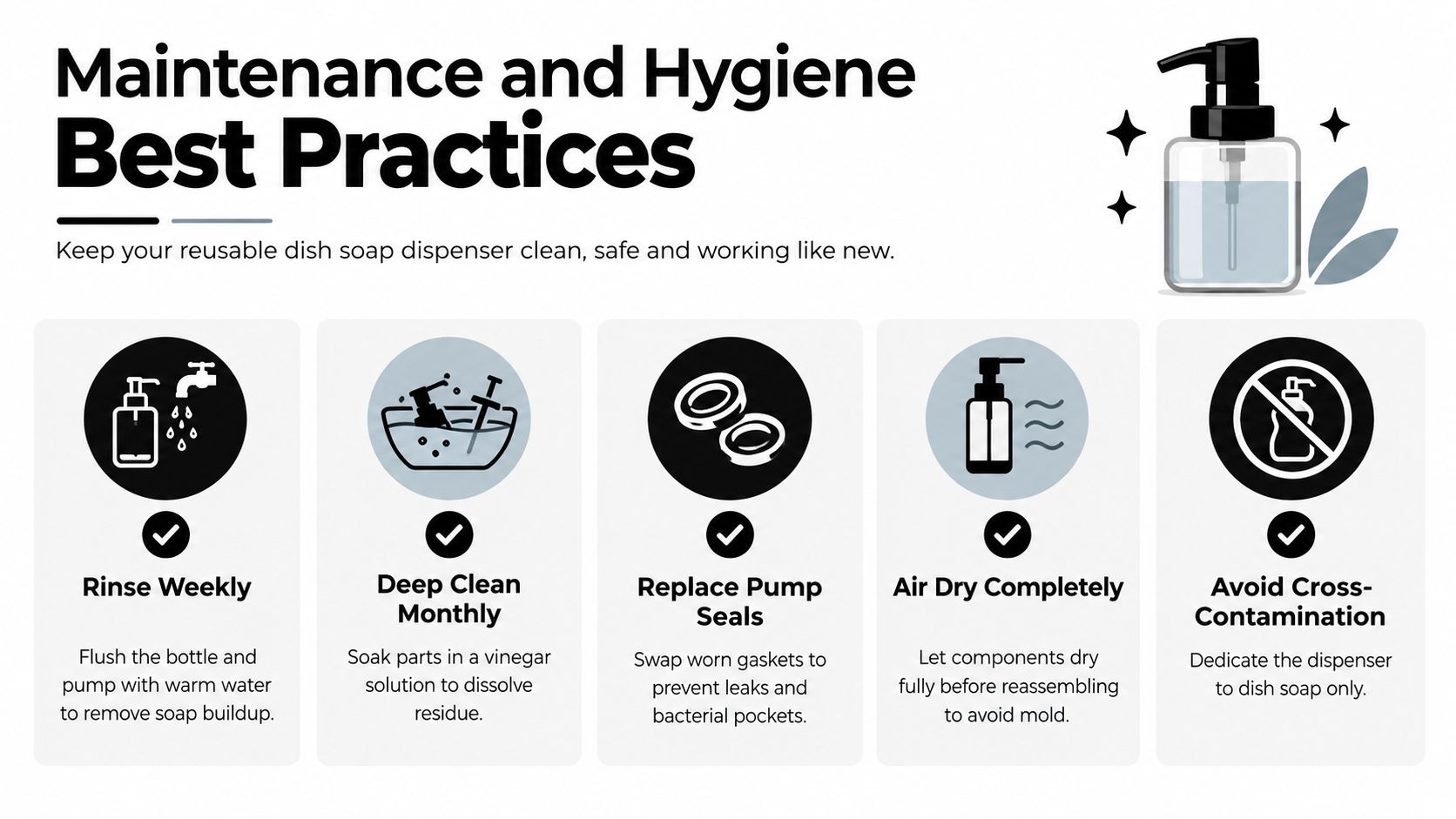
When the dispenser starts to feel sticky or the pump output changes, don't just add fresh soap on top. Empty the bottle, rinse it with warm water, and work clean water through the pump until the stream runs clear. Remove the pump from the bottle and rinse the threaded neck, dip tube, and underside of the head.
For a deeper clean, use the manufacturer's care guidance. A mild vinegar solution can help loosen mineral residue, but don't use it indiscriminately with soap formulas or materials that may react to acids. Avoid abrasive pads and harsh tools that scratch surfaces and create places for residue to collect.
A simple maintenance rhythm
- Rinse after buildup appears: Flush the pump and bottle before residue hardens.
- Dry every component: Let the bottle, dip tube, and pump air-dry fully before reassembly.
- Inspect the interface: Check threads, seals, and the pump head for sticky film or trapped liquid.
- Clear clogs gently: Warm water is a safer first response than forcing the pump or inserting sharp objects.
- Replace worn parts: A cracked gasket, weak spring, or leaking seal can make the dispenser unhygienic and waste soap.
The overlooked habit: Keep the pump head clean, not just the bottle. That's where moisture and stagnant product can remain after every use.
Dedicate the container to dish soap rather than switching between unrelated products. Label it clearly, especially if several dispensers share a sink. Maintenance takes little time when it's part of the refill routine, and it protects both the hygiene of the dispenser and the environmental value of keeping it in service.
Closing the Loop with Circular Refills
The bottle is only one part of the system. A reusable dish soap dispenser reduces waste most effectively when the soap comes through a refill pathway that also considers packaging, transport, and recovery. That's where supporting good companies who care can turn a personal kitchen choice into participation in a wider circular economy.
Fillaree is a women-owned manufacturing company based in Durham, North Carolina, producing refillable, low-waste essentials for home and body. Its product range includes dish soap, hand soap, shampoos, conditioners, and all-purpose cleaners, with a focus on reducing reliance on single-use plastic through refill systems.
A refill should be easy to repeat
Fillaree's home refill model uses 0.5-gallon boxes that can top up standard 8 oz bottles up to eight times, according to the publisher information provided for this article. Customers can also use refill stations, including partner locations across the United States, or visit the Durham storefront.
The system extends beyond selling a replacement package. Fillaree takes back used refill bags, washes and sanitizes them, and reuses them at no cost to the customer. That return pathway gives the packaging a planned next step instead of leaving the household to guess what responsible disposal should mean.
Circular thinking begins with the next use: Ask not only whether a package can be recycled, but whether the company has designed a practical route for reuse, return, or recovery.
Community shapes the value
The broader field of reuse includes both simple bulk dispensers and complex programs involving take-back, cleaning, deposits, and repair. A major industry analysis identified nearly 1,200 reuse and refill solutions globally, demonstrating demand from businesses and customers for alternatives to disposable packaging, especially single-use plastics, as reported in this analysis of global reuse and refill solutions.
For shoppers, spending with women-owned and community-focused businesses can support more than a product transaction. It can help sustain teams that connect manufacturing, local access, refill infrastructure, and practical education. Fillaree's refill station and zero-waste approach shows how the dispenser on your sink can connect to a network beyond your home.
Building Lasting Low-Waste Habits
A reusable dish soap dispenser becomes meaningful through repetition. The first refill feels like a purchase decision. The next one feels like a household rhythm. Over time, the value comes from choosing a durable container, caring for the pump, and using a refill system that makes continuation straightforward.
Start with three checks before buying:
- Inspect the construction. Look for a stable base, a refill opening you can access easily, and materials suited to your sink.
- Match the pump to the soap. Thick formulas need dependable liquid flow, while foaming systems require compatible soap and a clean mechanism.
- Plan the refill. Decide where the next soap supply will come from before the bottle is empty.
Let convenience support intention
Keep the refill where you'll see it, but not where it creates clutter. Add a small label to the dispenser, especially if you use more than one formula. When you clean the bottle, clean the pump at the same time. These tiny pairings prevent maintenance from becoming a separate chore that's easy to postpone.
The same mindset can extend beyond dish soap. A matching hand soap dispenser can replace another disposable bottle, while refillable all-purpose cleaner can bring the system into other rooms. Packaging choices matter across the household too, and an overview of eco-friendly alternatives to bubble wrap can help when you're evaluating how products arrive, not only how they're used.
Progress works better in community
You don't need a perfect kitchen to make a lasting change. Choose one dispenser that feels good in your hand, works with your soap, and can be cleaned without frustration. Then support companies that build useful products, fairer refill systems, and practical return pathways.
The goal isn't to perform sustainability at the sink. It's to make the lower-waste action the easiest action available, then share what works with neighbors, friends, and family. A durable bottle, a maintained pump, and a thoughtful refill can become a small daily vote for the kind of home and community you want to help build.
Fillaree offers refillable dish soap, reusable containers, home refill boxes, refill stations, and a take-back pathway for used refill bags. Visit Fillaree to choose a refill-ready option and make your kitchen sink part of a practical circular routine.