
What Is Eco Friendly Packaging and How to Choose It
You open a delivery box expecting one product and find a small mountain of cardboard, paper padding, plastic film, tape, and labels. Most of it served a useful purpose for a few minutes, yet the materials may remain in circulation, a landfill, or a waste-processing system for much longer. That everyday unboxing moment explains why the question what is eco friendly packaging deserves a more careful answer than “anything made from paper.”
Eco-friendly packaging is about the whole system. A package can contain recycled material and still be difficult to recover. A package marked compostable may need a specific industrial facility that your community doesn't have. A lightweight plastic pouch might use less material than a heavier alternative, but its recovery route may be limited.
The sustainable choice depends on the product, distribution route, local infrastructure, and what happens after use. This guide makes those trade-offs practical. You'll learn how recycled content, reuse, refill, compostability, recyclability, lifecycle assessment, and certifications fit together, then see how a circular refill model can work in daily life.
Table of Contents
- Introduction to Eco Friendly Packaging Today
- What Eco Friendly Packaging Really Means
- Common Eco Friendly Materials Compared
- Certifications and Lifecycle Thinking Explained
- Why Recycling Alone Does Not Solve Packaging Waste
- How Fillaree Makes Circular Packaging Work in Practice
- Choosing Better Packaging for Your Home or Brand
Introduction to Eco Friendly Packaging Today
Packaging has moved from a niche environmental concern to a major business priority. One industry estimate places the sustainable packaging market at about USD 325.94 billion in 2026, with a projection of USD 463.41 billion by 2031 and a 7.29% CAGR, while another industry summary values it at USD 243.83 billion in 2023 and projects USD 484.9 billion by 2032. These estimates differ, but both point to expanding demand as brands rethink materials, formats, and supply chains. (Mordor Intelligence sustainable packaging market analysis)
That growth reflects a simple reality. Packaging affects what companies buy, how products travel, how customers dispose of them, and whether materials remain useful after the first purchase. It also gives shoppers a visible way to support companies whose products align with their values.
Why the label alone isn't enough
Words such as recyclable, compostable, recycled, and biodegradable sound similar, but they describe different properties. Recyclable usually means a package can be processed by a suitable recycling system. Recycled content describes what went into making the package. Compostable describes a material's ability to break down under defined conditions and standards.
Those distinctions matter at the kitchen bin. A paper carton may be widely accepted in local recycling, while a compostable film may require commercial collection. A reusable bottle may prevent repeated single-use packaging, but only if someone refills it rather than replacing it.
Practical rule: Judge the package by what happens across its life, not by the most attractive word on its front label.
For households, that means buying products with less unnecessary packaging, using local disposal guidance, and choosing refill or return systems where they're convenient. For small brands, it means auditing every component, including closures, coatings, labels, adhesives, and shipping materials. A good product paired with a confusing or unrecoverable package can undermine the values behind the purchase.
By the end, you'll have a clearer way to choose packaging that supports lower waste, credible claims, and companies that care about how their products move through the world.
What Eco Friendly Packaging Really Means
Eco-friendly packaging is a system designed to reduce environmental impact across its lifecycle. The journey starts with collecting or extracting materials, then moves through manufacturing, transport, and the period when the package protects a product. It ends with reuse, recycling, composting, or disposal. Lifecycle assessment compares these stages, much like reviewing the full cost of a trip instead of judging it by the price of the ticket alone.
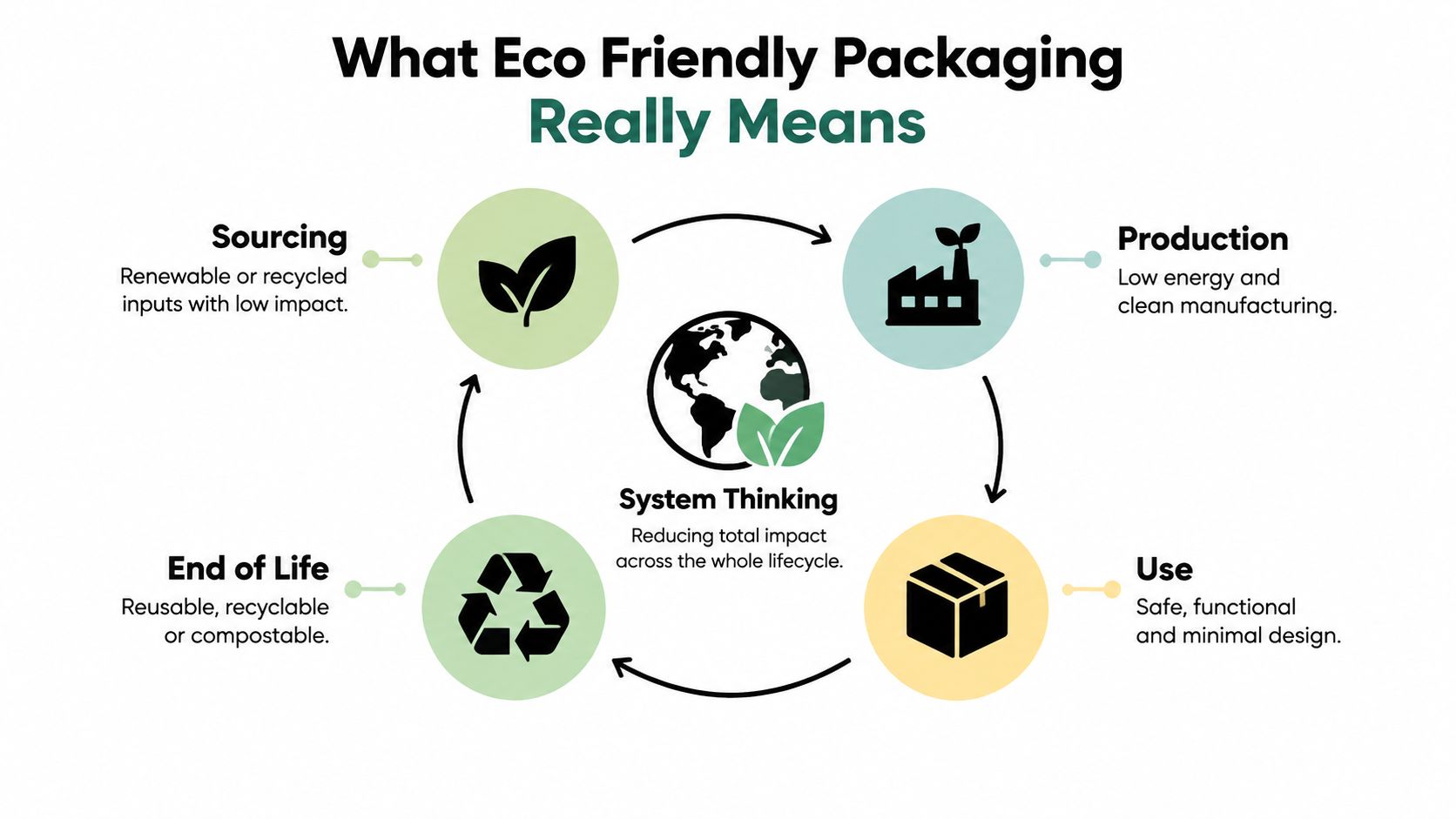
A single-use coffee cup and a refillable bottle show why material alone cannot settle the question. The cup may use less material for one purchase, then enter a waste stream. The bottle needs more material at the start, yet can support many refills. Its overall impact depends on how often people use it, how it is cleaned, how far it travels, and whether the system keeps it in service.
Four strategies shape the package
- Recycled content puts material recovered from earlier products into a new package. This can reduce demand for virgin feedstock, especially when the package remains recyclable after use.
- Reuse and refill keep a durable container or transport format circulating. The approach works when customers can return, refill, or wash the package without unreasonable effort.
- Compostability directs suitable material into an organics pathway instead of a recycling pathway. The package must meet a relevant standard and reach a suitable composting facility to perform as intended.
- Design for recyclability helps collection, sorting, and reprocessing systems handle the package. Simple material structures and compatible components can matter more than a broad environmental promise.
A renewable material does not guarantee a lower impact. Processing may require substantial energy, or the package may never reach the facility equipped to handle it. Plastic can also serve a practical role when it is lightweight, durable, made with recycled content, and supported by a real recovery route.
Ask which packaging system delivers the product with the lowest practical lifecycle burden, rather than which material looks green.
This system view helps reveal the perception gap between a package labelled recyclable and one containing recycled material. It also explains why a dependable refill model can outperform a supposedly greener disposable alternative. The strongest choice reduces waste through the whole loop, from sourcing to its next use.
Common Eco Friendly Materials Compared
No packaging material wins every comparison. The right choice depends on moisture, strength, product safety, transport distance, available recovery systems, and how customers will dispose of it.
Recycled paper and cardboard are practical for boxes, cartons, mailers, and inserts. Paper packaging can fit established recycling systems, but moisture, food contamination, coatings, and mixed-material construction can reduce its recovery options. The U.S. EPA reports that paper and paperboard packaging had an 80.9% recycling rate in 2018, with 32.1 million tons of corrugated boxes recycled out of 33.9 million tons of total paper and paperboard recycling. (U.S. EPA containers and packaging data)
Glass offers durability and a stable barrier for food, beverages, and personal care. It can be reused and recycled, but its weight can make transport more demanding, especially when the package travels long distances or returns through a collection loop.
Aluminum is lightweight compared with glass and useful for cans, tins, and some personal care formats. Its value depends on collection and sorting, while coatings, closures, and mixed components still need examination.
Recycled plastic can preserve the performance and low weight that brands need while reducing reliance on virgin plastic. It isn't automatically recyclable in every community, and flexible films often need special drop-off or take-back routes rather than curbside collection.
Bioplastics are made partly or fully from biological feedstocks, but bio-based doesn't automatically mean compostable or recyclable. Check the material specification and its intended recovery pathway.
Compostable films can suit selected food-service or organics applications, but only when certified and accepted by the relevant composting system. A compostable label without disposal instructions can send customers in the wrong direction.
Eco Friendly Packaging Materials at a Glance
| Material | Best For | Key Trade-off |
|---|---|---|
| Recycled paper or cardboard | Shipping boxes, cartons, inserts, mailers | Strong recycling potential, but moisture and coatings can interfere |
| Glass | Refillable food, beverage, and personal care containers | Durable and reusable, but heavy to transport |
| Aluminum | Cans, tins, and lightweight rigid formats | Useful recovery value, but collection and component design matter |
| Recycled plastic | Flexible pouches, bottles, and protective formats | Lightweight and resource-efficient, but recovery routes vary |
| Bioplastics | Applications requiring bio-based feedstock | Bio-based does not automatically define end of life |
| Compostable films | Products connected to verified organics collection | Require the right certification and composting infrastructure |
For a household coffee routine, packaging decisions can become surprisingly specific. A resource comparing the best pods for Keurig and Nespresso can help shoppers consider product format, materials, and disposal together rather than treating every pod as equivalent.
Small brands should also examine the shipping box as carefully as the product container. A practical example of that broader review appears in this guide to an eco-friendly shipping box, where the outer package becomes part of the sustainability decision instead of an afterthought.
Certifications and Lifecycle Thinking Explained
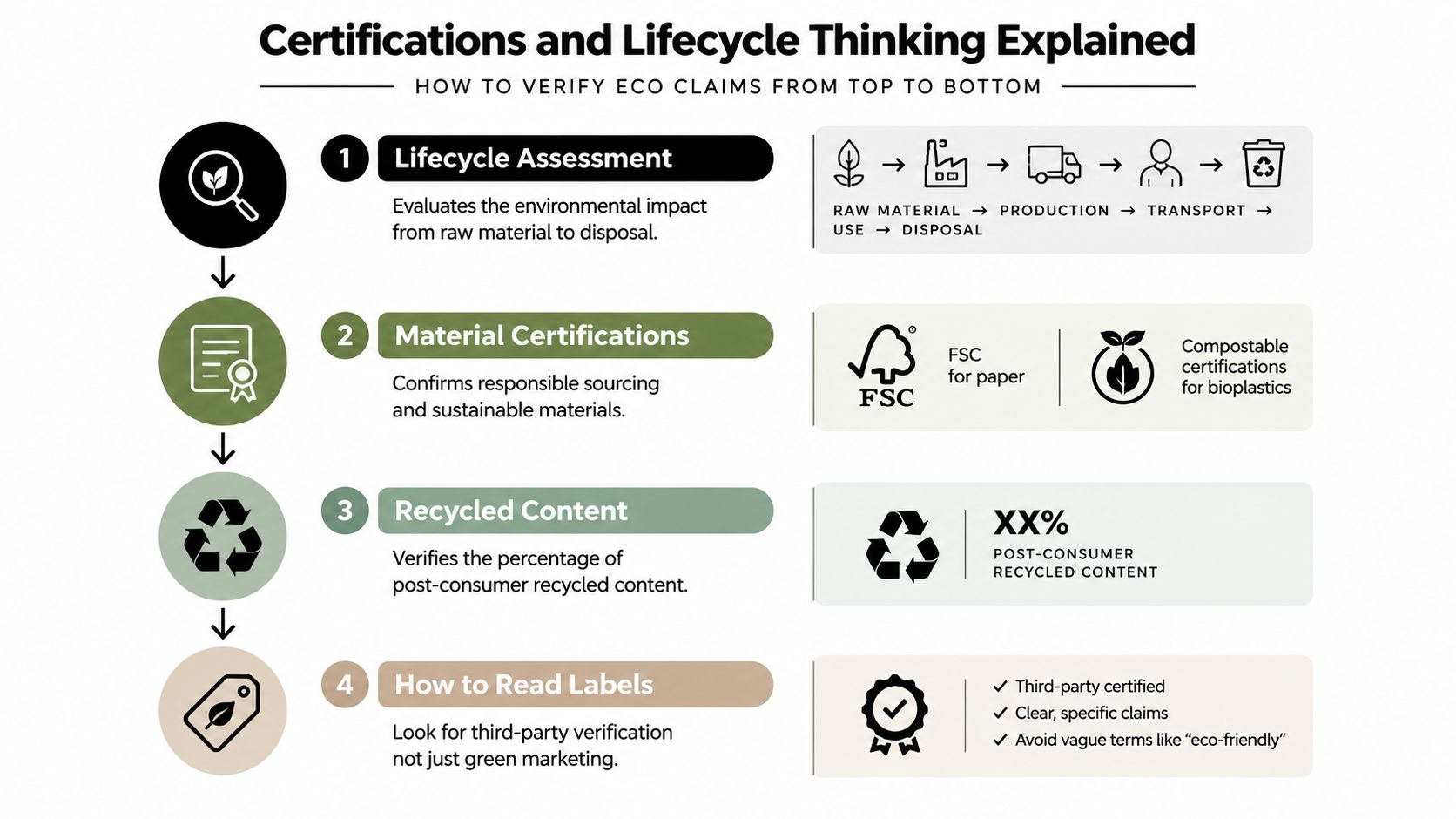
A package can look sustainable on a shelf and still create problems after disposal. Ask three questions: What is it made from? How was the claim verified? What happens after use? Certifications, lifecycle assessment, and precise labels help connect those answers.
Lifecycle assessment follows impacts from raw-material extraction through manufacturing, transport, use, and disposal. Comparisons also need the same functional unit, such as the packaging required to deliver a set amount of product or provide a set number of uses. Otherwise, a light single-use package and a heavier reusable one are being judged by different rules. The result depends on assumptions, including how often a container is reused and whether the required collection system exists.
What to verify on a label
- Paper sourcing: Look for a recognized forestry certification when virgin fiber is used, and check whether recycled content is included.
- Recycled content: Confirm whether the claim means post-consumer material and whether records support the stated composition.
- Compostability: Check the relevant certification, disposal instructions, and whether the intended composting facility accepts that format.
- Recyclability: Find out whether local programs accept the package. Technical recyclability alone does not guarantee collection or reprocessing.
In Europe, EN 13432 requires at least 90% disintegration after 12 weeks and 90% biodegradation within six months, with tests for ecotoxicity and heavy metals. ISO 17088 specifies requirements for compostable plastics. The same lifecycle study reported a cradle-to-grave footprint of 1.538 kilograms of CO2e for one kilogram of PET trays with 85% recycled content. Raising recycled content from 85% to 100% could reduce that footprint by about 24%. (EN 13432 and recycled-content lifecycle study)
Those findings do not make recycled PET the automatic winner. They show why a material swap needs context. A refillable container may require more material at the start, yet repeated use can change the comparison. A recyclable package may still perform poorly if local collection is unavailable. Packaging is a system choice, not a label or a single material.
Brands can document claims through an ESPR compliance policy, including evidence, component details, and disposal instructions. Shoppers can ask suppliers for the same information and review this practical guide on how to avoid greenwashing. Clear evidence helps separate a package that appears eco-friendly from one that works within a real recovery, refill, or reuse system.
Why Recycling Alone Does Not Solve Packaging Waste
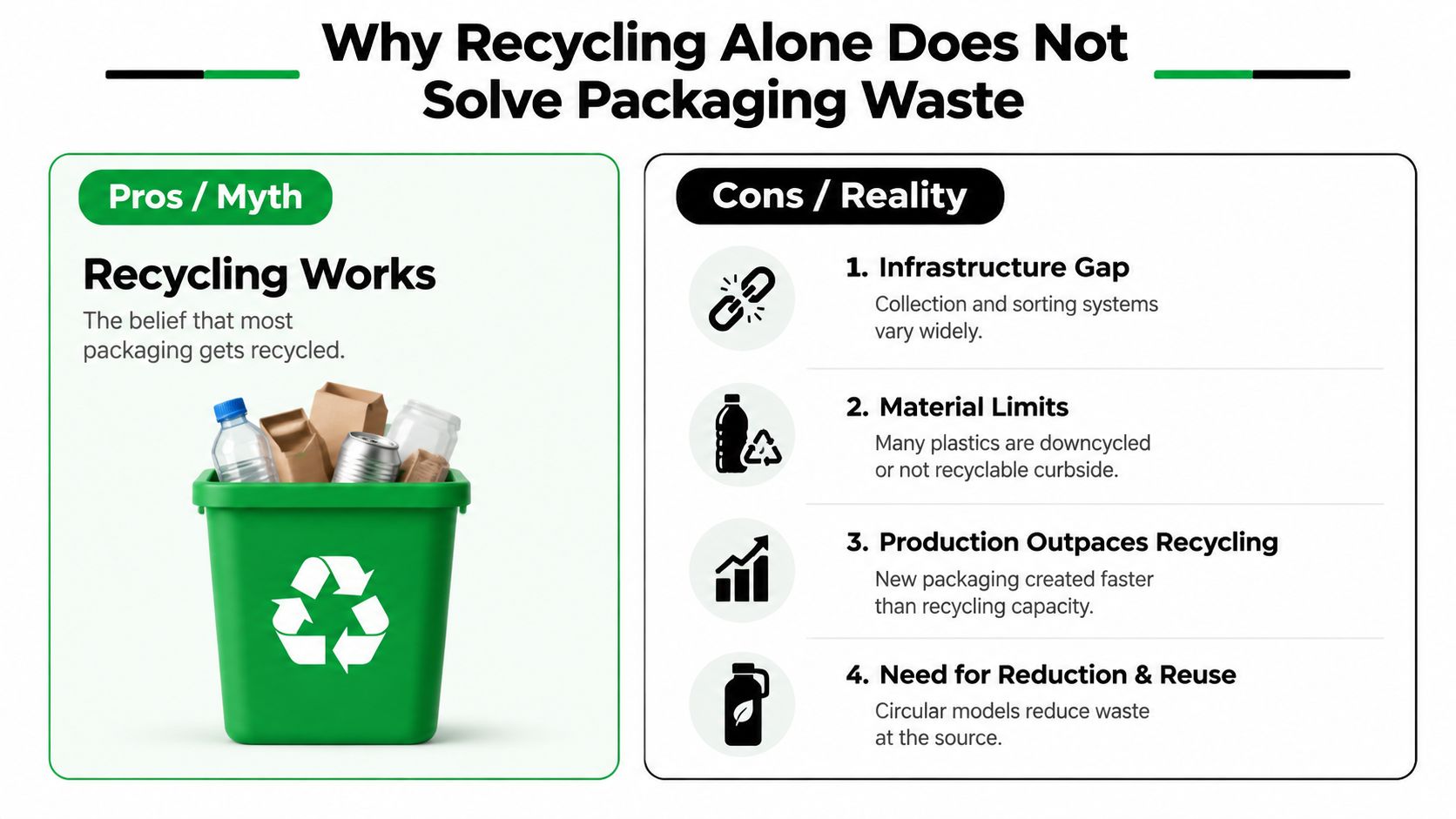
Recycling is valuable, but recyclable doesn't mean recycled. A package may be technically compatible with a process, yet fail to reach that process because the local program doesn't collect it, sorting equipment rejects it, contamination lowers its value, or the material has limited buyers.
The historical mismatch is substantial. OECD-linked analysis describes packaging as about 40% of annual waste generation and projects packaging waste rising from 142 million tons in 2019 to 380 million tons per year by 2060. A separate U.S. plastics packaging report summarized by a neutral industry source puts the U.S. plastics packaging recycling rate at 13.3%, unchanged since 2018, while thin-film LDPE and LLDPE mailers are recycled at just 2%. (OECD packaging waste analysis194/en/pdf))
Three labels, three different meanings
Recyclable describes a possible processing route. Recycled content describes material already recovered and used in the package. Compostable describes breakdown under specific conditions. Treating those terms as interchangeable creates poor disposal decisions and can contaminate otherwise useful waste streams.
Compostable packaging illustrates the infrastructure problem clearly. If a package needs industrial composting but a customer sends it to a landfill or curbside recycling, the intended benefit disappears. Recycling has a similar limitation when flexible films, multilayer laminates, or incompatible components lack a dependable collection route.
Why brands struggle to change
McKinsey identifies six major adoption barriers in 2025: affordability, performance, disagreement about what sustainability means, regulatory uncertainty, limited or unreliable supply, and incomplete knowledge of available solutions. Its 2025 consumer survey also found that people tended to rate recyclable or compostable plastic packaging as sustainable, while plastic containers and bottles made from recycled materials were among the least-sustainable options in their perception. (McKinsey sustainable packaging barriers)
That perception gap matters. A customer may praise a compostable pouch without access to composting, while overlooking a recycled plastic container that has a practical collection route. The better decision often starts earlier, with source reduction, concentrated products, refill formats, and durable packaging that stays in use.
How Fillaree Makes Circular Packaging Work in Practice
A refill system makes the idea of circular packaging easier to see. Instead of treating a bottle as a one-time container, the system separates the durable container from the product supply and creates a practical route for refilling or returning packaging.
Fillaree, a women-owned manufacturing company based in Durham, North Carolina, makes soaps, shampoos, conditioners, dish soap, and all-purpose cleaners through a refill-focused model. Customers can use 70+ refill stations across the United States, visit the Durham storefront, or order home refills in 0.5-gallon boxes that can top up standard 8 oz bottles up to eight times.
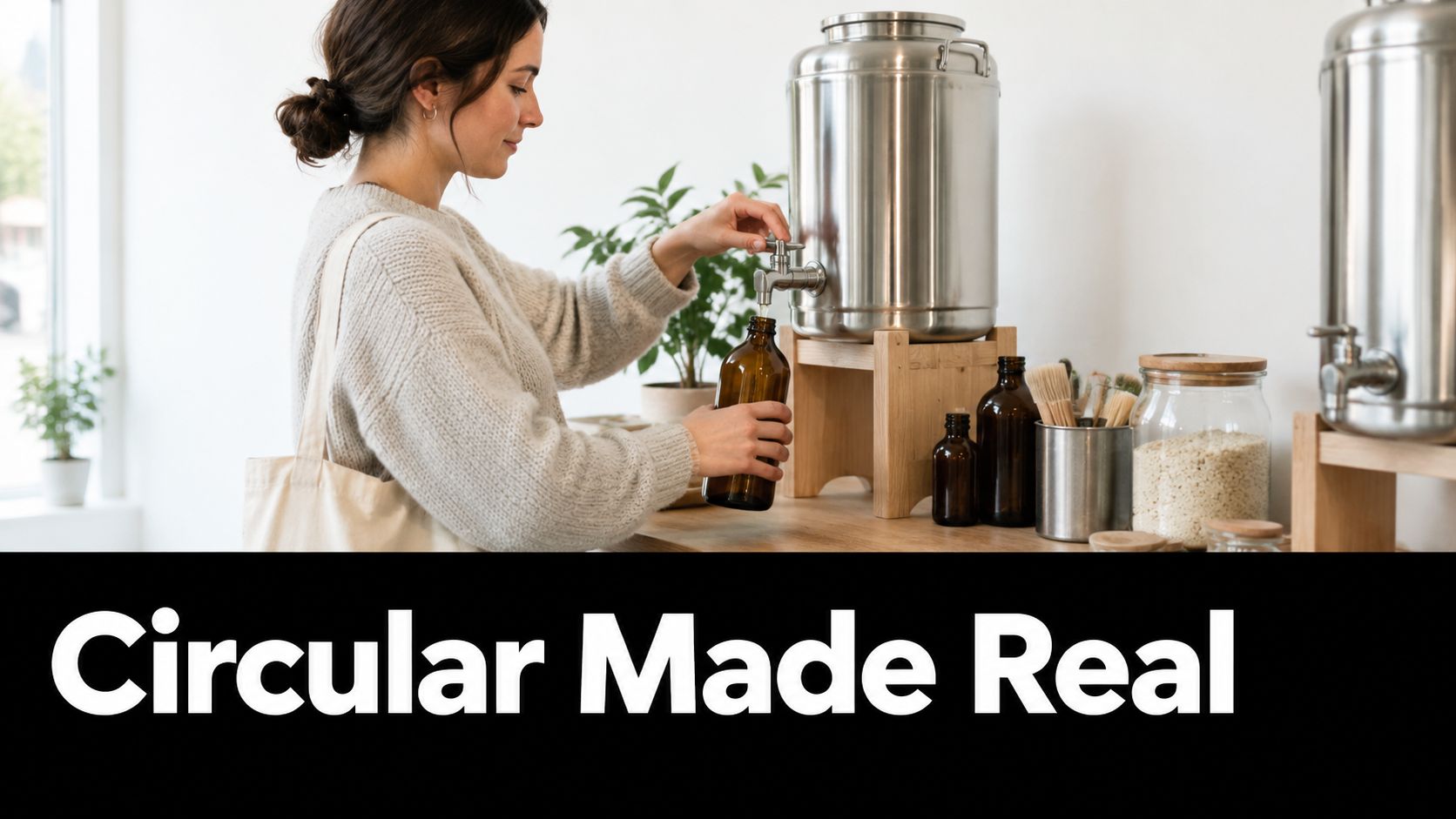
The return loop adds another layer. Fillaree takes back used refill bags, washes and sanitizes them, then reuses them at no cost to the customer. That approach addresses a weakness in many sustainability programs: asking customers to dispose of a package correctly without building a reliable system around that behavior.
The loop in everyday terms
A customer starts with a reusable bottle, buys or receives a refill, uses the soap or cleaner, and returns the empty refill bag through the take-back program. The company handles cleaning and reuse, while the customer avoids treating every purchase as a new container.
This model also shows why reuse can't be evaluated as a slogan. Return logistics, washing, customer participation, product protection, and convenient access all determine whether the loop functions. The Fillaree refill process gives customers a concrete way to understand those steps.
The broader lesson applies beyond soaps and cleaners. A café can examine returnable cups. A household can buy concentrated products and reuse dispensers. A small brand can test a return pouch or refill subscription before changing its entire packaging portfolio.
A circular package is not simply a durable object. It's a durable object attached to a working return, refill, or recovery system.
Supporting good companies that care means looking for that system evidence. The strongest examples explain what customers should do, what the company does next, and how the materials remain useful instead of disappearing into an uncertain waste stream.
Choosing Better Packaging for Your Home or Brand
Households and small brands need different tools, but they can use the same decision logic. Start with the option that prevents unnecessary packaging, then consider reuse, refill, recycling, and composting according to the infrastructure available where the package will be used.
A household checklist
- Buy less packaging: Choose concentrated products, larger formats, or refill options when they fit your routine.
- Reuse first: Keep durable bottles, jars, and bags in service rather than replacing them for cosmetic reasons.
- Check local rules: Search your local recycling or composting guidance before trusting a symbol on the package.
- Separate materials carefully: Remove avoidable contamination and follow instructions for films, caps, labels, and cartons.
- Support aligned businesses: Spend with companies that explain their sourcing, packaging components, return programs, and disposal routes.
Even personal expression can reflect those values. If you're choosing a visible environmental message for a vehicle or community event, a vegan car decal sticker is one example of selecting a product that communicates a principle while still requiring you to consider the sticker's own material and end-of-life details.
A brand checklist
For a small company, begin with a packaging inventory. List the product container, lid, label, seal, shipping box, filler, tape, and inserts. Then ask which components are necessary, which can be removed, and which local system can realistically process them.
A supplier should be able to explain material composition, recycled content, coatings, certifications, transport considerations, and disposal instructions. Test the package with the actual product before making a broad switch, because leaks, breakage, moisture exposure, and customer confusion can create more waste.
The European Union requires packaging placed on its market to be recyclable in an economically viable way by 2030, while its packaging rules also address recycled content, waste prevention, reuse formats, and high-quality collection and recycling across the lifecycle. (European Commission packaging waste rules) Regulatory direction reinforces a useful business principle: design for the recovery system that customers can access.
Consumers are also showing willingness to connect values with purchases. A 2026 systematic literature review found that consumers are typically willing to pay about a 10% to 20% premium for sustainable packaging. Independent consumer research summarized in Trivium Packaging's 2023 report found 82% of consumers were willing to pay more, up from 78% in 2022 and 74% in 2021. (2026 systematic review of consumer willingness to pay) (Trivium Packaging Buying Green report)
The most useful answer to what is eco friendly packaging isn't a single material. It's a choice that reduces unnecessary use, supports repeated circulation where practical, matches local infrastructure, and gives people enough information to act correctly.
Fillaree offers refillable soaps, shampoos, conditioners, dish products, and cleaners through refill stations, home refill boxes, and a take-back program for used refill bags. Visit Fillaree to explore a practical refill system and choose products that make lower-waste habits easier to maintain.