
What Is pH Balanced Soap and Does It Actually Matter
pH-balanced soap is a cleanser formulated near healthy skin's mildly acidic surface range, about pH 4.5–6.0. It's usually a synthetic-detergent cleanser, or syndet, rather than traditional alkali soap, and it's designed to make smaller, shorter-lived pH shifts at the skin surface.
But the popular advice to “just match your skin's pH” leaves out the parts that matter in the shower and at the refill counter. A cleanser's ingredients, how your skin responds after rinsing, and what happens to its packaging all deserve a place in the decision.
Table of Contents
- A Better Way to Think About pH-Balanced Soap
- How Soap Chemistry Got Us Here
- Why Skin pH Shift Matters in Real Life
- Where pH Stops Telling the Whole Story
- A Shopper's Checklist for Real Gentle Cleansers
- Good Products and Companies Worth Rewarding
- The Bigger Picture for Skin and Waterways
A Better Way to Think About pH-Balanced Soap
The useful question isn't whether a cleanser has a low pH. It's whether its finished formula cleans effectively without needlessly stressing your skin, and whether the company can explain what it means by “balanced.”
Think of skin like a pool's surface, not a pool of water. A pool's chemistry needs to stay within a range to keep the water comfortable and functioning as intended. Skin also has a surface environment, but it's a living barrier, not a tank. Its mildly acidic conditions are part of the acid mantle, the outer-surface environment associated with barrier function and microbial balance. Cleansing can shift that environment temporarily, and the formula influences how much.
The word “soap” can muddy the picture. In everyday conversation, people use it for bars, body washes, and liquid cleansers. Chemically, true soap is made through saponification, when fats or oils react with a strong alkali to form fatty-acid salts. That process generally produces an alkaline cleanser. Many products described as pH-balanced are instead syndets, which can be formulated closer to skin's natural range. A dermatology review of soap and cleanser chemistry explains why those categories shouldn't be treated as interchangeable.
| Substance | Typical pH range | Skin-compatible? |
|---|---|---|
| Healthy skin surface | About 4.0–6.0 | This is the natural reference range, with variation |
| Conventional true soap | About 8.5–11.0 | More alkaline than skin |
| Syndet cleanser | About 5.5–7.0 | Closer to skin's range, though the full formula still matters |
A pH number is a measurable property. “pH-balanced” is a label claim about that property. Neither tells you everything about how a cleanser will feel or whether it'll suit your skin. If you're also weighing ingredients such as CBD in a body product, CBD soap benefits explained by HempWell USA offers another topic to examine, but an added ingredient doesn't replace checking the cleanser's overall formulation.
How Soap Chemistry Got Us Here
The difference between soap and cleanser starts in the mixing bowl. In saponification, fats or oils react with a strong alkali, often called lye, to form soap molecules and glycerin. Those soap molecules are fatty-acid salts: in plain language, they're the cleansing material created when fat and alkali react.
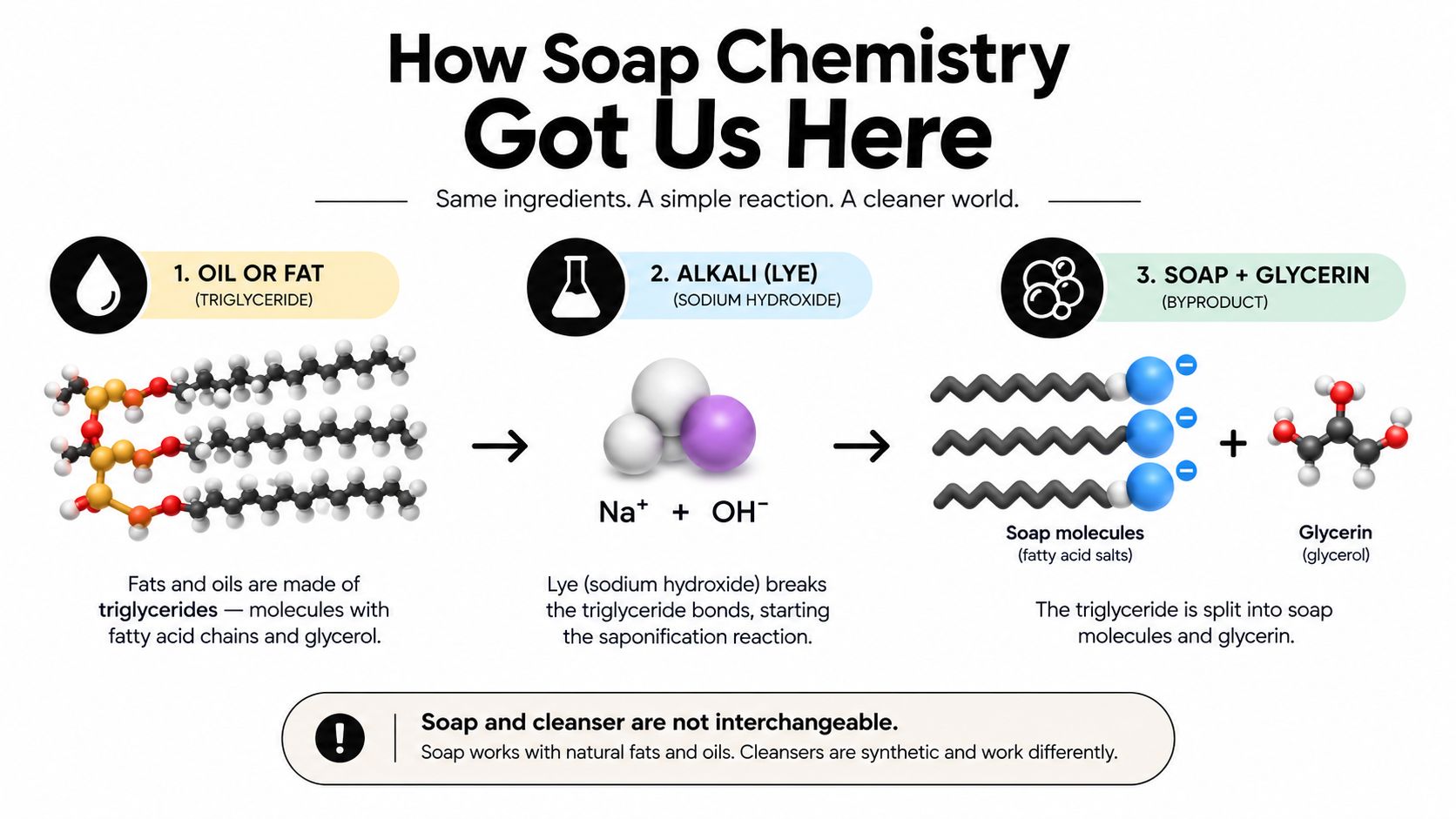
Because of that chemistry, true soap is generally alkaline. The finished product can vary, but adding “glycerin,” “castile,” or a plant-based description to the name doesn't change the basic saponification reaction. A glycerin bar can still be true soap, and a castile soap made with plant oils is still soap. Those labels tell you something about ingredients or product style, not that the product has a skin-matching pH.
Syndet cleansers use synthetic surfactants instead of relying on soap made through saponification. Surfactants help water lift away oils and dirt, and formulators can combine them to make bars or liquids in a mildly acidic-to-neutral range. That's why a product sold as a cleansing bar may behave more like a skin-compatible cleanser than a traditional soap bar, even if shoppers casually call both “soap.”
A pH ladder for the bathroom shelf
A simple comparison helps: healthy skin is generally mildly acidic, conventional soap is usually alkaline, and syndets often sit between those points. The ranges overlap and vary by product, so a bar's shape or a bottle's label can't tell you which chemistry it uses. The distinction between true soap and syndet is more informative than the word “bar.”
A study testing bathing soaps and shampoos found that only 3.125% of soap samples had a pH corresponding to normal skin pH, and another 3.125% were neutral, leaving 93.75% outside those two categories (study on cleansing products and skin-surface pH). The figures describe the products tested, not every soap on the shelf. They do illustrate why “soap” and “skin-pH cleanser” often refer to different formulation choices.
Why Skin pH Shift Matters in Real Life
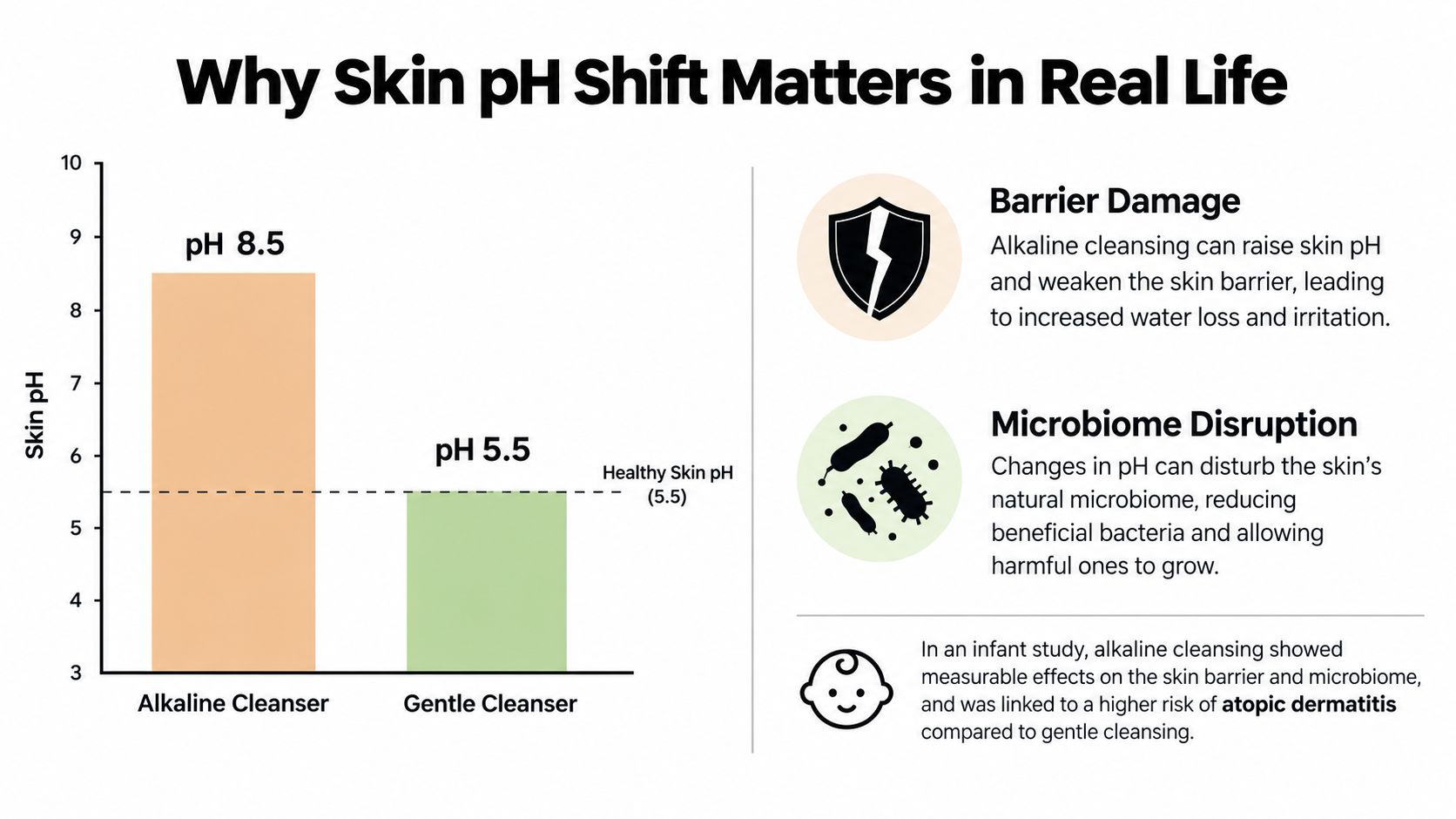
A cleanser's pH can change the skin's surface after washing, though the shift is usually temporary. In a randomized infant study, researchers compared water, two pH 5.5 detergents, and alkaline soap at pH 9.5. Skin pH rose after cleansing in every group: the increase was +0.19 with water and +0.45 with alkaline soap. The comparison shows that the wash itself and the cleanser's formulation can affect the size of the shift (the infant cleansing study).
A short-lived surface change does not prove that one wash causes lasting harm. Repeated washing can be more uncomfortable for dry or vulnerable skin, especially alongside hot water, frequent cleansing, or a formula that removes many skin lipids. Tightness, redness, and flaking can be signs that the routine is too aggressive.
A dermatology review reports that washing twice daily with classic alkaline soap at pH 10.2 reduced the stratum-corneum cell layer and caused loss of intercellular lipids in people with atopic dermatitis (review of cleanser effects on the skin barrier). The stratum corneum is the skin's outermost layer. Its lipids work like the mortar between bricks, helping hold the barrier together. The finding does not show that pH alone caused every symptom, or that an acidic cleanser treats dermatitis. It does show why exposure frequency and existing skin conditions matter.
Recovery time matters more than the rinse
A reading taken right after washing is only a snapshot. Expert material summarized in a dermatology presentation reports that skin pH may move toward baseline in roughly one hour after acidic cleansers and about three hours after alkaline soap. Individual skin and formulas vary, so these times are context rather than a promise (review discussing skin pH and cleansing).
A pH-balanced cleanser does not prevent every shift. Its formulation aims to make the change smaller and recovery less disruptive. If your skin feels uncomfortable, try brief washing with lukewarm water, rinse thoroughly, and apply moisturizer after drying. A cleanser may be one useful adjustment, though it is not a treatment plan for a skin condition.
For a visual overview of cleanser choices and skin-surface effects, see the comparison below.
Where pH Stops Telling the Whole Story
A cleanser can land in a skin-compatible pH range and still feel harsh. That's because pH is one part of formulation, not a mildness score. Surfactant type and concentration, fragrance, preservatives, cleansing strength, rinse behavior, and moisturizing ingredients all affect how a product performs on skin.
Consider two hypothetical products. One has a pH close to skin's range but uses a strong cleansing system that leaves a particular person feeling dry. Another sits a little outside that range but combines gentler surfactants with glycerin and rinses comfortably. The second might suit that person better, even though its pH is less exact. These examples aren't product test results; they show why the number can't predict everyone's experience.
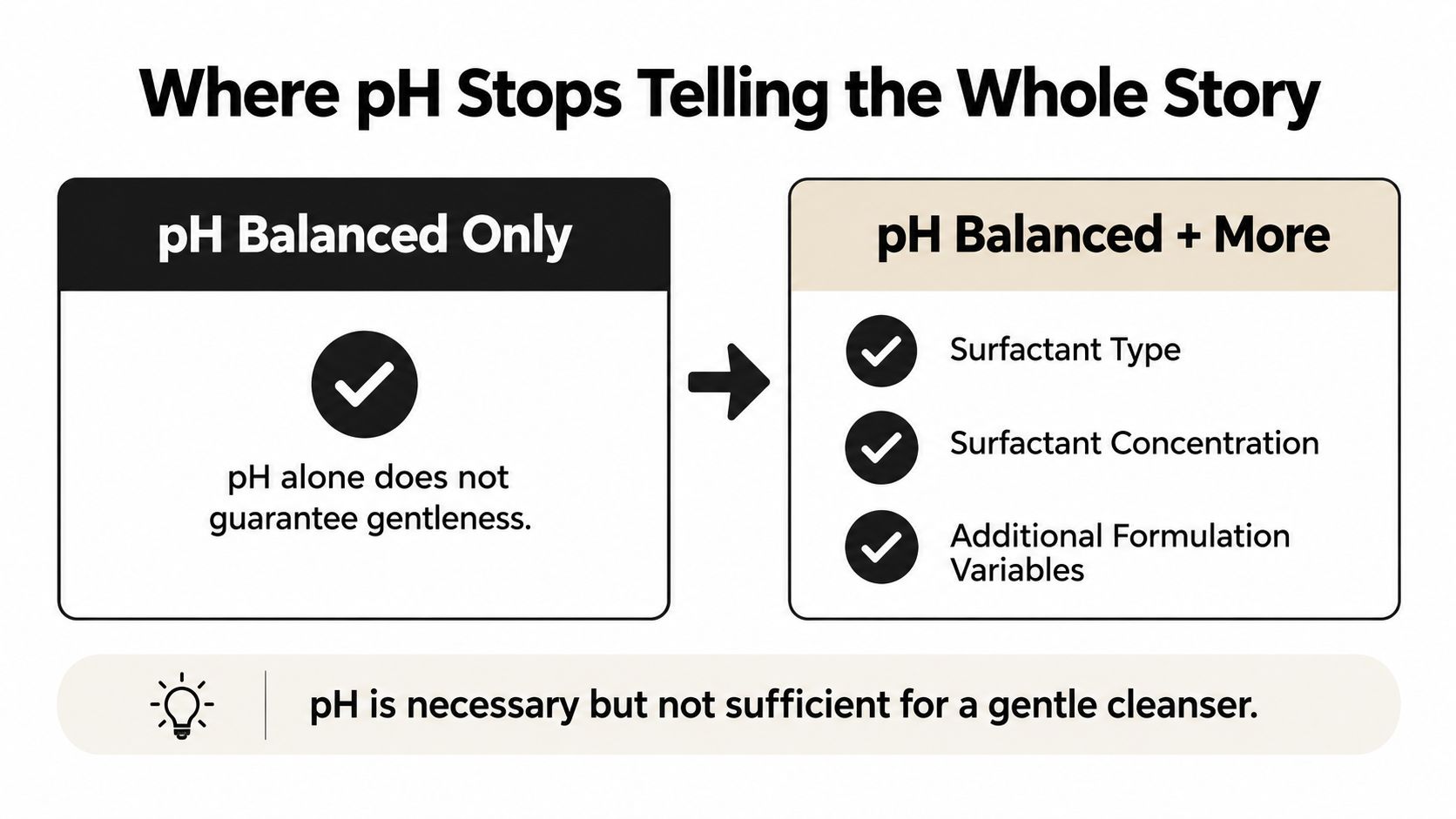
A peer-reviewed review cautions that pH alone doesn't determine mildness. It notes that cleansing systems dominated by anionic surfactants can cause more dryness and irritation under skin-pH conditions than under neutral conditions, underscoring the role of surfactant chemistry and the complete formula (review of cleanser mildness and pH). So don't assume every acidic cleanser is automatically better, or that every product outside a narrow target range is unsuitable.
Formulation rule: A useful label gives you a starting point. The ingredient list and your skin's response tell you more.
Fragrance can matter for people who find scented products irritating. Preservatives are also part of the formula, and their presence doesn't by itself make a cleanser unsafe or unsuitable. Added glycerin may contribute to a more comfortable feel, but it can't cancel out every other formulation choice. If you're learning about exfoliating products too, Athena Plastic Surgery's guide to mandelic acid exfoliant can help distinguish an active exfoliant from an everyday rinse-off cleanser.
For practical comparisons of wash formulas and their intended use, see this guide to choosing body wash. The core habit is to look past the headline claim: check what kind of cleanser it is, whether the brand discloses a measured finished-product pH, and whether your skin feels comfortable after regular use.
A Shopper's Checklist for Real Gentle Cleansers
You don't need a lab coat to compare cleansers. A short label-reading routine can help you judge skin compatibility and environmental claims without treating “natural,” “mild,” or “pH-balanced” as guarantees.
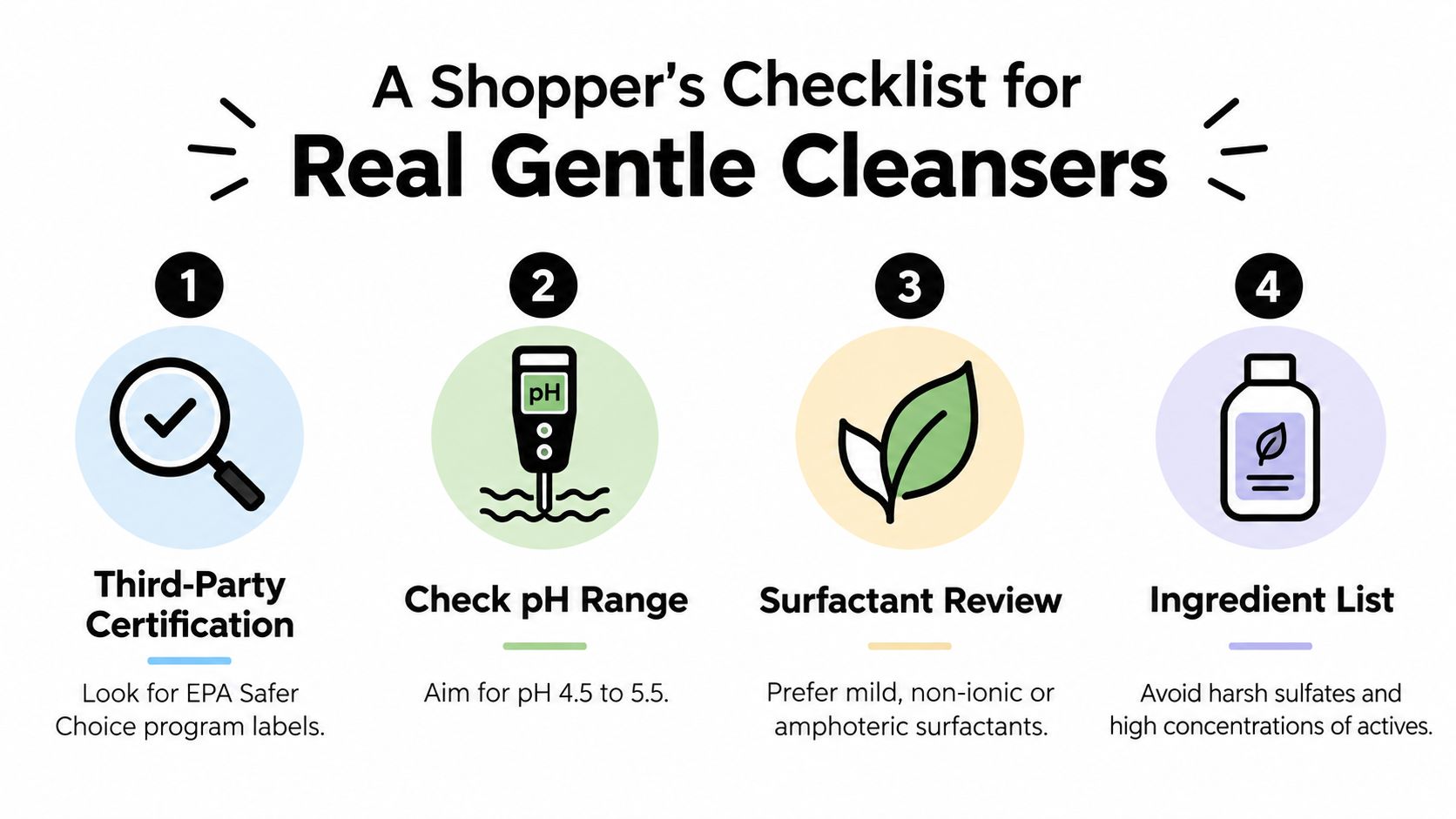
- Look for independent review. The U.S. Environmental Protection Agency's Safer Choice program evaluates every ingredient in a labeled product against criteria for human health and environmental concerns, including carcinogenicity, reproductive and developmental toxicity, aquatic toxicity, and environmental persistence. It also requires category-specific performance standards, and its pH provisions aim to reduce potential skin and eye irritation or injury (EPA Safer Choice Standard). Certification isn't a personal guarantee against irritation, but it's more substantive than an unsupported “balanced” claim.
- Check the cleanser category and pH. If the label or company website identifies a measured finished-product pH, use it as one clue. Ask whether the product is true soap or a syndet, and read the directions so you know how it's intended to be used. A single number doesn't capture surfactants, fragrance, or exposure time.
- Read the ingredients with your own sensitivities in mind. If fragrance tends to bother you, look for a fragrance-minimized or fragrance-free option. Notice the cleanser type and any moisturizing ingredients, then judge the formula as a whole rather than trying to decode one ingredient in isolation.
- Inspect environmental claims separately. A gentle formula isn't automatically a sustainable product. Federal Trade Commission guidance says environmental claims should describe the specific benefit and avoid giving a broader impression than the evidence supports. For an unqualified recyclable claim, recycling facilities must be available to at least 60% of consumers or communities where the product is sold; if access is more limited, the claim should say so. If packaging contains recycled material, the claim should specify the percentage rather than implying the whole package is recycled (FTC guidance on environmental marketing claims).
At a refill store, ask what the container is made from, whether the shop accepts it back, and what happens after return. Online, look for the same details in the product information. If you're also choosing a cleanser for acne-prone skin, XO's guide to finding the right face wash for acne can help you think about the difference between a daily wash and a product meant to address a specific concern.
Good Products and Companies Worth Rewarding
A good company gives shoppers more to assess than a soothing label. Look for clear ingredient information, a defined product category, credible safety review, and specific explanations of packaging and refill practices. Those details let you make a choice that reflects both skin comfort and your values.
For example, Fillaree is a women-owned manufacturing company based in Durham, North Carolina, with refillable home and body products. Its refill system includes partner refill stations and larger home refills, while its take-back approach is designed to reuse refill bags. The company also describes third-party certification for its formulas and provides product information that distinguishes real soap from pH-balanced, soap-free cleansers. Those are different questions: what a formula does on skin, what review it has undergone, and how its packaging is handled.
A detail worth noticing is that not every product in a company's range has to fit the same definition of “pH-balanced.” Fillaree lists its Soap and Suds products at pH 8.5–9.5, describing the range as higher because they're real soap. That's a transparent distinction, not a claim that true soap has the same chemistry as a syndet. Shoppers who prefer a cleanser closer to skin's surface range can use that information to compare products, while shoppers who choose traditional soap can weigh its formula and their own skin response.
Supporting good companies means rewarding clear information, not assuming one label proves everything.
The same approach works beyond one brand. Ask whether a company makes its cleanser category clear, explains its certifications, and states what happens to refill packaging. For more examples of how personal-care companies approach waste reduction, browse Fillaree's overview of sustainable personal-care brands. Use it as a comparison point, then check each company's own claims and product details before buying.
The Bigger Picture for Skin and Waterways
A pH-balanced cleanser may be a sensible skin-care choice, but the pH number doesn't tell you whether its packaging is recyclable, whether its ingredients meet independent safety criteria, or how the product affects waterways. Those questions need their own evidence. A company that explains its formulation and backs up its environmental language gives shoppers more to work with than one that leans on “natural” or “eco-friendly” alone.
“Antibacterial” also isn't a synonym for better everyday cleansing. Stronger cleansing isn't automatically healthier for skin, and a product claim should be evaluated in the context of its formula and intended use. Similarly, “microbiome-friendly” shouldn't be read as a guarantee based on pH alone: rinse-off products can affect skin conditions, but surfactant strength and the rest of the formula matter too.
The U.S. Food and Drug Administration's classification depends on whether a product meets the legal definition of soap or is regulated as a cosmetic or drug. That distinction affects how a product is treated under federal rules, and it isn't something a “pH-balanced” label settles. Nor is pH-balanced soap a treatment for eczema, acne, infection, or vaginal health. For another environmental detail to compare, Fillaree's explanation of phosphate-free cleaners adds context, but a phosphate-free claim alone doesn't establish that a whole product is environmentally harmless.
On your next shopping trip, check the cleanser type, scan the ingredients for your known sensitivities, and look for credible safety review and specific packaging information. Then choose a product that suits your skin and supports the kind of company you want to buy from.
Explore Fillaree to learn about its refillable soaps and body-care options, refill stations, and take-back approach for refill bags. Compare its product details with the cleanser criteria above, then choose the formula and refill format that fit your household.