
Eco Friendly Mops: Types, Care and How to Choose
You just wrung out the kitchen pad and it still smells faintly of last night's onions. The bathroom is next, the hardwood in the hall is already a little cloudy from yesterday's pass, and the stack of disposable sheets under the sink is the easy way out. A washable head only earns the eco-friendly label if it comes back clean, dry, and assigned to one kind of floor. Buy the durable one and skip the laundry, and you have a dirt taxi with a nicer story.
Table of Contents
- Eco Friendly Mop Types Side by Side
- Matching Mop Heads to Your Floors
- Why Reusable Heads Cut Waste Over Time
- Making a DIY Mop Head from Old Textiles
- Washing and Hygiene Limits of Reusable Heads
- Screening Cleaners and Companies for Low Waste
- Build a Low-Waste Mop Routine This Week
Eco Friendly Mop Types Side by Side
| Mop type | Material and head | Reuse model | Best use | Waste notes |
|---|---|---|---|---|
| Flat microfiber mop | Microfiber pad on flat frame | Machine-washable pads, replace when worn | Hard floors, daily wet cleaning | Low waste when pads are washed and kept |
| Cotton string mop with bucket | Cotton yarn head | Washable or replaceable head | Heavy soil, tile, garage | Heads need hot washing; higher water use per pass |
| Cellulose sponge mop | Compressed cellulose head | Replace head when worn | Quick spills, sealed floors | Check whether heads are accepted in home compost |
| Spin mop with washable pads | Microfiber or cotton pads on spin basin | Wash pads after each use | Larger open floors | Less water left on floor; pads need laundering |
| Steam mop with microfiber pads | Washable microfiber pad | Wash pad after each session | Sealed hard floors | Uses electricity; often needs no added cleaner |
| DIY mop from old textiles | Cut cotton T-shirts or towels on a handle | Cut, wash and reuse | Budget cleaning, small spaces | Keeps textiles out of landfill; pads wear out faster |
Flat microfiber uses a thin pad on a flat frame. You machine-wash the pad and retire it when the pile mats. It suits daily damp cleaning on sealed hard floors, and waste stays low only while those pads keep working.
A cotton string mop uses a yarn head you can wash or replace. It is the right tool for heavy soil on tile and in a garage. Each pass drinks more water than a flat pad, so the bucket is part of the waste math.
Cellulose sponge heads are compressed plant fiber on a wringer frame. You replace the head when it tears or stays sour. Many are compostable in principle. Confirm your local program accepts them before you toss one in the bin.
A spin mop pairs microfiber or cotton pads with a basin that spins water out. Open floors benefit because less water sits on the surface. The pads still need a real wash after each use, not a rinse in the same dirty water.
A steam mop heats water through a washable microfiber pad. On sealed hard floors it often needs no added cleaner, though it draws electricity and can mark finishes that hate heat or standing moisture.
A DIY head is cut cotton T-shirts or towels clamped to a handle you already own. You cut, wash, and reuse until the loops fray. It keeps textiles out of the landfill and wears out faster than a branded pad. If you are sewing the bundle yourself, fabric guidance for eco-conscious sewists from B-Sew Inn is a useful check on which cotton holds up to repeated washing.
Washable heads cut landfill waste when they last. Replaceable heads add a steady stream of packaging unless the brand sells refills without a new plastic shell. The better type follows your floor and how often you mop.
Matching Mop Heads to Your Floors
Match the head to how much water the floor can take and how stubborn the soil is. A pad that is perfect on porcelain will haze sealed wood if you leave it wet.
| Floor type | Best head | Cleaner approach | Avoid |
|---|---|---|---|
| Sealed hardwood | Microfiber pad, well wrung | Low-moisture, pH-neutral cleaner | Standing water and soaking seams |
| Laminate | Damp microfiber pad | Cleaner labelled for laminate | Wet mopping that swells joints |
| Vinyl plank or sheet | Microfiber or cotton pad | Neutral cleaner | Abrasive pads that dull the surface |
| Glazed ceramic or porcelain tile | Looped cotton or stiffer microfiber | Detergent cleaner, then clean-water rinse | Leaving residue that streaks |
| Sealed marble or granite | Soft microfiber pad | pH-neutral stone cleaner | Vinegar and acidic cleaners that etch |
| Concrete garage floor | Cotton string head | Degreaser for oil and grease | Using one head across zones |
Sealed hardwood wants a well-wrung microfiber pad and a low-moisture, pH-neutral cleaner. Water that pools at the seams works under the finish.
Laminate needs a damp pad, not a wet one. Keep the joints dry and stay inside the flooring maker's limits. A steam mop is a poor bet here unless that maker says otherwise.
Vinyl plank and sheet vinyl take microfiber or cotton with a neutral cleaner. Skip abrasive scrubbing that dulls the wear layer. For mix-it-yourself recipes aimed at this surface, DIY cleaning solutions for vinyl flooring from Flacks Flooring walks through what belongs in the bucket.
Glazed ceramic and porcelain can take a looped cotton head or a stiffer microfiber pad, a detergent cleaner, and a clean-water rinse so residue does not streak. Hit grout with a stiff brush before the washable head, or the pad just paints the lines gray.
Sealed marble or granite needs a soft microfiber pad and a stone-safe, pH-neutral cleaner. Vinegar and other acids etch the polish even when the stone looks tough.
Concrete in a garage with oil or grease calls for a cotton string head and a degreaser. Do not carry that head back into the kitchen.
Practical rule: Test any new cleaner in a closet corner first, then switch heads when the floor changes, so grit from one zone does not ride into the next.
Why Reusable Heads Cut Waste Over Time
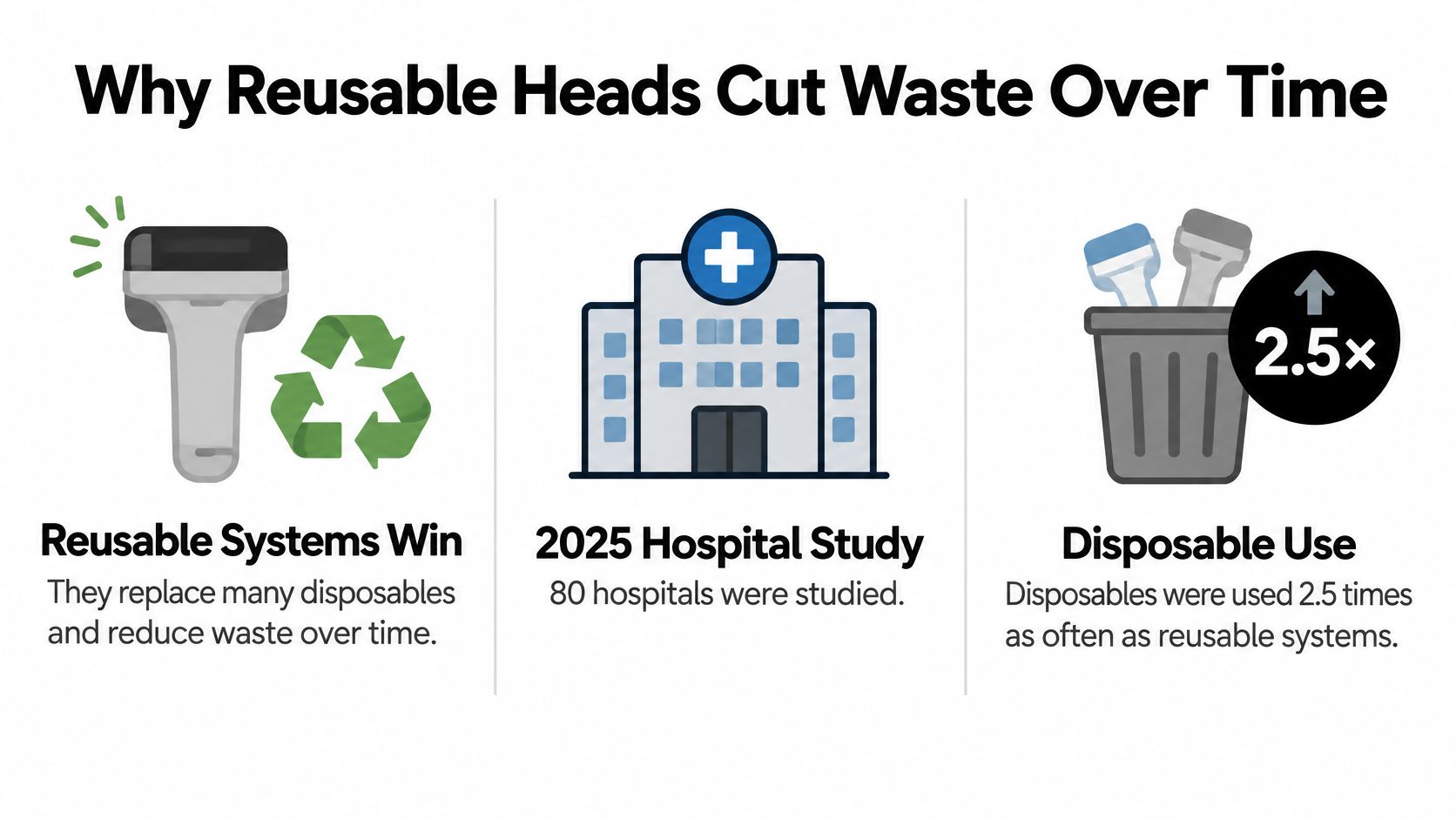
A reusable head only cuts waste while it keeps getting washed and put back on the floor. A durable pad left in the closet changes nothing.
The MDPI sustainability study compared bicomponent split-microfiber reusable products with disposables across global warming potential, natural-resource energy, blue-water use, and solid waste. Reusable products produced 65% to 95% lower impacts than disposables. Even in a conservative case where disposable and reusable products were used at an equal 1:1 rate, reusable flat mops still delivered more than 40% savings in every category the study scored. The edge came from skipping the making, packing, and shipping of large numbers of disposables over 1,000 uses.
What a longer head life changes at home
Older hospital evidence points in the same direction, with limits. A 2003 Sustainable Hospitals Project evaluation in a Boston-area hospital, reported by CleanLink, compared microfiber floor-mopping with conventional wet loop mops. Microfiber cut water and chemical use and lowered ergonomic strain. The purchase price was about twice a conventional loop system, and the microfiber head's estimated life was about 10 times longer. That work is more than 20 years old and describes a hospital cleaning operation, so treat it as context for the math, not a promise for a kitchen floor. I recommend judging a head by whether you will wash it hot, dry it fully, and keep bathroom and kitchen heads apart.
Count the disposable pads or wipes you bought in the last year. Then count the washable heads that would cover the same floors if you laundered them instead of tossing them. Households building that habit can look at how low-waste household products fit a refill routine around the mop, so the cleaner bottle is not the next disposable.
Waste savings show up when the head actually goes back into service, not when it only looks responsible on the shelf.
Making a DIY Mop Head from Old Textiles
You need old cotton T-shirts or terry towels, a handle with a clip or screw-on plate, sharp scissors, and a sturdy cord. This is a budget head for small rooms, not a substitute for a flat pad on fussy wood.
- Cut each T-shirt into strips about 2 to 3 inches wide. Or fold a towel into quarters and trim the edges so loose threads do not shed on the first pass.
- Bundle eight to ten strips, or layer the towel pieces, and clamp them so the loops sit flush against the plate. A lumpy bundle streaks and drips in the middle.
- Stitch two or three reinforcing lines through the bundle with cord. Without that stitch the strips walk sideways the first time you push.
- Run one test wash in warm water with detergent. The head should hold its shape and still drink water. If strips pull free, restitch before you mop.
- Label it for one zone, such as kitchen floors, and keep it away from bathroom heads.
Cotton holds more water than microfiber and drags more moisture onto the floor. Wring it hard and keep it on tile or sealed vinyl. I would not put a homemade cotton bundle on sealed hardwood.
Expect faster wear than a branded head. Retire it when loops fray or it stops picking up water. Wash it after every session, and skip fabric softener, which coats the fibers. This build suits tight budgets, small spaces, and textiles that would otherwise go in the bin.
Washing and Hygiene Limits of Reusable Heads
A washable head is a hygiene tool only after you treat laundry as part of the clean.
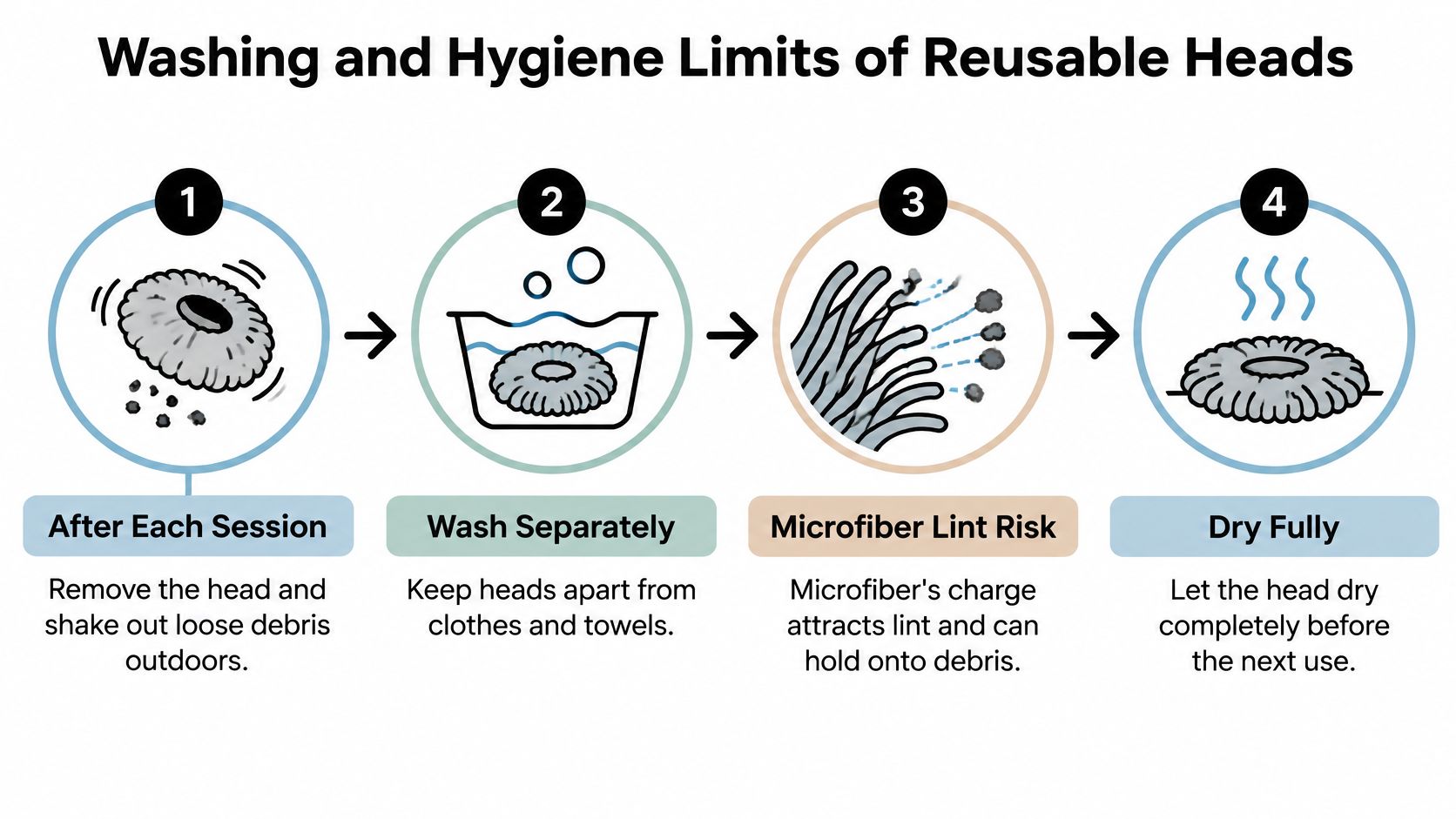
- Pull the head off after each session and shake loose debris outdoors.
- Wash heads apart from clothes and towels. An EPA microfiber fact sheet notes that microfiber mops are light, have removable heads, wring more easily, and leave less water than conventional mops, and that the fabric's electrical charge pulls in dirt, hair, and lint.
- Match the wash to the soil, and stop at the maker's temperature limit. Hotter is not automatically better, because excess heat and harsh chemicals can damage the pile.
- Skip fabric softener. It coats fibers and cuts absorbency.
- Add a microfiber-catching laundry ball or bag. Synthetic pile sheds fibers in the wash, and the EPA fact sheet points to that catch as a practical step.
- Dry the head fully before it goes back in the closet. A damp pad grows odor.
- Before the next use, check for smell, residue, fraying, or weak pickup. Keep separate heads for kitchens, bathrooms, and high-risk spills.
| Soil level | Wash temperature | Cycle | Notes |
|---|---|---|---|
| Heavy soil | Warm or hot water with detergent | Normal cycle | Follow manufacturer's maximum temperature |
| Light soil | Cold water | Gentle cycle | Suitable for dusting and daily damp mopping |
| Visible residue or odor | Warm water with detergent | Normal cycle | Inspect after wash and retire if odor remains |
What the removal numbers do and do not mean
Washed is not sterile. In a controlled evaluation of 24 rooms per cleaning condition, a microfiber system with detergent cut recoverable microbial contamination by 95%, against 68% for cotton string mops, and adding disinfectant left the microfiber result at 95%, as reported in the PubMed microbiologic evaluation. Mop design, liquid control, and wiping did more for routine soil than a stronger chemical. That 95% figure is not sterilization, and it does not cancel a disinfectant where infection-control rules require one.
Work the floor in this order. Clear loose debris first. Use a clean head for each room or zone. Put down enough detergent solution for full contact without standing water. Overlap your passes. Drop the used head into a closed laundry container. Never dunk it back in the bucket, or you paint the next room with the last one.
When a laundered head is still the wrong tool
Hospital laundry is a warning, not a home average. Of 15 newly laundered flat microfiber mop samples from six hospitals, 6 samples (40%) still carried microbiological contamination, including MRSA and C. difficile, as described by CMM Online. Those loads were washed at about 160 to 200°F and dried near 130°F. Do not copy hospital heat onto a household pad if the label sets a lower ceiling. The 40% figure belongs to healthcare textiles. It still shows why "washable" is not the same as hygienic.
Retire a head that stays smelly, frays, or no longer picks up water. A worn pad spreads soil while looking reusable. For a raw-meat spill, a pet accident, or anyone who is ill at home, I would use a head you can retire after that job rather than a favorite pad you plan to wash and put back on the dining room floor.
Screening Cleaners and Companies for Low Waste
Words like "green" and "natural" on a bottle are weak evidence. The chemical and the company need separate tests.
The U.S. Environmental Protection Agency's Safer Choice Standard requires each ingredient to be checked against criteria for its functional class, including toxicity thresholds for ingredients allowed in Safer Choice products. Look for that label on a floor cleaner instead of trusting the front panel. Pair a reusable head with a concentrated or carefully dosed cleaner that carries the mark, and use it the way the label says. The standard does not prove the mop head is durable, plastic-free, or low-waste. Those are different questions.
What a company credential actually checks
B Lab's standards for certified B Corporations, set out in B Lab's announcement of the new standards, expect a defined public purpose, stakeholder consideration in decisions, a way to handle stakeholder grievances, responsible marketing, oversight by the highest governing body, and public reporting on social and environmental performance. They also speak to environmental stewardship and circularity across operations and the value chain. Certification is not a promise of zero waste. It is a stronger screen than an unverified claim that a brand cares.
Refill take-back versus another single-use bottle
A refill only cuts packaging if the container comes back. Our circular refill system takes customers' bags back, washes them, and reuses them for the next refill, and we cover that return. We also wash and sanitize those bags to commercial kitchen standards. Ask any other refill seller, in writing, whether bags or bottles are taken back and reused, whether the shipper is plastic-free, and how far the refill travels. A mailer you cannot return is still a disposable, just a slower one.
Use three checks side by side:
- Label: Safer Choice, or another independent chemical screen you can name, on the cleaner you will dose into the mop water.
- Head: Washable pads with a retirement rule, not a "lifetime" claim and no spare.
- Loop: A written take-back for the refill pack, plus a cleaner you can dose from a bottle you already own. A floor cleaner concentrate is one way to stop buying a new single-use bottle every month.
Aligned buying is boring on purpose. You are checking a label, a laundry plan, and a return path, not collecting slogans.
Build a Low-Waste Mop Routine This Week
Start with the floors you walk on, not a fantasy whole-house system.
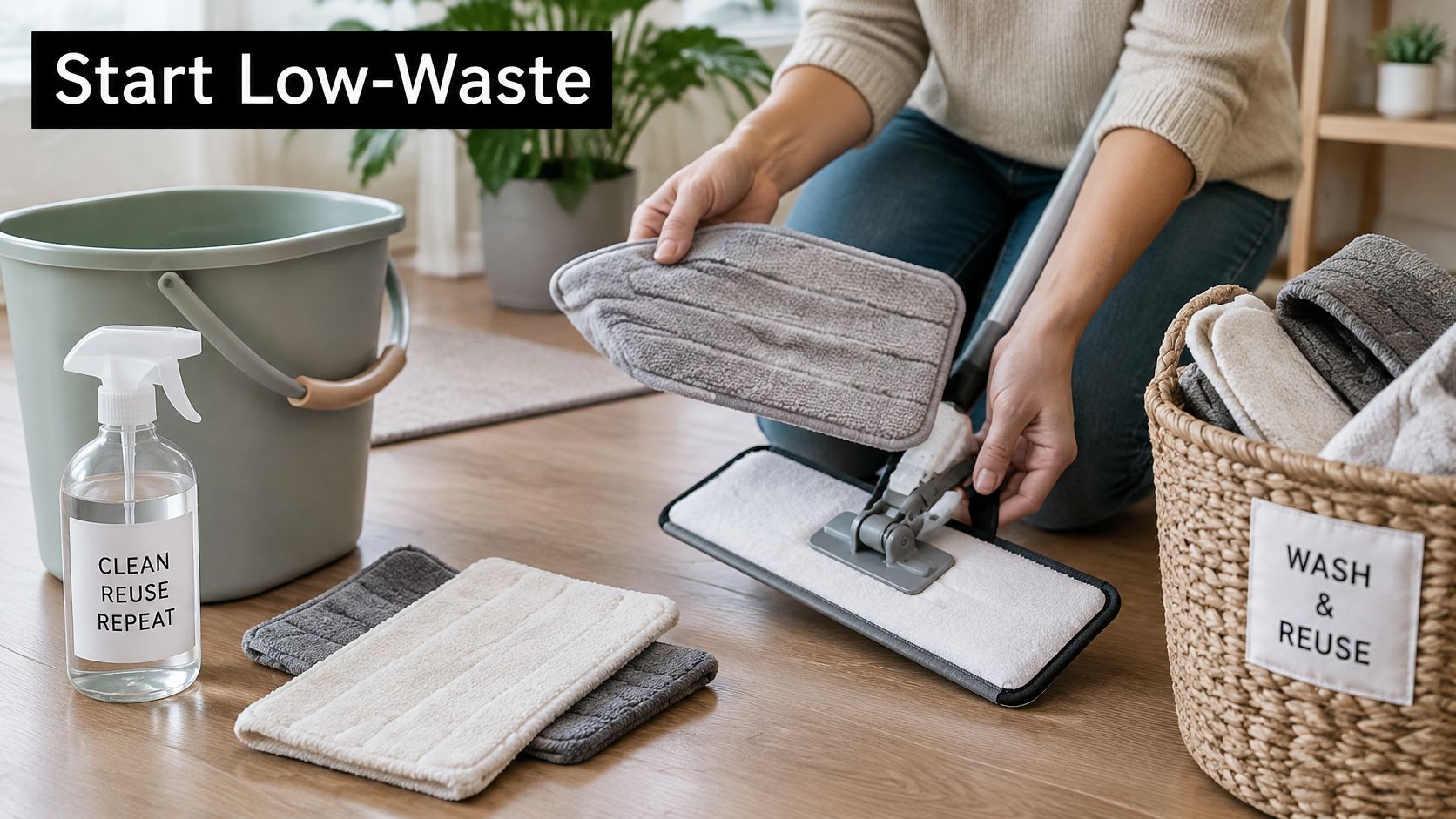
Pick the head from the floor match you already made. Sealed wood gets a well-wrung microfiber pad. Garage concrete gets cotton and a degreaser. Set a separate laundry bag or basket so mop heads never ride with towels.
Choose washable pads, then a cleaner with a Safer Choice label or a concentrate you can dose into a bottle you refill. Our BABS bottle can hold Clean Dream, the all-purpose cleaner, along with Soap & Suds or dish soap, so one bottle covers more than floors. All of our products are biodegradable, grey-water safe, and septic safe. Read the label before you treat that as permission for your drains. These are examples to confirm, not the only workable set. If you are already cutting single-use bottles in the kitchen, the same logic shows up in a zero-waste kitchen cleaning setup.
For two weeks, wash the head after every session. Note odor, streaks, and slow drying. A pad that smells on day ten is done, even if the pile still looks fluffy.
A short walk-through of pad changes and bucket habits helps if you want to see the motions before you commit:
If the head still picks up soil after those two weeks and the cleaner leaves the floor clear of residue, keep the system. If it streaks, stays damp, or smells, replace the head or the cleaner and test again. A durable reusable head is the wrong tool when the wash cannot reset it.
Fillaree makes refillable cleaners you can dose for floors without buying a new bottle every time, including concentrates that fit a low-waste mop routine. Our take-back washes and reuses refill bags at no cost to you, so the packaging loop is part of the clean. Visit Fillaree to match a refill to the head you are already washing.