

Should You Use Conditioner Everyday? a Practical Guide
The popular advice says you either need conditioner every day or should avoid it to prevent greasy, heavy hair. Neither rule is reliable. “Every day” can mean a rinse-out conditioner after shampooing, a conditioner-only wash, or a leave-in product, and those routines affect the scalp and hair lengths differently.
The better question isn't “What does the calendar say?” It's “What does my hair need today?” A lightweight conditioner may protect dry ends without bothering an oily scalp, while a rich product applied to the roots can create buildup even when the lengths still need moisture. The American Academy of Dermatology recommends conditioning after washing because conditioner moisturizes, detangles, and improves manageability, but it also emphasizes adapting hair care to texture and scalp needs (American Academy of Dermatology hair-care guidance).
Table of Contents
- Rethinking the Daily Conditioner Rule
- How Hair Type and Scalp Health Dictate Frequency
- Choosing the Right Conditioner Format for Your Needs
- Application Techniques That Prevent Buildup and Breakage
- Troubleshooting Over-Conditioning and Under-Conditioning
- Aligning Your Routine with Sustainable Refill Systems
- Building a Conscious and Effective Hair Care Habit
Rethinking the Daily Conditioner Rule
Daily conditioning isn't automatically excessive, and skipping conditioner isn't automatically healthier. The answer changes substantially depending on whether you're using rinse-out conditioner after shampooing, cleansing conditioner, or leave-in conditioner. Treating all three as the same product is where much of the confusion begins, as dermatology guidance also distinguishes these behaviors (AAD guidance on preventing hair damage).
A rinse-out conditioner belongs after shampooing and is removed with water. A leave-in stays on the hair and is usually lighter, while a conditioner-only wash, often called co-washing, combines cleansing and conditioning in one step. Someone with tightly curled, dry hair might use a leave-in between wash days, whereas someone with fine, oily hair may find even a small amount near the roots makes the hair flat.
Washing frequency matters, but it doesn't determine the needs of every part of your head. The scalp produces oil and may need cleansing based on sweat, sebum, climate, and comfort. The older lengths and ends don't produce their own oil, so they may need protection even when the scalp feels oily.
Practical rule: Separate the scalp schedule from the hair-fiber schedule. Cleanse according to scalp needs, then condition the lengths according to dryness, tangling, texture, and damage.
A useful baseline is to condition whenever you wash your hair, then adjust the amount, formula, and placement. People who wash infrequently may condition only on wash days. People with very dry, porous, curly, color-treated, or heat-exposed hair may need additional leave-in protection between washes.
That makes the answer to should you use conditioner everyday personal rather than universal. Daily use can be protective for vulnerable lengths, but daily application of a heavy product to the scalp can create a separate problem.
How Hair Type and Scalp Health Dictate Frequency
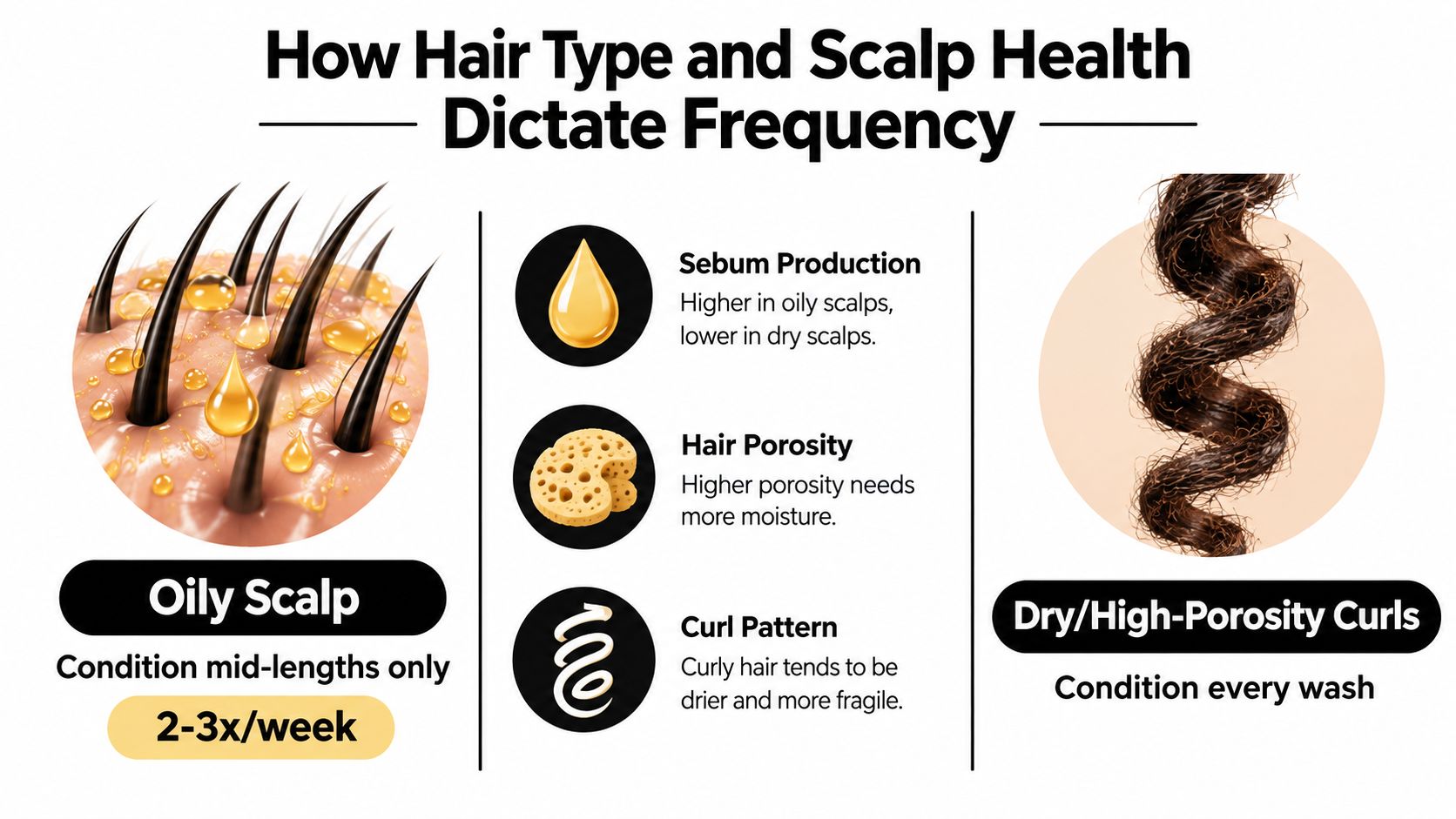
Conditioner does not need to follow a simple daily calendar. Hair care works better on two tracks: cleanse the scalp according to oil, sweat, and comfort, then condition the hair fiber according to dryness, texture, tangling, and damage.
Fine, straight hair can become weighed down quickly because a small amount of product coats its relatively narrow fibers. Dry, curly, thick, or textured hair often needs more moisture along the length because natural oils do not travel as easily from the scalp to the ends. The same wash schedule can therefore suit one person and leave another's ends rough or coated.
Scalp oil adds another variable. The American Academy of Dermatology says shampooing may range from daily for an oily, straight-haired scalp to only when needed, at least every 2–3 weeks for some dry, textured, curly, or thick hair. Conditioning should respond to the hair fiber rather than automatically copying the scalp's schedule. The scalp is the soil, while the lengths are older fabric. They may need different care.
Fine and oily hair
If the roots turn greasy quickly, choose a lightweight rinse-out conditioner and keep it on the mid-lengths and ends. Health's guidance identifies oily or fine hair as more likely to become greasy or weighed down with frequent conditioning, and says this hair may need conditioner one to three times weekly, even when the person washes daily or every other day (Health's guidance on conditioner frequency).
A person with straight, fine hair who exercises daily might shampoo often to remove sweat, then apply a small amount to the final third of the hair. If the roots remain fresh and the ends comb smoothly, the routine is balanced. Use less product before reducing conditioning altogether.
Porosity explains why two people with the same curl pattern can respond differently. A more open, damaged surface may lose moisture quickly and benefit from richer conditioning. Lower-porosity hair may feel coated when product stays on its surface. This guide to low- or high-porosity hair can help you assess how your hair absorbs and retains moisture.
Dry, curly, and processed hair
Curly, coily, coarse, or thick hair often benefits from conditioner across the full length. Applying it before detangling helps reduce friction, especially because wet hair stretches more easily during grooming.
Color-treated, bleached, and heat-damaged hair may need protection more often. Someone who shampoos infrequently can still condition at every wash and add light protection to dry ends between washes. The scalp may need little or no conditioner while the lengths need regular care.
Read scalp signals separately. Itching, flaking, persistent greasiness, or a coated feeling may indicate that conditioner is reaching the roots, the formula is too rich, or cleansing needs adjustment. These signs do not mean the lengths should go without conditioning. Adjust placement and product weight first, keeping the scalp routine and hair-fiber routine distinct.
Choosing the Right Conditioner Format for Your Needs
The product format matters as much as the schedule. A rinse-out conditioner, a leave-in spray, a deep treatment, and a co-wash don't deliver the same level of residue or cleansing. Choosing among them becomes easier when you match the format to the problem you're trying to solve.
Rinse-out conditioner
Rinse-out conditioner is the most flexible option for regular use. Conditioning agents deposit on the hair surface, reduce inter-fiber friction, and lower the force required to comb wet hair, which makes the benefit mechanical rather than merely cosmetic (peer-reviewed review of hair conditioners).
That matters because wet hair is easier to stretch and break during grooming. A small amount of a lightweight rinse-out formula can suit minimally damaged hair after each wash. Fine hair usually needs it on the mid-lengths and ends, while curly or damaged hair may need fuller distribution.
A deep conditioner or mask is richer and shouldn't be treated as a default daily product. It can make dry or processed lengths feel more manageable, but frequent heavy application may leave fine hair dull, limp, or coated.
Leave-in conditioner
Leave-in conditioner is useful when the lengths need ongoing slip between washes. Long, chemically treated, heat-styled, or highly textured hair may benefit from daily leave-in protection, especially when detangling is a recurring source of breakage.
Apply it from the mid-lengths to the ends rather than directly to the scalp. A lightweight spray may suit fine hair, while a cream can be more comfortable on coarse curls. Start with less than you think you need, because you can add product but can't remove excess without washing again.
Co-washing
A cleansing conditioner can work for some dry, curly, or textured hair because it combines gentle cleansing with conditioning. It may be a poor fit for an oily scalp or fine hair if the scalp begins to feel coated.
The same hair can need different formats at different times. For example, a person with curly hair might co-wash on a dry-weather wash day, use rinse-out conditioner after a more thorough shampoo, and apply a small leave-in amount to the ends before detangling. A simple zero-waste shampoo and conditioner routine can also reduce the temptation to keep several unsuitable products in rotation.
Application Techniques That Prevent Buildup and Breakage
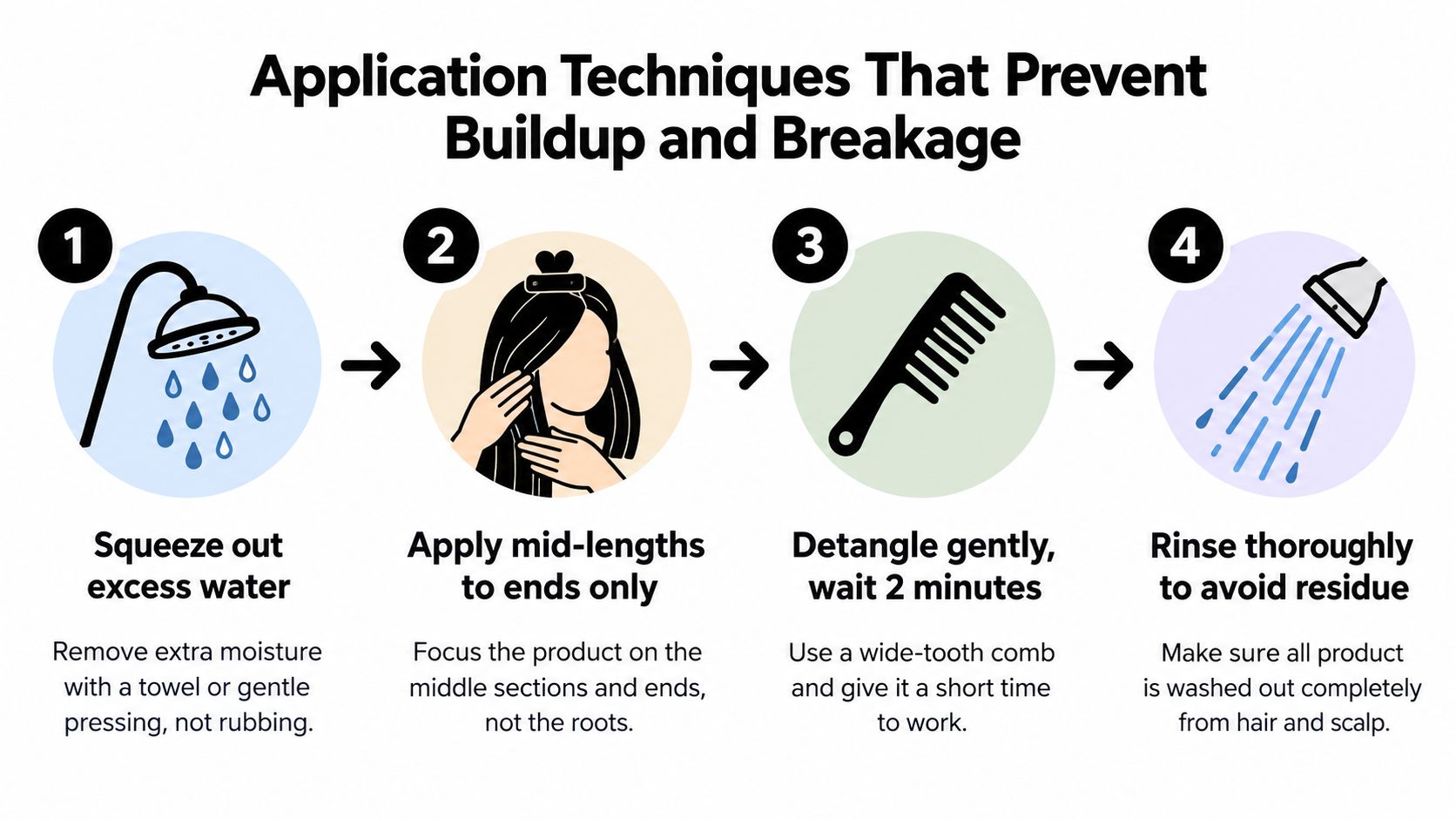
Where you apply conditioner determines whether it protects the hair or burdens the scalp. Most standard rinse-out formulas belong on the lengths, not rubbed into the roots. The ends are older and more exposed to friction, brushing, heat, and chemical processing.
A careful wash-day method
- Remove excess water. After shampooing, gently squeeze water from the hair. Conditioner can slide off overly saturated strands instead of spreading evenly.
- Start at the mid-lengths. For fine or straight hair, begin around the middle and work toward the ends. Keep the scalp clear unless the product specifically says it belongs there.
- Distribute through curls. For curly, coily, thick, or tangled hair, use your fingers or a wide-tooth comb while the conditioner is present. Work gently rather than pulling through knots.
- Allow contact time. A peer-reviewed dermatology review describes rinse-out, or “instant,” conditioners as products applied after shampooing, left on for about five minutes, and then completely rinsed out (dermatology review of shampoos and conditioners). Follow the product label if it gives different directions.
- Rinse until the hair feels clean but flexible. Incomplete rinsing can leave a film that feels greasy or dull. Dry, porous hair may need some softness left behind, but the scalp shouldn't feel coated.
This short demonstration can help you visualize gentle distribution and rinsing:
Adjust placement before abandoning conditioner
If your scalp becomes itchy or oily soon after washing, first move the product farther down the hair. Reduce the amount, switch to a lighter format, and rinse more thoroughly before deciding that your lengths don't need conditioning.
The opposite approach applies when the ends remain rough. Add product to more of the length, detangle while the conditioner is present, or use a leave-in on the ends after washing. Learn more about conditioner ingredients and their roles before choosing a richer formula.
Troubleshooting Over-Conditioning and Under-Conditioning
Your hair gives useful feedback when a routine is mismatched. Over-conditioning usually shows up as residue and loss of movement, while under-conditioning appears as friction, roughness, and difficulty managing the lengths. These signs aren't a perfect diagnosis, but they can guide a sensible adjustment.
| What you notice | Likely mismatch | First adjustment |
|---|---|---|
| Greasy roots soon after washing | Product is too close to the scalp or too rich | Apply less, move it downward, and rinse more thoroughly |
| Limp, dull, coated lengths | Too much residue for the fiber | Use a lighter formula or reduce frequency |
| Persistent tangling | The lengths need more slip | Condition more thoroughly and detangle gently while wet |
| Roughness or frizz | Moisture and surface protection may be insufficient | Use conditioner across more of the length |
| Breakage during grooming | Combing friction may be too high | Add slip before detangling and handle wet hair gently |
Don't change several variables at once. If your fine hair feels coated, reduce the amount first. If that doesn't help, move the application point farther from the roots, then consider a lighter rinse-out product.
Dry or tightly curled hair creates a different pattern. It may be shampooed less often but still need frequent conditioning or occasional leave-in protection to reduce detangling and grooming damage (discussion of hair-cleaning frequency and damage). In that situation, reducing all conditioner use because the scalp feels oily can leave the ends unprotected.
Read the location of the problem: greasy roots point toward scalp placement or product weight, while rough ends and breakage point toward insufficient protection along the fiber.
Persistent itching, flaking, scalp pain, or sudden changes in shedding deserve professional attention rather than endless product experimentation. Conditioner placement can contribute to discomfort, but it isn't a substitute for evaluating an ongoing scalp condition.
Aligning Your Routine with Sustainable Refill Systems
A lower-waste routine should work in practice, not just look convincing on a label. The useful questions are concrete: Can you refill the container safely? Does the company explain what happens to returned packaging? Does the formula have credible environmental screening? Can you buy only the amount and format your hair uses?
Third-party standards offer a stronger starting point than broad words such as “clean” or “green.” The US Environmental Protection Agency's Safer Choice criteria prohibit ingredients with acute aquatic toxicity values below 10 mg/L in products intended for direct release (EPA Safer Choice Standard). For ingredients with aquatic toxicity greater than 10 and less than 100 ppm, the criteria also address biodegradation within a 10-day window, concerning degradation products, and a bioaccumulation factor below 1,000. The standard restricts persistent, bioaccumulative, and toxic chemicals, including substances with half-lives over 60 days.
What responsible refilling should explain
A refill system isn't automatically circular because it uses a pouch or larger container. Research on refill practices in Brazil's personal-hygiene, perfumery, and cosmetics sector reports that ANVISA rules prohibit refilling packaging previously used by consumers, requiring new units for refilling. The researchers describe a regulatory contradiction that can limit packaging reuse and caution that their case study doesn't provide enough quantitative environmental or economic data to generalize refill impacts (study of refill practices and regulation).
For shoppers, that means asking how the system handles ownership, cleaning, sanitization, transport, and returned materials. A good company should make those mechanics easy to find, rather than asking customers to accept sustainability language without evidence.
Look for a conditioner that fits your actual routine, too. A refillable heavy formula isn't a low-waste choice if it makes your hair greasy and gets discarded unused. A product that can serve as light conditioning or a deeper treatment, following its directions, may help reduce the number of separate products you keep.
Fillaree offers refillable hair and body essentials, with local refill options and home refill packaging. Its conditioner is described for light conditioning with a quick rinse or deeper conditioning by leaving it on for 3–5 minutes before rinsing. Supporting good companies means checking both the product instructions and the operational details behind the refill model, then choosing a system you'll continue using.
Building a Conscious and Effective Hair Care Habit
Consider two routines. A person with fine, straight hair washes frequently because the scalp becomes oily, but the ends feel dry after heat styling. They don't need conditioner on the roots every day. A small amount on the ends after washing, followed by thorough rinsing, protects the vulnerable area without turning the scalp greasy.
Another person has thick, tightly curled hair and washes only when the scalp and hair need it. Their hair may still require conditioner across the full length every wash, plus a light leave-in when detangling between washes becomes difficult. The calendar looks different, but both routines follow the same principle: condition the fiber that needs protection and keep the scalp comfortable.
Reassess when your circumstances change. Sweat, exercise, humidity, cold weather, chemical processing, new styling tools, and a different haircut can all change how much moisture and slip your hair needs. Use physical cues rather than forcing a fixed schedule:
- Roots feel greasy: reduce scalp contact and product weight.
- Ends feel rough: extend conditioner farther through the lengths.
- Hair feels coated: use less, rinse better, or choose a lighter formula.
- Detangling causes breakage: add slip and work more gently while the hair is wet.
- Scalp itches or flakes: simplify placement and seek professional advice if symptoms persist.
A thoughtful routine protects your hair and makes sustainable purchasing easier. You can buy fewer products, choose a format that matches your texture, and support companies that care enough to explain ingredients, refilling, sanitation, and waste recovery. The right answer to “should you use conditioner everyday” is the one that leaves your scalp balanced, your lengths manageable, and your bathroom habits consistent with your values.
Fillaree offers refillable shampoos, conditioners, soaps, and other low-waste essentials designed for practical home routines, including conditioner options for light or deeper conditioning. Visit Fillaree to explore refill choices and build a hair-care habit that supports both your strands and the systems behind the products you buy.